Updated Mar 21, 2026 by PCF Group
Legal · October 1, 2022
Published by PCF Group
The termination of the production and distribution agreement between PCF Group S.A., its subsidiary People Can Fly U.S., and Take-Two Interactive Software marks a significant shift in the development trajectory of the action RPG codenamed Project Dagger. Effective September 23, 2022, the parties formalized an Understanding of Termination regarding the original July 2020 contract, which had previously granted Take-Two exclusive rights to fund and publish the title. This move transitions the project from a third-party funded model to one where People Can Fly retains full intellectual property rights and control over future commercialization. The financial settlement dictates that People Can Fly is not required to immediately repay the development advances received during the production period. Instead, the developer is obligated to pay Take-Two a fixed sum of $20 million, contingent upon the game’s commercial release. The repayment structure varies based on the chosen distribution path: if the game is self-published, the amount will be paid through quarterly royalties until the $20 million threshold is met; if a new third-party publisher is secured, the sum must be paid in two equal installments within 12 months of the game's launch. Notably, if the project is never commercially released, no repayment is required. By declining to exercise its buyout option for the intellectual property, Take-Two has allowed all rights to revert to People Can Fly. This outcome enables the developer to pursue independent publishing or seek alternative partnerships for the North American-developed title. The agreement reflects a strategic pivot for the Polish-headquartered PCF Group, emphasizing their intent to maintain ownership of their creative assets while managing the financial liabilities associated with high-budget game development.
PEOPLE CAN FLY Raport bieżący nr 22/2022 Data sporządzenia: 1 października 2022 r. Temat: Zawarcie porozumienia w sprawie rozwiązania umowy produkcyjno-wydawniczej z wydawcą Take -Two Interactive Software, Inc. Podstawa prawna: Art. 17 ust. 1 Rozporządzenia MAR Treść raportu: W nawiązaniu do raportu bieżącego numer 19/2022 z dnia 23 września 2022 r. , Zarząd PCF Group S.A. („ Spółka”, „Emitent”) informuje, że w dniu 1 października 2022 r., ze skutkiem na dzień 23 września 2022 r., spółka zależna Emitenta, People Can Fly U.S., LLC z siedzibą w Nowym Jorku, Stany Zjednoczone Ameryki („ People Can Fly US”), Emitent oraz wydawca Take-Two Interactive Software, Inc. spółk a prawa Delaware z siedzibą w Nowym Jorku, Stany Zjednoczone Ameryki („Wydawca”), zawarły porozumienie o rozwiązaniu ( Understanding of Termination; „ Porozumienie o Rozwiązaniu”) umowy produkcyjno-wydawniczej dotyczącej produkcji tytułu Project Dagger zawartej w dniu 21 lipca 2020 r oku przez Wydawcę z People Can Fly US oraz Emitentem, jako gwarantem wykonania umowy, na podstawie której Wydawca uzyskał wyłączne prawo do finansowania i wydania tytułu Project Dagger („Umowa”). Porozumienie o Rozwiązaniu określa szczegółowe zasady rozliczeń pomiędzy stronami w następstwie rozwiązania Umowy różnicując zasady rozliczeń w zależności od trybu wydania gry, tj. wydania gry w modelu self-publishing albo w modelu z nowym wydawcą.
a i wydania tytułu Project Dagger („Umowa”). Porozumienie o Rozwiązaniu określa szczegółowe zasady rozliczeń pomiędzy stronami w następstwie rozwiązania Umowy różnicując zasady rozliczeń w zależności od trybu wydania gry, tj. wydania gry w modelu self-publishing albo w modelu z nowym wydawcą. W tym zakresie Porozumienie o Rozwiązaniu przewiduje, że People Can Fly US nie będzie zobowiązana do zwrotu ( repay) Wydawcy wynagrodzenia otrzymanego od Wydawcy na produkcję gry ( developer advances ), a w to miejsce będzie zobowiązan a do zwrotu Wydawcy kwoty 20 milionów dolarów amerykańskich (20 mln $USD) („Kwota Zwrotu”) w następujący sposób: (a) w następstwie wydania gry Projekt Dagger przez People Can Fly US, Emitenta lub podmiot powiązany Emitenta („ Grupa”) w modelu self -publishing, People Can Fly US będzie zobowiązana do uiszcza nia na rzecz Wydawcy tantiem (royalties), płatnych kwartalnie, do m omentu, gdy suma tantiem będzie równa Kwocie Zwrotu; (b) w następstwie wydania gry Projekt Dagger przez Grupę w modelu z nowym wydawcą, People Can Fly US będzie zobowiązana do uiszczenia na rzecz
Wydawcy Kwoty Zwrotu w dwóch równych ratach płatnych najpóźniej w terminie 6 i 12 miesięcy od dnia premiery gry. Kwota Zwrotu nie przysługuje Wydawcy w sytuacji gdy nie dojdzie do wydania gry Project Dagger (commercial release) niezależnie od modelu. Wydawca nie skorzystał z przewidzianej w Umowie opcji wykupu praw własności intelektualnej do produktów wyprodukowanych na podstawie Umowy, a licencja udzielona Wydawcy wygasła. Tym samym, zgodnie z Umową, People Can Fly US zachowała, jako wyłączny właściciel, prawa własności intelektualnej do gry Project Dagger. Pozostałe postanowienia Porozumienia o Rozwiązaniu mają charakter standardowy ch postanowień odnoszących się do rozwiązania Umowy.
PCF Group S.A. announced the proposed termination of its production and publishing agreement with Take-Two Interactive Software regarding the development of Project Dagger. The termination, initiated by Take-Two in September 2022, marks the end of a partnership established in July 2020. While the parties had completed all milestones and payments for the first half of 2022, they failed to reach an agreement on a new work schedule for the next phase of development, leading to the decision to part ways. The proposed termination agreement includes favorable settlement terms for PCF Group, specifically regarding the repayment of development advances. The repayment amounts are structured to vary depending on whether the title is eventually released through a self-publishing model or with a new third-party publisher. Notably, Take-Two has declined to exercise its option to buy out the intellectual property rights, leaving PCF Group as the sole owner of the Project Dagger IP. This shift in the business relationship necessitates a change in accounting treatment. Expenditures on Project Dagger will now be recorded as development costs under International Accounting Standard 38, which is expected to significantly impact the Group’s financial results for the first half of 2022 and subsequent periods. PCF Group intends to continue development using its own resources, though it remains open to debt financing or securing a new publishing partner. Despite the termination, the company maintains its strategic goal of releasing at least one game annually starting in 2024, utilizing both self-publishing and traditional publisher-led models.
The announcement confirms that PCF Group S.A., operating under the People Can Fly brand, entered into a Master Services Agreement with Krafton Inc. of Seoul on 10 September 2024 to develop and publish a new gameplay mode, code‑named Project Echo, for an existing Krafton title. The agreement adopts a work‑for‑hire structure, whereby PCF Group acts as a contracted developer and receives a pre‑negotiated fee from Krafton for the services rendered. The contract is framed as a broad, multi‑year arrangement, with specific deliverables, production timelines, and remuneration details to be defined in subsequent Statements of Work. The terms mirror standard production‑publishing agreements for similar projects, indicating no extraordinary clauses or deviations from industry norms. Geographically, the partnership links a Polish development studio with a South Korean publisher, reflecting a cross‑regional collaboration focused on a single product enhancement rather than a broader market rollout. The timing aligns with People Can Fly’s strategic update issued on 31 January 2023, which emphasized pursuing attractive work‑for‑hire opportunities with reputable partners. Overall, the agreement underscores PCF Group’s commitment to leveraging its development capabilities within a structured, fee‑based model, while reinforcing Krafton’s strategy of expanding existing game ecosystems through external studio contributions.
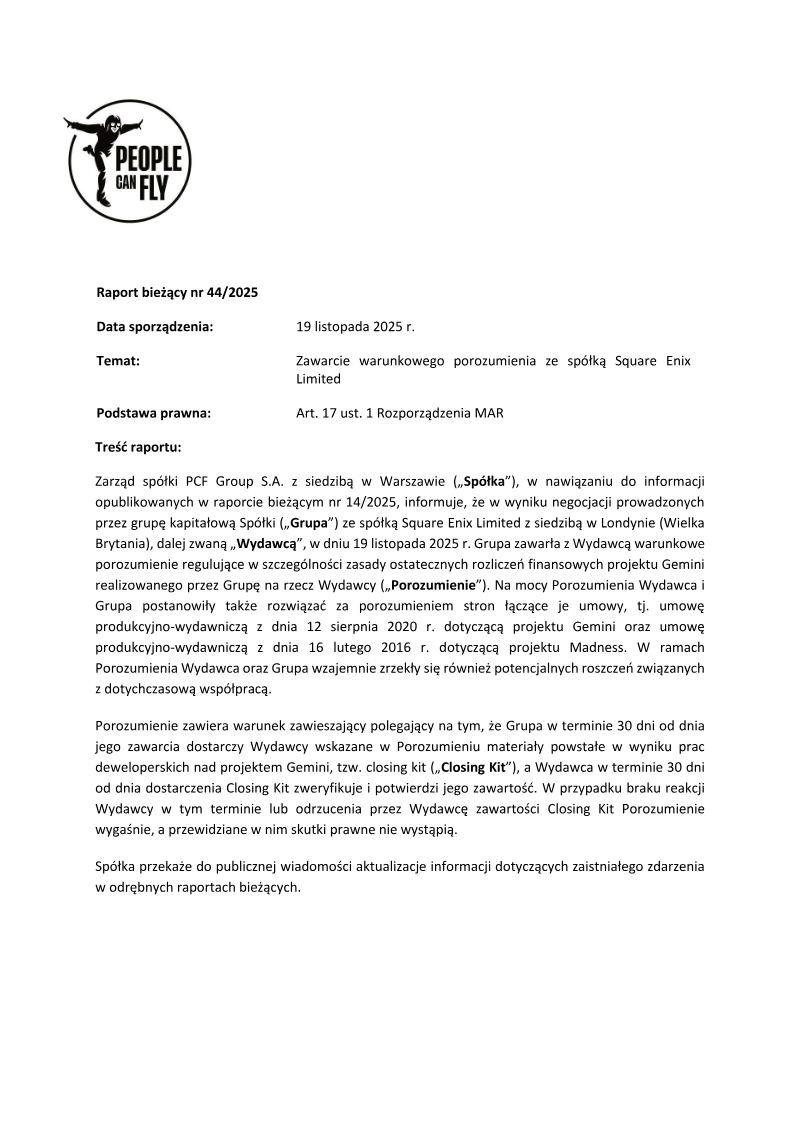
The primary aim is to announce that PCF Group S.A., headquartered in Warsaw, has entered into a conditional settlement with Square Enix Limited of London concerning the financial finalisation of the Gemini project and the termination of two existing production‑publishing contracts. The settlement, signed on 19 November 2025, resolves the 12 August 2020 agreement for Gemini and the 16 February 2016 agreement for the Madness project, with both parties mutually waiving any further claims arising from their prior collaboration. Key terms of the settlement include a suspensive condition: PCF Group must deliver, within 30 days of signing, a “Closing Kit” comprising all development materials generated for Gemini. Square Enix then has a further 30‑day window to review and confirm the kit’s contents. Failure by Square Enix to respond or any rejection of the kit will cause the settlement to lapse, nullifying all stipulated legal effects. The agreement therefore hinges on timely exchange and verification of deliverables rather than on any monetary settlement disclosed in the announcement. The scope is limited to the two companies—PCF Group, a Polish capital‑market entity, and Square Enix, a UK‑based publisher—and to the two video‑game projects, Gemini and Madness, spanning contractual relationships from 2016 to 2020. No quantitative data or broader market analysis is presented, and the communication serves solely as a regulatory disclosure under Article 17(1) of the MAR regulation. Further updates on the outcome of the conditional arrangement will be provided in subsequent filings.
PCF Group S.A., the parent company of the People Can Fly studio, has officially entered negotiations with a renowned global publisher to establish a comprehensive development and publishing agreement. This move follows the receipt of a formal proposal and a draft executive agreement on May 19, 2023, concerning the production and release of a new video game. The decision to pursue this partnership aligns with the company’s updated corporate strategy announced earlier in 2023, which emphasizes the pursuit of attractive work-for-hire opportunities with reputable industry partners alongside its own internal projects. The proposed collaboration is structured as a work-for-hire model, where the studio acts as the developer for hire on behalf of the publisher. Under this framework, the studio will receive agreed-upon remuneration for its development services. The negotiation covers both a master framework agreement and a specific executive agreement that outlines the technical and financial parameters of the project. These details include a comprehensive description of the product, a defined production schedule, and the specific milestones and conditions required for the payment of developer fees. While the specific identity of the publisher and the title of the game remain confidential, the terms of the draft agreement are described as consistent with standard industry practices for high-budget production and publishing deals. The commencement of these negotiations marks a significant step in expanding the studio's project pipeline, though the final execution of the contract remains subject to successful negotiation outcomes. This development reflects a strategic balance between the studio's independent intellectual property goals and its capacity to provide high-end development services to major external stakeholders in the global gaming market.