Updated Apr 30, 2026 by tinyBuild
Legal
Published by tinyBuild
TinyBuild Inc. established its formal corporate governance framework through a comprehensive recapitalization and restructuring process finalized in February 2021. The primary objective of this governance architecture is to facilitate the company’s listing on the London Stock Exchange’s AIM market while ensuring long-term operational stability. By authorizing 800 million shares of common stock and executing a significant stock split, the company positioned itself for public equity participation while implementing rigorous internal controls to protect shareholder interests and maintain regulatory compliance. The governance structure centralizes authority within the Board of Directors, granting them exclusive power to manage board vacancies and enforce strict transparency protocols. These protocols are explicitly designed to align with the United Kingdom’s Financial Conduct Authority transparency rules, requiring shareholders to disclose voting interests and beneficial ownership. To ensure adherence, the Board possesses the power to issue disclosure notices, with the authority to suspend voting rights, dividend payments, and transferability for any party that fails to comply within a 14-day window. Protection of minority shareholders remains a core tenet of this framework, evidenced by the implementation of a mandatory offer rule. Any entity acquiring 30% or more of the company’s voting rights must extend a formal cash-based offer to all remaining shareholders, a provision that can only be bypassed through specific waiver procedures. Furthermore, the company mandates a 75% supermajority vote for any amendments to the bylaws or certificate of incorporation, ensuring that fundamental changes to the corporate structure require broad consensus. These measures collectively establish a robust, defensive posture intended to safeguard the company’s market position and ensure equitable treatment of all stakeholders within the international gaming industry.

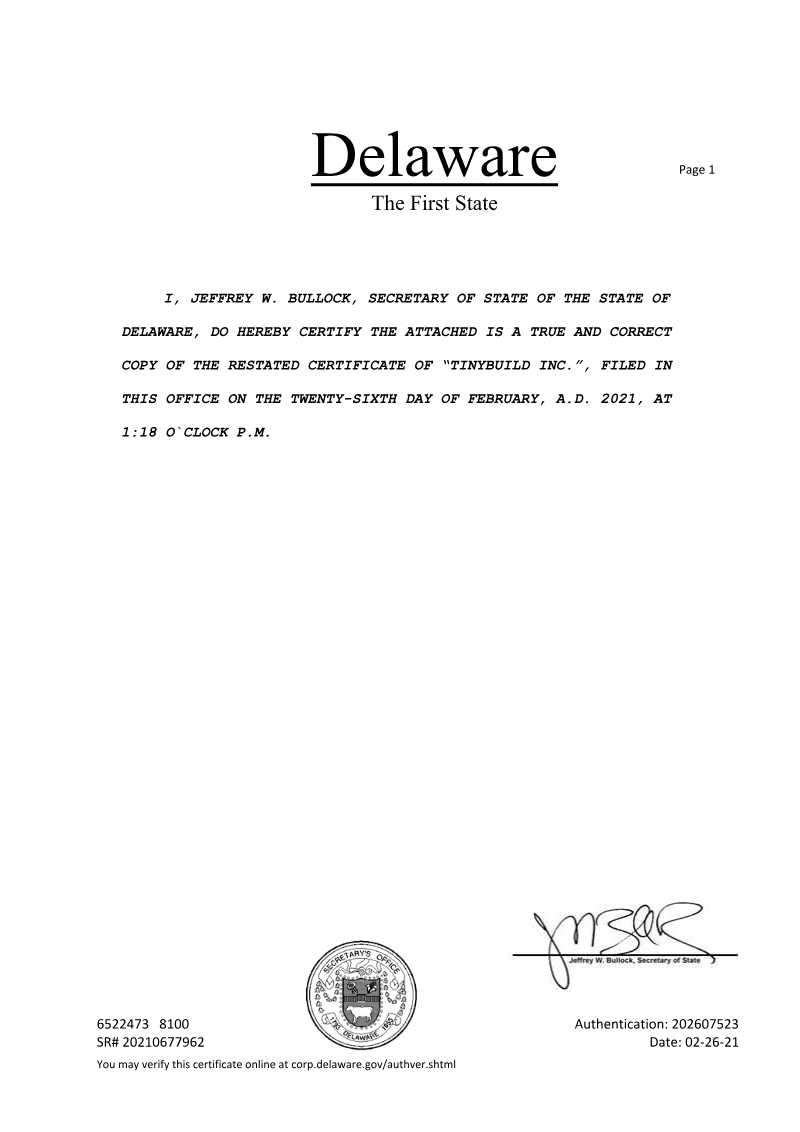
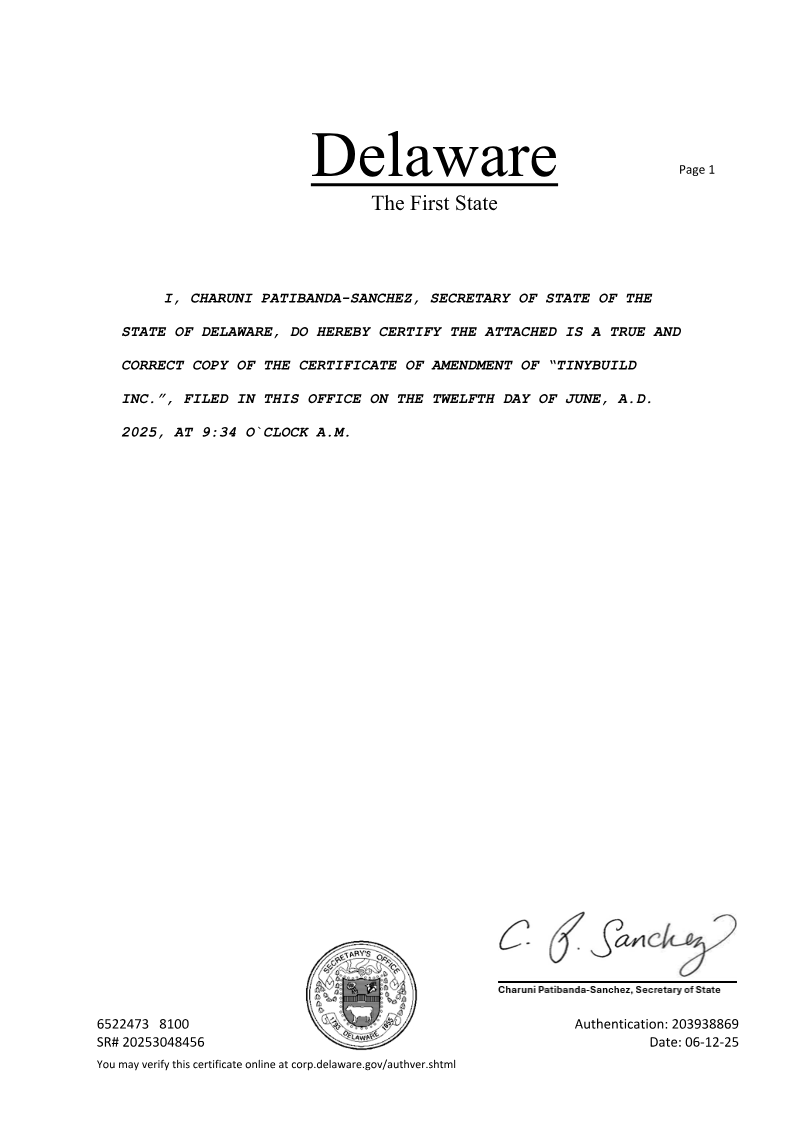
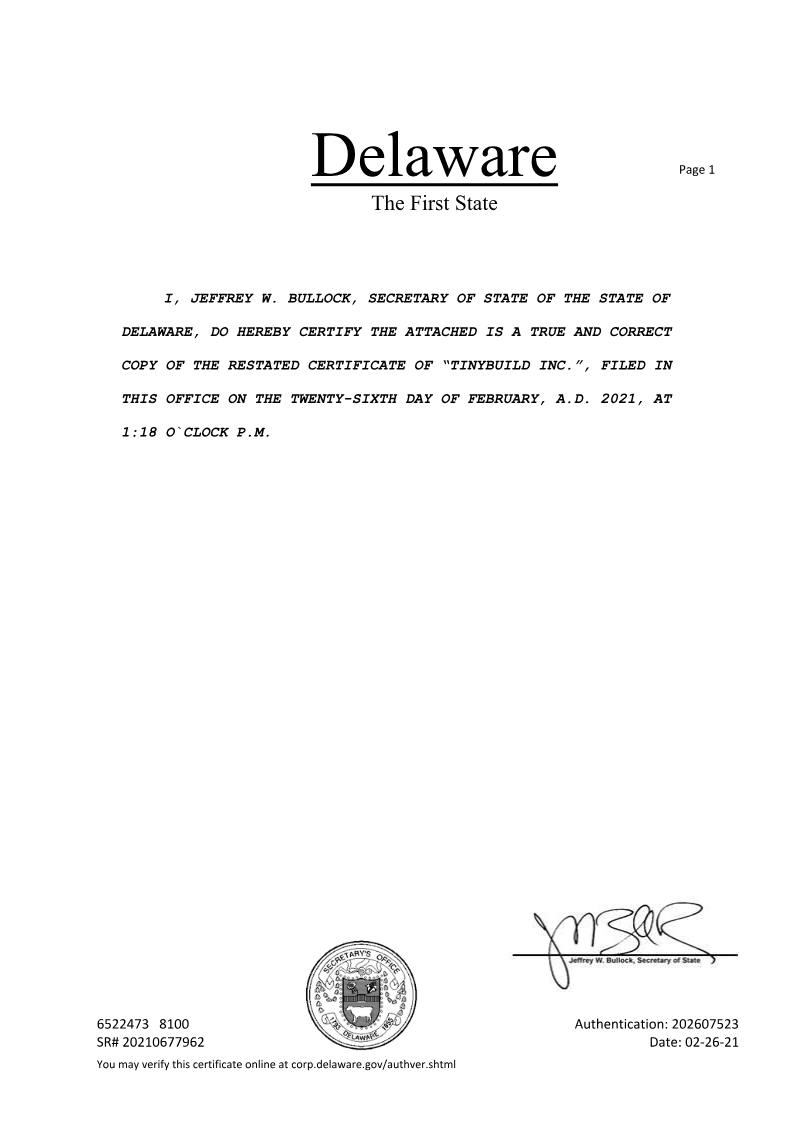
Delaware Page 1 The First State I, JEFFREY W. BULLOCK, SECRETARY OF STATE OF THE STATE OF DELAWARE, DO HEREBY CERTIFY THE ATTACHED IS A TRUE AND CORRECT COPY OF THE RESTATED CERTIFICATE OF “TINYBUILD INC.”, FILED IN THIS OFFICE ON THE TWENTY-SIXTH DAY OF FEBRUARY, A.D. 2021, AT 1:18 O`CLOCK P.M. SECRETA MSlR ARY'SOFFICE Whal 6522473 8100 Authentication: 202607523 SR# 20210677962 Date: 02-26-21 You may verify this certificate online at corp.delaware.gov/authver.shtml
Delivered 01:18 PM 02/26/2021 THIRD AMENDED AND RESTATED FILED 01:18 PM 02/26/2021 SR 20210677962 - File Number 6522473 CERTIFICATE OF INCORPORATION OF TINYBUILD INC. tinyBuild Inc., a corporation organized and existing under and by virtue of the provisions of the General Corporation Law of the State of Delaware, hereby certifies that: ONE: The name of the Corporation is tinyBuild Inc. and the date of filing the original Certificate of Incorporation of the Corporation with the Secretary of State of the State of Delaware was August 25, 2017. TWO: Pursuant to Sections 141, 242 and 245 of the General Corporation Law of the State of Delaware, this Third Amended and Restated Certificate of Incorporation has been duly adopted by the written consent of the Board of Directors of the Corporation and restates and integrates and further amends the provisions of the Certificate of Incorporation of the Corporation, as amended (the "Certificate of Incorporation") THREE: Pursuant to Sections 228, 242 and 245 of the General Corporation Law of the State of Delaware, this Third Amended and Restated Certificate of Incorporation has been duly adopted by the written consent of the stockholders of the Corporation and restates and integrates and further amends the provisions of the Certificate of Incorporation of the Corporation FOUR: The Certificate of Incorporation of the Corporation is hereby amended and restated to read as follows: ARTICLE I NAME The name of this corporation is TINYBUILD INC. (the "Corporation") ARTICLE II REGISTERED OFFICE
ds the provisions of the Certificate of Incorporation of the Corporation FOUR: The Certificate of Incorporation of the Corporation is hereby amended and restated to read as follows: ARTICLE I NAME The name of this corporation is TINYBUILD INC. (the "Corporation") ARTICLE II REGISTERED OFFICE The address of the registered office of the Corporation in the State of Delaware is 1209 Orange Street, City of Wilmington, County of New Castle, Zip Code 19801, and the name of the registered agent of the Corporation in the State of Delaware at such address is National Registered Agents, Inc.
ARTICLE III PURPOSE The purpose of the Corporation is to engage in any lawful act or activity for which a corporation may be organized under the Delaware General Corporation Law ("DGCL"). ARTICLE IV CAPITAL STOCK 1. Authorized Capital Stock. The total number of shares of capital stock which the Corporation shall have authority to issue is Eight Hundred Million (800,000,000), all of which shall be a class designated as common stock, par value $0.001 per share (the "Common Stock"). Effective upon the filing and effectiveness of this Third Amended and Restated Certificate of Incorporation of the Corporation (the "Effective Time"), the following recapitalization events shall be deemed to occur without any further action on the part of the Corporation or any stockholder of the Corporation (the "Recapitalization"): Every one (1) share of the Preferred Stock, par value $0.001 per share, of the Corporation issued and outstanding immediately prior to the Effective Time shall be automatically reclassified into one (1) issued and outstanding fully paid and non-assessable share of Common Stock; and (b) Immediately following such reclassification, each one (1) issued and outstanding share of Common Stock then outstanding shall automatically be reclassified into 129.8264566 issued and outstanding fully paid and non-assessable share of Common Stock (the "Stock Splif '); provided that, if the aggregate number of shares issued to any stockholder results in a fractional share, the aggregate number of shares issued to such stockholder in the Stock Split shall be rounded up to the nearest whole share.
paid and non-assessable share of Common Stock (the "Stock Splif '); provided that, if the aggregate number of shares issued to any stockholder results in a fractional share, the aggregate number of shares issued to such stockholder in the Stock Split shall be rounded up to the nearest whole share. The number of authorized shares of the class of Common Stock may from time to time be increased or decreased (but not below the number of shares of such class outstanding) by the affirmative vote of the holders of a majority in voting power of the outstanding shares of Common Stock. 2. Voting; Dividends; Liquidation, Dissolution or Winding Up. Except as otherwise provided herein, the powers, preferences and rights, and the qualifications, limitations and restrictions thereof, of the Common Stock shall be as follows: (a) The holders of the Common Stock shall have the exclusive right to vote for the election of directors of the Corporation (the "Directors") and on all other matters requiring stockholder action, each outstanding share entitling the holder thereof to one vote on each matter properly submitted to the stockholders of the Corporation for their vote; - 2 -
(b) Dividends may be declared and paid or set apart for payment upon the Common Stock out of any assets or funds of the Corporation legally available for the payment of dividends, but only when and as declared by the Board of Directors or any authorized committee thereof; and (c) Upon the voluntary or involuntary liquidation, dissolution or winding up of the Corporation, the net assets of the Corporation shall be distributed pro rata to the holders of the Common Stock. 3. Pre-emptive Rights. Effective as of the Recapitalization, and subject to the DGCL, this Certificate of Incorporation and the terms any resolution authorizing the issuance of any shares of capital stock of the Corporation: (a) the unissued shares from time to time shall be under the control of the Board of Directors, which may allot the same to such individuals, corporations, firms, partnerships (general or limited), associations, limited liability companies, joint ventures, trusts, estates or other legal entities or organizations (each, a "Person"), for cash or for such other consideration which is not cash, with such restrictions and conditions, in excess of their nominal value or at their nominal value and/or with payment of commission and at such times as the Board of Directors shall deem appropriate; and (b) the Board of Directors shall have the power to cause the Corporation to grant to any Person the option to acquire from the Corporation any unissued shares, in each case on such terms as the Board of Directors shall deem appropriate
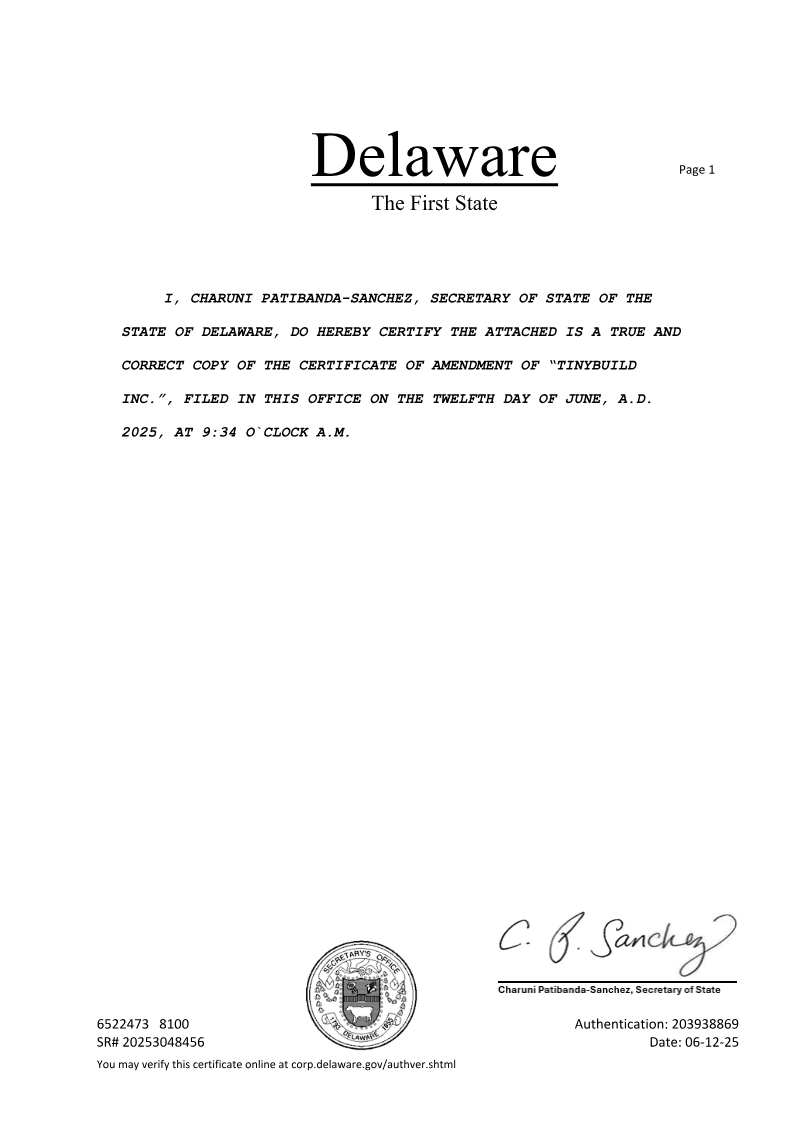
TinyBuild Inc., a Delaware-incorporated video game publisher, enacted significant structural changes to its corporate governance through a Certificate of Amendment filed on June 12, 2025. This legal filing formalizes a shift in the company’s internal leadership framework, specifically transitioning the Board of Directors toward a declassified structure. Under these new provisions, all directors will serve one-year terms expiring at the subsequent annual meeting of stockholders, effectively ending any previous multi-year staggered terms by the 2026 annual meeting. The amendments further centralize control over board composition within the board itself. The number of directors is now fixed exclusively by board resolution, and any vacancies or newly created positions must be filled by a majority of the remaining directors rather than by stockholders. While stockholders retain the power to remove directors with or without cause via a majority vote, the board maintains the sole authority to appoint replacements. Additionally, the company expanded its liability protections, stipulating that directors and officers are not personally liable for monetary damages resulting from breaches of fiduciary duty to the fullest extent permitted by the Delaware General Corporation Law. Geographically and legally, the scope of these changes establishes Delaware as the primary jurisdiction for corporate disputes. The amendment mandates that federal district courts serve as the exclusive forum for Securities Act of 1933 claims, while the Delaware Court of Chancery or the federal district court for the District of Delaware are designated as the sole venues for derivative claims under the Securities and Exchange Act of 1934. These updates, signed by CFO Gjasone Salati, align the company’s governing documents with modern Delaware corporate standards regarding executive indemnification and jurisdictional exclusivity.
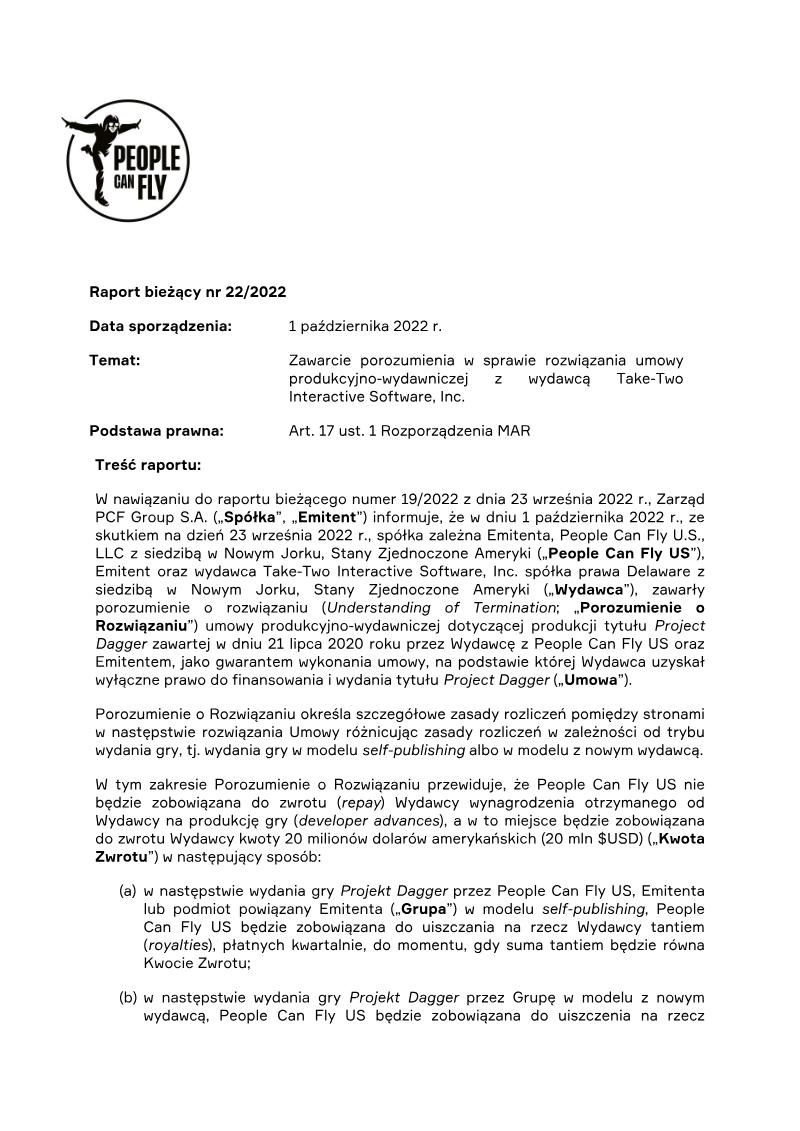
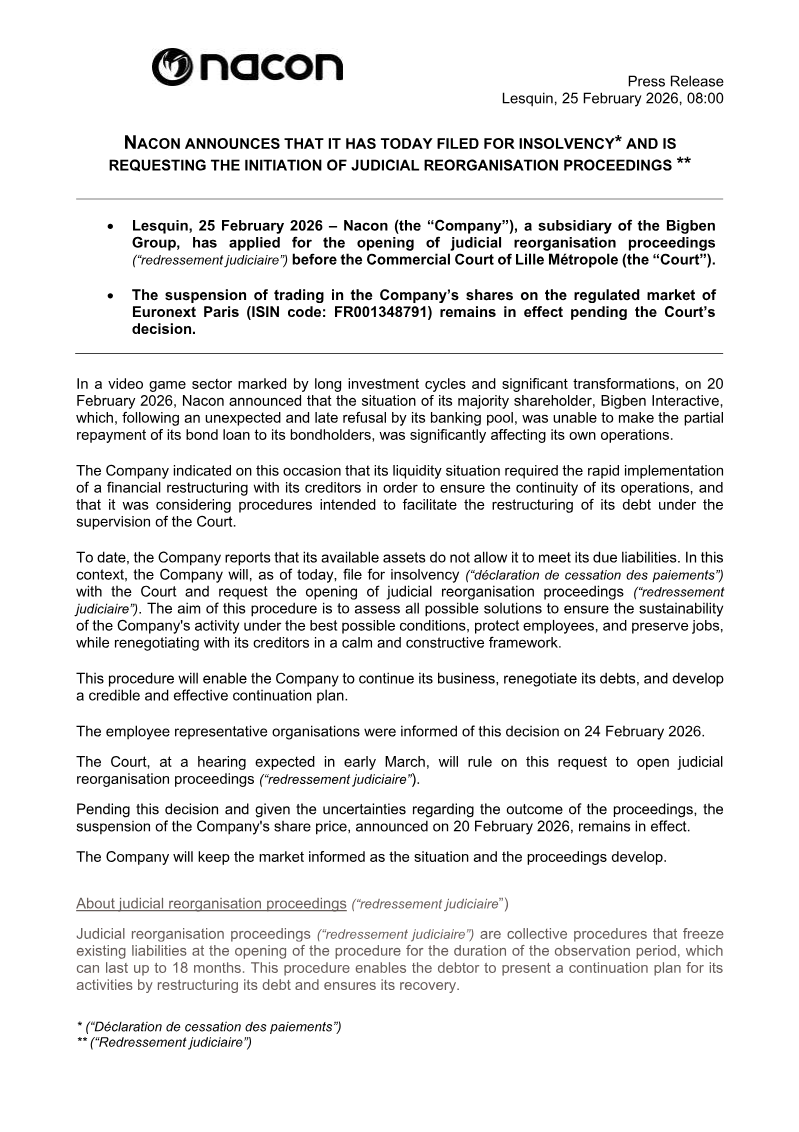
The report announces that on October 1, 2022, People Can Fly U.S., LLC and its parent PCF Group S.A. entered into a termination agreement with Take‑Two Interactive Software, Inc., ending the 2020 production and publishing contract for Project Dagger. The termination agreement specifies how financial obligations will be settled depending on the eventual release model of the title. If Project Dagger is released through self‑publishing by People Can Fly U.S., the company will pay royalties to Take‑Two on a quarterly basis until cumulative payments equal a predetermined repayment amount of $20 million. If the game is released with a new publisher, People Can Fly U.S. will repay the same $20 million in two equal installments due six and twelve months after launch. No repayment is required if the game never reaches commercial release, regardless of model. The agreement also confirms that Take‑Two did not exercise its option to acquire intellectual property rights under the original contract, and that the license granted to Take‑Two has expired. Consequently, People Can Fly U.S. retains exclusive ownership of Project Dagger’s intellectual property. Standard termination provisions accompany the agreement, covering general legal and procedural matters. The report covers a single geographic jurisdiction—both parties are headquartered in New York, USA—and pertains exclusively to the Project Dagger title within the video‑game development and publishing sector. No survey or external data sources are cited; the document is a straightforward corporate disclosure of contractual termination and financial settlement terms.
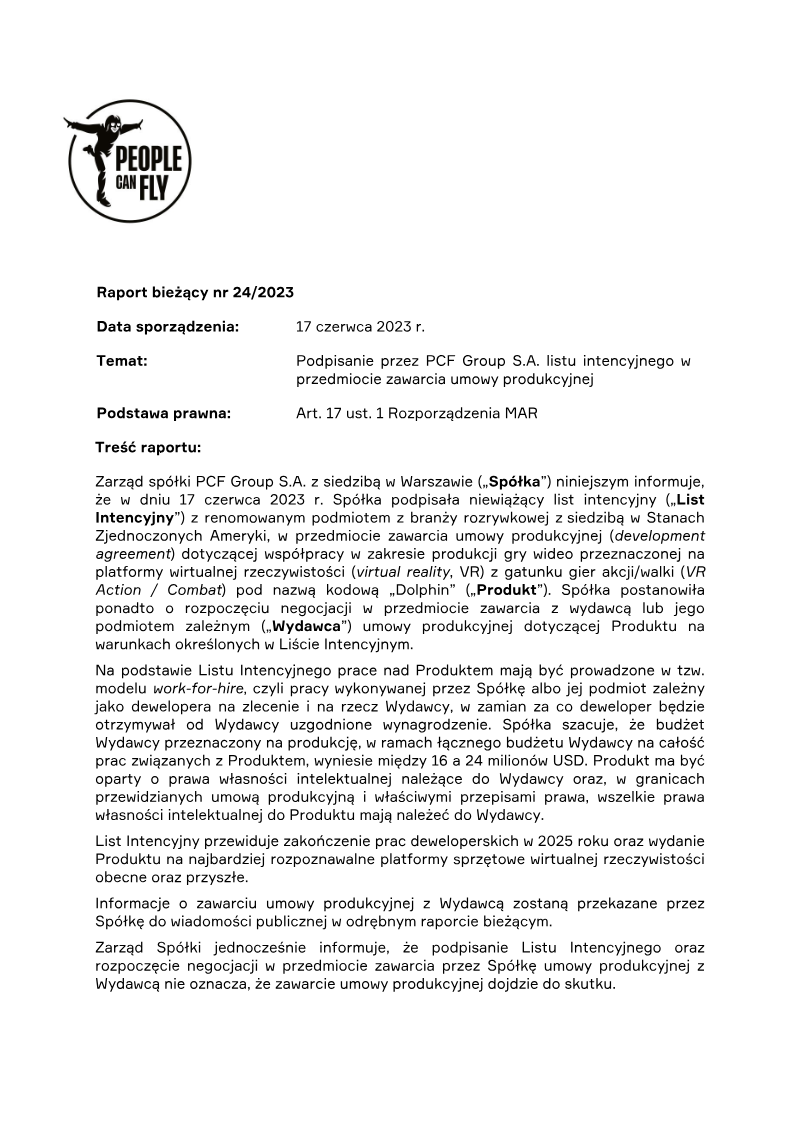
The report announces that PCF Group S.A., headquartered in Warsaw, entered into a non‑binding Letter of Intent on 17 June 2023 with a prominent U.S. entertainment company to develop a virtual‑reality action/combat video game under the code name “Dolphin.” The intent is to negotiate a production agreement with a publisher or its affiliate, under which PCF will act as a work‑for‑hire developer. The publisher’s total budget for the project is estimated between 16 million and 24 million USD, with intellectual property rights ultimately belonging to the publisher within contractual limits. Development is projected to conclude in 2025, with release planned for current and future leading VR hardware platforms. The report clarifies that signing the Letter of Intent does not guarantee a final production contract, and further details will be disclosed in a separate public update. The scope covers the U.S. entertainment partner and global VR platforms, focusing on action/combat gameplay. No survey or statistical methodology is cited; the information derives from corporate governance announcements and contractual estimates.
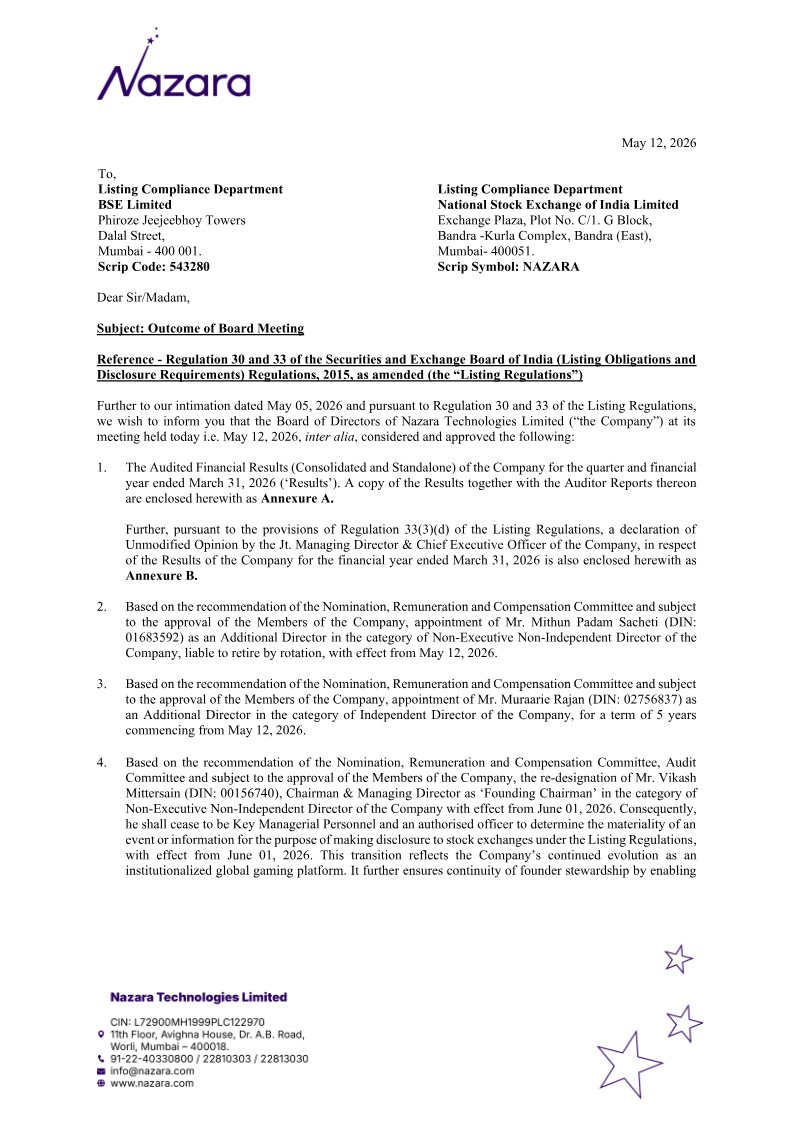
The board’s recent meeting confirmed the audited financial results for FY 2025‑26, approving an unmodified opinion from the CEO and appointing two new directors while reassigning the founding chairman to a non‑executive role. Internal audit responsibilities for FY 2026‑27 were assigned to MAKK & CO., and a previously filed amalgamation scheme with Paper Boat Apps was withdrawn. Audit coverage extended to 20 subsidiaries and 11 associates, totaling assets of ₹1,57,390 lakhs and revenue of ₹1,13,393 lakhs; the audit opinion remained unmodified with no material deficiencies. Consolidated financials for FY 2025‑26 showed operating revenue of ₹39.78 billion, a slight decline from the prior year, and net profit before tax falling to ₹4.25 billion due to higher operating expenses and a drop in gaming segment revenue. Total assets rose to ₹437.12 billion, while cash and equivalents fell sharply, reflecting significant investing outflows. Segment analysis highlighted gaming as the dominant asset holder at ₹134.1 billion, with e‑sports and ad‑tech also contributing to capital employed growth. Leverage increased modestly, with segment liabilities at ₹68.9 billion and unallocated items remaining substantial. The audit report noted a quarterly operating loss of ₹94,321 lakhs and significant impairment losses linked to regulatory changes under the 2025 Gaming Act. The act forced cessation of online‑money gaming for certain subsidiaries, resulting in ₹98.9 cr and ₹41 cr impairment charges without deferred tax recognition. Despite these challenges, the company’s standalone net worth remained robust at ₹2 24 cr, and it pursued strategic measures such as labour‑code cost adjustments, share‑based acquisitions, and warrant issuances to sustain growth. Overall, the meeting underscored Nazara Technologies’ continued focus on gaming and ad‑tech segments while navigating regulatory constraints, maintaining a solid equity base, and reinforcing governance through new audit appointments.