1 free read left. Create a free account for unlimited reading + AI research.
Create free account
Developing culture as product: How Gram Games sets itself apart
Key insights
6 takeaways- 01Gram Games treats organizational culture as a live, iterative product by applying the same rigorous development and maintenance cycles used in their game production.
- 02The company utilizes a flat organizational structure that replaces traditional hierarchies with fluid responsibilities to encourage innovation and agility.
- 03To foster creative risk-taking, the studio mandates weekly prototype days where all employees, regardless of role, pitch and develop new game concepts.
- 04Gram Games rejects the traditional work-life divide, operating under the belief that allowing employees to bring their authentic selves to work is a business imperative for maximizing creative potential.
- 05The studio explicitly incentivizes failure as a necessary component of the creative process, viewing it as essential for long-term success.
- 06Management integrates qualitative, open-door communication with quantitative OKRs to monitor performance and identify potential issues early.
Ask AI about this video
Transcript
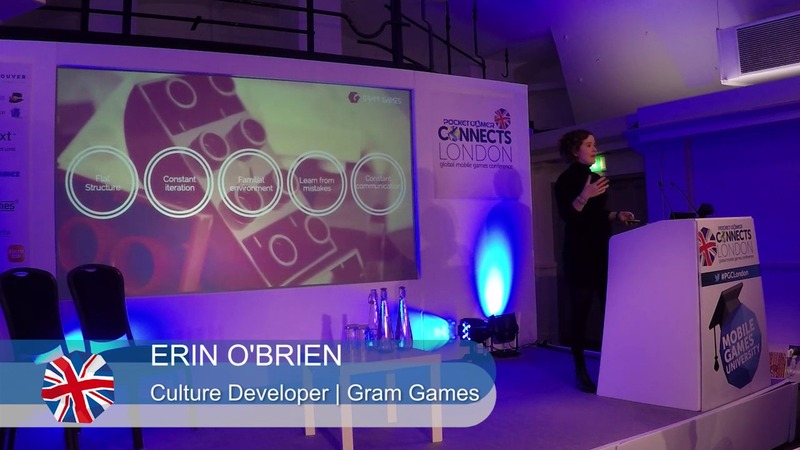
[Music] hello everybody I'm Erin O'Brien and I am the culture developer at Graham games and I do apologize I tried to channel my inner Steve Jobs and thus I am stuck behind the lectern because I can't get my kit up so so I'll be standing here but anyways a lot of you are probably sitting there thinking what the heck is a culture developer well at Graham we think of culture as a live product just like any of our games just like any title that we put out so I spend my day-to-day developing and also maintaining and looking for ways to iterate our culture and iterating the way that we as people within a company function to make the most efficient processes and ultimately to produce the best titles so oh sorry the clicker got it so it said that culture does not make people people make culture and while
this is like a really general idea that you can pretty much apply to anything this is something that we at Graham and I think that many people at many organizations should believe applies directly to gaming and directly to gaming companies because the people within our organization have worked together and have collaborated and have you know screwed up in order to make this culture that we're all proud of but that changes on a daily basis and so at the top and as an organization what we need to do is ensure that we take our we take the ideas and the concepts of the people within the organization and just guide it to make sure that that's as positive and as productive as possible so at Graham as I said we view this culture that the people have created not just as you know something that we notice every day when we come to work but as a marketable and iterative all product so it needs to be treated with all the resources and all the attention that any live product any life game would be so without the maintenance of
this culture and this is a belief that really does run through our whole organization from top to bottom we genuinely don't believe that any organization ours or otherwise can be successful because when it comes down to it projects teams people change all the time and what you have what people can be devoted to long term is a any culture so anyways so you guys are probably sitting there like okay fine you can say this you can stand up there whatever but how do you actually do this well the point is games are supposed to be fun right they're supposed to be entertainment you're supposed to enjoy them so the people who are making them and the people who are producing them also should be having fun they should be happy because if you're miserable and you're someone's like okay shade this one corner of this one thing for the next six weeks you're not going to produce something that is going to make audiences and gonna make consumers enjoy it quite as much sorry and the thing about it is is it this ends up being a positive
feedback loop because if you create an environment where people are enjoying themselves and where people are happy and where people feel that they can be themselves then ultimately they're going to contribute as much as they can in terms of work in terms of development in terms of products to make sure that the company that is providing them with that environment succeeds so it ends up being a business imperative right because you're gonna get better products and you're gonna get better outcome if you put in the time and the attention and the resources simply to make sure people are having fun and that they're happy so bottom line being to make good games try and create an environment where employees are not only happy but they have the resources and the attention to feel that they can explore the limits of their creative potential so at graham the way we do this and obviously this changes company to company but the way we do this is with a few core principles so firstly we have a flat structure and I know you guys remember like okay yeah sure right okay
but we really do we don't have middle managers we don't have real titles or hierarchies we have responsibilities and we have things that each of us can do but that's all constantly changing and morphing and it's not a product of an objective like okay you do this it's how can I contribute what can I do and how can I help ground to make the best products so secondly we have a culture that encourages and underlines constant iterations so anyone within organization should never be like it's done like that's just not that's just not a reality we are constantly changing and constantly looking for ways to change and constantly making mistakes because ultimately that is the way that you develop third a familial environment and some might say a friendly environment we have created a world within our offices that people feel like they're friends and they feel like they can be themselves and they feel like they can talk to people not just about work but about their lives because ultimately you're not you know one human
at work and one human at home you're one person and to try and like tamp down some of your personality traits or who you are at work is ultimately not going to be good for you all right and learning from mistakes as I said we want people to throw themselves out there we want people to throw out ideas no matter how dumb they are no matter how ridiculous they are and see if they stick because if you're just staying within the safe zone and you're not really trying to test the limits of what you do you're ultimately not going to come up with anything cool or fun or new because as we all know we work in an industry that is constantly changing and so there's no way to test that and there's no way to find the limits of that without risking it sometimes and actually every Friday and I do mean every Friday our company kind of pulls themselves out of their projects and has a prototype day so every single Friday everyone from our organization no matter if your marketing ops whatever can get up and be like hey I want to make a game where a monkeys dance on palm trees and
it will be voted on and it will be considered as a legitimate idea so that's pretty cool and finally constant communication I know this is outlined in the last talk but I cannot underline enough the importance of having an organization where people feel that they can raise their voice and also that they will be responded to because if you're going to maintain a flat structure and you're going to maintain this familial environment you got to know what's going on around you and yeah we have dailies every day but it's also a matter of sitting down with people and having a beer or having a coffee and like I can say for myself as an example we had an issue with you know meetings everyone hates meetings as I said in the last presentation and we ended up instituting a meeting band because from enough you know beers or hangouts or like literal bus rides home from work I was able to gauge that you know people all around us we're having trouble with these meetings and so we were actually able to get an outcome out of that so it's just about listening and talking and knowing what's going on around you okay and so there's
a couple principles that I think really underline all of these themes which is a couple themes that underline all these is that we believe that this idea of the work life don't divide is pretty much a fallacy like that doesn't mean you're working all the time that doesn't mean you're expected to be on your phone 24/7 that means that it's ridiculous to assume that at the place where you spend the majority of your life because come on we we work a lot we're at work a lot that you have to be someone different than who you are at home so you should be allowed to have and you know be open about the same personality traits the same kind of quirks and weird stuff that you know you think about and you're interested in at work as you are at home because ultimately if you don't feel like you can be yourself you're not going to be willing to kind of test your creativity you're not going to be able willing to put yourself out there and raise a game idea that could be a hit like 10 10 or merged or six or three hits you're not gonna feel comfortable raising your voice or raising your ideas and that is ultimately going to be a
failure and then the other theme is other than failure so we have an environment where not only do we say that you can fail but we're like you really should be failing if you're not failing you're playing it too safe and I know that this is kind of scary and it's sometimes not believable but we really want people to mess up because some of our greatest successes and some of our greatest developments and greatest titles have come out of people making huge mistakes or admitting in the middle of a process like hey okay I messed this whole thing if I need to scrap it and start from the beginning and if you're not willing to do that either you're gonna get to the end with a product that is less than ideal or you're never gonna find that product that hits the sweet spot that you're really proud of all right and so to dive a little deeper when I say developing culture as a product I mean that you you introduce ideas you introduce iterations you introduce updates and you introduce developments
in the same way that you would with any life title and so you put something out there you test it and then you pay attention to it and you monitor it in the same way that you would a live title so that means looking for bugs looking for glitches looking for ways that you can constantly iterate and constantly improve because when it comes down to it as I mentioned in the beginning culture is the only product that everyone and a team is actually committed to because projects change teams change and you you really don't want a team to finish their project put it out there and be like okay what now what because if you make sure that everyone within your team and everyone within your company is actually devoted to the core company values that your company puts forth then you're never gonna have people lost or confused at the end of a project they're gonna try and jump on to something else because they want to continue putting effort into making sure that the company itself is succeeding and so on a personal level or on a Gram games level we as a company genuinely believe that
our titles would not have had or enjoyed the successes that they have without our company culture because the only thing that has allowed us to create these products 10:10 merge and 6 and whatever the future may hold is because we've been able to communicate with each other because we trust each other because we've been able to take risks because we've been able to be creative and if we had you know not put as much time or as much energy into our company culture then this would not be the case and perhaps these titles just would never have come into being ok and so as some of you know we've just established a second studio and I'm sure that some of you are sitting out there thinking okay you guys have a small studio so this is totally feasible in a small studio but with a second studio maybe this will change maybe you'll eventually adopt a hierarchy things will kind of evolve and then sudden your massive machine right well I think that we are not ignorant we're going to this knowing that every single person that you bring into a team changes that
team because a culture is ultimately a product of the people that make it up right and to pretend it's not to pretend that you can tell people what to do or tell people how they should act tell people what to do and tell people what they should believe in and that they'll obey that it's just not going to work so as we bring new people in and we aren't bringing quite a few new people in as we bring people and we take them into account we listen to them we listen to what they want we immediately adopt them into processes and we do accept that things are gonna change but ultimately in every single thing that we do our onboarding processes our production processes everything these values run through and we make sure that the values are visible at every juncture and the hope and I think the reality will be that if those are visible enough all the time that ultimately those values will remain even as the company culture as a whole kind of morphs with new acquisitions uh yeah I mean and I guess the the final point
and the thing that will run through everything as we develop and as we expand and as we look at even more offices potentially in the future and expand into new products is that we have to be totally vigilant vigilant and totally attentive to every change in every shift in our company culture just like we are with live titles because if something shifts and you write it off as oh that's just a quirk or though that's just something that someone is that's just something that they believe in that's just something they do differently than everyone else here then that can grow into something worse I mean and everyone knows from development if there's a mistake and you overlook it and you don't actually give it the attention that it deserves then that's going to cause you a huge problem in the end and you know a company culture is no different and you can't ignore when things are changing even if it's for the better you can't ignore conflicts or tensions or anything like that everything needs to be addressed everything needs to be your iterated and
everything needs to be constantly improving to ensure that you have the most efficient process possible so yeah I actually finished early which is surprising but I don't know I suppose questions well I mean it's all it's all analytics so you look back so we have okay arcs right so we use objectives and key results so on a weekly basis we have an hour-long meeting and no one likes staring in a spreadsheet so we kind of compile it into a conversation right so I have a spreadsheet and I track the analytics of everything that everyone is doing so at the beginning of the quarter for those that don't know sorry it's easy we have objectives and key results so we set forth company objectives and the key results that are going to allow us to reach those objectives and then I sit down with everyone or you know I let
people I say okay guys please set your okay hours and then of course about four people put in there okay hours and I'm like hey guys can you please set in your food in your who cares do a couple Channel mentions know it's what's in their affairs and then I sit down with people and I'm like okay so if we want to achieve this this this and this over the course of this quarter how are you as a person going to contribute to that on an individual level on a personal level and you know ok ours can be anything from like I want to learn this to I am going to participate in this many production processes I'm going to participate in this many prototypes and then we make sure that there's a number tied directly to that objective and to those key results so well it's not I mean especially with like personal objectives it's not always exactly spot-on it as with everything that we do it allows us to be analytic and allows us to be analytically informed to a certain degree and you can see like even if someone's just you know not putting in their affairs week to week or they're like it's zero zero zero zero zero and people are generally pretty honest then
you know that there's something going on like you know that someone you know that either they're not being allowed to do what they want to do or they're not you know being able to contribute in the way that they want to contribute and as I underlined like we want people to be able to explore the limits of their creative potential and I'm dead serious so I say that and so we don't want people to feel stifled we don't want to feel we don't want people to feel like they don't know what they're doing but they can't say that so that's when you you know I our people manager approaches the person is like hey can we just like grab a beer we just like sit down and talk and so it's it's analytically of informed kind of emotional connection that makes any sounds like a contradiction but yeah [Music]
Summary
Gram Games operates on the core thesis that organizational culture should be treated as a live, iterative product rather than a static set of rules. By applying the same rigorous maintenance, monitoring, and development cycles used in game production to the internal work environment, the studio aims to foster a high-performance atmosphere that drives creative success. This approach is built on the belief that while projects and teams are transient, a well-maintained culture provides the long-term foundation necessary for a company to thrive and produce successful titles.
The studio’s operational framework relies on several key principles, including a flat organizational structure that eschews traditional hierarchies in favor of fluid responsibilities. To encourage innovation, the company promotes a culture of constant iteration and risk-taking, explicitly incentivizing employees to embrace failure as a necessary component of the creative process. This is supported by weekly prototype days, where all staff members—regardless of their specific role—are encouraged to pitch and develop new game concepts. Furthermore, the studio rejects the traditional work-life divide, advocating for an environment where employees can bring their authentic selves to work, which the company views as a business imperative for maximizing creative potential.
Methodologically, the studio manages this culture through a combination of qualitative communication and quantitative analysis. While maintaining a familial, open-door atmosphere, the company utilizes Objectives and Key Results (OKRs) to track individual and team contributions. These metrics serve as an analytical diagnostic tool; a lack of progress in an individual’s OKRs acts as an early warning system, prompting management to engage in direct, informal conversations to identify and resolve underlying issues. This integration of data-driven oversight and human-centric support ensures that the culture remains aligned with the company’s evolving needs as it scales.




















Comments