1 free read left. Create a free account for unlimited reading + AI research.
Create free account
Designing for Youth - Making Games for Players Under 14 - Extra Credits
Key insights
6 takeaways- 01Designers should avoid the 'box art' strategy of relying on licensed intellectual property and instead prioritize gameplay quality to meet the expectations of increasingly discerning parents.
- 02The industry must move away from the historical reliance on low-budget production and prioritize creating genuinely engaging, age-appropriate experiences.
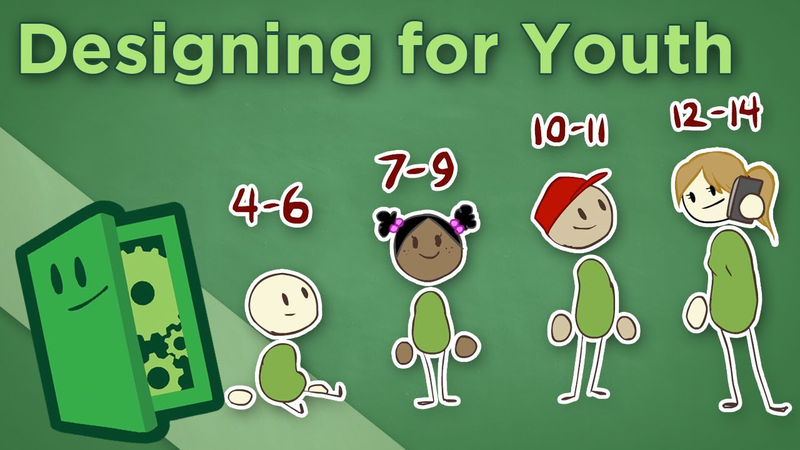
- 03Developers must segment the youth market into four distinct age brackets—4–6, 7–9, 10–11, and 12–14—to account for rapid shifts in cognitive, social, and literacy development.
- 04Failing to accurately target narrow developmental demographics is a primary cause of project failure in the youth gaming sector.
- 05Games should incorporate multiple levels of success to ensure accessibility for novices while providing sufficient depth to reward strategic thinking.
- 06Developers must avoid 'talking down' to children and instead treat them as adults with less experience to bridge the gap between familiar concepts and complex ideas.
Ask AI about this video
Transcript
This episode is late, very late. We auctioned this topic choice for charity over a year ago, and it was supposed to come out in December. But, between some production hitches on our side and James needing more time to research, here we are with it now. We're sorry, Rob. Your generosity to others made this happen, so I'm sorry we kept you waiting, but here it is at last. An episode on the challenges of designing games for kids. This is a topic which is becoming increasingly important in our industry, and one which is too often ignored. Surprisingly, in an industry that has for years been labeled just for kids, most of the products we put out aimed at kids clearly haven't had a lot of thought put into how to approach creating games for young people. Unfortunately, for years many of the {quote} "kids games" out there were licensed titles, and these games relied on the idea that the parents buying them wouldn't know anything about games, and so wouldn't know a good game from a bad one. The expectation was that the parent would walk into the video game aisle in their local Toys R Us, and before them would stretch a sea of colorful boxes that meant nothing to them. Then, they'd see one with Spider-Man or G.I. Joe on
it, and they'd think, "Hey, I know what that is. My kid likes that show. I'll get him that." This, unfortunately, meant that a company could sell almost as many titles of a licensed kids game by kicking it out the door as cheaply as possible as they would by creating something actually engaging and good. Thus, often kids game production became about lowering production costs rather than raising quality. In fact, this is a big part of why licensed titles in our industry have such a bad rap today. Luckily, this has been changing. Now that many people who grew up with games in their homes when they were kids are having kids of their own, games for children can no longer sell on box art and ignorance alone. Today, these games have to better cater to their audience, and that's one of the most difficult things when creating games for kids. You see, we often mentally lump ages 14 and up as one group when creating games. Most of the games you play probably fall into this category. People in this range may fall into many different demographics or target audiences, and they may have vastly different underlying things which appeal to them, but age specifically isn't usually considered a huge differentiator beyond 14. In fact, it's only been in the last few years that we've started creating games specifically for the 25 and up
audience because most of the time a great game is equally appealing if you're 14 or 45. But, that's much less true for an audience under 14. In general, you have to break them up into dramatically different demographics based on age alone. And generally, it's broken down as ages 4 through 6, 7 to 9, 10 and 11, and 12 to 14. And with even a moment's reflection, you can see how wildly different those groups are. A game which is great for a 4-year-old may not be very good for a 7-year-old and is almost certainly going to be a total miss for someone who's 12 or older. There are exceptions, of course, like Minecraft, which is catching on with kids of nearly every age, but games like that are pretty rare, which makes understanding these age demographics essential to the creation of quality children's games. Understanding things like the fact that in the youngest demographic, you can't guarantee that your audience will know how to read or that the oldest group is much more socially aware than children just a few years younger than them. Knowing stuff like that is essential to targeting your game. This turns out to be much easier said than done as many developers I've known originally thought they were creating a game for one age group, only to find out that they'd aimed too high
or too low, and that is fatal to a project if not discovered early. Good children's games also build in multiple levels of success from the outset. You need your game to be easy enough that any child can play on their own with or without a parent, but you also need to provide a broad enough experience that you're not talking down to the child with your gameplay. This is actually one of the keys to the success of things like Angry Birds or even Skylanders. Any child can play them just by mashing buttons or tapping on the screen, but a child who thinks through the mechanics and understands the game is rewarded for doing so, for thinking more deeply. Additionally, you have to be more aware of the different ways human beings learn when building games for kids. We touched on this a little in one of the episodes about how to build a good tutorial, and in fact, we could and probably should dedicate a whole episode to the theories around different types of learning because while by our teens we've been trained to learn in ways that have become standard in our society, what will stick with or make sense to a younger child is much more vague. Actually, just to go on a quick tangent, a lot of debate around the idea of learning styles in education. I'm kind of hand-waving it here, but if we do a full episode on learning methods in games later, we'll go into some of this
and how learning styles relate to games. The short version is you should teach the player in every unobtrusive way possible, and where you need to, a few obtrusive ones, too. While I don't know about the breakdown or efficacy of any given learning style for people, I do know that games that use more of them tends to get more people to understand what they're trying to teach. Who knows? Maybe that's because people learn differently, or maybe it's just a repetition thing. But this is one of the few universally true things James can say about the games he's worked on. Anyway, back on topic. The last difficulty in making games for kids that I want to bring up is the idea of not talking down to them. Not only in your mechanics, but in every aspect of your game. We seem to have this societal bias that children can only handle paplum, banal, or puerile things, and that's absolutely false. Everything from SpongeBob to Wall-E has shown us that children can appreciate challenging ideas and humor. The best children's books we have don't shy away from leaving the child with something to think about. So the games we make for them should take up this mantle as well. Here, James has only one piece of advice. It's what works for him. Perhaps it's just what helps put him in the right headspace, and it won't make sense to anybody else. But when James works on
experiences for children, and in fact in general when dealing with younger people, he simply thinks of them as adults with a lot less experience. If you can build that ramp that goes from things that children already understand to the concept you want to explore with them, I think you'll find that children are capable of quite a lot. Everything from Winnie the Pooh to The Little Prince, Toy Story to The Lego Movie do this. And games are perhaps even more capable of allowing children the opportunity to explore and ponder new things by bridging that gap. So I hope that helps some of you get a sense of the pitfalls of designing for a younger audience. The original question was, "What are some of the difficulties designers encounter when creating for children?" Of course, there's a much larger question to be asked of how to actually design a good game for kids, which is something I'm not sure we could tackle, but hopefully this will serve as a start. Just remember how much a small difference in age can change things, and how much value there is in having different levels of success in your game so kids can grow with it and kids of different skill levels and attention spans can all have something to play. Beyond that it's just a matter of not talking down to your audience and as easy as that is to say that may be the hardest thing of all. Good luck and good
creating.
Summary
Designing games for children under 14 requires a fundamental shift in development philosophy, moving away from the historical reliance on licensed intellectual property and low-budget production toward creating genuinely engaging, age-appropriate experiences. The industry has historically suffered from a "box art" strategy, where poor-quality games were sold to parents based on recognizable characters rather than gameplay merit. As the gaming demographic matures and parents become more discerning, developers must now prioritize quality and specific developmental needs to succeed in the youth market.
A primary challenge in this sector is the necessity of segmenting the audience into distinct age brackets—specifically 4–6, 7–9, 10–11, and 12–14. Unlike the adult market, where a single title often appeals to a broad range of ages, children’s cognitive, social, and literacy levels evolve rapidly. Developers must account for these differences, such as the inability of the youngest players to read or the increasing social awareness of pre-teens. Failing to accurately target these narrow demographics often leads to project failure.
Effective design for youth involves creating games with multiple levels of success, allowing players to engage through simple mechanics while rewarding deeper strategic thinking. This approach ensures accessibility for novices while maintaining depth for more experienced players. Furthermore, designers must avoid the common pitfall of "talking down" to children. By treating young players as adults with less experience, developers can bridge the gap between familiar concepts and complex ideas. Ultimately, the goal is to provide children with meaningful, challenging experiences that respect their intelligence and capacity for growth, mirroring the success of high-quality children’s literature and film.