Key insights
6 slides
Market context
Palm OS offers a unique market for independent developers, but hardware constraints are often overlooked.
The Palm platform provides an accessible market for independent developers. However, designers frequently fail to account for the device’s specific hardware and usage constraints.
1 / 6
- 01The window for independent, one-person game development on the Palm OS platform is a transient opportunity that will close as hardware evolves toward specialized gaming devices requiring professional teams.See it on page 8
- 02Developers frequently fail to account for Palm hardware constraints, specifically low-resolution displays, limited memory, and the device's primary function as a tool for quick, task-oriented business use.See it on page 3
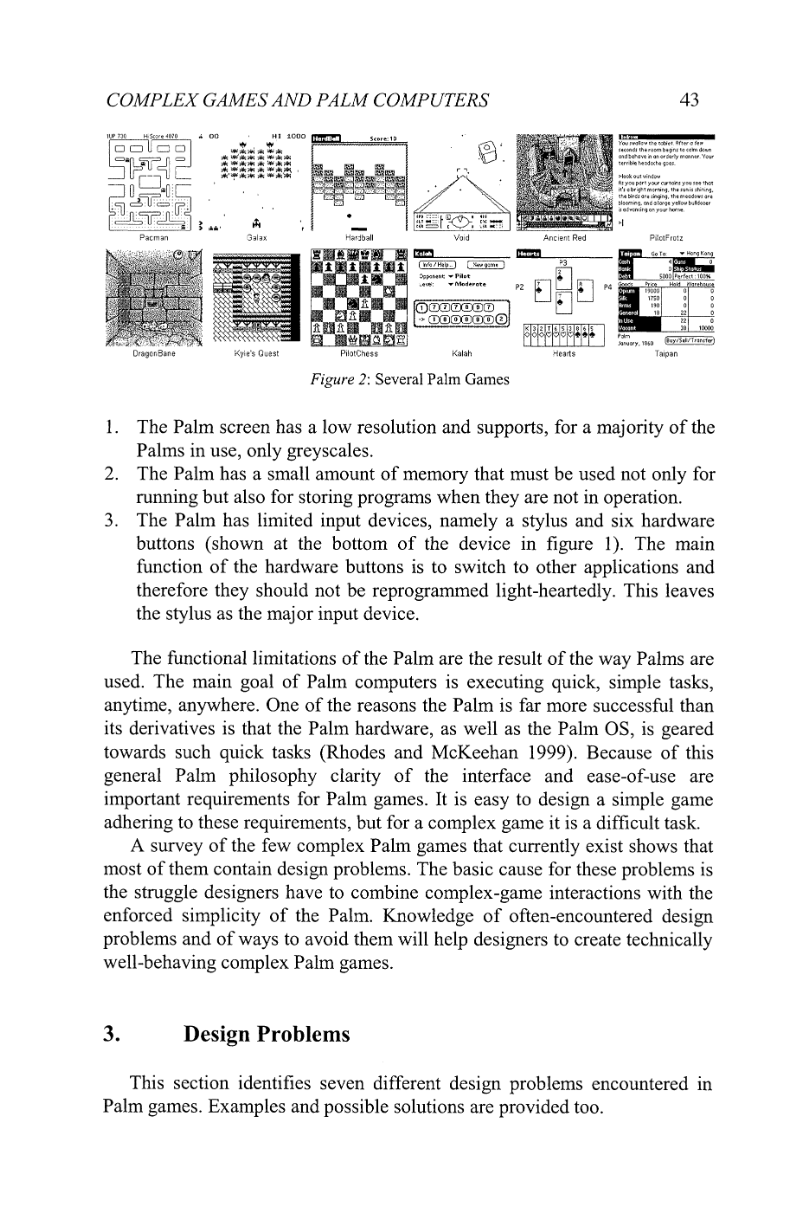
- 03Seven recurring design failures hinder Palm game viability: excessive screen density, navigation complexity, high memory overhead, poor control mapping, reliance on external materials, lack of interruptibility, and the necessity for external manuals.See it on page 3
- 04To ensure commercial viability, designers must prioritize hardware limitations during the design phase and minimize the memory footprint of their titles.See it on page 6
- 05Game interfaces must be intuitive enough to eliminate the need for documentation, while control schemes should be optimized specifically for the stylus.See it on page 5
- 06Games on the Palm platform require seamless state-saving functionality to accommodate the device's frequent, task-oriented interruptions.See it on page 6
Ask AI about this report
Summary
The primary objective of this analysis is to address the technical and functional design challenges inherent in developing complex games for Palm handheld computers. The central thesis posits that while the Palm platform offers a unique, accessible market for independent developers, designers frequently fail to account for the device’s specific hardware and usage constraints. By identifying these recurring design failures, the analysis establishes a framework of best practices to ensure that complex games remain playable and commercially viable within the constraints of the Palm ecosystem.
The research identifies seven critical design problems, including excessive screen density, navigation complexity, high memory overhead, poor control mapping, reliance on external materials, lack of interruptibility, and the necessity for external manuals. These issues stem from the Palm’s low-resolution displays, limited memory, and the device’s fundamental purpose as a tool for quick, task-oriented business functions. To mitigate these, the analysis proposes five design rules: prioritizing hardware limitations during the design phase, minimizing memory footprint, utilizing the stylus as the primary control mechanism, ensuring seamless state-saving for interruptions, and designing intuitive interfaces that eliminate the need for documentation.
The scope of this assessment covers the handheld gaming market during the late 1990s and early 2000s, specifically focusing on the Palm OS platform. The methodology relies on a qualitative review of existing Palm software and an evaluation of common design pitfalls observed in ported and original titles. The analysis concludes that the market for independent, one-person game development on Palm devices is a transient opportunity. As hardware evolves toward specialized gaming-focused handhelds, the industry will likely shift toward professional development teams, effectively ending the current window of opportunity for solitary programmers to achieve commercial success.