1 free read left. Create a free account for unlimited reading + AI research.
Create free accountWhitepaper DiGRA
1 free read left. Create a free account for unlimited reading + AI research.
Create free accountWhitepaperDiGRA
The study examines collegiate League of Legends play as a learning ecology. Its scope is one team, one home-institution tournament, and a small set of matches.
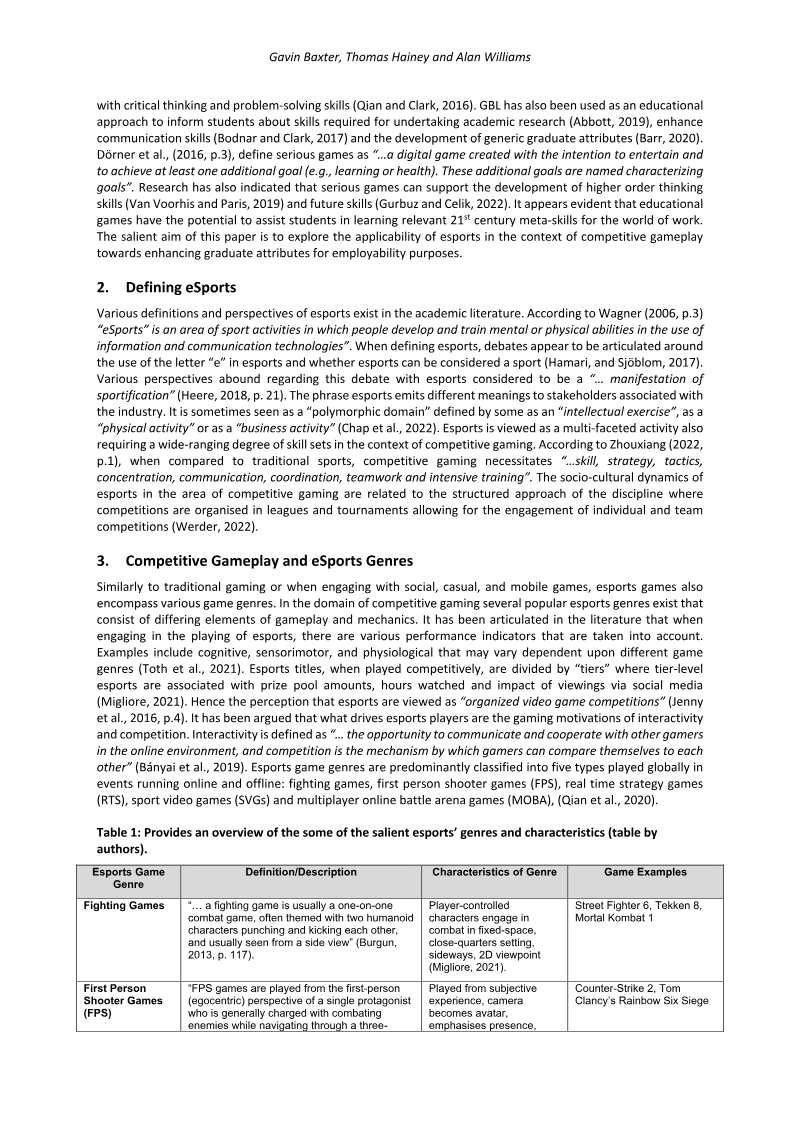
Scope. The findings are illustrative and not generalizable to other teams, games, or institutions.
This study investigates collegiate League of Legends play as a learning ecology, arguing that high-stakes competitive esports involve learning-relevant processes such as perceptual learning, reflection, task cohesion, psychological safety, and group potency. Using participant observation and video coding of a newly formed, mixed-expertise university team competing in a home-institution tournament, the authors examine how team members interact during pick-and-ban phases, objective coordination, post-game reflection, and post-win celebration. The scope is deliberately narrow: the analysis centers on a single team across one tournament and a small set of matches, so its findings are qualitative, exploratory, and illustrative rather than generalizable to other teams, games, or institutions.
Across the matches, the authors find that the team's collaborative learning strengthened over successive games. By the third game, members moved from reflecting individually on replays to engaging in team-level abstracted replay, a shift the authors connect to higher team proficiency, greater congruency in play, and increased willingness to take strategic risks. These gains were not uniformly successful, as some risks failed, but the pattern of reflection and adjustment is presented as evidence of reflective learning in action. Interdependence between tasks and outcomes, along with task cohesion, is identified as a recurring feature of the team's coordination.
The authors also highlight the social dimension of this learning. The Support player's behavior is singled out as fostering psychological safety and team morale, which in turn reinforced group potency and collaborative learning. Taken together, the study argues that the team's unexpected tournament victory reflected these improving learning processes rather than individual skill alone. The conclusions are offered as a case-based argument for treating competitive esports as meaningful learning environments, with the authors positioning the work as a foundation for larger, more systematic investigations.
Each row is a game or company this document names, each column a document, oldest first. A mark means that document names it. Select a row to see those documents.

DiGRA · 2026

DiGRA · 2026



DiGRA · 2026



DiGRA · 2026



DiGRA · 2026



DiGRA · 2026



DiGRA · 2026



DiGRA · 2026

DiGRA · 2026



DiGRA · 2026



DiGRA · 2026

DiGRA · 2026

European Conference on Games Based Learning (ECGBL) · 2025
European Conference on Games Based Learning (ECGBL) · 2025
European Conference on Games Based Learning (ECGBL) · 2024