Updated Mar 21, 2026 by Bandai Namco
Financial · September 1, 2011
Published by Bandai Namco
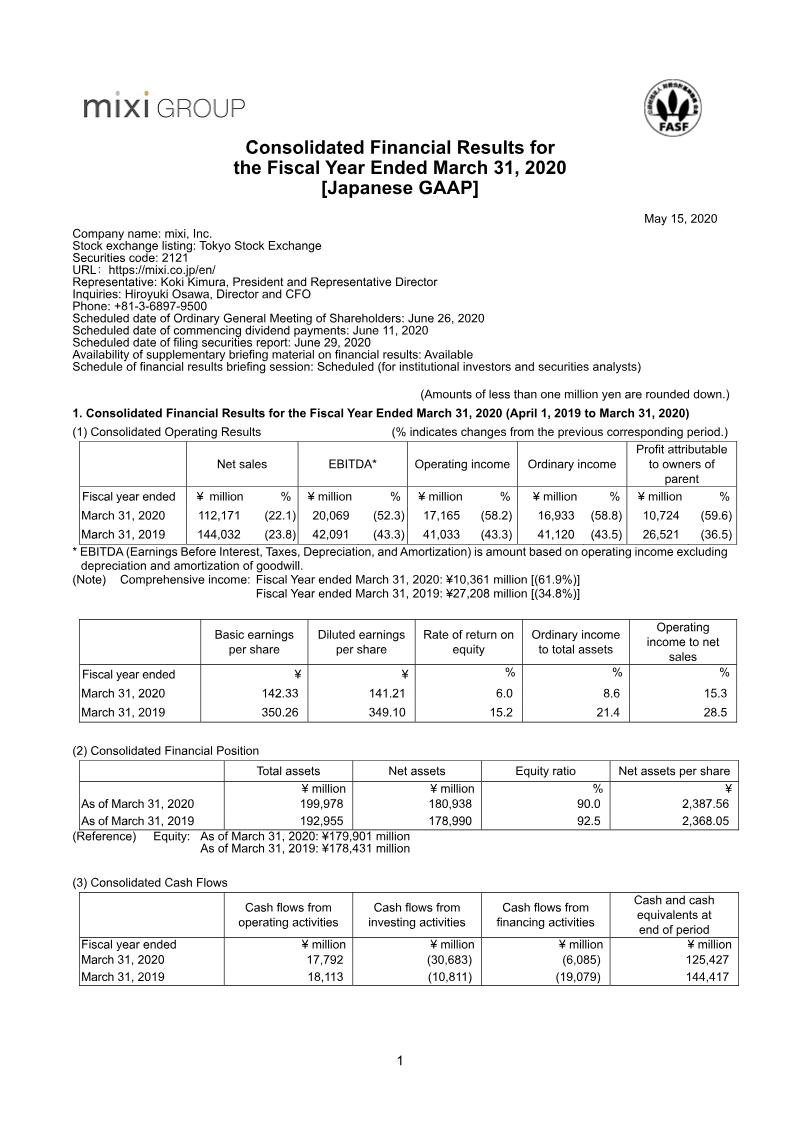
Bandai Namco’s 2011 financial results demonstrate a decisive turnaround after the sizable loss recorded in the previous year. Net sales rose 4 % to ¥394 billion, while operating income surged 767 % to ¥16.3 billion and a modest profit of ¥1.8 billion was posted after a ¥29.9 billion deficit. The recovery was anchored by a revitalised Toys & Hobby segment, whose sales increased 6 % to ¥158 billion, and a newly profitable Content segment, which posted a 7.4 % sales increase to ¥179.9 billion and swung to ¥3.1 billion in segment income. Although the Amusement‑Facility segment saw sales dip 4.6 % to ¥62.3 billion, efficiency measures lifted its segment income by more than five‑fold to ¥1.8 billion. Growth drivers included long‑standing character franchises such as Mobile Suit Gundam, Kamen Rider and POWER RANGERS, alongside a new adult‑collectible line projected to generate ¥10 billion in FY2012. Cross‑divisional initiatives, exemplified by the successful Kamen Rider OOO launch, reinforced the domestic market, which still accounts for roughly 90 % of revenue, while overseas performance lagged. The company’s governance framework features nine directors—three independent—and four statutory auditors, supported by committees overseeing internal control, risk‑compliance, information security and CSR. Environmental, social and economic responsibilities are pursued through projects like “BANDAI NAMCO Forest,” packaging‑reduction efforts, disability employment and cultural support. Financially, total assets contracted 5.4 % to ¥308 billion and the equity ratio slipped to 68.8 %, yet cash flow from operations more than doubled to ¥22.6 billion, delivering a current ratio of 245 % and an interest‑coverage ratio
The BANDAI NAMCO Group develops entertainment products and services in a wide range of fields, including toys, arcade game machines, game software, visual and music software, and amusement facilities. By building a strong operational foundation in the domestic market, as well as aggressively developing operations in overseas markets to secure future growth, we aim to be a “Globally Recognized Entertainment Group.” Our Mission Statement Dreams, Fun and Inspiration “Dreams, Fun and Inspiration” are the Engine of Happiness. Through our entertainment products and services, BANDAI NAMCO will continue to provide “Dreams, Fun and Inspiration” to people around the world, based on our boundless creativity and enthusiasm. Our Vision The Leading Innovator in Global Entertainment As an entertainment leader across the ages, BANDAI NAMCO is constantly exploring new areas and heights in entertainment. We aim to be loved by people who have fun and will earn their trust as “the Leading Innovator in Global Entertainment.”
The Point BANDAI NAMCO Group Annual Report 2011: Key Points This annual report explains the initiatives implemented by the Group in FY 2011.3 and the Group’s management policies and business strategies in FY 2012.3. Progress with the Restart Plan The Restart Plan was launched in April 2010 with the objective of bolstering the Group’s operational foundation to support the implementation of the current Mid-term Business Plan. This section describes the progress that has been made with the Restart Plan. Page 14: Message from the President Second Year of the Current Mid-term Business Plan Targeting the preparation of a foundation for global growth, the Group advanced the Restart Plan and implemented a range of initiatives. This section covers the results of those efforts. Page 4: Consolidated Financial Highlights Page 6: Review of SBU Operations Page 14: Message from the President Fiscal 2012.3: The Final Year of the Mid-term Business Plan This section describes the measures that will be implemented in the final year of the current Mid-term Business Plan, in preparation for the next plan. Page 14: Message from the President Page 20: Special Feature: Solid Base—Toys and Hobby SBU The BANDAI NAMCO Group will do its utmost to achieve its medium-to-long-term vision of being a “Globally Recognized Entertainment Group.”
3 PROGRESS Progress and Results 4 Consolidated Financial Highlights 6 Review of Strategic Business Units (SBU) Operations 12 Mid-term Business Plan 13 FOCUS The Next Step 14 Message from the President 20 Special Feature: Solid Base—Toys and Hobby SBU <thead> <th>26</th> <th>Corporate Governance</th> </thead> <tbody> <td>28</td> <td>The BANDAI NAMCO Group’s CSR Initiatives</td> <td>30</td> <td>Overview of Main Group Companies</td> <td>32</td> <td>Directors and Corporate Auditors</td> <td>33</td> <td>Financial Section</td> <td>67</td> <td>Corporate Data</td> </tbody> Forward-Looking Statements The forward-looking statements in this annual report are based on the information available to management as of August 2011, and include various risks and uncertainties. Accordingly, actual results may differ materially from these projections for a variety of reasons. Major factors that could influence actual results include changes in the BANDAI NAMCO Group’s operating environment, market trends, and exchange rate fluctuations. Notes 1. All figures in this report are rounded to the nearest unit. 2. FY 2011.3 and the year under review represent the one-year period ended March 31, 2011. 3. Figures in this annual report are as of August 2011.
PROGRESS Progress and Results In FY 2011.3, the Toys and Hobby business recorded strong results in Japan, and the Content business and Amusement Facility business had a certain degree of success with the initiatives implemented under the Restart Plan. Consequently, we recorded substantial year-on-year improvements in our results.
NAMCO BANDAI Holdings Inc. and Consolidated Subsidiaries For the years ended March 31 Thousands of U.S. dollars*1except per Millions of yen % Change share data 2009 2010 2011 2010 vs 2011 2011 For the Year Net sales ¥ 426,400 ¥ 378,547 ¥ 394,179 4.1% $ 4,740,577 Gross profit 146,023 128,753 139,415 8.3 1,676,668 Operating income 22,348 1,884 16,338 767.2 196,488 Recurring income<sup>*2</sup> 24,513 1,908 16,399 759.5 197,222 Net income (loss) 11,830 (29,929) 1,848 — 22,225 Capital expenditures 17,481 14,418 13,439 –6.8 161,624 Depreciation and amortization 22,546 18,989 18,001 –5.2 216,488 Cash flows from operating activities 19,301 10,582 22,562 113.2 271,341 Cash and cash equivalents at end of year 110,037 97,777 89,330 –8.6 1,074,324 At Year-End Total assets ¥ 363,445 ¥ 325,936 ¥ 308,269 –5.4% $ 3,707,384 Total net assets 260,579 229,012 213,693 –6.7 2,569,970 Per Share Data Yen % Change U.S.dollars*1 Net income (loss) (Basic) ¥ 47.95 ¥ (123.98) ¥ 7.71 —% $ 0.09 Total net assets 1,067.71 938.74 896.83 –4.5 10.79 Cash dividends 24.00 24.00 24.00 — 0.29 Main Financial Indicators % Return on equity (ROE) 4.3% –12.4% 0.8% Return on assets (ROA) 6.3 0.6 5.2 Overseas sales proportion 25.1 24.4 21.9 Operating income margin 5.2 0.5 4.1 Shareholders’ equity ratio 70.9 69.5 68.8
7.71 938.74 896.83 –4.5 10.79 Cash dividends 24.00 24.00 24.00 — 0.29 Main Financial Indicators % Return on equity (ROE) 4.3% –12.4% 0.8% Return on assets (ROA) 6.3 0.6 5.2 Overseas sales proportion 25.1 24.4 21.9 Operating income margin 5.2 0.5 4.1 Shareholders’ equity ratio 70.9 69.5 68.8 *1 U.S. dollar amounts have been translated, for convenience only, at the rate of ¥83.15=U.S.$1, the approximate exchange rate on the Tokyo Foreign Exchange Market on March 31, 2011. *2 Recurring income is a Japanese accounting term denoting income before extraordinary items.
The 2012 annual review presents Bandai Namco’s ambition to become the leading integrated entertainment group by 2015, targeting record operating income of ¥42.5 billion and record sales of ¥480 billion through a “Empower‑Gain Momentum‑Accelerate Evolution” strategy that leverages its global intellectual‑property portfolio. The fiscal year ending 31 March 2012 delivered ¥454.2 billion in net sales, a 15.2 % increase year‑on‑year, while operating income surged 111.8 % to ¥34.6 billion and net income rose 944.6 % to ¥19.3 billion, lifting the operating‑margin to 7.6 % from 4.1 % the prior year. Segment profit expanded 450 % to ¥17 billion, driven by strong arcade‑machine sales (¥73.4 billion), home‑software revenue (¥86 billion) and network‑content earnings (¥33.6 billion). Strategically, the group focuses on converting flagship franchises—Gundam, Kamen Rider, Power Rangers, Pretty Cure—into profit engines, reducing the share of unprofitable titles from roughly half of the portfolio in FY 2010.3, and extending market reach into new Asian territories while deepening brand management in Europe and the United States. Expansion into adult‑focused products, mobile and social gaming, and segmented amusement‑facility marketing complements the core toy
Bandai Namco faced a severe financial downturn for the fiscal year ending March 31, 2010, reporting a net loss of ¥29.9 billion and a 91.6% collapse in operating income. This decline was primarily driven by a global economic recession, a stagnant DVD market, and a lack of hit software titles, with half of the company’s 86 video game releases failing to achieve profitability. Significant special losses, including a ¥12.75 billion goodwill impairment and ¥21.2 billion in inventory devaluations, further strained the balance sheet. While the Toys and Hobby unit remained resilient through core franchises like Gundam and Masked Rider, the Game Contents and Amusement Facility segments suffered heavy losses across Japan, Europe, and the Americas. In response, the Group initiated the "Restart Plan" in April 2010 to restore profitability and operational agility. Central to this strategy is a shift from a vertical, outlet-based structure to a horizontal "content first" model. This reorganization merged the previously separate game, visual, and music units into a single Content Strategic Business Unit (SBU) designed to maximize Intellectual Property (IP) value across multiple platforms simultaneously. Structural reforms also included a workforce reduction of 800 employees, the closure of 63 unprofitable amusement facilities, and a streamlined management hierarchy that more closely links the holding company to core operations. Looking forward, the Group aims to achieve ¥6.5 billion in cost reductions by fiscal year 2011 while targeting ¥400 billion in net sales. Strategic priorities include a "selection and concentration" approach to game development, expanding into mobile and social networking markets, and leveraging global IP projects such as the 30th anniversary of PAC-MAN. Despite the significant net loss, the Group maintained a stable dividend policy and reinforced its corporate governance and CSR frameworks to ensure long-term stability and global growth.
The 2013 fiscal year demonstrated Bandai Namco’s ability to convert its long‑standing intellectual property into record financial results, underscoring an IP‑Axis strategy that leveraged legacy brands across toys, games and multimedia. Consolidated net sales reached ¥487.2 billion, a 7.3 % increase year‑on‑year, while operating income surged 40.6 % to ¥48.6 billion, delivering a 10 % operating margin and a 14.1 % return on equity. Net profit of ¥183.1 billion and cash holdings of ¥119 billion (≈US $1.27 billion) highlighted strong liquidity, and a ¥2.64 billion mid‑year dividend reflected confidence in cash generation. The Content segment accounted for 83.4 % of sales, with flagship franchises such as Mobile Suit Gundam contributing ¥65.2 billion and the Idolmaster franchise expanding from a single arcade title into a multi‑platform ecosystem. Domestic demand drove the bulk of performance; overseas sales comprised only 7.6 % of revenue, prompting a strategic merger of Namco Bandai Games Europe and Namco Bandai Partners to consolidate European marketing and restore profitability. Related‑party activity centered on a 26.3 % stake in Happinet, which generated ¥46‑48 billion in sales and ¥9‑10 billion in receivables. The company adjusted its actuarial assumptions, lowering the discount rate to 0.6‑1.4 % and reducing expected plan‑asset returns, while operating‑lease obligations rose to ¥8.7 billion. Corporate social responsibility was framed around four pillars—product safety, societal impact, environmental stewardship, and supply‑chain management—and operationalized through initiatives such as a
Bandai Namco’s 2009 annual review presents a candid assessment of a fiscal year dominated by the global financial crisis, which eroded consumer spending and forced the group to miss the objectives of its 2006‑2009 mid‑term plan. Consolidated net sales fell 7.4 % to ¥426.4 billion, operating income dropped 33.1 % to ¥22.3 billion, and net income plunged 63.8 % to ¥11.8 billion, driving a sharp decline in return on equity. All three core segments recorded double‑digit contractions: Toys & Hobby sales fell 8 % with a 19 % fall in operating profit, Game Contents declined 4 % while operating profit fell 26 %, and Amusement Facilities slumped 14 % with operating profit down 76 %. Character‑merchandising contributed ¥13 billion in sales, and the Game Contents SBU generated ¥150.3 billion in net sales and ¥11.6 billion in operating income, though a further decline to ¥5.5 billion in FY 2010 was forecast. The report underscores a strategic pivot toward medium‑ to long‑term growth, anchored in overseas expansion and structural reform. Japan’s share of external sales fell from 81 % in FY 2006 to 74 % in