Updated Jun 10, 2026 by Capcom
Financial
Published by Capcom
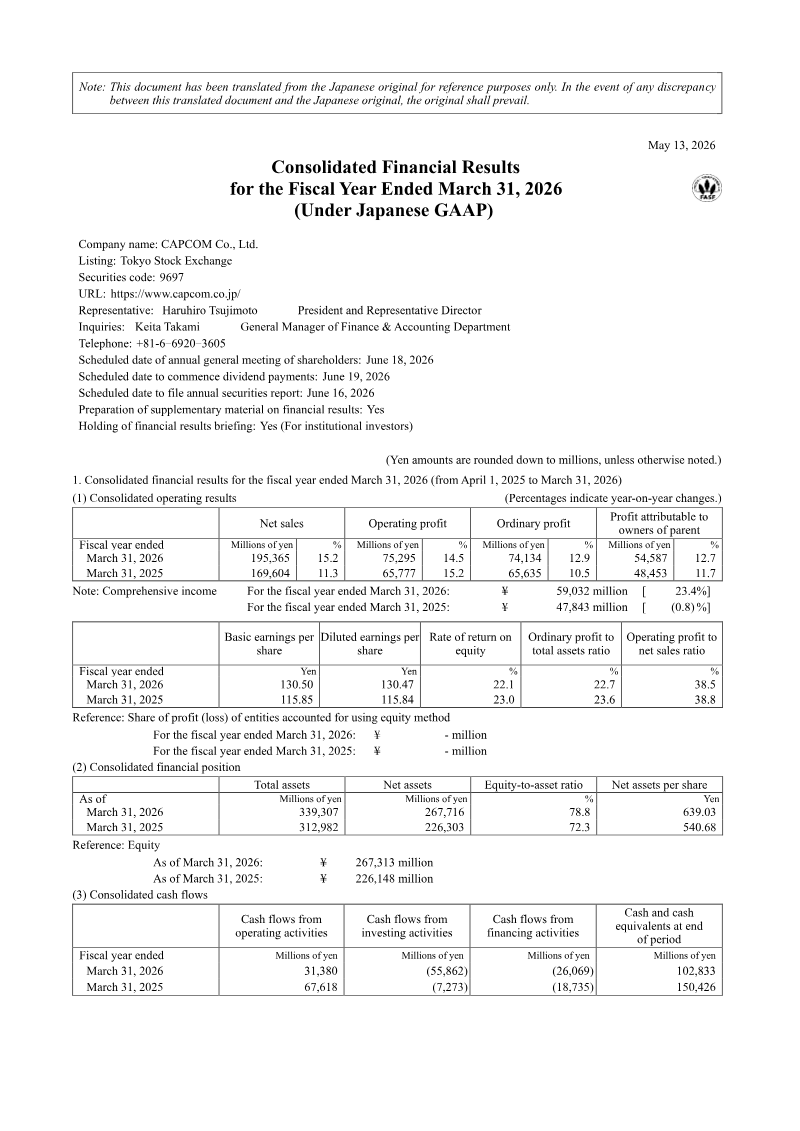
Capcom’s FY26/3 earnings marked the company’s strongest performance to date, with net sales reaching ¥1.95 bn and operating profit up 15 % year‑over‑year to ¥752 m. The growth stemmed from a “flywheel” effect: new IP releases, catalog sales, and digital distribution channels all contributed to a record 5.907 million cumulative units sold, up 13.9 % in volume. The company’s strategy for FY27/3 is to sustain this momentum, targeting a 10 %+ operating‑profit increase and expanding its retail footprint to 70 stores. Sales are projected at ¥2.09 bn, driven by quarterly releases of new IP titles and a focus on high‑margin franchises such as Resident Evil, Monster Hunter, and Street Fighter. A key pillar of the plan is a multi‑channel IP exploitation model that includes character licensing, media tie‑ins, eSports, and mobile extensions, with particular emphasis on emerging markets to push long‑term unit volumes toward 100 million. Operationally, Capcom has broadened its development workforce from 2,842 in FY23 to an anticipated 3,180 by FY27, leveraging cross‑generational teams and a proprietary engine to enhance productivity. AI tools have reduced routine task time, freeing developers for creative work. Workforce diversity has improved, with female core‑role representation at 15.7 % and paternity leave uptake at 79.7 %. Capital allocation remains balanced, returning 30 % of cash to shareholders while investing heavily in R&D. The company’s projected operating margin for FY27/3 is 49.8 %, with a shift toward higher digital and online revenue streams, underscoring its commitment to sustainable growth across global markets.

CAPCOM Capcom Co., Ltd. (TSE Prime, 9697) FY26/3 Earnings Summary FY27/3 Plans Mid- to Long-Term Growth Strategies
Part 1 ・Major Takeaways P3 Financial ・Performance Trends (Consolidated/Business Segments) P4 Summary and Plan ・FY27/3 Plans (Consolidated/Business Segments) P12 Part 2 ・Capcom Group Management Philosophy and Vision P1 Mid- to Long- ・Group Management Goals P2 Term Growth Strategies ・A Business Model to Support Future Growth P5 ・Financial Position Summary P1 Supplement ・Major Financial Information Summary P2 Forward looking statements Strategies, plans, outlooks and other statements that are not historical facts are based on assumptions that use information currently available and reasonable judgments. Actual performance may be significantly different from these statements for a number of reasons. In the entertainment industry, which includes Capcom, performance may be highly volatile because of diverging user needs and other changes in market conditions. Factors that can affect Capcom’s performance include: (1) the number of hit titles and sales volume in the Home Video Game Business, which accounts for the majority of sales; (2) progress in developing home video games; (3) consumer demand for home video game consoles; (4) sales outside Japan; (5) changes in stock prices and exchange rates; (6) alliances with other companies concerning product development, sales and other operations; and (7) changes in market conditions; (8) natural disasters, disease outbreaks, economic crises and other
FY26/3 Earnings Results • Achieved 13 consecutive years of OP growth, 11 consecutive years of over 10% OP growth • Highest consolidated sales and operating profit in Capcom history • Increased year-end dividend to ¥25, full-year dividend totals ¥45, dividend payout ratio 34.5% FY27/3 Full-year Plan • Continue to target over 10% OP growth • Dividend forecast: interim ¥23, year-end ¥23, full-year total ¥46 (100 million yen) Results Plan 24/3 YoY 25/3 YoY 26/3 YoY 27/3 YoY Net sales 1,524 21% 1,696 11% 1,953 15% 2,100 8% Operating profit 570 12% 657 15% 752 15% 830 10% Operating margin 37.5% - 38.8% - 38.5% - 39.5% - Ordinary profit 594 16% 656 11% 741 13% 830 12% Net profit attributable to 433 18% 484 12% 545 13% 580 6% owners of the parent
> **[Chart page]** This page contains visual data — view in PDF for the best experience. FY26/3 Results (100 million yen) 22/3 YoY 23/3 YoY 24/3 YoY 25/3 YoY 26/3 YoY Net sales 1,100 16% 1,259 14% 1,524 21% 1,696 11% 1,953 15% ■ Digital Contents 875 16% 981 12% 1,198 22% 1,251 4% 1,442 15% ■ Arcade Operations 124 26% 156 26% 193 24% 227 18% 256 13% ■ Amusement Equipments 57 -19% 78 36% 90 16% 156 73% 177 14% ■ Other Businesses 43 43% 43 0% 42 -4% 61 45% 76 25% Operating profit 429 24% 508 18% 570 12% 657 15% 752 15% ■ Digital Contents 453 23% 535 18% 598 12% 651 9% 706 8% ■ Arcade Operations 6 338% 12 88% 18 52% 24 30% 32 32% ■ Amusement Equipments 23 -3% 34 46% 41 20% 67 63% 100 50% ■ Other Businesses 15 54% 14 -6% 8 -38% 24 181% 36 47% Adjustments (*1) -69 - -87 - -96 - -110 - -122 - Operating margin 39.0% - 40.3% - 37.5% - 38.8% - 38.5% - Ordinary profit 443 27% 513 16% 594 16% 656 11% 741 13% Net profit attributable to 325 31% 367 13% 433 18% 484 12% 545 13% owners of the parent (*1) Adjustments include unallocated corporate operating expenses. The corporate operating expenses, which do not belong to any reportable segment, mainly consist of administrative expenses. *YoY indicates percent change from the previous year.
> **[Chart page]** This page contains visual data — view in PDF for the best experience. Earnings Trend FY26/3 Results • Sales and profits up, supported by flywheel effect of new title releases and catalog title expansion (100 million yen) 22/3 YoY 23/3 YoY 24/3 YoY 25/3 YoY 26/3 YoY Net Sales 875 16% 981 12% 1,198 22% 1,251 4% 1,442 15% ■ Consumer breakdown Package sales 300 44% 180 -40% 193 7% 180 -7% 162 -10% Digital sales (incl. digital license) 533 11% 773 45% 969 25% 1,036 7% 1,256 21% Digital license portion (*1) 9 -70% 70 678% 73 4% 34 -53% 36 6% Consumer total 833 21% 953 14% 1,162 22% 1,216 5% 1,419 17% Deferred revenue portion (*2) -19 - 38 - 47 - -198 - 123 - ■ Mobile Contents 42 -35% 28 -33% 35 25% 34 -3% 23 -32% Operating profit 453 23% 535 18% 598 12% 651 9% 706 8% Operating margin 51.8% - 54.5% - 49.9% - 52.1% - 48.9% - (*1) Digital license indicates revenue from providing content etc. to online platforms. (*2) Deferred revenue indicates the balance of deferred revenue and reversed revenue typically associated with free downloadable content made available after the release of a full game. *YoY indicates percent change from the previous year.
> **[Chart page]** This page contains visual data — view in PDF for the best experience. Unit Sales FY26/3 Results • Highest-ever cumulative total unit sales and catalog unit sales for a fiscal year period • Fourth-quarter unit sales reached a quarterly record (10 thousand units) 22/3 23/3 24/3 25/3 26/3 Titles sold / 304 / 219 307 / 230 292 / 235 248 / 227 253 / 244 sales regions Total unit sales 3,260 YoY 4,170 YoY 4,589 YoY 5,187 YoY 5,907 YoY 8.3% 27.9% 10.1% 13.0% 13.9% Share YoY Share YoY Share YoY Share YoY Share YoY New units 860 26.4% -10.4% 1,240 29.7% 44.2% 959 20.9% -22.6% 1,238 23.9% 29.0% 960 16.3% -22.5% Catalog units 2,400 73.6% 17.1% 2,930 70.3% 22.1% 3,629 79.1% 23.9% 3,949 76.1% 8.8% 4,946 83.7% 25.2% Digital Units 2,460 75.5% 6.3% 3,730 89.4% 51.6% 4,135 90.1% 10.9% 4,672 90.1% 13.0% 5,493 93.0% 17.6% PC Units (digital) 1,090 33.4% 36.3% 1,775 42.6% 62.8% 2,160 47.1% 21.7% 2,821 54.4% 30.6% 3,217 54.5% 14.0% Console units (digital) 1,370 42.0% -9.6% 1,955 46.9% 42.7% 1,974 43.0% 1.0% 1,851 35.7% -6.2% 2,276 38.5% 23.0% Physical units 800 24.5% 15.1% 440 10.6% -45.0% 454 9.9% 3.2% 514 9.9% 13.3% 413 7.0% -19.6% Overseas units 2,710 83.1% 11.3% 3,350 80.3% 23.6% 3,810 83.0% 13.7% 4,348 83.8% 14.1% 5,313 89.9% 22.2% Japan units 550 16.9% -4.3% 820 19.7% 49.1% 779 17.0% -5.0% 838 16.2% 7.7% 593 10.0% -29.2%
Thunderful Group’s interim report for the first quarter of 2024 details a period of significant financial decline and aggressive corporate restructuring. Net revenue fell 27.7 percent to 391.7 MSEK, while the group recorded an operating loss (EBIT) of 184.4 MSEK, a sharp reversal from the 19.2 MSEK profit reported in the same period the previous year. This downturn was driven by a 35.5 percent revenue drop in the Games segment and a 25.7 percent decrease in Distribution, largely due to weaker market demand for Nintendo Switch products and the underperformance of the internal title SteamWorld Build. To address these challenges, the group initiated a restructuring program aimed at annual cost savings of 90–110 MSEK. This process involved a 72.4 MSEK write-down of capitalized development costs following the cancellation or divestment of twelve game projects. Strategic shifts include the divestment of the German publishing subsidiary Headup GmbH and the sale of Nordic Game Supply’s assets to reduce net debt. Despite these pressures, the group successfully extended its Nintendo distribution agreement for the Nordics and Baltics through March 2026 and reported 13.9 percent growth in its Amo Toys division. The report covers the group’s global operations with a focus on European and Nordic markets for the period of January to March 2024. Financial data indicates a strained liquidity position, with cash and credit facilities dropping to 130.9 MSEK from 329.3 MSEK year-over-year. Management secured a bank waiver conditional on asset divestments and maintains that current funds are sufficient for continued operations. The overarching strategy moving forward emphasizes a simplified games portfolio, more rigorous project validation, and a balanced risk profile across internal and external development.
The financial overview for the first quarter of fiscal 2022 highlights a robust performance driven by new console releases and strong back‑catalogue sales. Total revenue rose 80.6 % from ¥11,363 million to ¥20,520 million, with operating profit more than doubling from ¥4,387 million to ¥9,718 million (121.5 % increase). Ordinary and net profits also surged by 105.5 % and 101.9 %, respectively, reflecting higher margins across the entertainment segment. Revenue composition shifted toward console titles, which accounted for 48.7 % of sales in the overseas market and 38.3 % domestically, supported by launches such as *Samurai Warriors 5* and remastered collections like *Ninja Gaiden: Master Collection*. Online/mobile sales grew 55.8 % in download volume, with the Romance of the Three Kingdoms series expanding into licensing‑out agreements. Non‑operating income benefited from gains on investment securities, prompting an upward revision of the half‑year earnings estimate. Geographically, Japan contributed 38.3 % of sales while overseas markets grew by 51.3 %, with North America and Europe showing mixed results—North America doubled its unit sales, whereas European units fell 26.3 %. Headcount increased by 2.5 % to 2,088 employees, and cost of goods sold rose 22.6 %, largely due to higher production for new titles. Methodologically, the report aggregates quarterly financial statements, sales data by platform and region, and download metrics from the company’s global service portfolio. The analysis underscores a strategic focus on IP licensing, back‑catalogue monetization, and digital distribution to sustain growth in the second half of fiscal 2022.
Koei Tecmo Holdings reports FY2022 financial results, emphasizing continued growth in its core gaming segment while expanding into ancillary IP‑licensing and merchandise ventures. Revenue rose 12 % year‑over‑year to ¥45.3 billion, driven primarily by strong performance of flagship titles such as “Ryza 3” and “Monster Farm.” Net income increased to ¥8.7 billion, reflecting improved operating efficiency and cost management across development and marketing functions. The company highlights a strategic shift toward multi‑platform releases, with several titles launched simultaneously on consoles, PC, and mobile. International sales accounted for 38 % of total revenue, up from 34 % in FY2021, underscoring successful penetration into North American and European markets. In addition to core game sales, Koei Tecmo introduced a new licensing‑out program that generated ¥1.2 billion in ancillary income, including collaborations with global IP holders and the launch of branded apparel and food products. Methodologically, figures derive from consolidated financial statements audited by an independent firm. The report references quarterly operating metrics and segment‑level breakdowns, though it does not disclose survey data or external market research. Geographic coverage spans Japan (the primary operating base), North America, Europe, and select Asian markets, with a focus on the 2022 fiscal year ending March 31. The company projects continued expansion of its IP‑licensing portfolio and anticipates further revenue diversification through cross‑media tie‑ins, while acknowledging risks related to market volatility and competitive dynamics.
The survey, conducted by Aream & Co., gauges executive optimism regarding consumer spending on gaming in 2025 across multiple channels and functional areas. Overall, 49 % of respondents view spending as “more optimistic,” another 49 % see it as unchanged, and only 2 % are less optimistic. When broken down by platform, mobile spending is perceived as more optimistic (49 %) while PC and console views are split between “more” (15–33 %) and “about the same.” In‑app purchases are viewed as more optimistic (80 %) versus in‑app advertising (41 %). Key challenges identified include content saturation and over‑supply, with 33 % citing these as concerns; marketing environment issues affect 49 %, and macro conditions are a worry for 17 %. Despite these, 54 % anticipate more new games in 2025, and 37 % expect higher average budgets. Marketing spend is expected to rise for 48 %, while engineering and game development are seen as more optimistic (71 % and 42 %). The survey also highlights a strong appetite for mergers and acquisitions, with 71 % expecting more M&A activity. Advanced integration across multiple functions is viewed as more optimistic (49 %) but limited implementation remains a concern. The data derive from a global sample of gaming CEOs, reflecting perspectives across mobile, PC, console, and various functional departments. The findings suggest a cautiously optimistic outlook for 2025, tempered by supply‑side pressures and marketing challenges.