1 free read left. Create a free account for unlimited reading + AI research.
Create free account
Build a brand or throw in the towel, says Creative Mobile's Vladimir Funtikov
Key insights
6 takeaways- 01Post-launch development is the most critical phase of the product lifecycle, requiring frequent updates and, if necessary, the launch of new IP to overcome previous design limitations.
- 02The rapid imitation of successful game mechanics by both independent developers and large corporations makes relying on past success blueprints an ineffective strategy for longevity.
- 03The mobile gaming market has shifted from a launch-success model to an oversaturated environment where brand identity is the primary defense against rapid cloning by competitors.
- 04When a game lacks strong intellectual property or recognizable characters, active community feedback loops via social media and forums are essential to drive product evolution.
- 05Developers must transition from speculative development to a long-term business model by focusing on deep, iterative engagement with a core, loyal audience.
- 06Dominating a specific niche is more sustainable than chasing broad, fleeting market trends, as it allows for more predictable revenue and defensible market share.
Ask AI about this video
Transcript
uh my name is of mobile a gaming company based in Tonia which is right across the GF here from h 8 km to the South it's still cold there though and um I think I should start by explaining the topic a little bit drag racing is a game made 3 years ago as a tiny IND the start of five people and that was the point when we really made it as a game develop because broke into top 10 top gr apps of way and we started seeing tens of millions of downloads but I'm not going to talk about that of how we made it because you don't care or you should not care because right now we're in completely different Market you know the success stories from 3 years ago do not necessarily work this way anymore instead I want to talk about what happened next because instead of living a dream we fac three very challenging years
that is how most developers Envision their life cycle of a game you put some effort into development you launch it then the marketers add some secret Source the publisher works the magic the game takes off and then it's rainbows and unicorns from then out yet unfortunately in our experience it didn't always work that way and more often than not you have to put at least that much effort after the game's life if you want to maintain momentum and you have to deal with a lot of uncertainty and simly random problems as your game continues to exist on the market and the biggest reason why this happens is of course the competition because the moment you produce something good something successful it becomes fible and when it's fible someone will try to reproduce it imitate or just copy it and K in China can try to copy it or an international corporation with VC F in the can try to copy nobody's ashamed of
doing this and it's funny how after we launch this game on Google Play We went for about a year making around half a million us a month and now we took notice but then we l Nunes and people took notice and if you look at the racing category go play these days in the top 10 there is consistently 3 four five games based on the same mechanic now I'm not saying they copy us but we kind of trigger this kind of focus people Sati on this sub gener and the better St of BU and it's very important to understand that when your game takes off even if it takes off spectacularly like in our casam all you have is your name some momentum and hopefully some cash you don't have a brand yet you have to work consciously towards building a brand and if you don't work hard enough chances are you'll be gone pretty soon because someone is working really
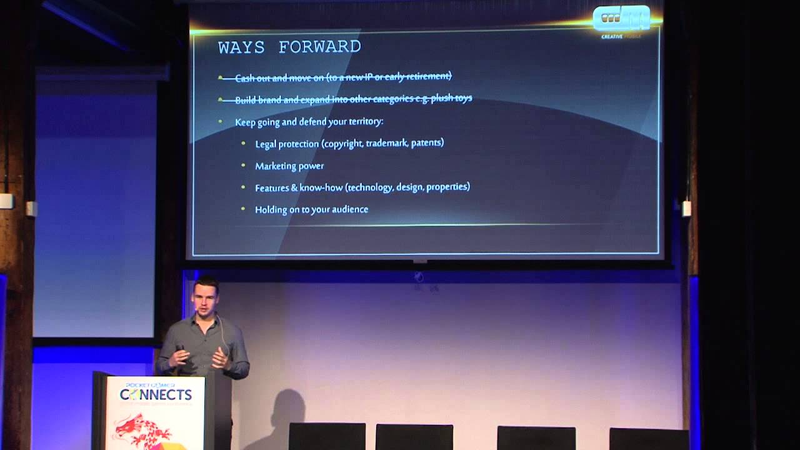
hard to take a place now of course there PL of ways to defend yourself against competition and therefore for the most obvious one is to just enjoy wild glass Cash Out live a happy life the other way is the RO Mar explained it very well before me I will go into detail here and the third way is to continue building the mobile brand the mobile product and try to use counter measures to stay in the lead now when we Face the decision 3 years go we roll out the first option almost immediately with a no way this is the best we can do we're super vicious we can shoot for the spars the second option the RO way we briefly considered and you might be thinking how dare you compare yourself to ro but we actually D that because we used to sit right next to angry birs in the rankings we used to see similar comparable amount of volume on go play so we thought about that but we didn't have any material to build the brand we didn't have recognizable
characters we didn't have a catch name for the game if we wanted to make flash toys what would they be cars we don't own the cars so we wrote that option out and what we left with was to continue to develop the mobile brand but even then we faced a lot of challenges first the name of the game Drag Racing we designed it for search optimization Discovery optimization purposes and B to do the gamer out name but then we found out there's a flip side to that when you get when your name is so generic you can't really trade market you can't really build a brand out of it because you can create an association between a generic term and your product you can name a game basketball and then make people think about the game when they hear basketb because it's generic it's the name of sport we didn't have much marketing power either we didn't have a budget and we didn't have a lifetime value for customers that will allow us to just buy our way to the top of the
shs so that was not an option either and we didn't have any unique technology or unique design decisions that was all on the surface the game was very easy to copy repr so the only option we had left to defend ourselves was to work with the audience listen to the audience try to satisfy them and win ourselves some time and that's what we did and we did by Trier discussions by places where players would communicate social media message boards where I should hire the guy who set up another official message board and we endorsed The Forum and we made sure there was always a flow of people coming into the forum and we participated in those discussions and talk to players a lot and listen to play a lot and let them Drive our development and we ended up publishing 40 updates per year 40 for the original game and relasing two Standalone titles based in the semic after the theand stles and those did well and combined the 40 million insts
and seven digit revenues each of the stles and this measures come by allowed us lot of time actually grow and we Pi at 15 16 million monly AC uses by before 2013 and that was pretty good not quite Super King numbers were pretty good still but perhaps more importantly by talking to the players we found that there was a big segment in the audience who wanted a more sophisticated product a more hardcore product a game which would be more realistic more involving more challenging for them so we decided to create a new IP a new brand and we decided to use this opportunity to address the mistakes we made previously and eventually make a stronger problem now that may sound insane when you think about it because dver franchise is just short of 200 million inst stars and here we are starting from scratch but we saw that as the only way to a real brand and build a stronger
product in the long run final thoughts my message contrary to what many developers think there's bigger opportunity after you go life and there's more work to do after you go life and if you listen to your audience and if you identify and understand the core audience your most loyal Bunch you can go you can go long you can really grow big you can succeed in the long run and if you really really really satisfy that audience you can dominate The Niche and dominating the niche is awesome because when you have a well defined audience with well defined requirements and you know how to reach those guys you have a sustainable business you are not longer throwing things on the wall you know exactly what you're doing and you going keep doing this for years but sometimes it makes sense to creating brands in order to satisfy your customer because that's the only way to build a strong brand and
that's my message thank you for listening [Applause]
Summary
The mobile gaming industry has shifted from a landscape where initial launch success guarantees longevity to a highly competitive, oversaturated market where developers must actively build a brand to survive. Success stories from several years ago are no longer reliable blueprints, as successful game mechanics are quickly imitated by competitors, ranging from independent developers to large international corporations. Without a conscious effort to establish a unique brand identity, developers risk seeing their products become obsolete as generic titles are flooded with clones.
To maintain momentum, developers must move beyond the initial development phase and commit to long-term product evolution. When a game lacks inherent brand assets—such as recognizable characters or unique intellectual property—the most effective defense against competition is deep engagement with the player base. By actively listening to community feedback through social media and forums, developers can turn their audience into a driver for development. This strategy of iterative improvement, exemplified by releasing frequent updates and standalone titles, allows developers to secure market share and generate consistent revenue.
Ultimately, dominating a specific niche is a more sustainable path than chasing broad, fleeting trends. By identifying and satisfying the requirements of a core, loyal audience, developers can transition from speculative development to a predictable, long-term business model. In some instances, this may require the difficult decision to launch entirely new intellectual properties to address previous design limitations and build a stronger, more defensible brand. The primary takeaway is that the period following a game's launch is not the end of the journey, but rather the beginning of the critical work required to secure a permanent place in the mobile ecosystem.















Comments