1 free read left. Create a free account for unlimited reading + AI research.
Create free accountWhitepaper Loading... The Journal of the Canadian Game Studies Association
1 free read left. Create a free account for unlimited reading + AI research.
Create free accountWhitepaperLoading... The Journal of the Canadian Game Studies Association
They enable users to engage more authentically.
Key enablers. Spatialized voice and lip-synced avatars are foundational for genuine social presence and intuitive interaction.
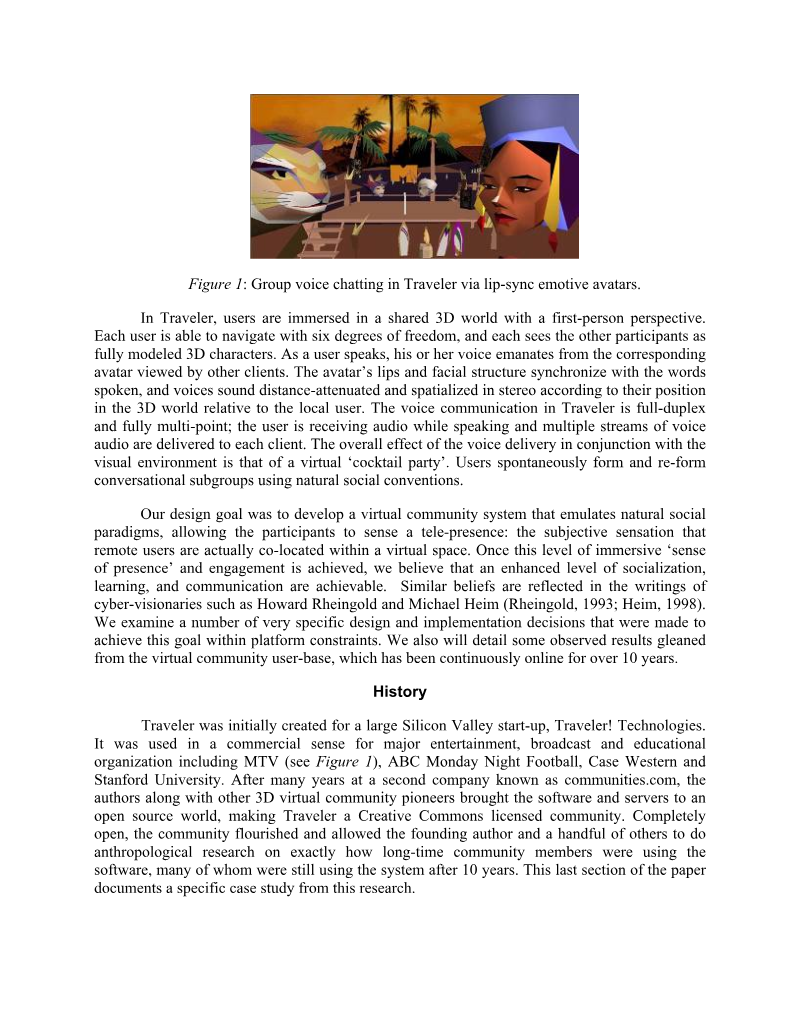
Traveler represents a foundational shift in digital interaction by prioritizing spatialized, multi-point voice communication and lip-synced avatars to foster genuine social presence. By binding users to their digital representations, the platform successfully encouraged high levels of immersion and intuitive social behaviors that transcended simple role-playing. This environment allowed participants to move beyond superficial interactions, facilitating the construction of housed selves where individual personalities were deeply integrated into the virtual architecture itself.
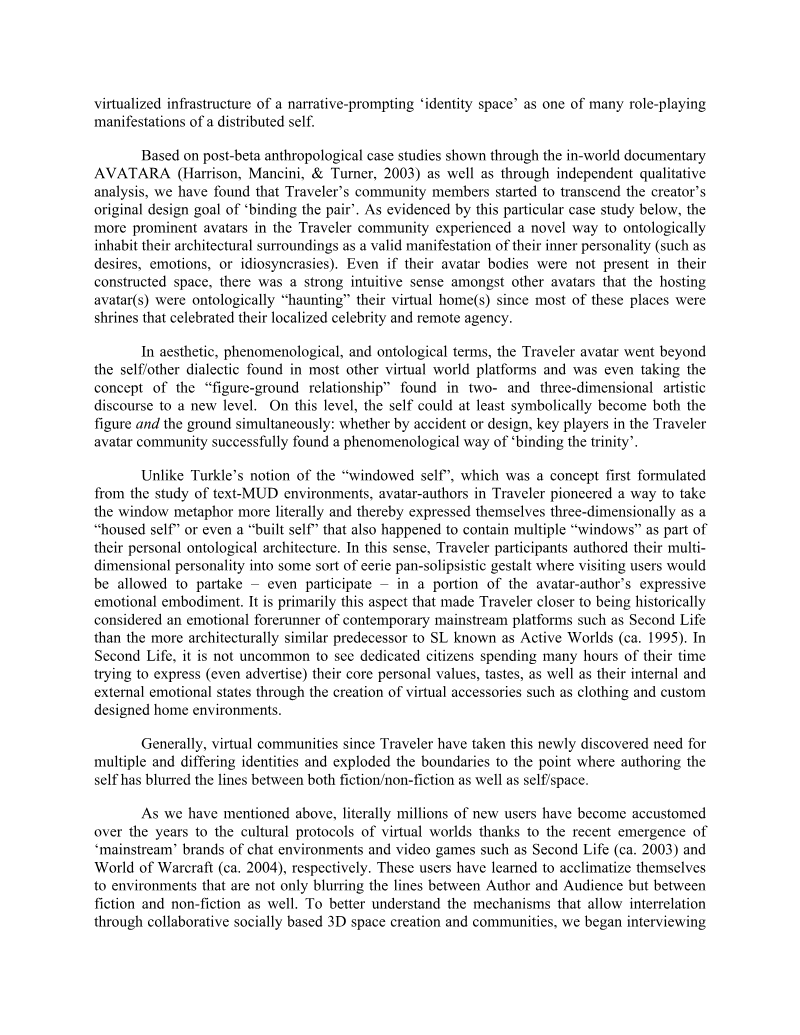
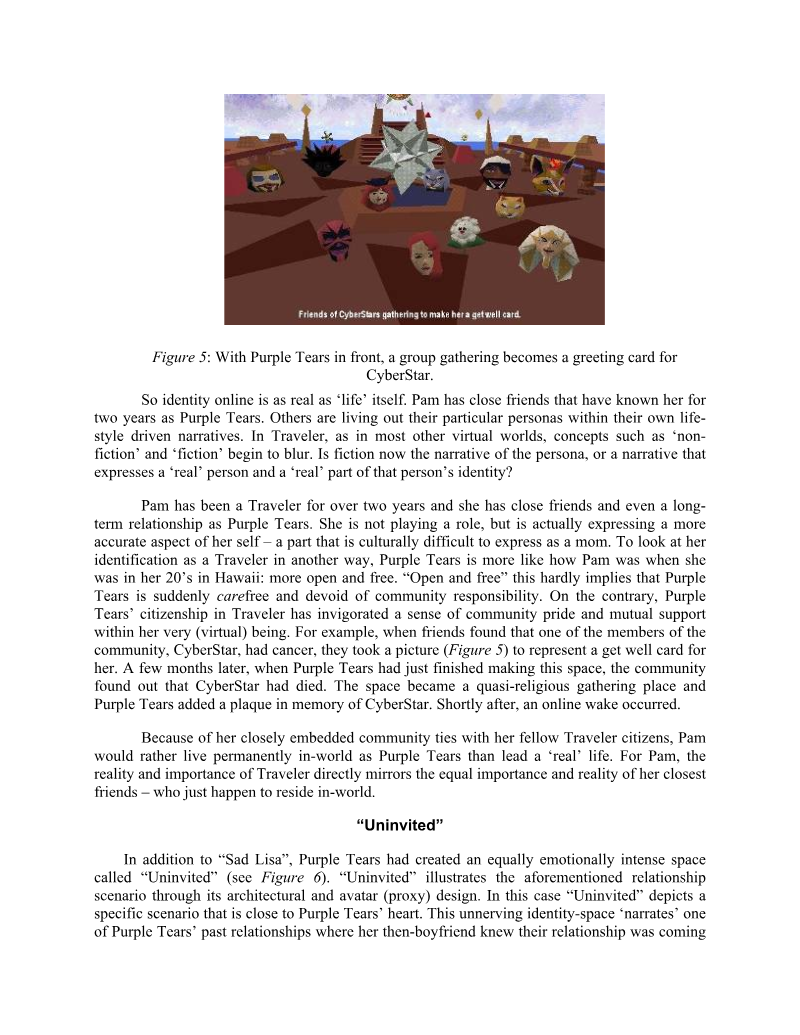
These virtual spaces function as extensions of the user’s psyche, enabling individuals to author their identities through immersive, emotionally resonant experiences. Case studies of long-term users reveal that these environments serve as canvases for authentic self-expression, where participants build indigenous mythologies through collaborative narrative-building and oral transmission. Within this framework, the distinction between fiction and reality blurs, as personal relationships and community experiences within the virtual realm carry the same psychological weight and significance as those in the physical world.
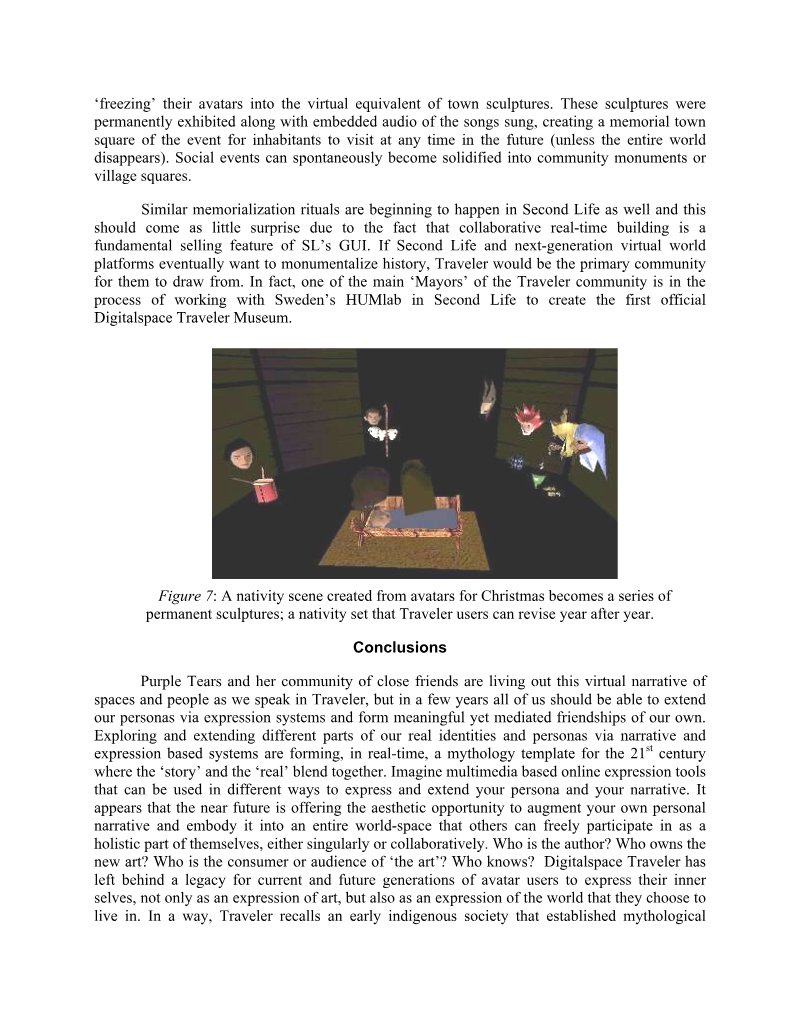
Ultimately, these early virtual communities demonstrate that users naturally seek to memorialize social experiences by transforming avatars and digital spaces into permanent, collaborative monuments. This process of narrative-based expression is effectively creating a new 21st-century mythology, where personal identity and world-building are inextricably linked. Future virtual platforms must recognize these community-driven models to understand how users will continue to embed their personal narratives into digital spaces, as the desire to project the intimate self into virtual architecture remains a primary driver of long-term engagement in digital environments.
Loading... The Journal of the Canadian Game Studies Association · 2018
Loading... The Journal of the Canadian Game Studies Association · 2018
Loading... The Journal of the Canadian Game Studies Association · 2017
Loading... The Journal of the Canadian Game Studies Association · 2017
Loading... The Journal of the Canadian Game Studies Association · 2017
Loading... The Journal of the Canadian Game Studies Association · 2017
Loading... The Journal of the Canadian Game Studies Association · 2017
Loading... The Journal of the Canadian Game Studies Association · 2017
Loading... The Journal of the Canadian Game Studies Association · 2017
Loading... The Journal of the Canadian Game Studies Association · 2017
Loading... The Journal of the Canadian Game Studies Association · 2016
Loading... The Journal of the Canadian Game Studies Association · 2016
International Journal of Role-Playing · 2026