1 free read left. Create a free account for unlimited reading + AI research.
Create free account
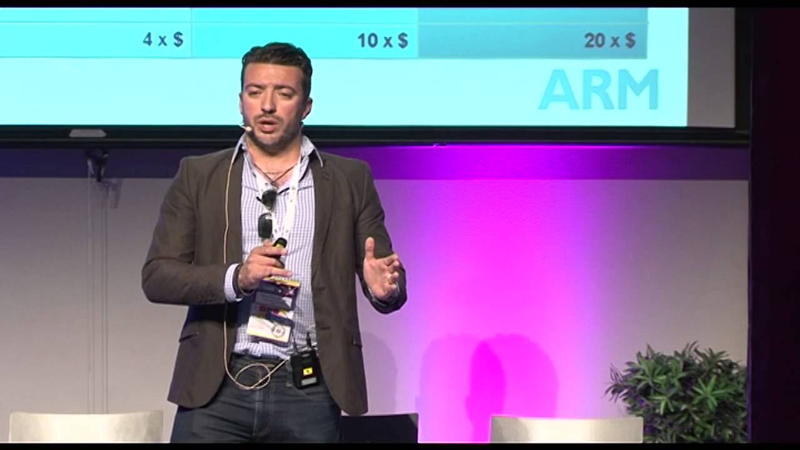
ARM's Nizar Romandhane on making money in R&D
Key insights
7 takeaways- 01ARM operates on a dual-revenue model consisting of upfront licensing fees and per-unit royalty payments, which provides the company with granular, real-time data on global device shipments.
- 02ARM technology currently holds a dominant market share, powering over 95% of smartphones, tablets, and portable gaming consoles, and more than 70% of smart TVs.
- 03The global market for connected screens is projected to exceed four billion units by 2017, with significant growth expected in the entry-level smartphone segment.
- 04Flagship-level processing power is expected to migrate to entry-level devices within a two-year cycle, rapidly increasing the performance standard for budget hardware.
- 05Technological development is focused on power efficiency via big.LITTLE architecture and the transition to 64-bit processing to support more complex applications.
- 06Mobile GPU capabilities are approaching the performance levels of previous-generation consoles like the Xbox 360 and PlayStation 3, with projections indicating mobile hardware will eventually exceed current-generation console performance.
- 07ARM is developing specialized, ultra-low-power processor designs to capture the emerging wearables market.
Ask AI about this video
Transcript
Thanks Chris. Hello everyone. So uh I'm Naran. I work for ARM. Uh my role is a bit to look after the ecosystem or developer relations. So before we start uh can you raise your arm if you know what ARM is. Oh good. Okay. Uh so I'll be going through that uh in the beginning. So where we fit in the smartphone is actually we design the processors uh and GPUs that that power most of these. We are mainly associated to the main application processor that your games run on. We have two brands. Cortex is our brand for the central processor, the CPU. Marley is our brand for the graphics processor, the GPU. But in typical smartphones, you have far more than one ARM processor and one GPU. We have roughly around 10 or more now in all the uh on the phone managing the
flash, the SIM card, uh the communication and so on. But the main processors you care about are the ones of the application processor that uh allow you to run your games. Uh so we design these processes only. We don't make the chips themselves. So our customers do these chips. We are design only company. So how do we make money then? So our business model is based on R&D mainly. We design the processes that takes us roughly two to three years to create a processor from scratch from idea. Uh we incur the first cost. So all of the R&D is in incurred on us. We start licensing these processes to the chip companies Samsung, Qualcomm and so on. uh and then we get the first revenue which is the license doesn't cover all the cost. So the second uh revenue stream is the royalty revenue stream. So per each chip
our customers pay us royalties. So that's good for us because it allows us to have constant stream of revenue. But the mo most important thing is gives us very accurate view on the market because our customers have to report how many ships uh how many chips they ship, how many ARM processes plus when we negotiate the license with them, they have to give us their forecasts, how many they think they will ship. So we combine all that data and that gives us a very good view how many smartphones, how many tablets, how many smart TVs and so on are shipping worldwide. And today I'll be sharing mainly that with you. Uh I have only 10 minutes so I'll focus mainly on numbers. That's probably what uh you guys uh would like to hear about the most. So today we think that there are two billion people using smartphones out there. Overall six billion people connected with our power technology, their smart TVs, setup boxes, a lot of other devices. The second fact is that tablets
now sell more than PCs. So people buy tablets as their primary comput device rather than PCs and our market share across all these devices is relatively high. We have high presence in mobile. Mobile is associated to ARM. More than 95% market share in smartphones and tablets but we have also high market share in smart TV and set of box. More than 70% of smart TVs are powered by ARM processors. uh we have also uh presence in mobile uh or portable gaming consoles PSP etc. 95% of these are also powered by ARM and also digital cameras. We have also graphics processors and uh we started these late after our CPUs and with these we have managed to gain a market share uh relatively high not as high as our CPUs but one Android device in three has ARM
also GPU as well as the ARM CPU. Uh across the devices there's 20% in Android smartphones higher in Android tablets 50% and actually in uh uh uh Android uh DTVs at more than 70%. Uh these are numbers about our licences and Marley 400 is actually the highest uh shipping GPU in all these devices. Uh that's the GPU that's in the S2 most of PS3s and a lot of the cheap Android smartphones, tablets you see out there. So today I'll be sharing a little bit our view on mobile trends. A focus mainly on volumes, our predictions. Uh in 2017 there will be uh roughly over four billion connected screens across smartphones, tablets, smart TVs and so on. You can see the biggest part of that is actually mobile devices. media players still would be
will be there but tiny market share. Mobile computing uh tablets and so on have big market share and you can see desktop PCs marginal uh TV setup box is growing also very very very fast. So if we look a bit at the breakdown uh folks on a smartphone then we think by 2017 1.8 8 billion smartphones will sell. So on a yearly basis and clearly the market will segment. You will still have the feature phone or sorry the voice only phone which is a very very basic mobile phone that does probably only calling and SMS. People think that will disappear and everything will be smartphone. No we think around 700 million of these will sell which means the rest will be smartphones. 1.1 billion smartphones. But what will clearly happen is that this market will segment into three segments. The premium
smartphone, the flagship device from Apple, Samsung, really the high end will be big, roughly 400 million. But you will have also a tier in between the mid-range and roughly 550 million. But you will see this big massive entry level smartphone around 850 million of these. Uh these will be basic smartphones. Uh if you compare them to to to what you have today, they will be more powerful than the premium smartphone that you have on the market today. Which means a lot of people will be enabled with smartones that can run mobile games easily. Roughly if you want to think what is this the entry level smartphone compared to the premium we work to ensure that the premium smartphone becomes mid-range the year after and then entry level a year after that. So in two years what was the premium smartphone becomes the entry
level smartphone. So if we look today the S5 for example from Samsung in two years from now 2016 that will be the entry level smartphones in terms of performance which is a smartphones that will be selling at less than $100. Uh looking at smart TV which is a market that is growing very fast. Why am I talking to about smart TV uh today for you guys? It's mainly smart TV. We uh like to think of it as a gigantic smartphone. It shares the same CPU and GPU that most of the smartphones that you're used to. So ARM processors, but it has a big massive screen and a lot of these particularly in China use also Android. So exactly the same operating system from from uh the smartphone ecosystem. the controls are different but that means there is an opportunity for mobile content or the mobile ecosystem to be ported to smart TV. So this is a do this is a market that you
should look at because it is grown a lot. You can see uh that overall the TV market is stable but the market um or the percentage of smart TV in that market is growing very fast and by 2016 probably you'll have around 160 million smart TV selling every year. If you compare that to maybe to consoles which are selling maybe a 10 or 16 million per year that's 10 times more than consoles. I'll come to in a second why I mentioned so consoles. Um a bit about technology trends. What are you going to see going forwards? You'll hear a lot the term big little phones with big little technology. What does that mean? It means that these smartphones have two processors inside. Big processor for the heavy tasks and a small processor for the less intensive tasks. The reason we did this is that we realized when we design our processors, we designed them
for the heaviest task. But most of the time the phone doesn't need that. If you're running casual games, simple games, you don't need to have a very powerful processor running these. So our approach going forward is to have two processors in a smartphone. If the application doesn't require a lot of um processing power, then the little pro processor will be running it, which means your players will be able to play these games for a long long time. They will not have to worry about battery power consumption. If I play my game, my phone will not last until the end of the day. So, a lot of phones like the Note 3, Galaxy S5 are powered with this technology and you'll see this more and more uh in the market. The other trend is 64bit. So we introduced 64 bits of processors and by the end of this year you will see Android probably devices or uh smart TVs and so on with this technology. Uh Apple
was already the first to introduce this last year but you will see more and more devices. 64-bit means you have you can address more memory. So if you're doing games with large assets, you need a lot of memory. You'll be able to do this. And you'll see trend of phones released with 4 GB, 8 GB of memory. The good news is that all your games in 32-bit will run on 64-bit. So it's fully backwards compatible. You don't have to worry about rebuilding your games or or or retesting them. Plus a lot of other performance up uh like uplift and new features will be in 64bit. I spoke earlier about console and why uh I mentioned that is that today the smartphones that be selling will have almost the Xbox 360 and PlayStation 3 GPU compute capability which means you have these consoles in that tiny device that you carry in for your pocket. So content game content can run a rich
experience like people had with the Xbox 360 or PlayStation 3. And you can see the graph year on year where that the GPU compute power capability. Then probably by maybe 2018 mobile will catch with the next gen the Xbox One and PlayStation 4. And probably after that we will f for the first time it will outpace even the next gen. So you should look at these devices as really powerful consoles uh everywhere. I know casual gaming is is is really big but maybe there is a market for richer content uh better in in visuals. [Music] Um I'll skip this one. Uh another trend is wearable. You'll see a lot of these coming in the future. Uh we think by 2018 there will be almost half a billion of these devices probably companion devices to your phone but why not you can run games natively on these smart
watches health monitors and so on. Uh and then lastly, how can we help you as a developer? We have a developer website. So if you need technical support, plenty of tools, plenty of free support tester. Everything is free. And then we have a connected community website. So if you want to interact with community members, you can have your own page. You can uh uh meet OEMs, silicon companies if you want to advert uh uh sorry publish through these um or interact with ARM. That's it for me. If you have any questions, sorry I ran late. Fantastic. Thank you very much. The Molly developer website is actually brilliant. I don't know who makes that for them, but it's very fantastic business. Um, we have any questions for this is last question last. Any questions for the man that sees a future and knows what devices? Any questions? I have a question. That's good. So, I have one question then we can switch over. So
wearables and I missed your entire presentation because I'm running about very very impressive. Good point but I've seen it before. No, but wearables are you guys is that are you guys working a lot of stuff in that space at the moment? Presumably that's you know even more up your alley in terms of lightweight. Can you talk about it? Are you prepared to talk about it? Yeah. So most of these devices are powered already with ARM processors but the current generation is based on processes we designed a while back. So it's off the shelf. Uh but now we're designing processes specifically for that market. So even lower in power uh more tailored to that use case. Okay. Fabulous. Okay. So and wearables will be big. Yeah. Everybody's telling me they're big. I'm not sure it's going to work. But our prediction half billion at least by 2017 18. Is anybody here making any games for wearables? Oh, there is. Yeah. Good. Good. Good.
Summary
ARM operates as a design-only company, focusing on the research and development of CPU and GPU architectures that power a vast majority of the world’s mobile and consumer electronic devices. The business model relies on two primary revenue streams: upfront licensing fees paid by chip manufacturers and ongoing royalty payments generated per unit shipped. This structure provides the company with granular, real-time data regarding global device shipments and market forecasts, allowing for precise analysis of industry trends across smartphones, tablets, and smart TVs.
The current market landscape is characterized by high penetration, with ARM technology powering over 95% of smartphones, tablets, and portable gaming consoles, and more than 70% of smart TVs. Projections indicate that by 2017, the global market will encompass over four billion connected screens. While the smartphone market is expected to segment into premium, mid-range, and entry-level tiers, the entry-level segment is poised for significant growth. Notably, the performance capabilities of entry-level devices are expected to evolve rapidly, with current flagship-level processing power becoming the standard for budget devices within a two-year cycle.
Technological advancements are currently centered on power efficiency and performance scaling. The implementation of big.LITTLE architecture allows devices to balance high-performance tasks with low-power efficiency, while the transition to 64-bit processing enables greater memory addressing for complex applications. Furthermore, the GPU compute capabilities of mobile devices are rapidly approaching the performance levels of previous-generation home consoles, such as the Xbox 360 and PlayStation 3, with projections suggesting mobile hardware will eventually match and exceed current-generation console performance. Emerging segments, particularly wearables, are also being targeted with specialized, ultra-low-power processor designs to accommodate the anticipated growth of that market.
























Comments