1 free read left. Create a free account for unlimited reading + AI research.
Create free accountWhitepaper International Journal of Serious Games
1 free read left. Create a free account for unlimited reading + AI research.
Create free accountWhitepaperInternational Journal of Serious Games
Distilling the key insights…
Constrained virtual environments, characterized by low-fidelity, 2D-layered scenes, represent a highly effective and resource-efficient alternative to traditional 3D serious games within the heritage sector. By utilizing techniques such as parallax, layering, and depth-of-field effects, developers can replicate the narrative depth and mechanics of complex 3D environments while significantly reducing labor costs. This approach addresses the primary barrier for cultural institutions seeking to implement immersive educational experiences: the high financial and technical burden associated with high-fidelity 3D development.
Empirical research involving 34 participants demonstrates that these constrained environments achieve levels of user presence and perceived quality comparable to their 3D counterparts. Notably, the 2D format facilitates superior information retention and navigation, as users in the study collected more information tokens than those in the 3D version. These findings suggest that the simplified interface reduces cognitive load, allowing players to focus more effectively on educational content. Expert feedback from the Arts Council England reinforces this, noting that while institutional interest is high, success depends on long-term maintenance and seamless integration into existing museum narratives.
To maximize the efficacy of these environments, practitioners should prioritize clear visual landmarks, robust onboarding processes, and immersive ambient audio. These design elements are essential for maintaining engagement and ensuring that the educational goals of the heritage experience are met. While the current study establishes a foundational framework for cost-effective game design, future efforts should expand to larger, more diverse cohorts to further validate learning outcomes. Ultimately, this methodology provides a scalable solution for cultural institutions to deliver high-quality, interactive historical content without the prohibitive costs of traditional 3D game engines.
International Journal of Serious Games · 2023
International Journal of Serious Games · 2022

International Journal of Serious Games · 2020
International Journal of Serious Games · 2020
International Journal of Serious Games · 2020
International Journal of Serious Games · 2020
International Journal of Serious Games · 2020
International Journal of Serious Games · 2020


International Journal of Serious Games · 2020

International Journal of Serious Games · 2020


International Journal of Serious Games · 2020
Air Force Institute of Technology · 2020



European Conference on Games Based Learning (ECGBL) · 2026
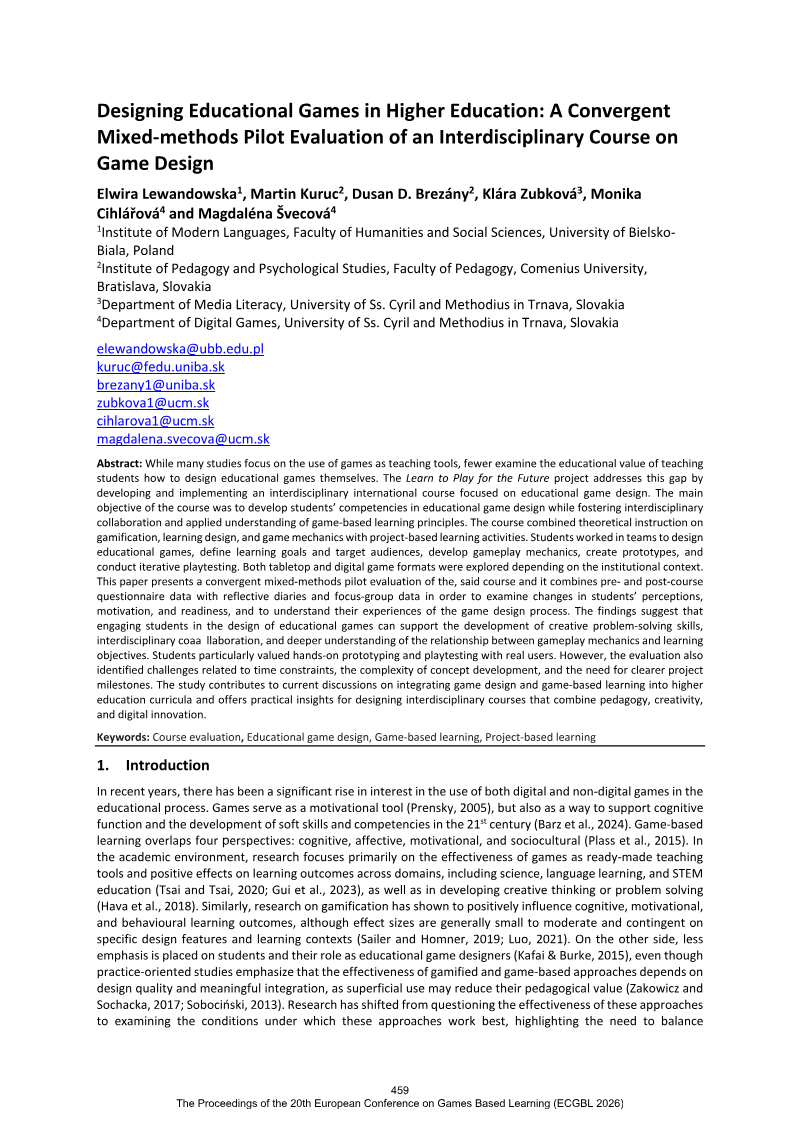
European Conference on Games Based Learning (ECGBL) · 2026



European Conference on Games Based Learning (ECGBL) · 2026