1 free read left. Create a free account for unlimited reading + AI research.
Create free accountReport European Conference on Games Based Learning (ECGBL)
1 free read left. Create a free account for unlimited reading + AI research.
Create free accountReportEuropean Conference on Games Based Learning (ECGBL)
Puzzles include multiple-choice, drag-and-drop, cable connection and color-code formats. They cover the periodic table, pH, nomenclature, gas laws and stoichiometry.
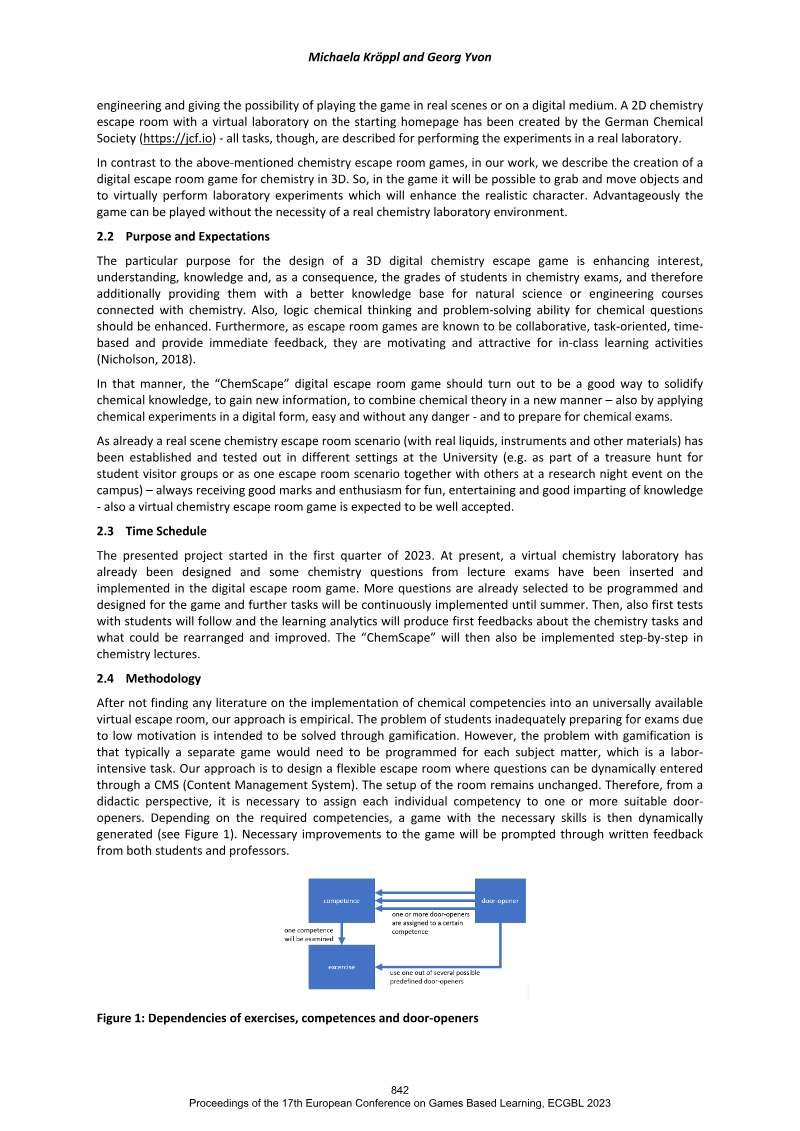
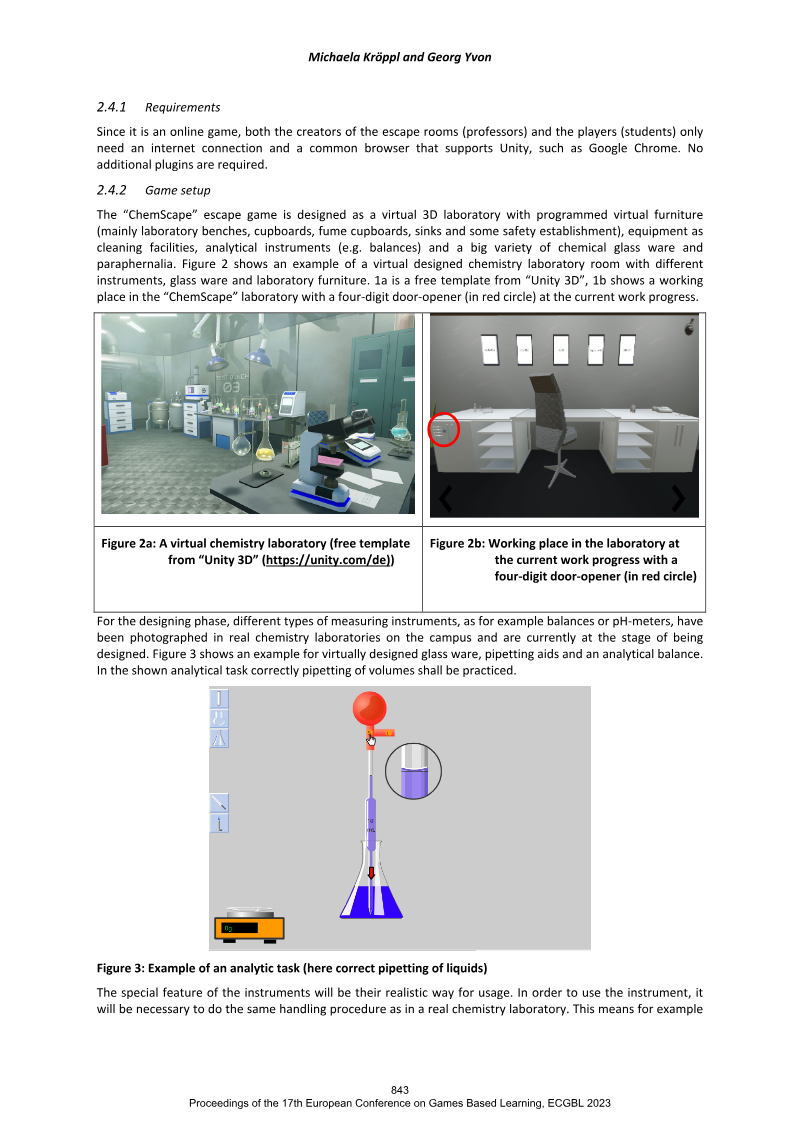
The paper introduces "ChemScape," a virtual 3D chemistry escape room designed to help students reinforce chemical theory and prepare for exams through a gamified, hands-on approach. Developed in Unity 3D from photographs of real university laboratory inventory, the game presents players with a realistic virtual laboratory in which they must discover hidden chemistry questions, operate instruments such as balances, conduct virtual experiments, and solve tasks within a time limit. Progression is governed by roughly ten "door-openers," including multiple-choice, drag-and-drop, cable connection, and color-code puzzles, covering topics such as the periodic table, pH, nomenclature, gas laws, and stoichiometry. The authors argue that such a format can increase engagement, lower the barrier to understanding abstract theory, and offer a safer, lower-cost alternative to physical chemistry activities.
The development timeline and evaluation are reported in modest detail. The project began in early 2023, and an initial user test with 45 participants playing in supervised groups on mobile devices produced largely positive qualitative feedback. Identified issues included unclear question wording, small clickable buttons, and door-openers that malfunctioned on an iPad. The authors state that these were corrected immediately after testing. The evaluation relied on interviews and observed gameplay rather than controlled comparisons, and no measured learning outcomes or exam performance data are presented, so the expected benefits remain unverified.
The planned outlook for 2024 includes a database-driven version allowing dynamic question generation, optional retries, and an in-game virtual laboratory rat offering hints. The authors also intend to pilot the game in chemistry lectures and as an event attraction at their university. The work is framed primarily as a development and proof-of-concept report, with its effectiveness as an exam-preparation tool still to be empirically established.
Each row is a game or company this document names, each column a document, oldest first. A mark means that document names it. Select a row to see those documents.



European Conference on Games Based Learning (ECGBL) · 2026



European Conference on Games Based Learning (ECGBL) · 2026



European Conference on Games Based Learning (ECGBL) · 2026



European Conference on Games Based Learning (ECGBL) · 2026



European Conference on Games Based Learning (ECGBL) · 2026



European Conference on Games Based Learning (ECGBL) · 2026



European Conference on Games Based Learning (ECGBL) · 2026



European Conference on Games Based Learning (ECGBL) · 2026



European Conference on Games Based Learning (ECGBL) · 2026



European Conference on Games Based Learning (ECGBL) · 2026



European Conference on Games Based Learning (ECGBL) · 2026



European Conference on Games Based Learning (ECGBL) · 2026



European Conference on Games Based Learning (ECGBL) · 2026



European Conference on Games Based Learning (ECGBL) · 2026



Breda University of Applied Sciences · 2026