1 free read left. Create a free account for unlimited reading + AI research.
Create free accountArticle Deconstructor of Fun
1 free read left. Create a free account for unlimited reading + AI research.
Create free accountArticleDeconstructor of Fun
Fortnite's April 2018 mobile surge is examined here as a case study in Battle Pass monetization, asking whether the system drives higher revenue per user than loot box models or merely benefits from a large user base. Fortnite had just passed PUBG in PC and console revenue ($126M versus $103M) and held the top-grossing spot on mobile, despite being invite-only at first. The central thesis is that a player-friendly, cosmetics-only Battle Pass will likely become the dominant model for "free-to-win" games, ideally evolving into a hybrid with gacha elements.
The mechanics are laid out in detail. Fortnite sells only cosmetics, offered through a rotating daily shop and a seasonal Battle Pass with free and premium tracks. Challenges provide progress even in lost matches, limited-time seasons create fear of missing out, and paid tier skips extend spend beyond the pass price. The endowment effect of seeing locked rewards further pushes both conversion and engagement. By contrast, PUBG's luck-based loot boxes, sometimes gated by purchased keys, lack dust-style safeguards and feel less fair. Fortnite's design is traced to Valve's DOTA2 compendium (2013), which has since added multiple paths, unlimited tiers, and loot box rewards, and is now shifting toward the DOTA Plus subscription.
The quantitative analysis uses Sensor Tower data on lifetime average revenue per install across Fortnite, Rules of Survival, Knives Out, and pay-to-progress titles such as Clash Royale. Knives Out initially looks strongest among cosmetic games, but its lead stems from a heavy Japanese audience, which monetizes at roughly double US levels. Excluding Japan, it ranks worst, while Fortnite performs better. Extrapolating logarithmic trendlines over 20 months and borrowing Clash Royale's growth curve (an extra 50% for Rules of Survival and Knives Out, 125% for Fortnite), the author estimates comparable long-term LTV for Fortnite and Knives Out, with Fortnite's design judged superior once audience mix is considered. Pay-to-progress games earn more per user, but cosmetics-driven titles compensate with higher install volumes.
The author stresses the roughness of these estimates: Fortnite had under two months of data, was iOS-only with high device requirements, and arrived with a pre-engaged PC and console fanbase.
Each row is a game or company this document names, each column a document, oldest first. A mark means that document names it. Select a row to see those documents.
Deconstructor of Fun · 2026

Deconstructor of Fun · 2026

Deconstructor of Fun · 2026

Deconstructor of Fun · 2026

Two & a Half Gamers · 2026

Two & a Half Gamers · 2026

Deconstructor of Fun · 2026

Deconstructor of Fun · 2026

Jason Schreier · 2026
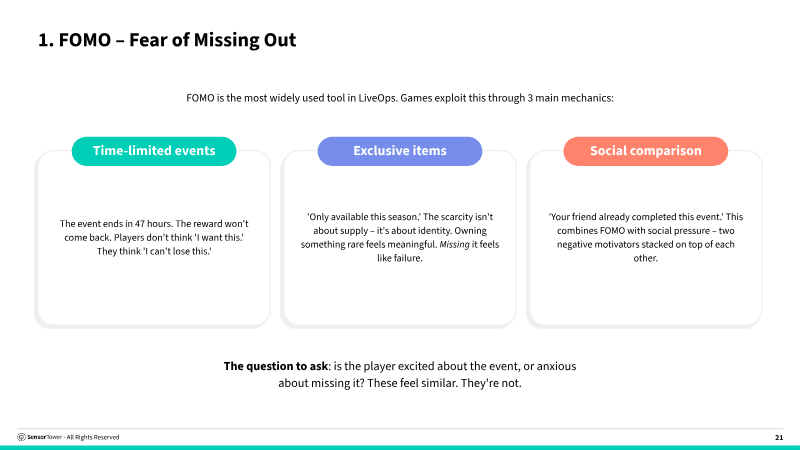
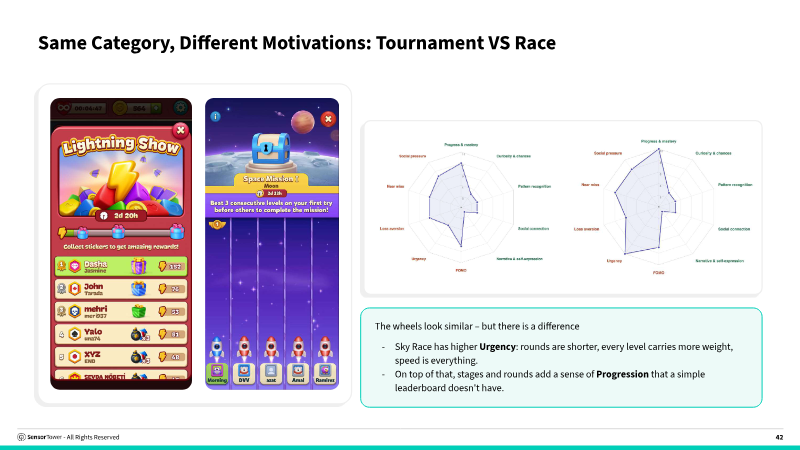

Sensor Tower · 2026

Two & a Half Gamers · 2026
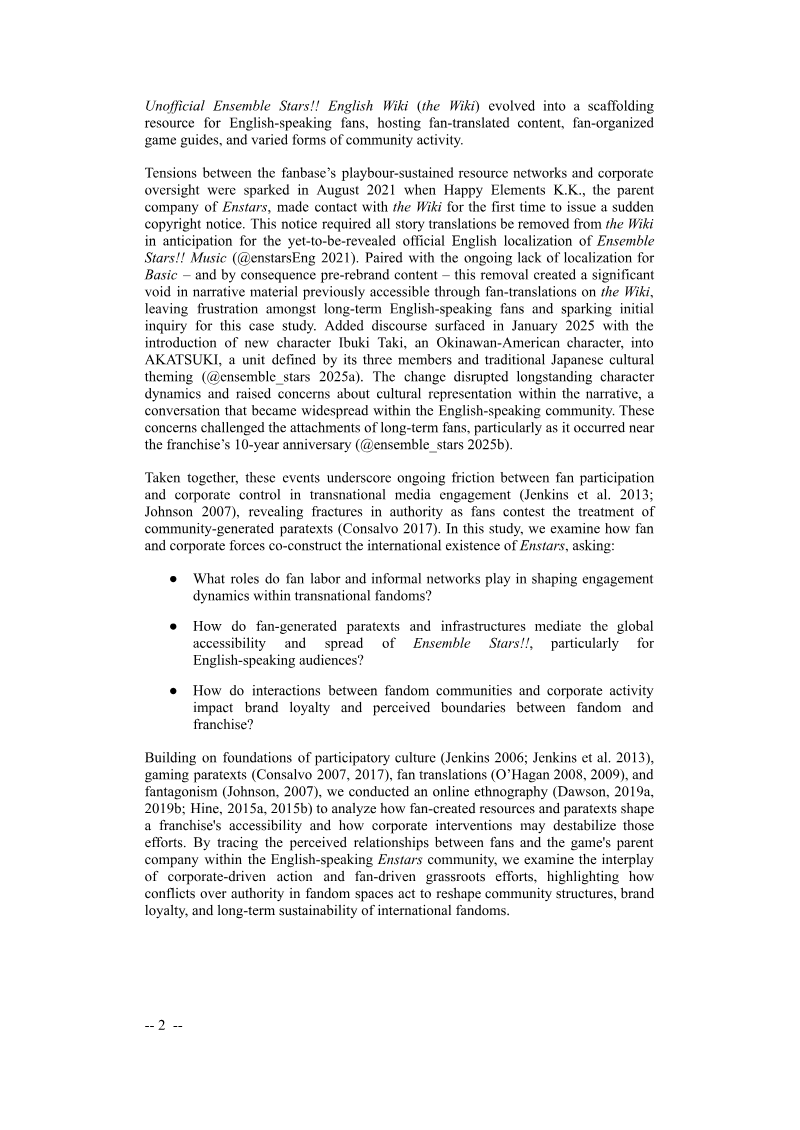
DiGRA · 2026
AppMagic · 2026

PocketGamer.biz · 2026