1 free read left. Create a free account for unlimited reading + AI research.
Create free account
10 trends shaping the global mobile games industry
Key insights
7 takeaways- 01The industry is shifting from traditional publishing toward comprehensive 'publishing services' that integrate data analytics, cloud infrastructure, and monetization strategies.
- 02Free-to-play remains the dominant revenue model for mobile gaming, accounting for 70% to 94% of total App Store revenue.
- 03North Asian firms are currently driving a significant wave of multi-billion dollar mergers and acquisitions, signaling a shift in the global industry power balance.
- 04Rising costs-per-install (CPI) on iOS and Android are forcing developers to rely more heavily on aggressive user acquisition budgets and direct platform-holder support to overcome discoverability challenges.
- 05Finland maintains its status as a mobile innovation hub, while Brazil is emerging as a high-growth market due to increasing smartphone penetration and a growing local studio scene.
- 06Indie studios are increasingly using Steam as a 'proving ground' for titles before transitioning to mobile, reversing the previous mobile-first development trend.
- 07To combat digital noise, well-funded companies are returning to traditional brand marketing channels, including television and outdoor advertising.
Ask AI about this video
Transcript
right so yes I'm going to try and fit 10 Trends in 15 minutes um I've written a report uh for this event which is about 10 15,000 words so not a piece of editorial but a kind of PDF report um that people can buy but you guys will get it for free I'll go into the details of that at the end but I'm going to try and summarize those 15,000 words in 15 minutes or 10 as uh Chris would prefer um very briefly I'm a freelance games journalist I used to be editor of development magazine now Pocket Gamer develop Euro gamer Edge couple of UK newspapers but uh we're not here to listen to about me um so let's get on Trend one is this idea of publishing is dead Long Live publishing as I started doing the research there was quite a lot of talk about is publishing the kind of traditional model of publishing applied to kind of retail box products making a return and it's not quite but there is this new model of um publishing
emerging it's kind of taken the old form and reshaped it so now it includes as well as traditional publishing Services monetization Services data analytics the kind of games of service backend and Cloud stuff um discoverability funding Services quite a lot of funding stuff seems to be coming into it and more PR and marketing um from the journalist perspective this kind of new publishing model is pretty helpful so if you're a developer and looking at companies provide that it's definitely ly working from kind of my end of the deal um ones to watch include scopely and tilting point I do have a look at them they're offering kind of interesting models and um yeah in each of these Trends I'm going to include a quote from the report so um Matthew Wilson from roio Stars which is roio's kind of new publishing newish publishing operation he says he does believe that publishing's role is becoming more important going forward in Mobile gaming so there is something of a return of publishing happening or at least a rebirth of a new form of
publishing um so Trend two this is ridiculous if I gathered all the people in a room that this didn't need to be told to it would be you lot sitting in this room but it was part of the report so let's burn through it anyway Finland continues to be this dominant power for games that are successful in the West in Latin America increasingly in Southeast Asia and even creeping into the kind of North Asian markets uh and some stats of course provided by Neo games um 200 games companies 2,400 staff in a country with a fairly small populance um in 2013 the industry was valued at 3.3 billion that's pretty impressive going again relative to the size of the country um 37% based here again you're here so I presume you know a lot of this stuff um interestingly 50% of Finland start uh games companies are in startup mode they've appeared in the last two years you can see how vibrant the startup
scene is why I guess in brief Nokia in kind of establishing that Foundation of understanding mobile was really important in research I realized established in 1865 doing Rubber and paper stuff didn't realize that the other thing is demo scene which I'm love demo scene so if I start talking about it I'll fill the whole 15 minutes but a kind of creative coding in a competition context which kind of served to make a lot more younger people coding literate um but yeah I won't go on talking about demo scene I'll get very excited and boring at the same time um so yeah we spoke to Andrew stalo in this section of the report um and he was talking about this idea that all boats rise there's a collaborative nature to The Finnish Dev scene which Rivals a lot of countries so uh maybe something to look at but again I'm not going to lighter on this because you lot are all in Finland and th I presume you know about Finland and the mobile industry so Trend three something John touched on very briefly is is there
this return of Premium again from the journalist perspective there's this real affection for premium I certainly when I'm as a freelancer pitching in reviews pitching in features editors are a bit more beguiled by a paid game it seems a little ridiculous to me um as a journalist who enjoys free-to-play and premium and all kinds of games um so yeah there is that beguiling of the press and there have been a lot of recent successes Minecraft was probably a little while ago now but Monument Valley you can't have missed um that's been so heavily promoted by Apple um kind of backing up what um John says it seems that the store providers are starting to warm to premium a little more than they have in a long time but also out there football manager which included IAP Leo's Fortune Badland there's all these really high quality paid premium games and certainly from the journalist perspective it's easier to be able to write about them because of its super data recently based on all their data termed this horrible term premium
I'm not even going to bother there's no point in that word um yeah uh but the fact remains uh I think 94% was possibly China but on a country by country basis across the Apple App Store freet to-play accounted for 70 to 94% of um freet topl accounted for 70 to 94% of revenues so free to play isn't going away by any stretch and I think if premium's revenues Are Climbing it's fractional but PR premium status and the opportunity to have your games supported by store providers certainly seems to be falling in the favor of paid um Ben Cousins formerly of Dina DNA I'm a consultant I'm sure you know of um he kind of said and I interviewed him for the report and he said about if you want to go for lifetime value and you want to make a lot of money it's still got to be free to play but obviously you need that huge amount of money to invest um you know you need the money to support and advertise it it um and that's not
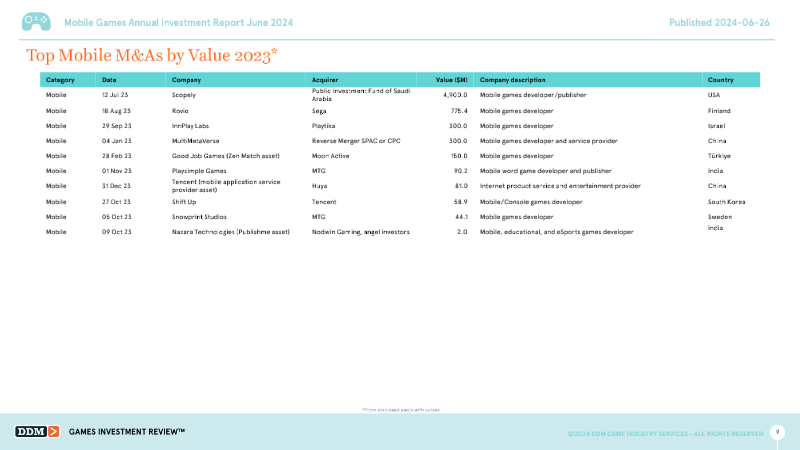
available to people so maybe there's a new attraction in um what paid can offer maybe it's suddenly becoming a bit more realistic a model um my words have disappeared off the bottom of the slide there um but anyway we're running out of time so let's move on to Trend four um Asian merges and Acquisitions um are they continuing to reshape the global Power Balance it really seems like they are the famous one is obviously soft bank and Gung hos 1.53 billion acquisition of 51% of supercell um it's certainly something at least from the industry and trade side of Journalism that we like to write about and it's easy to get headlines from um in terms of the press perspective um yeah there were across 2013 there was 3.3 billion spent in merges and Acquisitions um in that same period eight of the 10 of those largest Acquisitions were Acquisitions from um Asia from uh the north of Asia mainly um
and so I spoke to Yun at Saka um business development manager these really didn't overrun on my little laptop but there you go that's my bad um he is the business development manager and producer at line and um he certainly when I spoke to him for the report again you can read it in detail in the report um that there was definitely an interest Asian game companies are aware of both the audience and the industry in the the west and they're aware of it from an merge as an Acquisitions context so it seems it's going to continue and it seems that the balance of power in terms of ownership is Shifting toward Wars um towards Asia more and more I mean you know it's not like it's been small before um Trend five um is the future of discoverability um it seems that CPI as we all know Remains the dominant model there but it is getting less support from App Stores as John alluded to or
not alluded to just said um and it seems to be getting worse rather than better I trolled through loads and loads of data from all kinds of people and it seems that iOS CPI for loyal paying users Rose from June 2013 at $124 to $192 in April 2014 um Android a less significant ratio in the growth from 90 cents to $11 but it's still climed um going back to Ben Cousins who I spoke to a lot for this report um the only two viable methods according to him are support from the platform holder that kind of maybe goes back to paid again at the moment and buying users so you could say that trend is the nothing's changed apart from the trend continues um Trend six is Brazil's continued rise I spent my childhood and still skateboarding and not playing football so I don't know anything about it but there's some kind of World Cup going on that isn't
actually why I chose this slide it's not just kind of to typical journalist topical uh segueing Brazil has kind of been identified as an Emerging Market as part of the brick countries um Brazil Russia India China for a long time so it's kind of almost got you know we're there's this feeling of waiting for it to become tangible but um yeah there's a new Apple Factory underway there 4g's just arrived smartphone penetration nearly doubled from 2012 to 2013 so it's now just over 26% um there's 217 I'm sorry that ratio looking at the current data it looks like the penetration don't know if it's going to double again but it is just thundering on tremendously there um and there's a really high player toplayer ratio in Mobile gaming in Brazil um 61% of um gamers in regularly invest are kind of loyal paying users um and yeah I
spoke to Marcelo TZ who's director of the Brazil game show which is getting increasingly big and increasingly impress impressive it's kind of a easy demonstration at a glance of what's happening in Brazil year on year um and there's now 200 small to medium studios in Brazil and most of them in Mobile so you know it still hasn't reached Brazil still hasn't reached this point that we've been hearing about for quite a long time but it feels finally like it's getting really really close to being there and some people are playing football there oh Trend seven is PC stealing Mobile's grassroot Studios so um there was 10 years ago um there was definitely and probably even eight nine years ago there was this talk about PC gaming being dead and that PC gaming was completely dead in the watered duude to piracy and it was over and then steam came along in 2003 obviously Indie gamings existed as long as the games industry but it was
that timing was this perfect storm for Indie gaming and now it has become a kind of darling of the indie game and startup scene in terms of that's what mobile before the discoverability issues came along if a tiny bit of time um mobile was a place where Studios would use as a Proving Ground experiment with creative ideas and I don't want to overplay this because it's really hard to find numbers on it but steam has this new attraction it certainly has this new cultural play out 75 million active users okay that's not a tremendous amount compared to some mobile numbers it's climbing increasingly quickly 10 million um extra users from October 2013 and 3,000 games on there and again offering that journalist perspective and so the national UK newspapers I do game reviews for if I try and pitch in a mobile game review they want me to do three mobile games in a 100 words if a game is on Steam which if you have don't know steam is kind of an app store for PC Mac and Linux if a game is on Steam
it just makes it all the easier it gives me more work out there's definitely the money and the user numbers aren't there but steam is certainly has this new attraction and it's certainly beguiling newspaper magazine website editors um and yeah it does seem I spoke to a number of small Studios and there was this idea although converting your game is difficult there was this idea of doing it first on Steam as a kind of test released almost before you go to Mobile so Steam and PC is something to watch in terms of interesting games I guess that's the lesson um I spoke I mentioned tilting point before apologies if I'm getting the name wrong uh the pronunciation of the name wrong Jesse divnick um he kind of said to me that he definitely although there wasn't a migration away from Mobile going steam first was something they were certainly seeing from Studios that typically would be going mobile first um has crowd lost its way I'm going to have to go really
quickly here but there was a time again offering that journalist perspective when almost something being on Kickstarter or Indiegogo or the Fundy or the many others was enough to write about it it's almost the opposite now you get so Kickstarter and the other crowdfunding platforms have their own discoverability issues in that there's so many projects on there four to 10,000 game projects admittedly a couple of thousand of those are tabletop gaming but there are so many projects at any one time it's almost a turn off for journalists now because the amount of contacts I get on a near daily basis saying oh this game's on Kickstarter this game's on Indiegogo do you want to right about it a minute and a half bloody hell I've got a minute and a half left um but the stats suggest rude health I mean there's that 1.1 billion has been pledged on since it began on over 62,000 projects um 3,430 successful game projects already 34 of those game projects have made a million so and that's just Kickstarter who's open with their data compared to
everyone else um so yeah the rate of games failing is climbing a tiny bit it's now at 65% it's trickling upward um there's also the huge issue of your successful project and then making release I couldn't damn well find the exact numbers but certainly it's easy to find games that were hugely successful on Kickstarter and then collapsed um it is still a great crowdfunding is still a great way to make money for your project it doesn't guarantee coverage it may even impede your chances there uh I'm going to move on now um but I spoke to uh the guy from Trent from League of Geeks they've had a lot of success with our Melo recently and he said that it's actually just settling down so that's probably the best way to think about it Trend nine IPOs on the ra rise oh I've got a barely any time but the king IPO and the Zinger IPO people either tell you it was a crippling failure or it was a s you know expected difficulty of an
IPO and that um actually the market is maturing um and it's kind of a positive sign I'm going to fly past all that data I'll send my slides to anyone if they really want to see it but there's far more of this data in report loads and loads of numbers um but yeah Nicholas LEL who is just peering like a what no killroy over the bottom of the screen there with his name said that it kind of suggests that the markets not the mobile indust the the markets are starting to kind of mature in their attitude and there's a new caution from a lot of companies I can see Chris moving around so let's get into Trend 10 and I think auron talked about this so I'm kind of reiterating what he said but could brand marketing be back this idea that traditional kind of non-digital marketing such as Billboards and TV and Merchandising and cross promotion with fast food products and all of that kind of thing it seems really it is making comeb back it's really expensive there's this kind of
bitter irony that it's more useful to paid games but it's more in the price range of those making huge well backed financially backed free-to-play games um and I'm probably just going to have to leave it at that aren't I but uh so very quickly if you go to pocketgamer.biz pgbn you can download the full report if you register there are these cards if you haven't been given one they're available at reception there's a little code and you can download these reports for free that otherwise would not be free and uh there's my email address if you want a journalist email address and thank you wow
Summary
The global mobile games industry is currently navigating a period of significant structural evolution, characterized by shifting publishing models, changing platform dynamics, and the maturation of emerging markets. A primary thesis emerging from current industry trends is that the mobile sector is moving away from a "wild west" phase toward a more professionalized, service-oriented ecosystem where discoverability, high-quality production, and strategic marketing are paramount.
Key findings indicate that traditional publishing is being replaced by comprehensive "publishing services" that integrate monetization, data analytics, and cloud infrastructure. While free-to-play remains the dominant revenue model—accounting for 70% to 94% of App Store revenue—there is a notable resurgence in the prestige and platform support afforded to premium, paid titles. Concurrently, the industry is seeing a shift in the global power balance, with Asian firms, particularly from North Asia, leading a wave of multi-billion dollar mergers and acquisitions. Discoverability remains a critical challenge, as the cost-per-install (CPI) for loyal users continues to rise on both iOS and Android, forcing developers to rely heavily on platform-holder support or aggressive user acquisition budgets.
Geographically, Finland remains a powerhouse of mobile innovation, driven by a collaborative developer culture and a strong legacy of mobile literacy. Meanwhile, Brazil is emerging as a significant growth market, evidenced by rapidly increasing smartphone penetration and a burgeoning local studio scene. In terms of development trends, the PC platform—specifically Steam—is increasingly serving as a "proving ground" for indie studios that previously prioritized mobile-first releases. Crowdfunding, while still a viable funding source, has become more saturated, leading to higher failure rates and a more skeptical reception from media outlets. Finally, the industry is witnessing a return to traditional brand marketing, such as television and outdoor advertising, as well-funded companies seek to break through the digital noise. These trends collectively suggest a maturing market where success requires a sophisticated blend of creative development, financial backing, and strategic platform navigation.


















Comments