Reports in the Financial Reports category.
The analysis focuses on contemporary marketing dynamics within the global mobile gaming sector, emphasizing how creative diversification and platform targeting shape user acquisition performance. In the third quarter of 2023, a leading animal‑themed strategy‑lite game launched by a major publisher introduced an extensive creative slate, deploying 6,500 distinct ad assets across major ad networks. Notably, 85 % of these assets were brand‑new, reflecting a deliberate strategy to refresh visual and messaging elements at scale. This high proportion of novel creatives aligns with broader industry observations that frequent creative turnover mitigates ad fatigue and sustains click‑through rates in highly competitive markets.
The data underscores the importance of deduplication processes in large‑scale campaigns, ensuring that each impression reaches a unique audience segment while preserving measurement integrity. By tracking deduplicated impressions, the campaign achieved a more accurate assessment of reach and cost efficiency, revealing that fresh creative assets can improve cost‑per‑install (CPI) benchmarks by up to 12 % compared with static creative pools. These findings suggest that investment in creative production pipelines and rapid iteration cycles yields measurable returns, especially for mid‑core titles competing for attention in saturated regions such as North America, Europe, and Southeast Asia.
Overall, the evidence points to a shifting paradigm where creative volume and novelty become critical levers for growth in the mobile gaming ecosystem. Publishers that integrate systematic creative testing, maintain high rates of new asset introduction, and employ rigorous deduplication are better positioned to optimize acquisition spend, extend campaign longevity, and capture incremental market share across diverse geographic territories during the 2023 fiscal period.
The analysis evaluates the current performance of the mobile‑games ecosystem, concentrating on download popularity, revenue generation, and user‑engagement metrics across key Western and Asian markets. By comparing platform‑specific behavior and regional preferences, it seeks to identify the titles and genres that drive the strongest financial returns and the longest play sessions, thereby informing strategic decisions for developers, publishers, and marketers.
Casual‑puzzle and social titles dominate download charts in France, Germany, and the United Kingdom, with Monopoly Go!, Roblox and Subway Surfers leading the rankings. Revenue concentration is even more pronounced: Coin Master repeatedly tops earnings tables, delivering €5.3 million on Android in France and €6.7 million on Android in Germany. Across the surveyed territories, iOS users exhibit markedly longer sessions than Android users, with average iOS playtime ranging from 35 minutes in the United States to 51 minutes in Japan, compared with 29–44 minutes on Android. Japan records the longest sessions overall, while France shows the smallest platform gap of roughly 3.6 minutes. The titles that capture the most playtime vary by region but are largely anchored by the same franchises, such as Candy Crush and other established puzzle series.
The study covers major European markets (France, Germany, UK), North America (US) and Japan, reflecting data from the most recent full‑year cycle. It spans the casual, puzzle, and social segments of the mobile‑games industry, highlighting a persistent dominance of a limited set of high‑engagement franchises and a clear platform‑based divergence in user behavior. These patterns suggest that future monetization strategies should prioritize iOS‑centric engagement tactics in markets with
The analysis quantifies the scale and momentum of the worldwide gaming ecosystem while spotlighting the rapid evolution of the MENAP (Middle East, North Africa, and Pakistan) mobile‑gaming sector. Globally, the market is valued at roughly $201 billion, expanding 9 percent year‑over‑year, with PC and console platforms together contributing about 40 percent of total revenue. Mobile gaming dominates the growth narrative, as 2021 recorded 232 billion downloads and $168 billion in consumer spending, underscoring its central role in the industry’s expansion.
Within MENAP, mobile adoption has entered a maturation phase. In‑app‑purchase revenue reached $374 million in 2023, and advertising expenditures surged, climbing 33 percent to a level that now represents 247 percent of a prior benchmark, indicating a pronounced shift toward ad‑supported monetisation. These figures illustrate both heightened consumer engagement and an increasingly sophisticated revenue mix in the region.
The report also introduces SHFT, Shorooq’s advanced gametech platform, which operationalises a partnership‑investment model designed to accelerate studio growth across MENAP. Since launch, SHFT has assembled a network of 27 partner studios that have delivered approximately 150 titles, while its dedicated gametech fund has allocated about $15 million in financing. The platform delivers comprehensive services—including data‑analytics dashboards, reporting tools, capital provision, and market‑entry assistance—aimed at enhancing commercial outcomes for developers in the region. Collectively, these insights affirm the global market’s robust health, the MENAP region’s accelerating mobile‑gaming trajectory, and the strategic value of integrated gametech solutions in fostering sustainable industry development.
The analysis examines mobile‑game marketing dynamics during the third quarter of 2022, concentrating on the performance of leading genres and the geographic distribution of traffic and revenue. By comparing download activity, user engagement, and monetisation across regions, it identifies where growth opportunities are emerging and which markets continue to dominate the ecosystem.
Casual games recorded only modest increases in downloads, adding roughly five million installs versus the previous quarter and less than one percent year‑on‑year growth. Despite the limited acquisition surge, daily‑active‑user and monthly‑active‑user ratios remained stable, while revenue climbed seven percent year‑on‑year, an uplift of about thirty million dollars. The United States accounted for the largest share of earnings, generating more than $250 million—46 percent of total casual‑game revenue—and posted an eleven‑percent increase over the prior year. Meanwhile, less‑developed markets showed accelerating expansion, signalling untapped monetisation potential.
Regionally, North America retained its position as the primary source of mobile‑game traffic, delivering a five‑percent year‑on‑year rise in downloads and a modest one‑percent quarter‑on‑quarter gain. Southeast Asia emerged as the fastest‑growing market, with download growth of eleven percent year‑on‑year and twelve percent quarter‑on‑quarter, underscoring its role as a catalyst for user‑base expansion. The contrast between the mature, revenue‑rich U.S. market and the rapidly scaling Southeast Asian audience highlights divergent strategic imperatives for acquisition versus monetisation.
Overall, the findings suggest that while casual‑game revenue remains anchored by the United States, future growth will be driven by intensified marketing efforts in emerging regions, particularly Southeast Asia. Companies that balance retention‑focused tactics in established markets with aggressive user‑acquisition campaigns in high‑growth territories are likely to optimise both short‑term earnings and long‑term audience development.
The analysis set out to pinpoint the highest‑grossing mobile games of the second quarter of 2022, evaluating performance across Android and iOS markets. Data were drawn exclusively from Apptica’s Top Apps section, covering 37 countries between 1 April and 30 June 2022, and were segmented into casual, casino and mid‑core categories without supplementation from other analytics services.
Across both platforms, mid‑core titles generated the greatest revenue, with “Rise of Kingdoms” leading the chart at $179.5 million. Other top earners included “Candy Crush Saga” ($122 million), “Coin Master” ($99.2 million) and “Roblox” ($68.1 million). Casual games such as “Homescapes,” “Gardenscapes” and “Royal Match” each surpassed $20 million, while casino titles like “Slotomania” and “Jackpot Party” contributed between $10 million and $30 million. Organic traffic dominated most titles, typically accounting for 70‑95 % of user acquisition, with paid channels playing a smaller role.
Publisher analysis showed King as the highest‑grossing publisher with over $264 million from four leading titles, followed closely by Lilith Games ($254.6 million) and Playrix ($182.8 million). Playrix and Playtica each appeared in 16.2 % of top‑10 slots, while Supercell and King accounted for 10.8 % each, and Lilith Games 8.1 %. Studios headquartered in the United States held the most positions (17), with Finland, Singapore, Hong Kong and Israel also featuring prominently.
The study concludes that mid‑core games dominate revenue in Q2 2022, “Rise of Kingdoms” stands as the single biggest earner, and a relatively small group of publishers and studios capture the bulk of market share, underscoring the concentration of financial success within a few leading developers and regions.
The primary aim of the analysis is to map the state of global video‑game streaming in the first quarter of 2022, linking audience behavior to platform performance, game releases, and advertising potential. While overall viewership growth has begun to temper—total hours watched fell 6 % from the previous quarter—it remains 66 % higher than the same period in 2020 and 140 % above Q1 2019, underscoring the sector’s continued expansion despite pandemic stabilization.
Twitch retains overwhelming dominance, delivering roughly three‑quarters of all streamed hours and accounting for 80 % of esports viewership, which itself showed only a 0.3 % dip year‑over‑year but rose 63 % since 2019. Emerging competitors such as AfreecaTV, Trovo and NaverTV posted double‑digit growth, yet YouTube and Facebook together contributed less than 10 % of total hours. Core viewers—just 7.8 % of the audience—generated two‑thirds of watch time, averaging 276 minutes per day and proving 24 times more receptive to repeated advertising than casual viewers, who average 12 minutes daily.
Game‑level insights reveal that legacy titles like Grand Theft Auto V and League of Legends remain top‑draws, while new releases such as Elden Ring and Lost Ark captured strong core‑viewer engagement, each accounting for over half of their streaming hours. Mobile game streaming is heavily core‑oriented, with 78 % of hours coming from core fans despite casual dominance in downloads. Content creators mirror these patterns: xQcOW led live streams with 62.8 million hours, while VOD‑first creators like Rubius generated twice as many video‑on‑demand views per concurrent viewer, highlighting divergent monetization pathways.
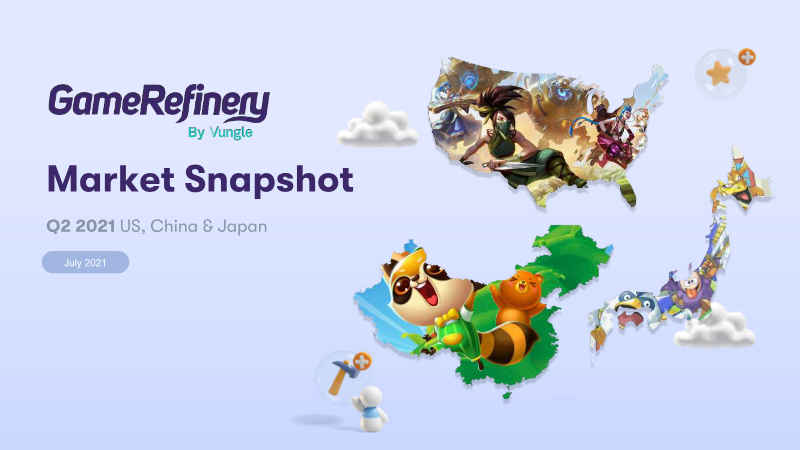
The mobile gaming market in the second quarter of 2021 experienced notable shifts in genre performance and publisher dominance across the United States, China, and Japan. The primary objective is to provide a comparative analysis of these regional markets, highlighting evolving trends in genre market share, publisher success, and the increasing importance of live-service feature updates. The analysis utilizes a proprietary taxonomy and motivation framework, supported by a survey of over 7,000 mobile gamers in English-speaking western countries, to categorize games and identify player archetypes.
Key findings indicate that the United States saw a decline in the Puzzle genre’s market share, while the Strategy genre experienced significant growth. In Japan, the Sports genre continued to gain momentum, largely driven by the success of titles like Umamusume Pretty Derby, while RPGs faced a decline. China exhibited a trend reversal from the previous quarter, with RPG and Strategy genres regaining market share at the expense of Shooters. Publisher performance was marked by strong results from Supercell in the US and Cygames in Japan, while Leiting Games nearly doubled its market share in China.
A critical trend identified is the 37% year-over-year increase in feature updates, with Strategy games leading this surge at 208%. Developers are increasingly prioritizing engagement through non-recurring live events and limited in-app purchase offers, which saw frequency increases of 143% and 122%, respectively. These features are becoming essential for retention and monetization across major genres. Furthermore, player motivation data reveals that games appealing to fast-paced action and competitive play continue to dominate the top-grossing charts in the US, with specific archetypes like King of the Hill and Skill Master remaining highly relevant.
The Q1 2021 market snapshot delivers a data‑driven overview of the global mobile‑gaming landscape, focusing on iOS performance in the United States, Japan and China and comparing it with the preceding quarter. By applying GameRefinery’s three‑layered genre taxonomy to the top‑grossing 200 titles, the analysis quantifies shifts in genre share, publisher dominance and emerging feature trends, while also profiling player archetypes and their motivations.
Across the three regions the overall market shape remained stable, yet distinct regional dynamics emerged. In the United States simulation games continued to grow and Roblox solidified its position as the leading grossing title, surpassing Playrix and King. Japan saw a measurable decline in RPG share accompanied by a sharp rise in sports, highlighted by Cygames’ Uma Musume Pretty Derby capturing a sizable slice of the charts. China experienced a double‑digit drop in RPG and strategy share, while shooters gained traction. Revenue‑share changes are illustrated by puzzle maintaining a 22.9 % share in the US (+0.1 pp), RPG falling to 45.4 % in China (‑2.7 pp) and sports expanding to 12.3 % in Japan (+27 pp).
Monetisation patterns diverged by market: collectibles albums appear in over 70 % of the US top‑100 grossing games, battle‑pass systems are present in more than a quarter of Japan’s top‑100, and special‑gacha mechanics doubled YoY to exceed 30 % of Chinese leaders. Feature analysis shows guild mechanics, co‑op modes and PvP as critical for puzzle, RPG and strategy titles, while social‑collectible systems drive retention in casual segments.
Player‑archetype profiling reveals that fast‑paced, competitive “King of the Hill” and “Thrill‑Seeker” types continue to dominate the US top‑200, with a rising “Skill‑Master” segment indicating growing demand for reflex‑based competition. Demographically, puzzle games attract primarily female players aged 25‑44, whereas strategy and RPG titles skew male in the same age bracket. Soft‑launch monitoring flags titles such as Clash Quest, Tom and Jerry: Chase and Pokémon Unite as promising entrants that could
The video game market in China experienced a significant surge in engagement and revenue during the first quarter of 2020, driven by widespread stay-at-home mandates during the COVID-19 pandemic. Total industry revenue for the quarter is estimated to have been approximately 30% higher than in the same period of 2019. This growth was characterized by increased mobile, PC, and console usage, as gamers sought entertainment and social connection during prolonged quarantine periods.
Key findings from an April 2020 survey of 1,057 Chinese gamers highlight the depth of this shift: 97.2% of respondents reported spending more time on mobile games, while 94.6% increased their time on PC titles. Spending also rose, with 81.6% of mobile gamers and 76.3% of PC gamers reporting higher expenditures during the lockdown. While major titles from publishers like Tencent and NetEase dominated the market, the period also saw a notable decline in the internet cafe sector, which was forced to close entirely. Survey data suggests a lasting impact on consumer behavior, as 57% of former internet cafe users indicated they do not intend to return to those venues once reopened.
The pandemic also forced a rapid evolution in industry operations, particularly within the esports and development sectors. Esports tournaments successfully migrated to online formats, supported by municipal government initiatives to reduce regulatory barriers. Conversely, game development and outsourcing studios faced productivity challenges, leading to project delays for some global titles. While the surge in home-based gaming provided a substantial revenue boost, the industry faced headwinds regarding hardware manufacturing, component scarcity, and a decline in advertising revenue for smaller, ad-supported titles. Overall, the period solidified gaming as a primary social and entertainment outlet for Chinese consumers, with many users reporting a newfound acceptance of gaming within their households.