Sensor Tower
Research137 documents
Documents
Report26 pages
2026 Predictions: Trends in Gen AI, Gaming & Digital Ad Spend
The forecast outlines how generative‑AI, short‑form video and evolving ad formats will reshape the digital economy by 2026. It argues that AI‑driven applications will move from a niche category to a core revenue engine, rivaling traditional paid‑media traffic and reshaping user‑acquisition dynamics across mobile, web and gaming. The analysis draws on Sensor Tower’s app‑store, advertising and web‑traffic datasets, applying its App IQ and Game IQ taxonomies to the top publishers, the 1,000 most‑visited U.S. sites and the leading Steam releases, with historical data through December 2025 and forward projections to 2026.
Generative‑AI apps are projected to generate more than $10 billion in worldwide in‑app‑purchase revenue, achieve 7.2 billion downloads and capture 43 billion hours of usage in 2026—an 82 % year‑over‑year increase that will place the genre among the top five for downloads, revenue and engagement. Short‑drama vertical video is forecast to overtake traditional OTT streaming in download volume, securing roughly 80 % of downloads and closing the IAP gap to 20 % of OTT’s share, driven by rapid adoption in markets such as India, Indonesia and Brazil. Meanwhile, U.S. digital ad spend will total $20 billion, with image‑based creatives outpacing video growth (35 % versus 15 % YoY) as social platforms, especially Meta’s Reels, shift budgets toward static formats.
On the web, generative‑AI traffic will surpass paid sources on more than half of the top 1,000 U.S. sites by the end of 2026, up from 37 % in late 2025,
- Generative AI apps will become a top-five category by 2026, generating over $10 billion in IAP revenue, 7.2 billion downloads, and 43 billion hours of usage, representing an 82% year-over-year growth.
- By the end of 2026, generative AI traffic will surpass paid sources on more than 50% of the top 1,000 U.S. websites, up from 37% in late 2025.
- Short-drama vertical video is projected to overtake traditional OTT streaming in download volume, capturing roughly 80% of total downloads with rapid adoption in India, Indonesia, and Brazil.
- U.S. digital ad spend will reach $20 billion in 2026, with image-based creatives growing at 35% year-over-year, significantly outpacing the 15% growth rate of video formats.
- Social platforms, specifically Meta’s Reels, are shifting advertising budgets away from video toward static, image-based formats.
+1
Sensor TowerJan 2026
Report26 pages
Predictions for the Digital Economy in 2026
The analysis projects a rapid expansion of the digital economy through 2026, driven primarily by generative AI applications and vertical video formats. Generative‑AI apps are expected to generate more than $10 billion in in‑app purchase revenue by 2026, with downloads projected to reach 4 billion and user engagement exceeding 43 billion hours. The genre will climb into the top five mobile categories across downloads, revenue, and time spent, surpassing established sectors such as shopping and movies. Short‑drama vertical video is forecast to overtake traditional OTT streaming in global downloads, narrowing the revenue gap and capturing 40 % of time spent by 2026.
Digital advertising spending is shifting back toward image‑based creatives, with a 35 % year‑over‑year increase in image ad spend and a projected acceleration of this trend by 2026, especially within social channels where Reels and similar formats dominate. Meanwhile, generative AI traffic to the top 1,000 U.S. websites is projected to rise by more than 130 % YoY, reaching a point where half of these sites receive higher traffic from AI than paid sources by the end of 2026.
Mobile game acquisition costs remain high, and the market is trending toward smaller, ad‑native titles that can monetize efficiently. Steam releases are accelerating, with 2025 already breaking records for new titles, indicating a shift toward faster, lower‑budget development cycles. Overall, the report underscores a digital landscape increasingly shaped by AI‑driven content and streamlined monetization models across mobile, web, and gaming sectors.
- Generative AI applications are projected to reach $10 billion in in-app purchase revenue, 4 billion downloads, and 43 billion hours of user engagement by 2026, becoming a top-five mobile category.
- Short-drama vertical video is forecast to surpass traditional OTT streaming in global downloads and capture 40% of total user time spent by 2026.
- By the end of 2026, half of the top 1,000 U.S. websites are expected to receive more traffic from generative AI than from paid sources, with AI-related traffic rising over 130% year-over-year.
- Digital advertising is shifting back toward image-based creatives, evidenced by a 35% year-over-year increase in image ad spend that is expected to accelerate through 2026.
- The gaming market is trending toward smaller, ad-native mobile titles to combat high acquisition costs, while Steam is seeing record-breaking release volumes driven by faster, lower-budget development cycles.
+3
Sensor TowerDec 2025

Report34 pages
Cross-Platform Gaming: Bridging Mobile and PC/Console 2025
The global gaming landscape in 2025 is defined by a strategic synergy between the accessibility of mobile platforms and the immersive depth of PC and console ecosystems. Mobile serves as the primary engine for discovery and user acquisition, generating over 52 billion annual downloads and $82 billion in in-app purchase revenue. Meanwhile, PC and console platforms, led by storefronts like Steam, anchor brand loyalty and drive high-value engagement through seasonal peaks and premium content. By leveraging mobile’s massive reach to feed into high-fidelity ecosystems, publishers maximize total franchise growth and ensure long-term revenue stability.
Publishers are increasingly bridging these distinct markets through four primary models: companion apps, "lite" versions for mass-market discovery, adapted experiences, and full cross-platform progression. Success stories such as the EA SPORTS FC companion app, which reached 78 million downloads, demonstrate how mobile accessibility sustains franchise loyalty. Furthermore, titles like PUBG Mobile and Delta Force illustrate that mobile engagement frequently drives corresponding spikes in PC player activity. This interconnectedness is particularly effective for RPGs and Shooters, which utilize unified ecosystems and shared progression to significantly increase player lifetime value and retention.
Ultimately, a successful cross-platform strategy balances high-volume mobile genres, such as Simulation and Puzzle, with the prestige and monetization intensity of blockbuster PC and console releases. Adapting complex intellectual properties into accessible mobile formats allows franchises to capitalize on broader cultural trends, as seen with the resurgence of the Fallout brand. By treating mobile as a discovery engine and PC/console as the anchor for brand identity, publishers can effectively navigate the global market to capture both broad audiences and high-spending core players.
- Mobile platforms function as the primary discovery engine for the gaming industry, generating over 52 billion annual downloads and $82 billion in in-app purchase revenue.
- Publishers maximize franchise growth by using mobile to feed into high-fidelity PC and console ecosystems, which anchor brand loyalty and drive high-value engagement.
- Cross-platform progression and unified ecosystems are most effective for RPG and Shooter titles, significantly increasing player lifetime value and retention.
- Companion apps are a proven strategy for sustaining franchise loyalty, evidenced by the EA SPORTS FC companion app reaching 78 million downloads.
- Mobile engagement frequently correlates with increased player activity on PC, as demonstrated by titles like PUBG Mobile and Delta Force.
+1
Sensor TowerDec 2025

Report48 pages
Digital Market Index: Q3 2025
Global mobile app consumer spending reached a record $43.2 billion in the third quarter of 2025, representing an 11.3% year-over-year increase. This growth was primarily fueled by a 20% surge in non-game revenue, particularly from Generative AI tools which generated $1.5 billion during the period. While total global downloads remained stable at 37.6 billion, a clear divergence emerged between sectors; non-game downloads grew by 5.5%, while gaming installs continued a post-pandemic decline. Geographically, the United States maintained its market leadership with $15 billion in revenue, though Brazil emerged as the fastest-growing major market with a 29% revenue increase. India simultaneously reached a two-year high in downloads, surpassing 6.5 billion.
The digital advertising landscape saw significant expansion, with U.S. spend rising 12% to $35.9 billion. Social media remains the dominant channel, capturing 72% of the market, but mobile app advertising is the fastest-growing segment at 42% year-over-year. Within specific industries, the gaming sector entered the top five spending categories for the first time following a 28% increase in investment. Strategic shifts were also evident in the insurance and consumer goods sectors, where companies like Geico and Procter & Gamble executed massive quarterly spending spikes to capitalize on premium fluctuations and seasonal demand.
Retail media has become a critical pillar of the digital economy, dominated heavily by Amazon. Generating over 80 billion impressions, Amazon’s reach surpassed the combined total of the next thirty major retailers. Outside of Amazon's ecosystem, retail media impressions grew 7% year-over-year, though performance was inconsistent across platforms; Target and Best Buy saw double-digit growth while Walmart experienced a decline. Personal care remains the most competitive retail category, driven by high-volume co-branded partnerships between major manufacturers and established retail platforms.
- Global mobile app consumer spending reached a record $43.2 billion in Q3 2025, an 11.3% year-over-year increase driven by a 20% surge in non-game revenue.
- Generative AI tools emerged as a significant revenue driver, contributing $1.5 billion to the mobile app market during the third quarter.
- U.S. digital advertising spend rose 12% to $35.9 billion, with mobile app advertising identified as the fastest-growing segment at 42% year-over-year.
- Gaming sector investment in digital advertising grew by 28%, securing its position as a top-five spending category for the first time.
- Amazon dominates the retail media landscape with over 80 billion impressions, exceeding the combined total of the next thirty major retailers.
+1
Sensor TowerNov 2025
Report56 pages
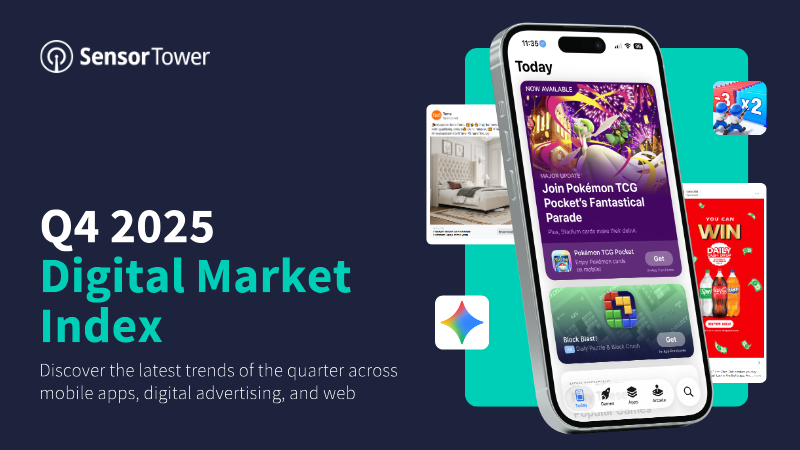
Digital Marketing Index Report: Q4 2025
The analysis evaluates global digital‑marketing dynamics for the final quarter of 2025, emphasizing shifts in channel performance, the rise of generative‑AI as a discovery source, and the concentration of retail‑media reach among dominant platforms. Growth patterns reveal a stark regional divide: India stands alone among the five largest markets as the only one posting positive overall change, while other leading economies recorded declines or stagnation.
In the United States, retail‑media impressions expanded 13 percent quarter‑over‑quarter to reach 123 billion, with Amazon accounting for the entire volume and delivering more than six times the impressions generated by Walmart. This concentration underscores Amazon’s expanding role as the primary conduit for retail‑media exposure in North America. Across the same period, generative‑AI referrals, although still representing less than one percent of total traffic, surged dramatically—up 133 percent year‑over‑year in the United States, United Kingdom and France, and 126 percent in Canada. The rapid acceleration signals that chat‑based assistants such as ChatGPT, Claude and Gemini are emerging as significant discovery engines despite their modest share of overall visits.
Conversely, traditional organic search experienced the only decline among major acquisition channels, falling four percent year‑over‑year. Paid advertising, email marketing and other performance‑driven tactics continued to post gains, reinforcing a broader transition toward paid and AI‑augmented pathways for user acquisition. The findings collectively illustrate a digital‑marketing ecosystem increasingly dominated by platform‑centric retail media and AI‑driven referral mechanisms, while legacy search channels lose ground in mature markets.
- India was the only major global market to record positive overall digital marketing growth in Q4 2025, while other leading economies experienced stagnation or decline.
- Generative AI referrals surged by 133% year-over-year in the US, UK, and France, signaling their emergence as significant discovery engines despite currently accounting for less than 1% of total traffic.
- US retail-media impressions grew 13% quarter-over-quarter to 123 billion, with Amazon capturing the entire volume and delivering six times the impressions of Walmart.
- Traditional organic search was the only major acquisition channel to decline in Q4 2025, falling 4% year-over-year.
- Digital marketing strategies are shifting toward paid advertising and AI-augmented pathways as legacy search channels lose market share in mature economies.
+2
Sensor TowerOct 2025
Report46 pages
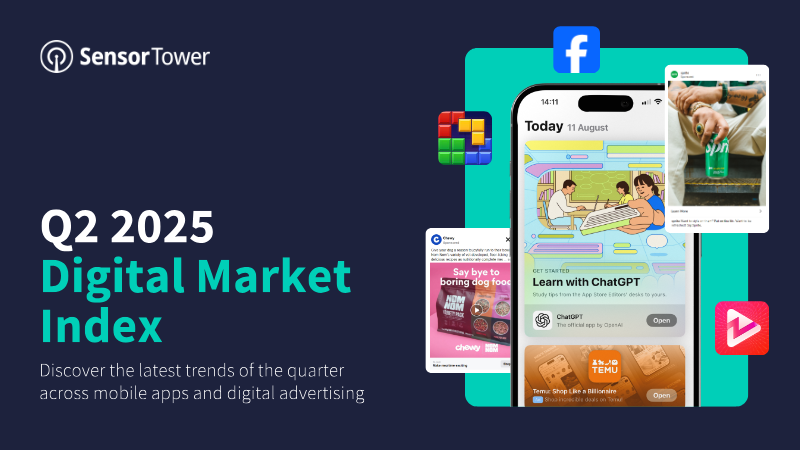
Digital Market Index: Q2 2025
The global digital landscape reached a significant milestone in the second quarter of 2025, as in-app purchase revenue hit a record $40 billion. This period marked a historic structural shift in the mobile economy, with non-gaming applications accounting for 52% of total consumer spending, surpassing mobile games for the first time. While total downloads stabilized at 37 billion, the market displayed clear signs of maturation; gaming downloads contracted by 6.8% year-over-year, while AI-driven productivity tools and short-drama streaming platforms emerged as the primary engines of growth. The United States maintained its position as the premier revenue market at $15 billion, though emerging regions such as Brazil and various African nations are increasingly vital for download volume and monetization expansion.
Within the gaming sector, Strategy titles overtook RPGs as the highest-grossing category, achieving a 23% year-over-year increase. However, the most significant individual performance came from ChatGPT, which became the fastest application to reach one billion downloads and secured a position among the top five global revenue earners. This surge in AI utility was mirrored in the advertising sector, where U.S. digital ad spend rose 12% to $34 billion. Major technology firms including Microsoft, Google, and Adobe significantly increased their marketing budgets to promote AI integrations like Copilot, contributing to a landscape where social media maintains a 72.5% share of total ad spend.
Retail media has solidified its role as a critical advertising channel, with U.S. impressions rising 29% to 65 billion across various retailers. Despite this broad growth, Amazon remains the undisputed leader in the space, generating nearly 80 billion impressions and outperforming all other tracked retailers combined. These findings are supported by expanded tracking capabilities across key Asian markets and diverse digital channels, though the data specifically excludes certain year-over-year Amazon metrics due to recent tracking implementation. Overall, the quarter reflects a pivot toward high-utility AI applications and a diversifying advertising ecosystem dominated by social and retail platforms.
- In Q2 2025, non-gaming applications surpassed mobile games for the first time, accounting for 52% of the record $40 billion in total in-app purchase revenue.
- Global mobile gaming downloads contracted by 6.8% year-over-year, while Strategy titles replaced RPGs as the highest-grossing gaming category with a 23% increase.
- ChatGPT became the fastest application to reach one billion downloads and secured a top-five position in global revenue, signaling a major shift toward AI-driven utility.
- U.S. digital ad spend rose 12% to $34 billion, driven by increased marketing budgets from firms like Microsoft, Google, and Adobe to promote AI integrations.
- Retail media continues to expand, with U.S. impressions rising 29% to 65 billion, though Amazon remains the dominant leader with nearly 80 billion impressions.
+1
Sensor TowerAug 2025

Report16 pages
Mobile Game Feature Impact Spotlight
Sensor Tower introduces Game IQ Deep Tags, a taxonomy of 70 specialized markers designed to analyze the impact of specific mobile game features on market performance. These tags are categorized into gameplay, monetization, engagement, and social elements, providing developers with a framework to benchmark competitor roadmaps and identify high-value feature sets. The analysis covers the top 1,000 mobile games globally from Q2 2024 through Q1 2025, a segment representing 16 billion downloads and $67 billion in consumer spend.
The findings reveal that feature density does not always correlate with market dominance. In the casual puzzle genre, titans like Royal Match and Candy Crush Saga utilize fewer luxury features, such as voice acting or cinematic cutscenes, compared to competitors like Gardenscapes, suggesting that core gameplay often outweighs feature volume. Conversely, in the mid-core RPG and strategy sectors, comprehensive monetization and engagement systems are standard. For instance, Age of Empires Mobile demonstrates high revenue per download by utilizing nearly all available monetization tags, while top RPGs leverage IP collaborations and recurring task systems to maximize player retention and session length.
The research identifies significant growth opportunities in the hybridcasual segment, where features like in-app purchase (IAP) bundles remain underutilized despite correlating with a $1.77 increase in lifetime revenue per download. Additionally, portfolio analysis of top publishers like Tencent, Scopely, and King shows a universal prioritization of login systems to track player data, while specific mechanics like "monetized retries" remain niche to casual puzzle specialists. Ultimately, the data suggests that strategic feature implementation, rather than exhaustive adoption, is the primary driver of commercial success across different mobile gaming verticals.
- Strategic feature selection, rather than exhaustive feature adoption, is the primary driver of commercial success across the top 1,000 mobile games globally.
- In the hybridcasual segment, implementing in-app purchase (IAP) bundles correlates with a $1.77 increase in lifetime revenue per download.
- Casual puzzle leaders like Royal Match and Candy Crush Saga maintain market dominance with lower feature density, proving that core gameplay often outweighs the addition of luxury elements like cinematic cutscenes.
- Mid-core strategy titles, such as Age of Empires Mobile, maximize revenue per download by utilizing a comprehensive suite of monetization tags.
- Top publishers including Tencent, Scopely, and King universally prioritize login systems to track player data, while mechanics like 'monetized retries' remain niche to the casual puzzle genre.
+1
Sensor TowerJun 2025

Report37 pages
Southeast Asia: Mobile Game Market Insights 2025
Southeast Asia solidified its position as the world’s second-largest mobile gaming market by downloads in early 2025, reaching 1.93 billion installs. While the region currently ranks seventh globally in revenue at $625 million, it demonstrates significant monetization potential fueled by expanding digital payment infrastructure and rising smartphone penetration. Indonesia serves as the primary volume driver with 870 million installs, while Thailand leads the region in consumer spending, generating $162 million. This growth is increasingly supported by publishers based in Singapore and Vietnam, who have emerged as a dominant global force, contributing over 5.8 billion installs to the international market through a mix of hypercasual hits and competitive titles.
Market dynamics reveal a shift toward high-engagement genres and localized content strategies. Although casual arcade and simulation games drive the highest download volumes, monetization is concentrated in Strategy, MOBA, and RPG segments. Mobile Legends: Bang Bang remains the regional revenue leader, sustained by hyper-local live operations and community engagement. Simultaneously, the 4X Strategy genre is experiencing rapid expansion, highlighted by a 77.7% revenue surge for titles like Last War: Survival. Conversely, traditional MMORPGs have seen a decline of nearly 20%, making way for Open World Adventure RPGs and sophisticated strategy games that leverage deep social and competitive mechanics.
The regional landscape is characterized by distinct national preferences and the global expansion of local firms. Vietnam has become a powerhouse for survival-themed hypercasual games, while Thailand shows a unique affinity for realistic sports simulations. Established titles like Garena Free Fire continue to dominate global charts by blending cultural relevance with nostalgic collaborations. Ultimately, the region’s trajectory is defined by a transition from high-volume downloads to sophisticated monetization, driven by a combination of community-led activations and the strategic global influence of Southeast Asian publishers.
- Southeast Asia is the world’s second-largest mobile gaming market by volume, recording 1.93 billion installs in early 2025, while ranking seventh globally in revenue at $625 million.
- Indonesia is the region's primary volume driver with 870 million installs, whereas Thailand leads in monetization, generating $162 million in consumer spending.
- Publishers based in Singapore and Vietnam have become a dominant global force, contributing over 5.8 billion installs to the international market through hypercasual and competitive titles.
- The 4X Strategy genre is experiencing rapid growth, evidenced by a 77.7% revenue surge for titles like Last War: Survival, while traditional MMORPGs have declined by nearly 20%.
- Monetization is concentrated in Strategy, MOBA, and RPG segments, with Mobile Legends: Bang Bang remaining the regional revenue leader due to hyper-local live operations.
+3
Sensor TowerJun 2025
Report50 pages
State of Mobile Gaming 2025
The global mobile gaming market entered a period of mature recovery in 2024, characterized by a strategic pivot toward live services and high-value player retention. While total downloads declined by 6.6%, global in-app purchase revenue grew by 4% to reach $82 billion. This growth was primarily driven by North America and the Middle East, offsetting spending declines in Asia. The industry has transitioned into a "live operations" era, where 84% of all revenue is generated by games utilizing continuous updates and seasonal events. This shift is further evidenced by a 50% decrease in new game releases since 2020, as publishers prioritize high-quality core titles over volume.
Genre performance highlights a market dominated by Strategy and RPG titles, which collectively generated over $34 billion in 2024. Action games emerged as the fastest-growing category with a 46% revenue increase, fueled by breakout hits like Last War: Survival. Despite the dominance of established franchises, a record 11 games surpassed $1 billion in annual consumer spend, including MONOPOLY GO!, which secured the top global position. The market is also seeing a demographic shift, particularly in the United States, where the 18-24 age group now represents 18% of the player base, up from 13% in 2022.
Marketing strategies have evolved to combat rising user acquisition costs, with a significant move toward high-intent creative content and short-form video platforms. TikTok experienced a 67% year-over-year growth in social ad share, while mid-core developers nearly doubled their impression share on social networks. To maintain profitability, publishers are increasingly leveraging external web stores, celebrity partnerships, and localized cultural influencers, such as virtual YouTubers in the Japanese market. These trends underscore a broader industry movement toward sophisticated monetization models and IP-driven growth in an increasingly concentrated competitive landscape.
- Global mobile gaming revenue grew 4% to $82 billion in 2024 despite a 6.6% decline in total downloads, signaling a shift toward high-value player retention.
- The industry has entered a 'live operations' era, with 84% of total revenue now generated by games utilizing continuous updates and seasonal events.
- Publishers have reduced new game releases by 50% since 2020, focusing resources on high-quality core titles rather than volume.
- Strategy and RPG titles remain the market leaders with over $34 billion in combined revenue, while Action games emerged as the fastest-growing category with a 46% revenue increase.
- A record 11 games surpassed $1 billion in annual consumer spend in 2024, with MONOPOLY GO! securing the top global position.
+1
Sensor TowerMar 2025
Report95 pages
State of Mobile 2025
The global mobile economy reached a significant milestone in 2024, with consumer spend hitting $150 billion. This growth was primarily propelled by a 25% surge in non-gaming app revenue, particularly within the entertainment, productivity, and generative AI sectors. While total app downloads declined for the fourth consecutive year, indicating a maturing market, user engagement reached a record 4.2 trillion hours. The rise of generative AI served as a primary catalyst for this engagement, with AI chatbot downloads increasing by 635 million and the subgenre generating nearly $1.3 billion in revenue.
The mobile gaming sector demonstrated a robust recovery in 2024, reaching $80.9 billion in internal purchase revenue. Although total game downloads fell by 6%, the market shifted toward high-quality, core genres. Strategy and RPG titles dominated monetization, while the "hybrid-casual" model—combining simple mechanics with midcore progression—emerged as a vital growth driver. Established franchises continue to exert dominance, with titles older than two years accounting for over 80% of revenue. Notably, the industry saw a record eleven games surpass $1 billion in annual revenue, signaling a concentration of wealth among top-tier performers.
Beyond gaming, the landscape was defined by the continued dominance of social media, which accounted for 2.4 trillion hours of global usage. TikTok became the first non-game app to reach $15 billion in lifetime spend, reflecting a broader trend of social platforms diversifying revenue through in-app purchases and subscriptions. In the retail sector, Chinese e-tailers like Temu and SHEIN expanded their global footprint, while the finance sector saw a resurgence driven by cryptocurrency and digital wallets. Despite signs of "digital fatigue" in traditional streaming, the mobile ecosystem remains resilient, characterized by strategic shifts toward ad-supported tiers, meaningful AI integration, and incentivized health and fitness platforms.
- The global mobile economy reached $150 billion in consumer spend in 2024, driven by a 25% surge in non-gaming revenue despite a four-year decline in total app downloads.
- Mobile gaming revenue recovered to $80.9 billion, with 80% of earnings generated by titles older than two years and a record eleven games surpassing $1 billion in annual revenue.
- Generative AI became a primary engagement catalyst, with chatbot downloads increasing by 635 million and generating nearly $1.3 billion in revenue.
- Total mobile user engagement hit a record 4.2 trillion hours, with social media platforms accounting for 2.4 trillion of those hours.
- The 'hybrid-casual' gaming model has emerged as a critical growth driver, while strategy and RPG titles continue to dominate monetization.
+1
Sensor TowerJan 2025

Report65 pages
The State of AAA Game Advertising: 2023 Review
The 2023 AAA game advertising landscape underwent a strategic pivot toward launch-focused campaigns, with new releases accounting for half of all top-tier spending. This shift reflects a broader industry trend of prioritizing high-impact, multi-channel visibility to capture immediate market share. While YouTube remains the dominant advertising medium for PC and console titles, publishers have increasingly diversified their media mix by integrating Facebook, TikTok, and Instagram to target specific demographics. This evolution in outreach is complemented by a growing reliance on platform-based partnerships, such as deep Xbox branding and hardware collaborations, which serve to anchor major titles within broader ecosystem strategies.
Creative execution in 2023 varied significantly based on the title’s core value proposition. Successful campaigns ranged from the consistent, exploration-themed branding of single-player experiences like Hogwarts Legacy to the dark, horror-inspired aesthetics and live-service integration of titles like Diablo IV. Furthermore, the industry increasingly utilized transmedia efforts and review-based accolades to sustain momentum. However, the year also highlighted the risks of fragmented marketing, as seen with Call of Duty: Modern Warfare III, which suffered from a lack of a cohesive reveal campaign and negative consumer perception regarding its status as a standalone sequel.
Ultimately, the year demonstrated that while massive advertising budgets and established intellectual property remain primary drivers for AAA success, organic viral growth and streamlined gameplay models also provide viable paths to market dominance. The industry is currently defined by a tension between traditional, high-spend multi-channel campaigns and the rising influence of mobile-first strategies and community-driven engagement. As publishers navigate these shifting dynamics, the ability to align creative messaging with specific platform strengths and cross-industry partnerships has become the definitive factor in maintaining visibility within an increasingly competitive global market.
- In 2023, AAA publishers shifted toward launch-focused campaigns, with new releases accounting for 50% of all top-tier advertising expenditure.
- While YouTube remains the primary advertising medium for PC and console games, publishers are increasingly diversifying their media mix by integrating Facebook, TikTok, and Instagram to target specific demographics.
- Strategic platform-based partnerships, such as deep Xbox branding and hardware collaborations, are now essential for anchoring major titles within broader ecosystem strategies.
- The failure of Call of Duty: Modern Warfare III demonstrated that fragmented marketing and a lack of a cohesive reveal campaign can severely damage consumer perception and market performance.
- Successful 2023 campaigns utilized varied creative strategies, ranging from exploration-themed branding for single-player titles like Hogwarts Legacy to horror-inspired aesthetics and live-service integration for Diablo IV.
+3
Sensor TowerJan 2025

Report23 pages
The State of Puzzle Games: An Analysis of the Puzzle Category in Mobile Gaming
The mobile puzzle game market is undergoing a significant structural evolution, characterized by a shift in product models and a notable rise in hybridcasual gaming. This analysis, covering global data from January 2018 through June 2023, examines the performance of various puzzle sub-genres, including swap, blast, chain, and pair mechanics. By leveraging store intelligence and download estimates from the Apple App Store and Google Play, the findings highlight how developers are increasingly integrating meta-features and diversified monetization strategies to sustain revenue in a maturing landscape.
A central finding is the remarkable growth of the hybridcasual product model, which saw a 430% increase in revenue between early 2022 and early 2023. While traditional casual games continue to dominate overall market share through consistent operations and robust meta-features, they have experienced modest declines in both downloads and revenue. Conversely, hybridcasual titles—particularly within the pair sub-genre—have successfully captured user interest by blending accessible gameplay with more sophisticated monetization tactics, such as in-app purchases, which were previously less common in hypercasual-leaning segments.
The data indicates that sub-genres like pair have emerged as high-growth areas, with hybridcasual revenue in this category rising from $7 million in the first quarter of 2022 to $40 million by the first quarter of 2023. Meanwhile, other established sub-genres, such as merge and physics, have seen download declines as their reliance on hypercasual models wanes. Successful top-tier games across all categories now frequently employ a combination of live operations, season passes, and social clans to drive engagement. Ultimately, the puzzle market is moving toward a hybrid approach, where the simplicity of casual mechanics is increasingly supported by the deeper monetization and retention frameworks typically associated with mid-core titles.
- The hybridcasual puzzle model experienced a 430% revenue increase between early 2022 and early 2023, signaling a major shift in market structure.
- Hybridcasual revenue in the 'pair' sub-genre grew from $7 million in Q1 2022 to $40 million in Q1 2023.
- Traditional casual puzzle games are experiencing modest declines in both downloads and revenue despite maintaining overall market share through robust meta-features.
- Established sub-genres like merge and physics are seeing download declines as their reliance on hypercasual models diminishes.
- Top-tier puzzle games are increasingly adopting mid-core retention and monetization strategies, including live operations, season passes, and social clans.
+3
Sensor TowerJan 2025