Market (Mobile)·Updated Mar 17, 2026 by Sensor Tower
Report · June 18, 2025
Published by Sensor Tower
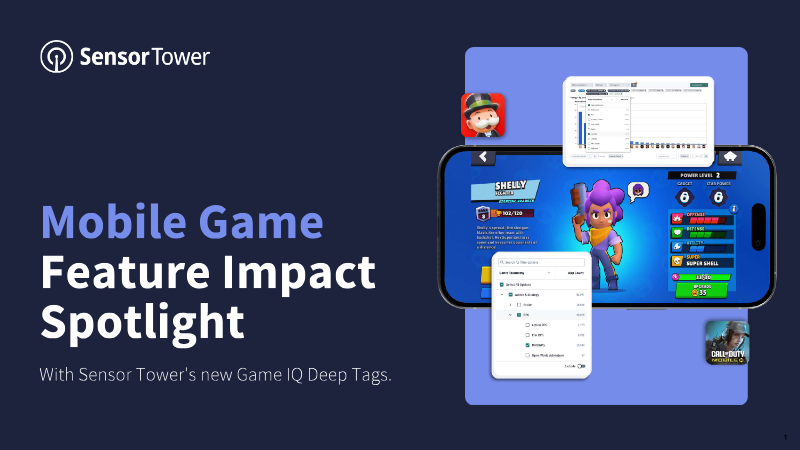
Sensor Tower introduces Game IQ Deep Tags, a taxonomy of 70 specialized markers designed to analyze the impact of specific mobile game features on market performance. These tags are categorized into gameplay, monetization, engagement, and social elements, providing developers with a framework to benchmark competitor roadmaps and identify high-value feature sets. The analysis covers the top 1,000 mobile games globally from Q2 2024 through Q1 2025, a segment representing 16 billion downloads and $67 billion in consumer spend. The findings reveal that feature density does not always correlate with market dominance. In the casual puzzle genre, titans like Royal Match and Candy Crush Saga utilize fewer luxury features, such as voice acting or cinematic cutscenes, compared to competitors like Gardenscapes, suggesting that core gameplay often outweighs feature volume. Conversely, in the mid-core RPG and strategy sectors, comprehensive monetization and engagement systems are standard. For instance, Age of Empires Mobile demonstrates high revenue per download by utilizing nearly all available monetization tags, while top RPGs leverage IP collaborations and recurring task systems to maximize player retention and session length. The research identifies significant growth opportunities in the hybridcasual segment, where features like in-app purchase (IAP) bundles remain underutilized despite correlating with a $1.77 increase in lifetime revenue per download. Additionally, portfolio analysis of top publishers like Tencent, Scopely, and King shows a universal prioritization of login systems to track player data, while specific mechanics like "monetized retries" remain niche to casual puzzle specialists. Ultimately, the data suggests that strategic feature implementation, rather than exhaustive adoption, is the primary driver of commercial success across different mobile gaming verticals.
With Sensor Tower's new Game IQ Deep Tags. Mobile Game Feature Impact Spotlight 1
Understanding how features are performing on the market is key to roadmap prioritization. What are our competitors' feature sets? What percentage of games in our niche already have this feature? How do games with this feature perform compared to games without this feature? These questions are key to understanding how crucial a feature is to your game. Sensor Tower already provides the most comprehensive suite of tags that helps developers answer these questions, but we've just upgraded it even further with Game IQ Deep Tags. This report spotlights insights generated using these new tags. © Sensor Tower Inc. - All Rights Reserved © Sensor Tower Inc. - All Rights Reserved - All Rights Reserved 2
What are Game IQ Deep Tags? Game IQ Deep Tags are a collection of 70 new tags marking games that have a certain feature. These 70 tags are further broken down into four categories. - All Rights Reserved Sensor Tower Game IQ Deep Tags Category Gameplay Monetization Engagement Socials Deep Tag Minigames External Stores IP Collaborations Leaderboards Examples: 3
Game IQ Deep Tags give insight into the most successful games in the market. The following metrics shows how games covered by Deep Tags performed in the last twelve months. Source: Sensor Tower Note: iOS and Google Play combined. iOS only for China. Excludes third-party Android. For Q2 2024 - Q1 2025, worldwide, iOS and Google Play: - All Rights Reserved What do Game IQ Deep Tags cover? Top Mobile Games - 1k New App Downloads 16Billion IAP Purchases $67Billion Total Minutes Spent 17Trillion Total Sessions 2.1Trillion 4
Royal Match Candy Crush Saga Gardenscapes Homescapes Fishdom Adoption among casual puzzle games Voice Acting 12% Replayable Stages/Levels 28% Activated Automation 1% Dialogue Skip 25% Rarity System 24% Cosmetics 36% Opening Sequence 23% Cinematic Cutscenes 25% Dynamic Transitions 18% Dialogue 39% Minigames 22% Collection 56% User Level 34% Tutorials 84% Login System 75% In-game notification 68% Competitive PvE 49% Total # of Gameplay Tags (Out of 36) 7 8 12 17 12 - All Rights Reserved Top casual puzzle games Royal Match and Candy Crush Saga are not as feature rich as Playrix competitors. Match swap is one of the biggest genres in mobile gaming, and sitting at the pinnacle of this competitive sub-genre are Royal Match and Candy Crush Saga. One might expect these titans to be extremely feature rich, but, compared to Playrix competitors, that doesn't seem to be the case. Gardenscapes and Homescapes in particular includes several luxury features like Voice Acting and Cinematic Cutscenes, which Royal Match and Candy Crush Saga don't have. While any publisher would be extremely happy with the performance of Homescapes throughout the years, it seems that casual puzzle games don't strictly need all of these features to find success. Source: Sensor Tower Adoption is for games tagged with Deep Tags (top 1000 mobile games), not all mobile games.Not all Gameplay Deep Tags are shown in this table. Game IQ Deep Tags - selected Gameplay tags Top casual puzzle games by in-app purchase revenue 2Q2024 - 1Q2025 5
Pokémon TCG Pocket Age of Empires Mobile Dark War:Survival Last Z: Survival Shooter DC: Dark Legion™ Squad Busters Piggy Bank Periodic Refresh Shop Monetized Continue/Retry Monetized Timer So Currency Shop - Free Purchase Consumables Hard Currency External Stores IAP Bundles VIP System Monetization tag count (out of 11) 7 9 1 3 2 6 Lifetime revenue per download $7.30 $5.46 $3.62 $3.34 $2.61 $1.17 - All Rights Reserved Age of Empires Mobile has the most comprehensive monetization of top strategy games released in the past twelve months. The game is only missing Piggy Bank and Monetized Continue/Retry, neither of which have seen much adoption in strategy yet. In contrast, Dark War: Survival only has five tags. This suggests that Dark War: Survival has opportunities to improve its monetization on top of its already considerable success. Source: Sensor Tower Lifetime revenue per download is worldwide, iOS and Google Play. Some new strategy games have solid monetization despite lacking competitors' features. Game IQ Deep Tags - Monetization tags Top mid-core strategy games launched in last twelve months 2Q2024 - 1Q2025 6
The global mobile gaming market entered a period of mature recovery in 2024, characterized by a strategic pivot toward live services and high-value player retention. While total downloads declined by 6.6%, global in-app purchase revenue grew by 4% to reach $82 billion. This growth was primarily driven by North America and the Middle East, offsetting spending declines in Asia. The industry has transitioned into a "live operations" era, where 84% of all revenue is generated by games utilizing continuous updates and seasonal events. This shift is further evidenced by a 50% decrease in new game releases since 2020, as publishers prioritize high-quality core titles over volume. Genre performance highlights a market dominated by Strategy and RPG titles, which collectively generated over $34 billion in 2024. Action games emerged as the fastest-growing category with a 46% revenue increase, fueled by breakout hits like Last War: Survival. Despite the dominance of established franchises, a record 11 games surpassed $1 billion in annual consumer spend, including MONOPOLY GO!, which secured the top global position. The market is also seeing a demographic shift, particularly in the United States, where the 18-24 age group now represents 18% of the player base, up from 13% in 2022. Marketing strategies have evolved to combat rising user acquisition costs, with a significant move toward high-intent creative content and short-form video platforms. TikTok experienced a 67% year-over-year growth in social ad share, while mid-core developers nearly doubled their impression share on social networks. To maintain profitability, publishers are increasingly leveraging external web stores, celebrity partnerships, and localized cultural influencers, such as virtual YouTubers in the Japanese market. These trends underscore a broader industry movement toward sophisticated monetization models and IP-driven growth in an increasingly concentrated competitive landscape.
Mobile gaming solidifies its position as the leading segment of the global video‑game market, with revenue projected to reach $83 billion in 2024, reflecting a 6 percent year‑over‑year increase. In contrast, home‑console spending is expected to decline by 1 percent to $42 billion, while handheld revenues are slated to fall 2 percent to just under $2.5 billion. The upward trajectory of mobile is driven primarily by rapid expansion in emerging regions such as India and Indonesia, where user acquisition and spending are accelerating faster than in mature markets. Within mobile, fast‑growing sub‑genres—particularly simulators and multiplayer online battle arenas—accounted for $2.34 billion, representing 5.8 percent of total mobile revenue, and achieved a modest 0.4‑point rise in download share during the latest reporting period. In the United States, monetisation patterns among mobile players continue to favour rewarded‑video advertisements. These ads recorded the highest net‑sentiment score of +20 points and were the most frequently encountered format in the third quarter of 2023. Other ad formats, including playable, native, banner/display, and standard video, lagged behind both in visibility and user sentiment, indicating a clear preference hierarchy that shapes publisher revenue strategies. Overall, the data underscore a market increasingly centred on mobile platforms, propelled by growth in developing economies and reinforced by user‑friendly ad experiences. Console and handheld segments face modest contractions, suggesting that future investment and innovation will likely concentrate on mobile‑first titles, emerging‑region outreach, and optimisation of rewarded‑video ad ecosystems to sustain growth.
India is the world’s largest mobile gaming market by volume, reaching 8.45 billion downloads in the 2024-25 fiscal year. Despite this massive scale, which is more than double that of Indonesia, the market faces significant monetization hurdles. Total in-app purchase revenue stands at approximately $400 million, reflecting a cost-sensitive consumer base that favors free-to-play models. However, the market shows signs of evolution, with revenue growing 8.5% year-over-year, driven largely by high-value spenders on iOS and the increasing adoption of digital payment systems like UPI. The player base is predominantly young and male, with 77% of gamers aged 18-34 and 86% identifying as male. While casual subgenres such as driving simulators, platformers, and tabletop games dominate download charts due to their cultural resonance, revenue is concentrated in core competitive genres. Shooters, specifically Battle Royale titles like Garena Free Fire and Battlegrounds Mobile India, command 50% of total market revenue. Strategy and Casino games also represent significant portions of the spending landscape, highlighting a divide between mass-market reach and deep-engagement monetization. A central fixture of the domestic industry is Ludo King, which has remained the most downloaded game in India since 2017, surpassing 1.25 billion lifetime downloads. Its success is attributed to the digitization of a traditional board game combined with social features like live voice chat. While domestic publishers like Gametion and Dream11 maintain strong local positions, there is a growing trend of India-based firms expanding into overseas markets, such as the United States and Saudi Arabia, to capture higher per-user revenue. The findings are based on Sensor Tower’s App Performance and Audience Insights data for the period of April 2024 through March 2025. The methodology utilizes estimates from the App Store and Google Play, excluding ad revenue, third-party Android stores, and pre-installs. The scope focuses on the Indian mobile ecosystem while providing comparative context against other major Asian markets.
The global mobile economy reached a significant milestone in 2024, with consumer spend hitting $150 billion. This growth was primarily propelled by a 25% surge in non-gaming app revenue, particularly within the entertainment, productivity, and generative AI sectors. While total app downloads declined for the fourth consecutive year, indicating a maturing market, user engagement reached a record 4.2 trillion hours. The rise of generative AI served as a primary catalyst for this engagement, with AI chatbot downloads increasing by 635 million and the subgenre generating nearly $1.3 billion in revenue. The mobile gaming sector demonstrated a robust recovery in 2024, reaching $80.9 billion in internal purchase revenue. Although total game downloads fell by 6%, the market shifted toward high-quality, core genres. Strategy and RPG titles dominated monetization, while the "hybrid-casual" model—combining simple mechanics with midcore progression—emerged as a vital growth driver. Established franchises continue to exert dominance, with titles older than two years accounting for over 80% of revenue. Notably, the industry saw a record eleven games surpass $1 billion in annual revenue, signaling a concentration of wealth among top-tier performers. Beyond gaming, the landscape was defined by the continued dominance of social media, which accounted for 2.4 trillion hours of global usage. TikTok became the first non-game app to reach $15 billion in lifetime spend, reflecting a broader trend of social platforms diversifying revenue through in-app purchases and subscriptions. In the retail sector, Chinese e-tailers like Temu and SHEIN expanded their global footprint, while the finance sector saw a resurgence driven by cryptocurrency and digital wallets. Despite signs of "digital fatigue" in traditional streaming, the mobile ecosystem remains resilient, characterized by strategic shifts toward ad-supported tiers, meaningful AI integration, and incentivized health and fitness platforms.