PCF Group
Game Co.591 documents
Documents
Presentation9 pages
Omówienie Wyników Q1 2022
PCF Group S.A., the parent company of the People Can Fly game development studio, reported significant year-over-year growth in its financial results for the first quarter of 2022. The primary objective of the data is to provide an overview of the Group’s fiscal performance, comparing Q1 2022 against Q1 2021 and the full year of 2021. The findings indicate a robust expansion in scale, with total revenues reaching 50.4 million PLN, a 63.1% increase over the same period in the previous year.
Profitability metrics also showed substantial gains. EBITDA rose by 77.2% to 16.5 million PLN, while adjusted EBITDA, which accounts for MSSF2 warrant valuations, grew by 61.5% to 16.8 million PLN. Net profit for the quarter reached 13.9 million PLN, representing a 78.8% increase year-over-year. This growth was largely driven by development revenues, which climbed to 47.4 million PLN, while royalty income remained a minor contributor at 0.5 million PLN.
The Group’s operational capacity expanded alongside its financials, with total employment increasing from 495 at the end of 2021 to 550 by March 31, 2022. On the balance sheet, the value of development work in progress saw a significant 49% increase, reaching 38.6 million PLN. While cash reserves saw a marginal 1% decline to 135.8 million PLN, total equity grew by 6.3% to 276 million PLN. These figures reflect a period of intensive production activity and organizational scaling within the global gaming industry.
- PCF Group S.A. reported Q1 2022 total revenues of 50.4 million PLN, representing a 63.1% year-over-year increase.
- Net profit for the first quarter of 2022 reached 13.9 million PLN, a 78.8% increase compared to the same period in 2021.
- EBITDA grew by 77.2% to 16.5 million PLN, while adjusted EBITDA rose 61.5% to 16.8 million PLN.
- Development revenues were the primary financial driver at 47.4 million PLN, while royalty income contributed only 0.5 million PLN.
- The value of development work in progress increased by 49% to 38.6 million PLN, reflecting intensive production activity.
PCF GroupMay 2022
Legal26 pages
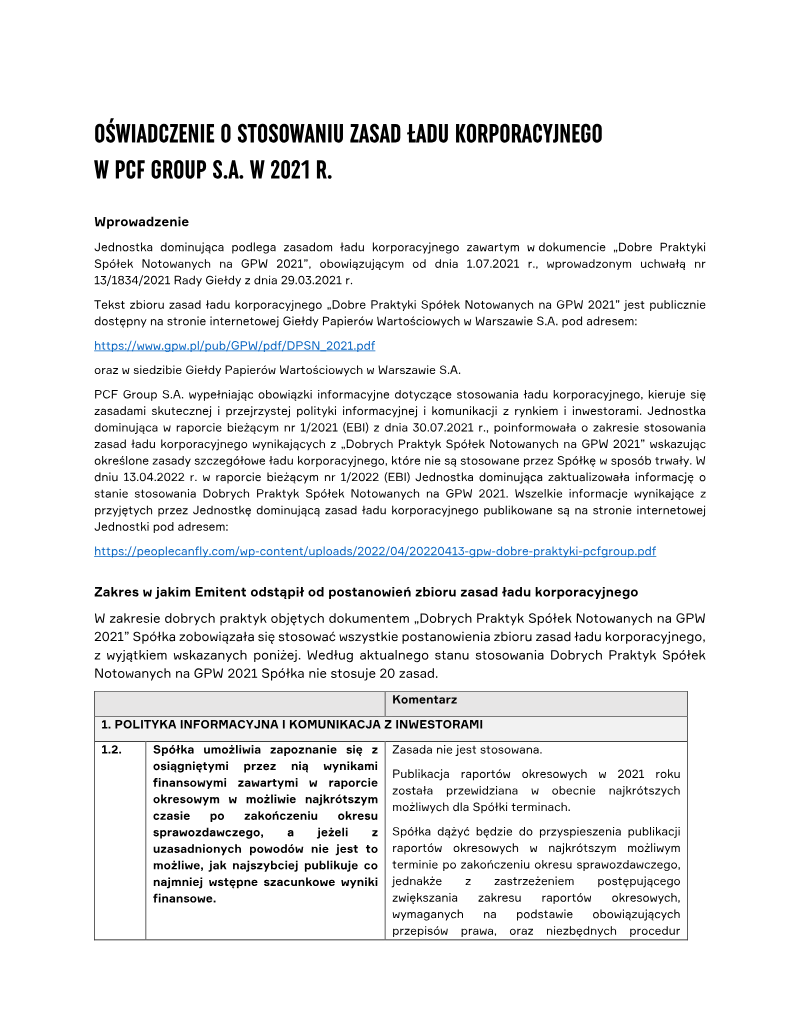
Statement on the Application of Corporate Governance Principles in PCF Group S.A. 2021
PCF Group S.A. navigated its first full year as a listed entity in 2021 by balancing the "Best Practice for GPW Listed Companies 2021" with the operational demands of a rapidly expanding AAA video game developer. While the organization committed to these governance standards, it formally opted out of twenty specific principles, primarily regarding ESG integration, formalized diversity policies, and internal audit structures. Management justifies these deviations by prioritizing professional qualifications over demographic quotas and citing the specialized nature of the gaming industry, though it maintains high workplace standards through LEED-certified facilities and informal risk management systems.
The governance framework is characterized by significant concentrated control held by a "Group of Authorized Shareholders" led by Sebastian Wojciechowski. This group retains 70.65% of voting rights and possesses personal rights to appoint a majority of the Supervisory Board, provided they maintain a 40% ownership threshold. Furthermore, Wojciechowski holds the personal right to appoint the President of the Management Board, a body he led as a single-person entity throughout 2021. While no formal restrictions on voting rights exist, a substantial portion of Series A shares remains subject to four-year lock-up agreements following the 2020 initial public offering.
Financial oversight and transparency are managed through a five-member Supervisory Board and an Audit Committee featuring independent experts in finance and gaming. Although the company lacked a dedicated internal audit department in 2021, the Management Board maintained financial reporting risk systems that received no negative feedback from external auditor Grant Thornton. The organization is currently transitioning toward higher transparency standards, with plans to implement real-time streaming of general meetings and more formalized internal reporting to align with evolving regulatory expectations for public companies in Poland.
- A group of authorized shareholders led by Sebastian Wojciechowski maintains 70.65% of voting rights and holds the personal authority to appoint a majority of the Supervisory Board.
- PCF Group S.A. formally opted out of 20 governance principles from the 'Best Practice for GPW Listed Companies 2021', specifically citing ESG integration, diversity policies, and internal audit structures.
- Sebastian Wojciechowski exercised significant centralized control in 2021 by serving as the sole member of the Management Board and holding the personal right to appoint its President.
- The company operated without a dedicated internal audit department in 2021, relying instead on financial reporting risk systems that received no negative feedback from external auditor Grant Thornton.
- A substantial portion of Series A shares remains subject to four-year lock-up agreements established during the company's 2020 initial public offering.
+1
PCF GroupApr 2022
Legal2 pages
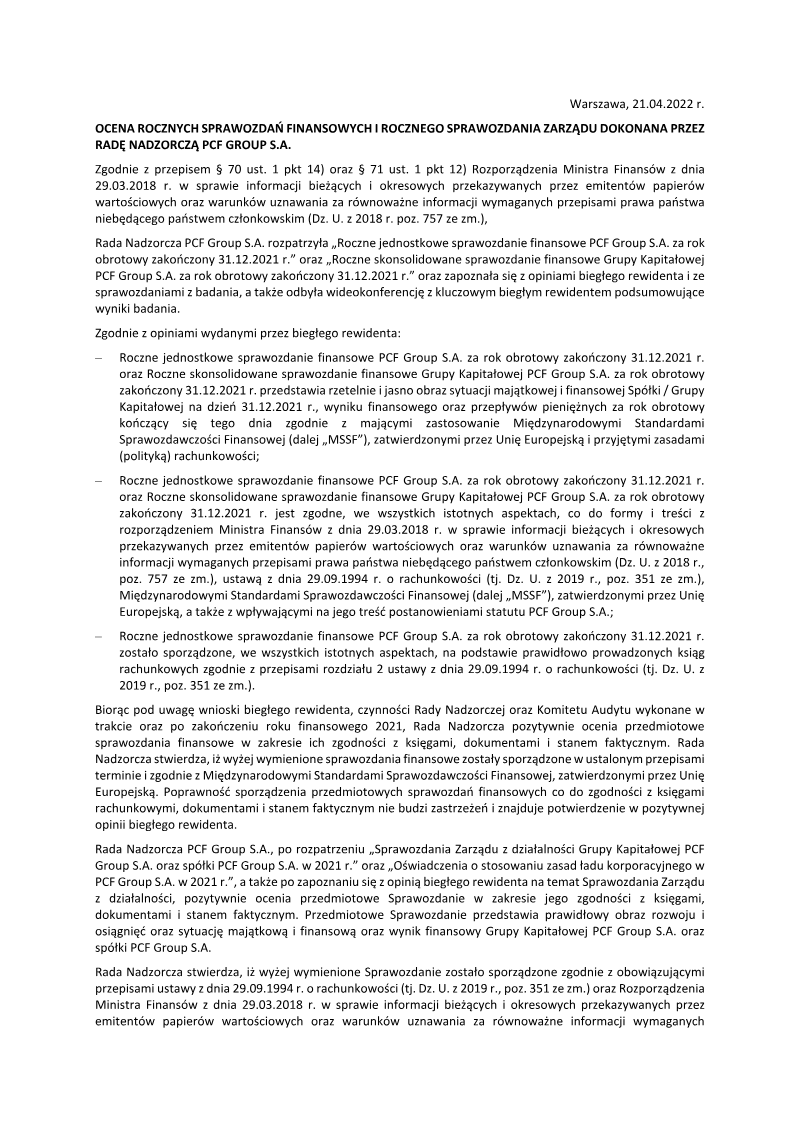
Ocena Rocznych Sprawozdań Finansowych i Roczne Sprawozdanie Zarządu: 2021
The Supervisory Board of PCF Group S.A. issued a formal evaluation of the company’s individual and consolidated financial statements for the fiscal year ending December 31, 2021. The primary purpose of this assessment is to verify the accuracy, legality, and reliability of the financial data and the Management Board’s report on activities. This evaluation serves as a critical governance step for the Warsaw-based game development group, ensuring compliance with Polish financial regulations and International Financial Reporting Standards (IFRS) as adopted by the European Union.
The findings confirm that the financial statements provide a fair and clear view of the Group’s assets, financial position, and cash flows. The Supervisory Board’s positive opinion is supported by an independent auditor’s review and a subsequent video conference with the key auditor to discuss the results. The audit concluded that the financial records were maintained correctly in all material respects and that the reports were prepared in accordance with the Accounting Act and the Regulation of the Minister of Finance regarding current and periodic information for securities issuers.
Beyond the quantitative financial data, the Supervisory Board evaluated the Management Board’s report on the activities of the PCF Group and the company’s statement on corporate governance for 2021. The assessment concludes that these narrative reports are consistent with the financial statements and free from material misstatements. The documentation accurately reflects the development, achievements, and financial results of the Group, while the corporate governance statement was found to include all legally required components. This formal approval validates the transparency of the Group’s operations during the 2021 period.
- The Supervisory Board of PCF Group S.A. formally approved the company’s individual and consolidated financial statements for the fiscal year ending December 31, 2021.
- An independent audit confirmed that the financial records were maintained in accordance with the Accounting Act, the Regulation of the Minister of Finance, and International Financial Reporting Standards (IFRS).
- The Supervisory Board verified that the financial statements provide a fair and accurate representation of the Group’s assets, financial position, and cash flows.
- The Management Board’s report on activities for 2021 was found to be consistent with the financial statements and free from material misstatements.
- The company’s corporate governance statement for 2021 was assessed and confirmed to include all legally required components.
+1
PCF GroupApr 2022
Legal1 pages
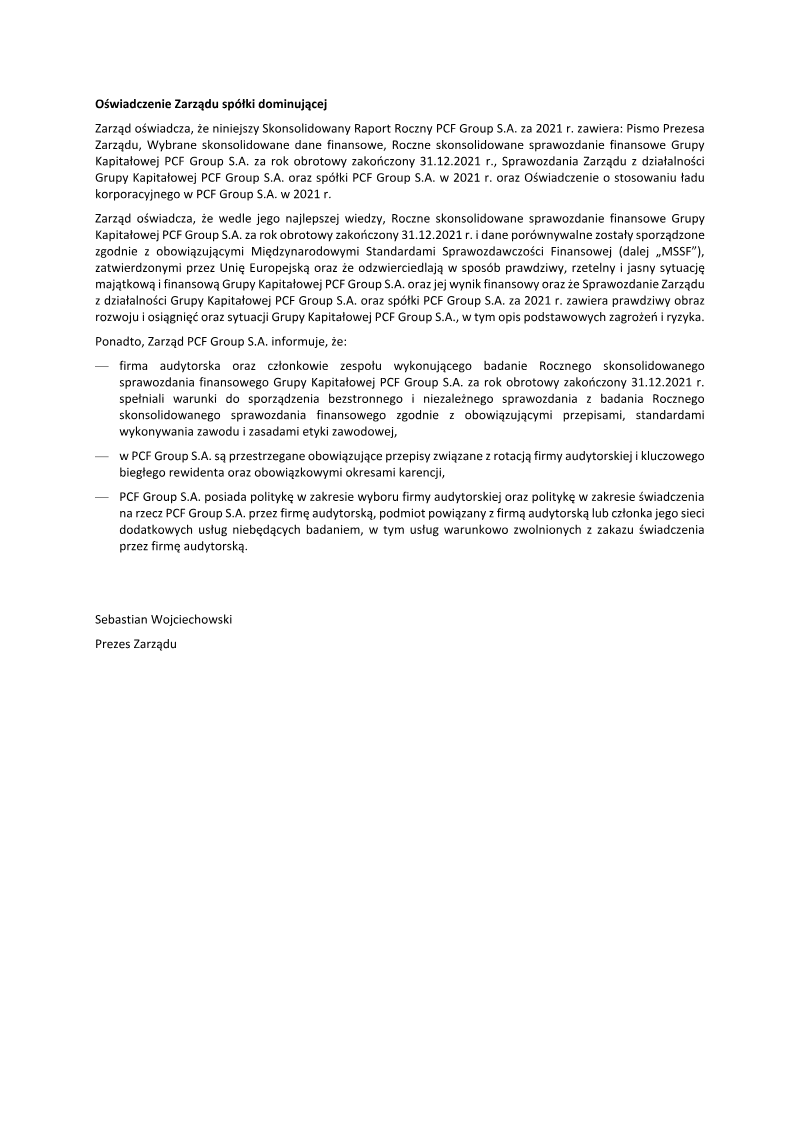
Skonsolidowany Raport Roczny PCF Group S.A. za 2021 r.
The 2021 fiscal year for PCF Group S.A. represents a period of formal financial consolidation and strategic reporting following its operations as a major international game developer. The primary focus of the annual disclosure is to provide a transparent overview of the Group’s financial health, asset situation, and operational results for the period ending December 31, 2021. This reporting period is characterized by the application of International Financial Reporting Standards as adopted by the European Union, ensuring that the data reflects a reliable and clear image of the company’s economic standing and development trajectory.
Key findings indicate a commitment to rigorous corporate governance and audit independence. The Group emphasizes that its financial statements and the accompanying management reports accurately depict the achievements and risks inherent in its business model. This includes a comprehensive assessment of the development progress within its portfolio and the identification of fundamental threats and risks that could impact future performance. The scope of the report covers the entirety of the PCF Group Capital Group, including the parent company and its subsidiaries, providing a holistic view of its global footprint in the PCF (People Can Fly) ecosystem.
Methodologically, the financial data is verified by an independent auditing firm, adhering to strict professional ethics and mandatory rotation regulations. The management board confirms that the selection of auditors and the provision of non-audit services follow established internal policies designed to maintain impartiality. By integrating detailed financial data with strategic management commentary, the Group aims to provide stakeholders with a definitive account of its operational stability and its capacity for growth within the competitive global gaming industry.
- The 2021 consolidated annual report for PCF Group S.A. covers the financial and operational status of the parent company and its global subsidiaries as of December 31, 2021.
- Financial statements were prepared in accordance with International Financial Reporting Standards (IFRS) as adopted by the European Union to ensure standardized reporting.
- The report provides a comprehensive assessment of the People Can Fly (PCF) ecosystem, detailing development progress across the company's game portfolio.
- Management identified fundamental business risks and threats that could impact the Group's future performance and long-term growth trajectory.
- Financial data underwent verification by an independent auditing firm, with the management board confirming adherence to strict corporate governance and auditor independence regulations.
+1
PCF GroupApr 2022
Legal1 pages
Raport Roczny PCF Group S.A. za 2021 r.
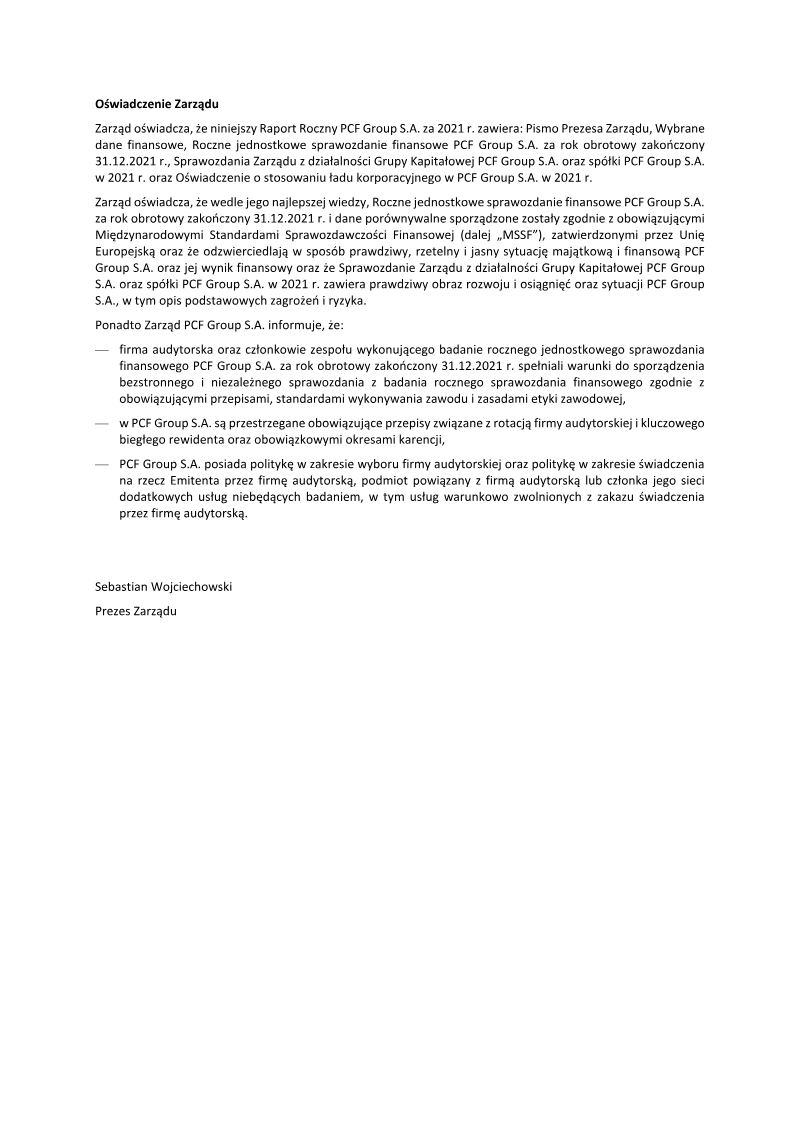
The 2021 annual financial results for PCF Group S.A. reflect a period of significant operational development and corporate governance adherence for the Polish game development studio. The primary objective of the disclosure is to provide a transparent overview of the company’s financial health, asset situation, and management performance for the fiscal year ending December 31, 2021. This reporting period is characterized by the group’s transition into a publicly traded entity following its earlier market debut, focusing on the execution of its multi-project strategy and the expansion of its global development capabilities.
Financial data presented in the report was prepared in accordance with International Financial Reporting Standards as adopted by the European Union. The findings confirm that the company maintained a stable financial position while navigating the risks inherent in the AAA game development sector. Key components of the reporting include the individual financial statements of the parent company and the consolidated performance of the capital group, which encompasses various international subsidiaries. The management emphasizes that the results provide a fair and clear view of the group’s achievements and development trajectory during the year.
A significant portion of the documentation focuses on compliance and the integrity of the auditing process. The board confirms that the selection of the auditing firm and the conduct of the financial review met all legal requirements for impartiality and independence. Furthermore, the group adheres to strict policies regarding the rotation of auditors and the limitation of non-audit services to ensure professional ethics. This focus on corporate governance serves to mitigate risk and provide assurance to shareholders regarding the reliability of the reported financial outcomes and the group’s long-term strategic stability.
- PCF Group S.A. maintained a stable financial position throughout the 2021 fiscal year while operating as a publicly traded entity.
- The company focused on executing a multi-project strategy and expanding its global development capabilities during the 2021 reporting period.
- Financial statements for the fiscal year ending December 31, 2021, were prepared in accordance with International Financial Reporting Standards as adopted by the European Union.
- The reported financial results encompass both the individual performance of the parent company and the consolidated results of its international subsidiaries.
- Management implemented strict corporate governance policies, including auditor rotation and limitations on non-audit services, to ensure financial integrity and shareholder assurance.
+1
PCF GroupApr 2022
Legal18 pages
Informacja o Stanie Stosowania Dobrych Praktyk 2021
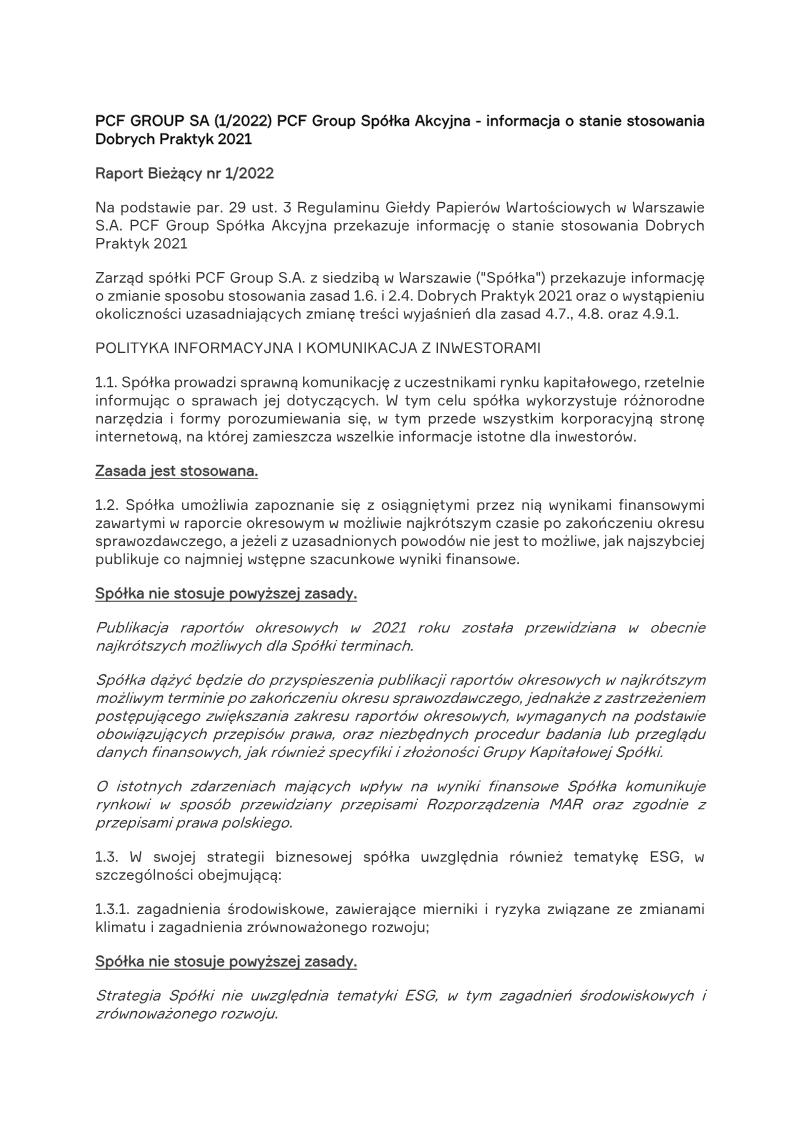
PCF Group S.A. demonstrates a governance strategy that balances standard public company transparency with the specific operational realities of a high-end AAA game development studio. While the firm adheres to the majority of the 2021 Best Practices for GPW Listed Companies, it intentionally diverges from several key recommendations regarding environmental, social, and governance (ESG) integration and board composition. Specifically, the company rejects formalized gender diversity quotas, such as the recommended thirty percent threshold for management and supervisory boards, opting instead for a merit-based recruitment model. Furthermore, it does not currently publish detailed ESG performance metrics, citing the relatively low environmental impact inherent to the digital entertainment industry.
Operational governance reveals a reliance on lean internal structures, which results in certain compliance gaps. The company lacks dedicated departments for internal audit and risk management, preventing the Supervisory Board from providing formalized assessments of internal controls. While the firm maintains robust investor communication and independent oversight, it does not yet offer electronic participation in general meetings or provide preliminary financial estimates. These omissions are attributed to perceived technical and legal risks, though there is a stated intent to evaluate electronic meeting capabilities in the future.
Recent adjustments indicate a move toward closer alignment with regulatory expectations. The company committed to implementing live broadcasts of general meetings and has updated its internal regulations to require supervisory review of all management board resolutions. Future incentive programs are expected to incorporate both financial and non-financial objectives, ensuring that executive compensation remains tied to long-term sustainability. Overall, the governance profile reflects a transition period for the developer as it matures within the public market while maintaining its focus on technical excellence and meritocracy over rigid administrative frameworks.
- PCF Group S.A. rejects formalized gender diversity quotas for management and supervisory boards, prioritizing a merit-based recruitment model instead.
- The company lacks dedicated internal audit and risk management departments, preventing the Supervisory Board from providing formalized assessments of internal controls.
- PCF Group S.A. does not currently publish detailed ESG performance metrics, citing the low environmental impact of the digital entertainment industry.
- The firm does not provide electronic participation in general meetings or preliminary financial estimates, citing perceived technical and legal risks.
- Governance adjustments include a new requirement for supervisory review of all management board resolutions and a commitment to implement live broadcasts of general meetings.
+2
PCF GroupApr 2022
Legal17 pages
PCF Group Spółka Akcyjna – Informacja o stanie stosowania Dobrych Praktyk 2021
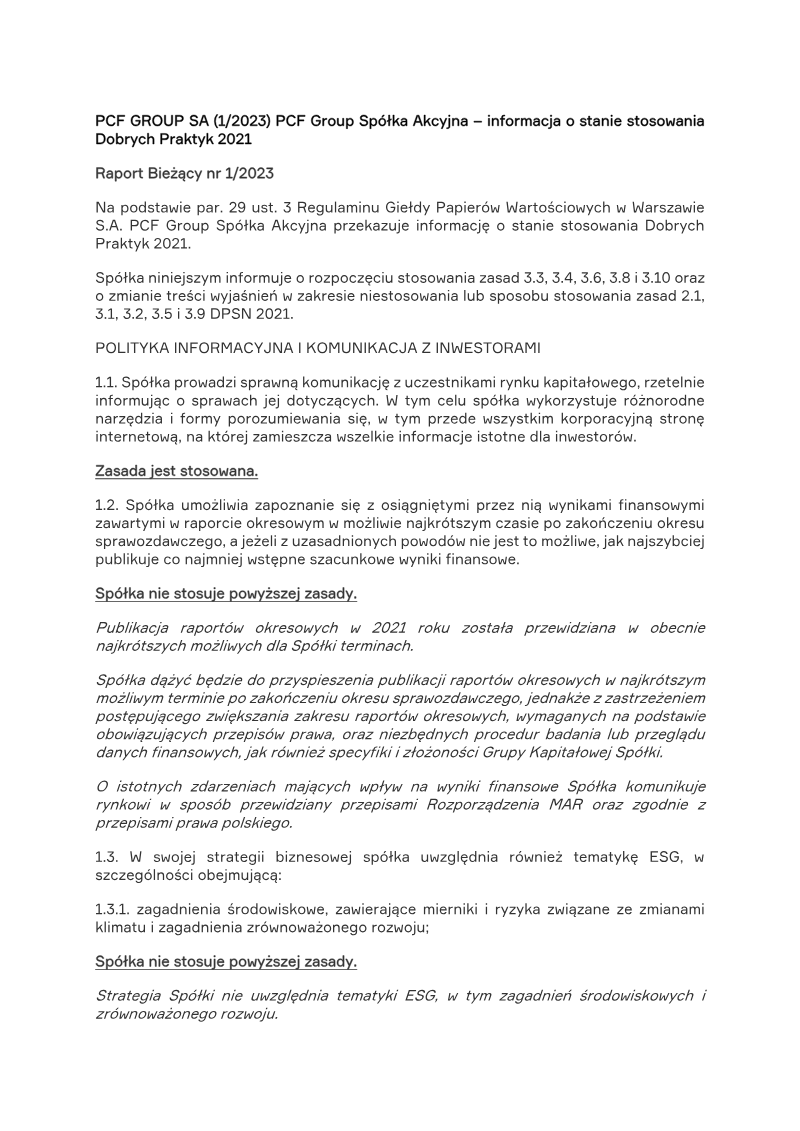
PCF Group SA maintains a selective approach to the 2021 corporate governance standards for companies listed on the Warsaw Stock Exchange, balancing regulatory expectations with the specific operational needs of a global AAA game developer. The governance framework emphasizes transparent investor communication, independent oversight, and shareholder accessibility. Notable implementations include the appointment of an internal auditor to oversee risk and compliance systems, the facilitation of electronic participation in general meetings, and the provision of real-time bilingual broadcasts for shareholders. While the company encourages dividend payments, such distributions remain contingent upon financial stability and the strategic necessity of reinvesting capital into development projects.
Strategic deviations from established best practices are primarily driven by the company’s assessment of its industry-specific impact and organizational size. Management has opted not to integrate formal ESG targets into its business strategy, asserting that game development carries a low environmental footprint. Furthermore, the company rejects formalized diversity quotas for its Board and Management, prioritizing specialized professional qualifications and technical expertise over demographic metrics. This philosophy extends to the decision not to publish a gender pay gap index, which the company argues would provide a misleading representation of its specialized employment structure.
Operational oversight remains centralized, with the company foregoing separate departments for risk management and compliance in favor of integrated internal controls. While the company lacks a formalized long-term incentive program, it maintains a commitment to aligning future compensation structures with sustainable value growth. These governance choices reflect a prioritization of professional meritocracy and operational flexibility over the adoption of standardized administrative frameworks, ensuring that corporate policies remain aligned with the specific demands of the high-budget software development sector.
- PCF Group SA maintains a selective approach to 2021 Warsaw Stock Exchange corporate governance standards, prioritizing operational flexibility for AAA game development over standardized administrative frameworks.
- The company rejects formalized ESG targets and gender pay gap reporting, citing a low environmental footprint and the potential for misleading data due to its specialized employment structure.
- Management explicitly rejects diversity quotas for the Board and Management, opting instead for a philosophy centered on professional meritocracy and technical expertise.
- Operational oversight is centralized through integrated internal controls rather than separate risk management and compliance departments, with an internal auditor appointed to oversee these systems.
- Dividend distributions are not guaranteed, as the company prioritizes the reinvestment of capital into strategic development projects to maintain financial stability.
+1
PCF GroupApr 2022
Legal1 pages
Raport Bieżący Nr 8/2022
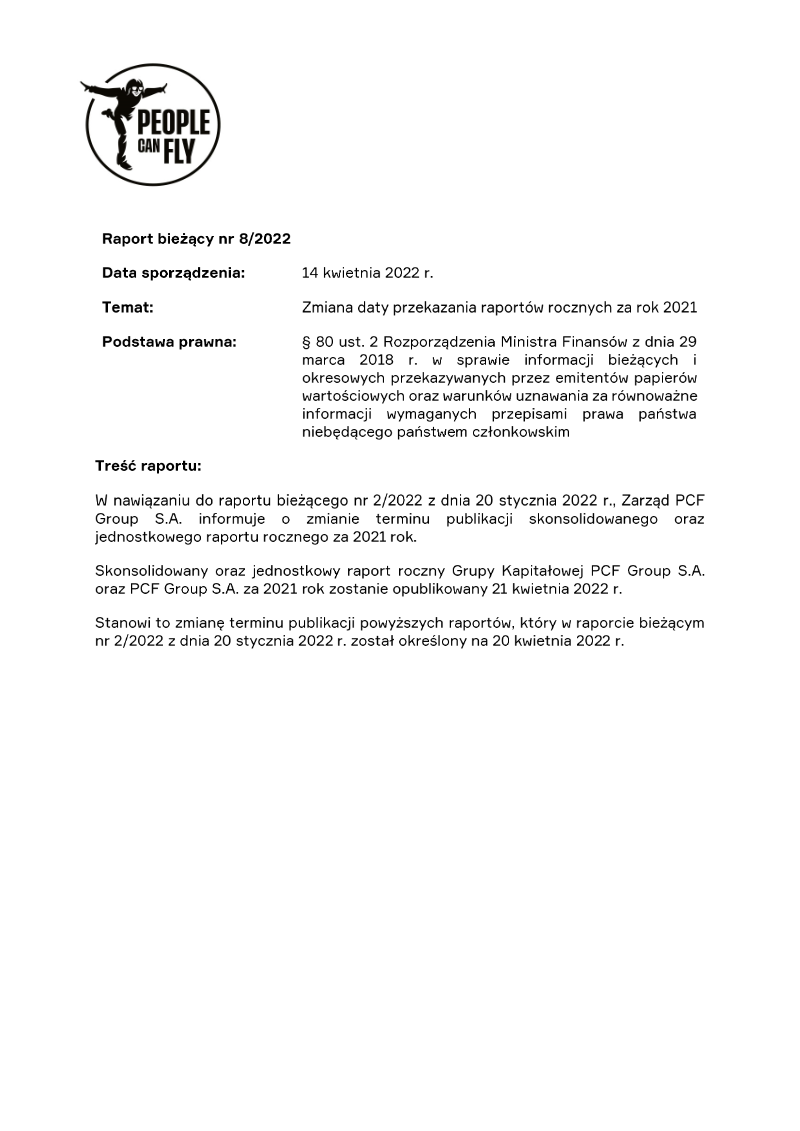
The Management Board of PCF Group S.A. has officially rescheduled the publication date for its 2021 annual financial results. This administrative adjustment affects both the standalone annual report for the parent company and the consolidated annual report for the entire PCF Group capital group. Originally slated for release on April 20, 2022, as established in a previous regulatory filing from January, the new publication date is set for April 21, 2022.
This disclosure serves as a formal update to the company’s financial calendar for the 2021 fiscal year. The scope of the announcement is limited to the timing of financial reporting for the Polish-based game development group, which is known for its global operations in the AAA shooter segment. The change represents a one-day delay in the dissemination of audited financial performance data to investors and the public.
The notification was issued in compliance with Polish financial regulations regarding periodic information provided by issuers of securities. By shifting the deadline, the company ensures that its reporting timeline remains transparent to the market. No specific reason for the twenty-four-hour postponement was provided in the communication, which focuses strictly on the revised schedule for the 2021 reporting cycle.
- PCF Group S.A. has rescheduled the publication of its 2021 annual financial results from April 20, 2022, to April 21, 2022.
- The delay applies to both the standalone annual report for the parent company and the consolidated annual report for the entire PCF Group capital group.
- The postponement represents a one-day shift in the dissemination of audited financial performance data to investors and the public.
- No specific reason was provided by the Management Board for the twenty-four-hour adjustment to the reporting schedule.
- The update serves as a formal revision to the company's 2021 fiscal year financial calendar.
+1
PCF GroupApr 2022
Legal5 pages
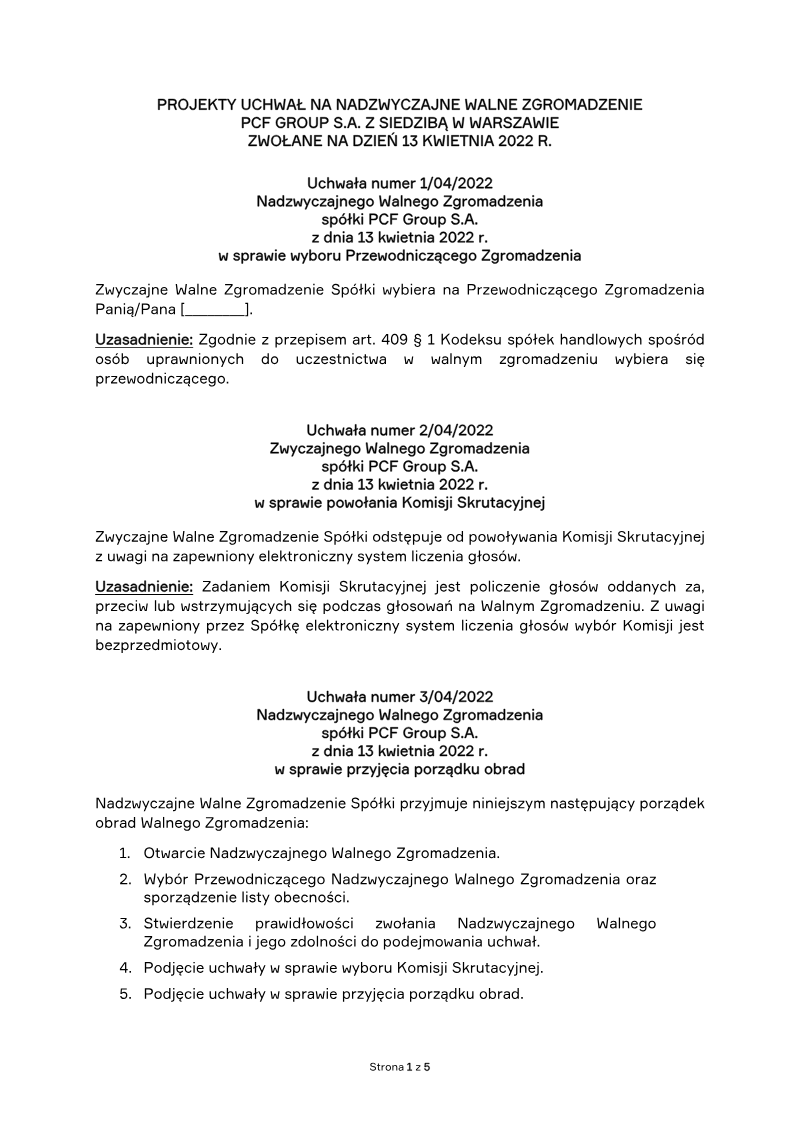
Draft Resolutions for the Extraordinary General Meeting
These draft resolutions outline the formal agenda and governance proposals for the Extraordinary General Meeting of PCF Group S.A., a Polish video game developer and publisher, scheduled for April 13, 2022. The primary purpose of the meeting is to formalize recent changes to the company’s Supervisory Board and to align internal regulations with the Best Practice for GPW Listed Companies 2021.
A central finding of the document is the proposed ratification of Dagmara Zawadzka as a member of the Supervisory Board. This appointment follows the resignation of Aleksander Marcin Ferenc on March 3, 2022. Zawadzka was initially co-opted by the board on March 7, 2022, to maintain the required five-member minimum for public companies under the Polish Commercial Companies Code. The resolutions specify that she meets the independence criteria necessary for audit committee service.
The document also details significant amendments to the Supervisory Board's operating regulations. Key changes include a new requirement for the board to provide formal opinions on draft resolutions submitted by the Management Board for General Meetings. Additionally, the regulations are being updated to mandate open voting for all board resolutions, removing previous provisions for secret ballots in personnel matters to ensure compliance with current market transparency standards.
Procedural resolutions cover the appointment of a meeting chairperson, the waiver of a dedicated Scrutiny Committee in favor of an electronic voting system, and the confirmation that the company will bear all costs associated with convening the meeting. These actions reflect the administrative requirements for a publicly traded entity operating within the Polish legal framework and the Warsaw Stock Exchange environment.
- PCF Group S.A. scheduled an Extraordinary General Meeting for April 13, 2022, to formalize governance updates and board composition.
- Dagmara Zawadzka is proposed for formal ratification to the Supervisory Board, replacing Aleksander Marcin Ferenc who resigned on March 3, 2022.
- The Supervisory Board's operating regulations now mandate that the board must provide formal opinions on all draft resolutions submitted by the Management Board.
- Voting procedures for the Supervisory Board have been updated to require open voting for all resolutions, eliminating secret ballots for personnel matters to align with market transparency standards.
- The company is transitioning to an electronic voting system for the meeting, waiving the requirement for a dedicated Scrutiny Committee.
+2
PCF GroupApr 2022
Legal1 pages
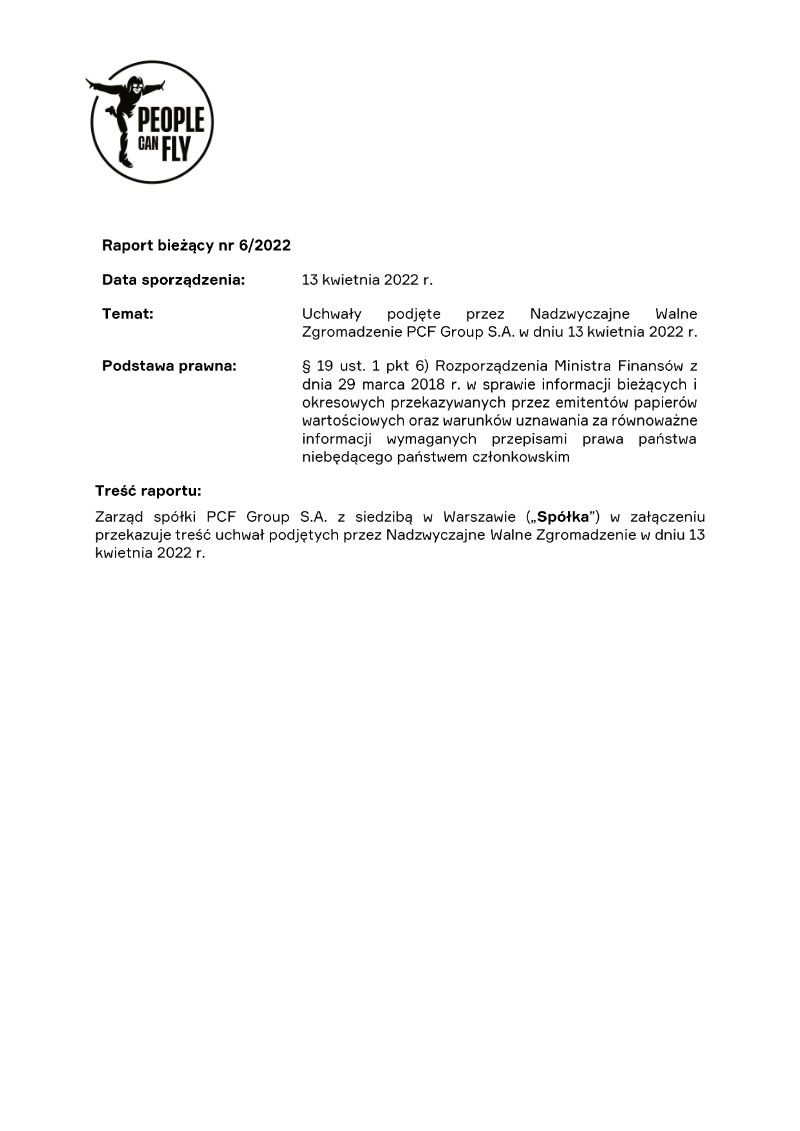
Raport Bieżący Nr 6/2022
The Extraordinary General Meeting of PCF Group S.A., held on April 13, 2022, resulted in the formal adoption of several corporate resolutions essential to the company’s governance and operational framework. This regulatory disclosure, issued from the company’s Warsaw headquarters, serves to fulfill legal transparency requirements for issuers of securities under Polish financial regulations. The primary focus of the meeting was to codify specific administrative and strategic decisions through a standardized voting process by the company’s shareholders.
The scope of the meeting covered internal corporate actions relevant to the 2022 fiscal period, specifically addressing the immediate governance needs of the Polish game development studio. While the summary of the proceedings confirms the passage of all proposed resolutions, the legal basis for the disclosure rests on the Minister of Finance’s ordinance regarding current and periodic information provided by securities issuers. This ensures that all stakeholders are informed of the official outcomes of the assembly in a timely manner.
Methodologically, the document reflects the results of a formal shareholder vote, though specific vote counts or the granular details of each resolution were handled as attachments to the primary announcement. The tone remains strictly neutral and administrative, reflecting the standard communication style of a publicly traded entity on the Warsaw Stock Exchange. These actions represent a routine but necessary component of PCF Group S.A.’s compliance and corporate management strategy within the broader European gaming industry.
- PCF Group S.A. held an Extraordinary General Meeting on April 13, 2022, to formalize key corporate governance and operational resolutions.
- All resolutions proposed during the April 13, 2022, meeting were successfully adopted by the company's shareholders.
- The meeting served to fulfill mandatory regulatory transparency requirements for securities issuers under Polish financial law.
- The proceedings focused on internal administrative and strategic decisions necessary for the company’s 2022 fiscal period.
- Detailed vote counts and granular resolution specifics were filed as attachments to the primary regulatory disclosure.
+1
PCF GroupApr 2022
Legal1 pages
Raport Bieżący Nr 7/2022
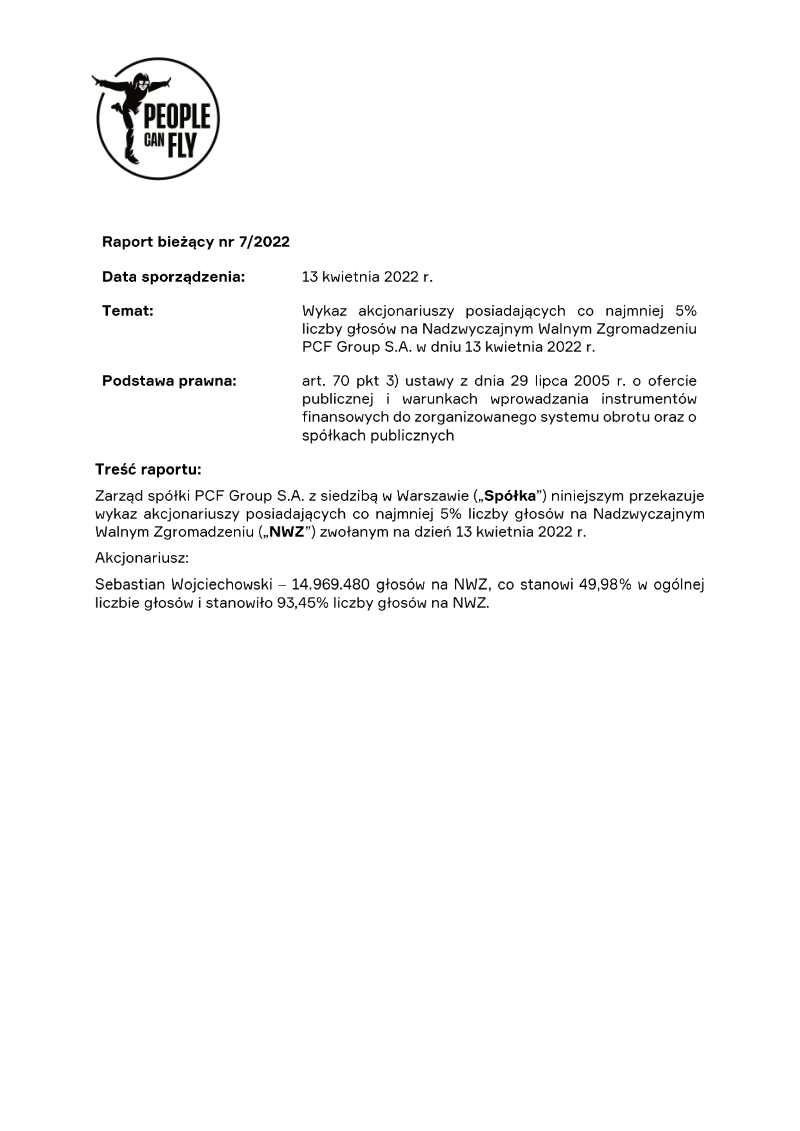
The disclosure outlines the shareholder structure and voting power distribution during the Extraordinary General Meeting of PCF Group S.A., held on April 13, 2022. This regulatory filing identifies the primary stakeholders who exercised significant influence during the proceedings, specifically focusing on those holding at least 5% of the total votes present at the assembly. The scope of the data is limited to this specific corporate event and reflects the ownership status of the Warsaw-based game development studio at that point in time.
The primary finding reveals a high concentration of voting power held by a single individual. Sebastian Wojciechowski accounted for 14,969,480 votes during the meeting. This figure represents 49.98% of the company’s total overall voting rights. However, based on the actual attendance at the Extraordinary General Meeting, this stake translated into a dominant 93.45% of the votes cast during the session. This indicates that while the shareholder holds nearly half of the company's total equity, their influence over the specific resolutions passed on this date was nearly absolute due to the absence or lower participation of other minority shareholders.
The methodology for this disclosure follows the legal requirements set forth in the Polish Act on Public Offering, which mandates transparency regarding significant voting blocks in public companies. By documenting these figures, the company provides clarity on its governance dynamics and the centralized nature of its decision-making authority during the spring of 2022. The report serves as a snapshot of the internal power structure of one of Poland’s prominent AAA game developers during a period of active corporate governance.
- At the April 13, 2022, Extraordinary General Meeting of PCF Group S.A., Sebastian Wojciechowski held 14,969,480 votes, representing 49.98% of the company's total voting rights.
- Due to low attendance by other shareholders, Sebastian Wojciechowski exercised 93.45% of the total votes cast during the meeting.
- The concentration of voting power allowed Sebastian Wojciechowski to exert near-absolute control over the resolutions passed at the April 2022 assembly.
- The disclosure was issued as 'Raport Bieżący Nr 7/2022' to comply with the Polish Act on Public Offering regarding transparency of significant voting blocks.
- The data reflects the governance structure of the Warsaw-based AAA game developer specifically as it stood during the spring of 2022.
+1
PCF GroupApr 2022
Legal10 pages
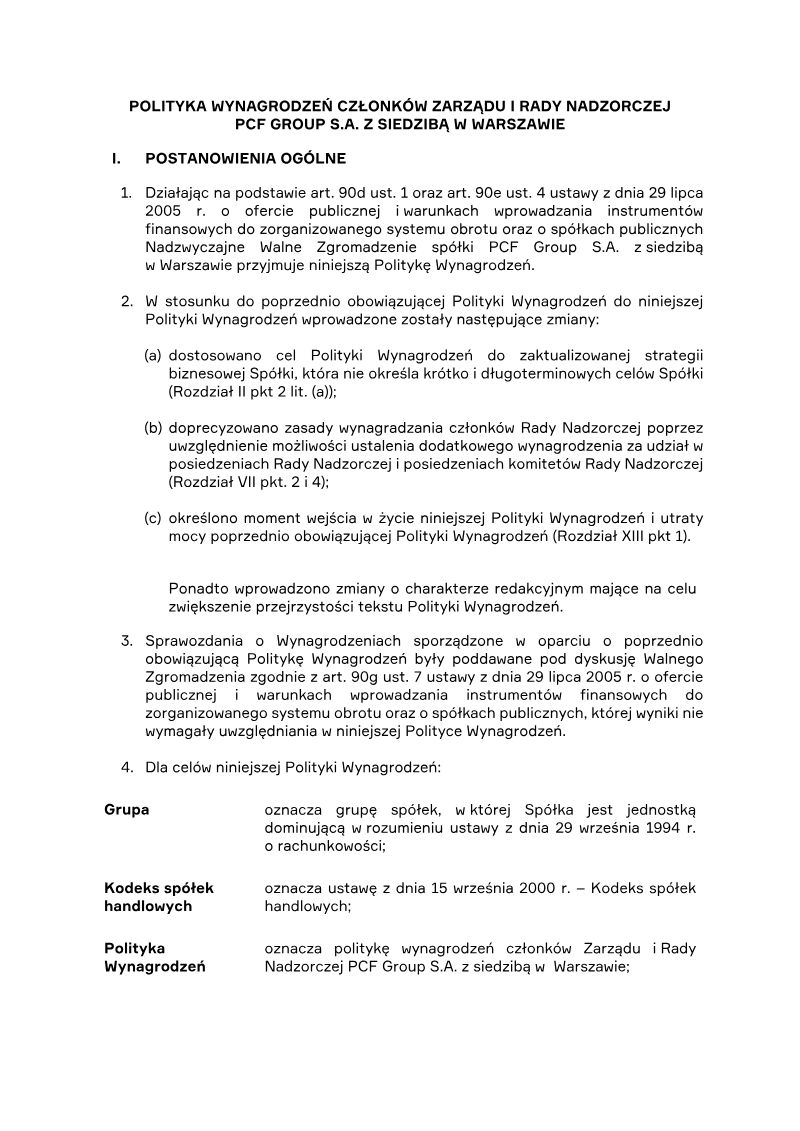
Polityka Wynagrodzeń Członków Zarządu i Rady Nadzorczej
The Remuneration Policy for PCF Group S.A., a Warsaw-based public company in the gaming industry, establishes a formal framework for compensating members of the Management Board and Supervisory Board. Adopted by the Extraordinary General Meeting, the policy aligns executive incentives with the company’s updated business strategy, long-term stability, and shareholder interests while mitigating conflicts of interest. It covers the parent company and its subsidiaries, ensuring that pay structures reflect market standards within the gaming sector and the specific responsibilities of each role.
Management Board compensation consists of fixed monthly pay, variable performance-based bonuses, and additional benefits. Variable remuneration is tied to specific financial and non-financial targets, such as net profit, stock price performance, strategic milestones, and game quality metrics. To ensure fiscal prudence, variable components are capped at five times the annual fixed salary. While the company does not currently issue stock-based incentives, the policy allows for the future implementation of share-based motivational programs subject to shareholder approval. Management contracts may include non-compete clauses with compensation for up to 12 months and notice periods generally ranging from three to 12 months.
Supervisory Board members receive fixed monthly fees determined by the General Meeting, regardless of the number of meetings held. The policy introduces the possibility of additional compensation for participation in specific board or committee meetings, such as the Audit Committee. Unlike the Management Board, Supervisory Board members do not receive variable performance-based pay or severance benefits upon dismissal.
The Supervisory Board is responsible for the annual preparation of a remuneration report, which must be audited by an external entity. The policy requires a formal review by the General Meeting at least every four years. Provisions are included for temporary derogation from these rules if necessary to protect the company's long-term financial viability or profitability, requiring a formal resolution by the Supervisory Board detailing the justification and duration of the exception.
- PCF Group S.A. caps variable performance-based bonuses for Management Board members at five times their annual fixed salary to ensure fiscal prudence.
- Management Board compensation comprises fixed monthly pay, variable bonuses tied to financial and non-financial metrics like game quality and stock performance, and additional benefits.
- Supervisory Board members receive only fixed monthly fees without performance-based pay or severance benefits, though they may earn additional compensation for committee participation.
- Management contracts include notice periods of three to 12 months and non-compete clauses providing compensation for up to 12 months.
- The policy permits the future implementation of share-based incentive programs for the Management Board, provided they receive formal shareholder approval.
+1
PCF GroupApr 2022