Korea Creative Content Agency
Association15 documents
Korean government agency for creative content industries. Publishes the Game Industry White Paper, Games Monitor, and esports data.
Documents
Report6 pages
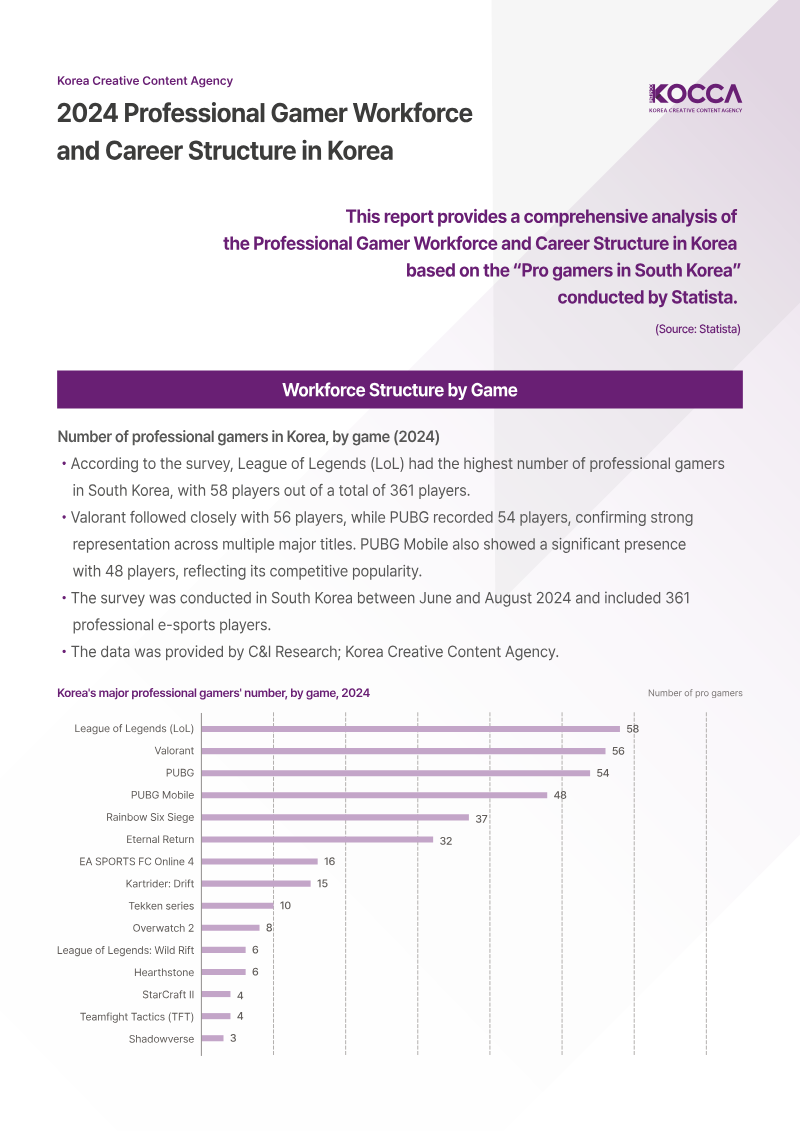
2024 Professional Gamer Workforce and Career Structure in Korea
The analysis aims to map the composition, demographics, career trajectories, and income streams of South Korea’s professional e‑sports workforce, drawing on Statista surveys conducted between June and November 2024. It covers domestic players across major titles, Korean competitors active in overseas leagues, and the age, tenure, and earnings profiles of a sample of 138 active professionals, providing a snapshot of the industry’s structure during the current competitive season.
Domestic data identify 361 professional gamers, heavily clustered around four titles: League of Legends (58 players), Valorant (56), PUBG (54) and PUBG Mobile (48). Smaller but notable presences include Rainbow Six Siege (37) and Eternal Return (32). Internationally, 372 Korean e‑sports athletes were reported competing abroad, with League of Legends accounting for 169 participants and Overwatch 2 for 108, while StarCraft II, Valorant and other games each contributed fewer than 30 players.
Age distribution reveals a predominance of young adults, as 37.7 % fall within the 22‑24 year bracket, followed by 29.7 % aged 25 and older, 23.9 % aged 20‑21, and 8.7 % under 19. Career length shows a polarized pattern: 29.7 % have six or more years of experience, while the
- South Korea’s professional e-sports workforce consists of 361 domestic players and 372 athletes competing in overseas leagues.
- League of Legends is the dominant title for Korean professionals, accounting for 58 domestic players and 169 athletes competing internationally.
- The professional player base is heavily concentrated in four domestic titles: League of Legends (58), Valorant (56), PUBG (54), and PUBG Mobile (48).
- Overwatch 2 serves as the second-largest destination for Korean talent abroad, with 108 players currently competing in international leagues.
- The workforce is primarily composed of young adults, with 61.6% of professionals aged 20 to 24 and only 8.7% under the age of 19.
+2
KOCCA – Korea Creative Content AgencyJan 2024
Report5 pages
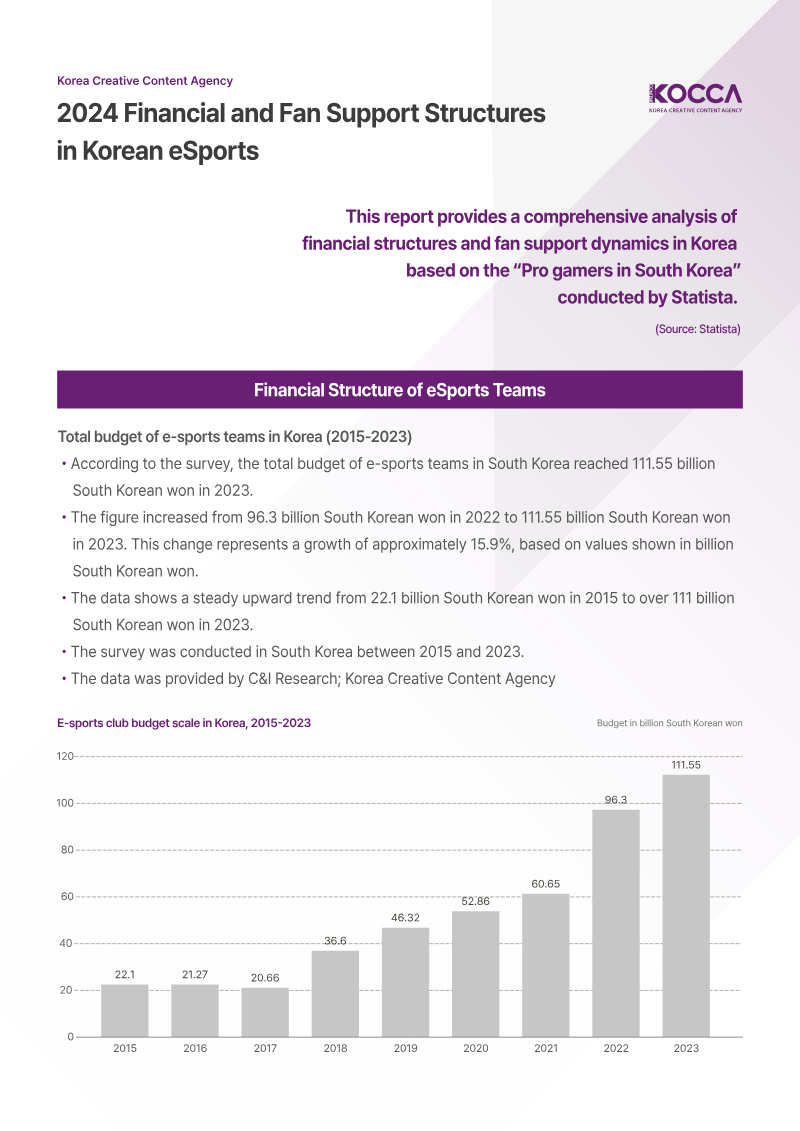
2024 Financial and Fan Support Structures in Korean eSports
The analysis examines the financial scale of Korean e‑sports organizations and the patterns of fan support, drawing on a longitudinal budget survey (2015‑2023) and two 2024 public opinion polls conducted across South Korea. It targets professional teams, the broader e‑sports audience aged ten and older, and the period from the mid‑2010s through mid‑2024, providing a comprehensive view of market growth and consumer behavior.
Budget data reveal a steady expansion, with total team expenditures rising from roughly 22.1 billion won in 2015 to 111.6 billion won in 2023—a near five‑fold increase over eight years. The most recent year alone saw a 15.9 % jump from 96.3 billion won in 2022, underscoring accelerating investment in the sector. These figures originate from C&I Research and are based on the Statista “Pro gamers in South Korea” survey.
Fan engagement remains modest: among 2,000 respondents surveyed between June and August 2024, only 35.3 % reported supporting a specific professional team, while 64.7 % did not align with any team. Of the 706 supporters who identified a favorite, T1 commanded an overwhelming 78.2 % share, with the runner‑up Gen.G attracting just 5.4 % and all other teams each receiving under 2 % of votes, indicating a highly concentrated fan base.
Motivational analysis shows that personal affinity for players drives support (48.6 %), followed by a positive perception of the team’s image (41.4 %). Interest in tactical or skill‑based aspects accounts for only 9.2 % of the rationale, highlighting the primacy of player appeal in shaping loyalty.
Overall, the sector demonstrates robust fiscal growth, yet the majority of the audience remains unaffiliated with specific teams, and fan allegiance is heavily skewed toward a single dominant organization. Player popularity emerges as the key lever for deepening fan commitment and expanding market participation.
- Korean e-sports team expenditures grew nearly five-fold between 2015 and 2023, rising from 22.1 billion won to 111.6 billion won.
- Market investment is accelerating, with total team spending increasing by 15.9% between 2022 and 2023 alone.
- Fan loyalty is highly concentrated, as T1 commands 78.2% of identified team supporters, while the runner-up Gen.G holds only 5.4%.
- The majority of the Korean e-sports audience remains unaligned, with 64.7% of 2024 survey respondents reporting no specific team affiliation.
- Player affinity is the primary driver of fan loyalty, accounting for 48.6% of support motivations, compared to just 9.2% for tactical or skill-based interest.
+1
KOCCA – Korea Creative Content AgencyJan 2024
Report7 pages
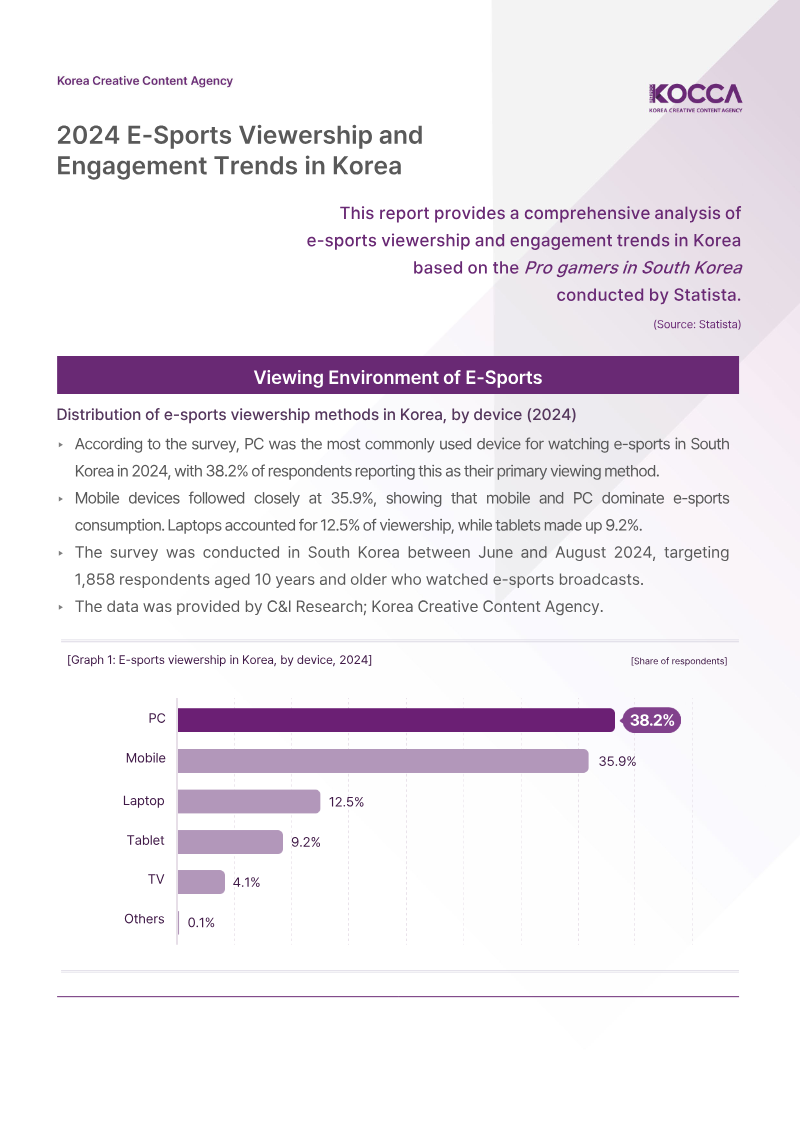
2024 E‑Sports Viewership and Engagement Trends in Korea
The analysis aims to map current e‑sports viewership and engagement patterns among South Korean audiences, highlighting how consumption devices, platforms, and motivations shape the market and indicating the potential for offline event conversion. Findings reveal a sharply concentrated viewing environment: personal computers account for 38.2 % of primary devices and mobile phones 35.9 %, together representing 74.1 % of usage, while laptops, tablets and televisions capture smaller shares. Platform preference is even more centralized, with YouTube commanding 78.5 % of respondents, far ahead of SOOP (14.1 %) and CHZZK (7.2 %).
Regularity of consumption is high; 38.5 % of participants watch e‑sports 1–2 times per week and 20.4 % watch 3–4 times weekly, meaning at least 58.9 % engage at least once a week. Weekday sessions cluster around one hour for the majority, whereas weekend viewing extends, with 22 % spending two hours on weekdays and 28.6 % doing so on weekends; longer sessions of five hours or more occur for 4.7 % of weekday viewers and 8.1 % of weekend viewers.
Motivational drivers are dominated by entertainment and self‑improvement: 62.1 % watch because the game is fun, 41.9 % seek to enhance their own gameplay, and 37.5 % cite stress relief. Additional reasons include boredom or free access (27.3 %), support for specific players (22.1 %), and social bonding with friends or coworkers (8.6 %).
The survey, conducted between June and August 2024, sampled 1,858 South Korean e‑sports viewers aged ten and older, with data supplied by C&I Research and the Korea Creative Content Agency. A clear majority—62.7 %—expressed willingness to attend live e‑sports events, while 26.9 % remain undecided and 10.4 %
- YouTube dominates the South Korean e-sports market with a 78.5% platform share, significantly outpacing competitors SOOP (14.1%) and CHZZK (7.2%).
- E-sports consumption is primarily mobile and desktop-driven, with PCs (38.2%) and mobile phones (35.9%) accounting for 74.1% of all viewing devices.
- Engagement is frequent and consistent, as 58.9% of viewers watch e-sports content at least once a week, with 20.4% watching 3–4 times weekly.
- Viewer motivation is driven primarily by entertainment (62.1%), gameplay improvement (41.9%), and stress relief (37.5%).
- There is strong potential for offline market growth, as 62.7% of the 1,858 surveyed viewers expressed a willingness to attend live e-sports events.
+1
KOCCA – Korea Creative Content AgencyJan 2024