
Game Developers Conference
Game Developers Conference (GDC, now the GDC Festival of Gaming) is the professional event for the games industry. It publishes recorded talks and interviews, annual industry survey reports such as the State of the Game Industry, and news articles.
Documents
Fostering Diversity in Games
Fostering diversity within the gaming industry necessitates a transition from passive rhetoric to intentional, systemic reform.
- Inclusive hiring and team composition are essential drivers of product quality and market resonance rather than just ethical considerations.
- Studios must move beyond passive rhetoric by implementing structural reforms such as blind application reviews and the removal of gendered language from job descriptions.
- Meaningful progress requires rigorous, ongoing auditing of internal processes, including recruitment, professional development, and conference attendance.
Helping Players Hate (or Love) Their Nemesis
The Nemesis system serves as a foundational design framework for fostering long-term, emotionally charged relationships between players and procedurally generated adversaries.
- The Nemesis system relies on a 'revenge loop' where time progresses after a player's death, forcing them to track down and re-engage enemies who have been promoted or changed by their victory.
- To foster deep antagonistic relationships, developers should aim for multi-encounter arcs; in Shadow of War, approximately 85% of captains are killed in one encounter, while 14% require two and 4% require three or more.
- Designers should prioritize visual impact around an enemy's head and shoulders, as these areas are more memorable to players than other body parts or equipment.
Understanding the Social Values of Your Players
Gaming companies can significantly enhance community engagement and corporate social responsibility by aligning initiatives with the core values of their global player base.
- Research involving 3,000 players across seven global regions indicates that gamers have a strong desire for social impact and leadership, signaling a shift toward developers fostering meaningful, data-informed connections.
- Utilizing the United Nations’ Sustainable Development Goals provides a structured framework for gaming companies to identify and align with player priorities such as mental health, quality education, and economic opportunity.
- Data-driven validation through focus groups and representative surveys of 400 players per region ensures that corporate charitable initiatives remain relevant and effective.
The 2016 Failure Workshop
The indie game development landscape is frequently defined by the psychological and operational hurdles that follow an initial success.
- Developers often trigger a 'sophomore slump' by over-engineering and succumbing to feature creep in an attempt to replicate previous successes.
- Avoiding early, unpolished feedback stifles the iterative process, leading to prolonged development cycles that lack a cohesive core.
- Strategic failure frequently results from a misalignment between a game’s core fantasy and its aesthetic presentation, causing target audiences to reject technically proficient products.
The Design of Everyday Games
User experience design functions as a holistic discipline that transcends mere interface aesthetics, encompassing the entire customer journey from initial marketing to long-term community engagement.
- User experience design must be treated as a holistic discipline that aligns service, community, and interface to create a cohesive, intuitive product journey.
- Interaction design should prioritize recognition over recall by using explicit labels and standard navigation patterns rather than ambiguous icons or non-standard layouts.
- Developers must employ a rigorous, iterative process based on observation, contextual inquiry, and frequent playtesting to ensure the product meets actual user needs rather than assumed behaviors.

Game a Week: Teaching Students to Prototype
The Game a Week pedagogical model serves as a transformative framework for game design education, prioritizing rapid iteration over the perfectionism that often leads to creative stagnation.
- The 'Game a Week' pedagogical model mandates the development of a new game prototype every seven days to prioritize rapid iteration over perfectionism.
- Institutions including NYU and RMIT utilize this high-pressure framework to force students to abandon over-commitment to singular projects and embrace a cycle of experimentation.
- The curriculum uses strict deadlines and thematic constraints to teach students the essential industry skill of scoping projects to fit limited timeframes.
Partnership on Darkest Dungeon: The Double-Edged Sword
The 50/50 co-presidency model in game development functions as a high-stakes balancing act that requires constant navigation of competing egos and divergent decision-making styles.
- Establish a zero-tolerance policy for unresolved tension: if a disagreement or negative feeling persists for more than 24 hours, the affected partner is obligated to raise and discuss the issue immediately.
- Implement a mutual veto power system to ensure both partners have final say, which helps reduce the pressure to micromanage and provides security that the project will not move in an unwanted direction.
- Use 'devil's advocacy' as a formal decision-making tool by intentionally arguing for positions you do not believe in to stress-test ideas and uncover potential flaws.
PLAYERUNKNOWN: From Mod Creator to Creative Director of PUBG
Brendan Greene’s trajectory from a photographer and designer to the Creative Director of PUBG illustrates the transformative power of modding culture in modern game development.
- PUBG achieved rapid commercial success by selling 40 million copies and reaching 3 million concurrent players within its first year of release.
- The game’s core mechanics, including the shrinking play zone, originated from Brendan Greene’s iterative development of Battle Royale mods for the Arma series.
- Development prioritized emergent gameplay and community feedback over rigid design documentation, allowing for the integration of unintended features like the bulletproof frying pan.

The Future of Storytelling: How Medium Shapes Story
Video games currently face a significant creative plateau, having achieved remarkable technical sophistication while failing to produce narratives that resonate with the cultural longevity of classic literature or theater.
- The game industry is currently experiencing a creative plateau, characterized by an over-reliance on action-oriented mechanics that prioritize physical interaction over social complexity.
- Interactive storytelling is shifting from disposable avatars toward persistent virtual companions that utilize natural language processing and emotional sensing to evolve alongside the user.
- Future narrative design must move beyond static, scripted experiences to embrace technologies that allow games to actively listen to and interpret player input.
All Style, All Substance: The Audio Journey of the Vanity and Traversal System for Sunset Overdrive
The audio development for Sunset Overdrive centers on the creation of a highly responsive, dynamic soundscape that reinforces player agency and stylistic expression.
- The audio system dynamically shifts from realistic Foley to stylized, cartoon-inspired effects based on the player’s traversal momentum and combo-based 'Level of Awesome'.
- To manage 10,000+ audio assets efficiently, the team replaced manual animation tagging with an event-driven configuration file system.
- The technical architecture supports 29 clothing types and 13 surface interactions while maintaining a strict memory footprint of 2.88 MB.
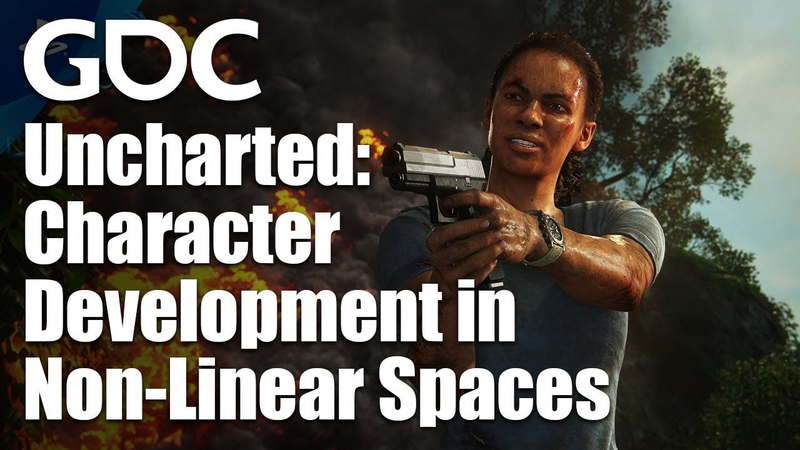
Character Development in Non-Linear Spaces: Uncharted: The Lost Legacy
The development of Uncharted: The Lost Legacy represents a significant evolution in narrative design, specifically regarding the integration of character-driven storytelling within non-linear, open-world environments.
- To maintain a cohesive narrative in non-linear environments, developers anchored critical story milestones to specific, standardized architectural locations that trigger regardless of the player's chosen path.
- The team utilized a modular dialogue system that decoupled incidental interactions from primary story beats, allowing character relationships to evolve organically during free-roaming exploration.
- The narrative architecture employed segmented conversations tied to key landmarks, using neutral dialogue that dynamically shifts based on the player’s progress to ensure a consistent character trajectory.
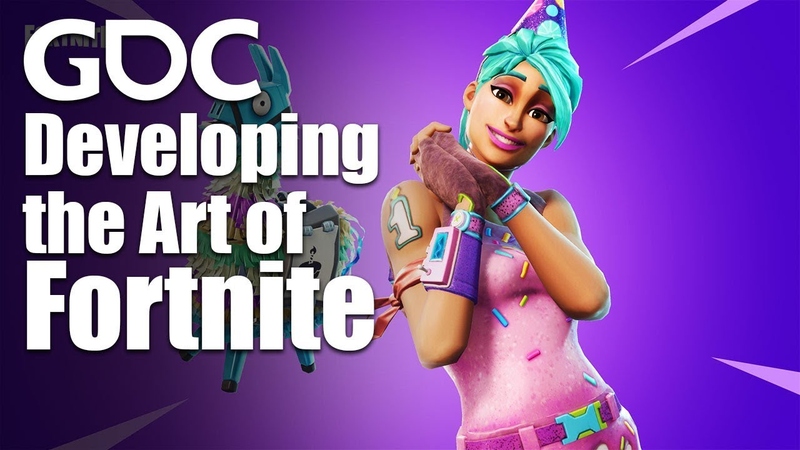
Developing the Art of Fortnite
Fortnite originated as a gritty, realistic survival horror title before undergoing a fundamental artistic pivot toward a vibrant, stylized aesthetic.
- The Fortnite art team transitioned from a realistic, high-fidelity aesthetic to a stylized approach to better support long-term, live-service, free-to-play requirements.
- To maintain gameplay clarity, the team prioritized exaggerated, expressive shape language over realism, ensuring that character silhouettes and weapon designs remained readable during third-person combat.
- The team utilized a modular, grid-based building system but integrated gestural, stylized forms into individual assets to maintain a cohesive visual identity despite the rigid structural constraints.