
Game Developers Conference
Game Developers Conference (GDC, now the GDC Festival of Gaming) is the professional event for the games industry. It publishes recorded talks and interviews, annual industry survey reports such as the State of the Game Industry, and news articles.
Documents
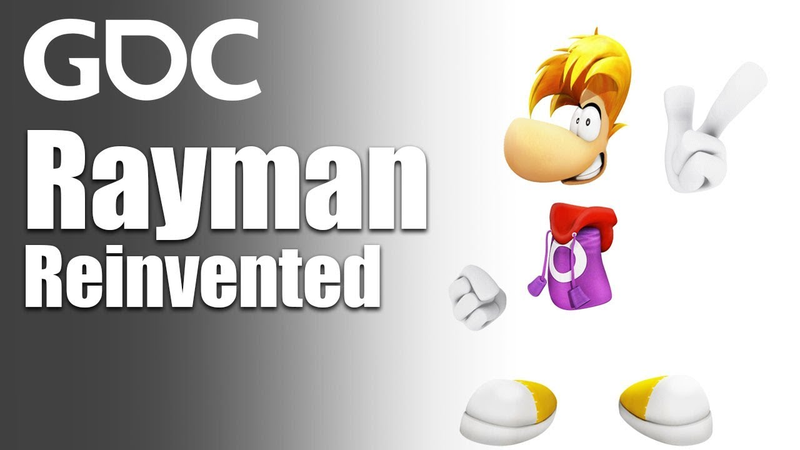
Rayman Reinvented
Ubisoft Montpellier’s revitalization of the Rayman franchise centers on a strategic return to 2D platforming, prioritizing accessibility and iconic character design through the implementation of the proprietary UbiArt Framework.
- Ubisoft developed a proprietary 2D animation engine called UbiArt Framework to allow artists to import their original concept drawings directly into the game, preserving the artistic essence without the need for traditional 3D modeling.
- The UbiArt system utilizes a mesh-based deformation technique where artists place bones on 2D assets, enabling them to animate and deform drawings in real-time to create complex movements from simple 2D elements.
- The animation pipeline is highly efficient, allowing a single animator to produce approximately 250 character animations in just two weeks by reusing and deforming existing assets.
Game Design Case Studies - One Designer | One Game | One System
Procedural generation and physics-based control systems represent two of the most significant challenges in modern game design, requiring a delicate balance between algorithmic automation and intentional player experience.
- Successful procedural generation in roguelikes requires combining multi-stage algorithms, such as cellular automata and critical path analysis, with hand-built content to avoid repetitive or hollow player experiences.
- Physics-based games must bridge the gap between simulation sluggishness and responsive control by using hybrid solutions like PID controllers for object stabilization combined with anticipatory animations.
- Strategic depth in complex systems is best achieved by moving beyond perfect mathematical balance; intentionally under-costing specific items can prevent stagnation and drive active player engagement.

The 2018 Indie Soapbox
The 2018 Indie Soapbox serves as a manifesto for redefining the purpose of game development, advocating for a shift away from industry-standard metrics like optimization and content consumption toward experiences rooted in cultural relevance, personal transformation, and social impact.
- Developers should prioritize cultural relevance, personal transformation, and social impact over industry-standard metrics like optimization and content consumption.
- Inclusive design must move beyond traditional demographics to actively represent people of color and gender-diverse individuals while addressing physical accessibility.
- Creators should eliminate barriers such as repetitive motion requirements and poor UI/UX to prevent the alienation of players living with chronic pain.
The State and Future of Board Games: From Apps to "Legacies"
The board game industry is currently undergoing a period of rapid expansion, marked by a market valuation exceeding $1 billion and the release of over 3,500 titles in 2017.
- The board game industry is experiencing rapid, sustained growth, with over 3,500 new titles being released annually.
- App-integrated board games are an emerging category that utilizes digital components to augment physical play, though they face resistance from players who prefer to avoid screens during tabletop sessions.
- Legacy games, which involve permanent physical alterations to components over a series of sessions, are becoming a permanent design tool rather than a passing trend, appealing to players accustomed to long-form video game campaigns.
Don't Break the Chain: Maintaining Productivity on Your 19th Game
Sustainable productivity in game development relies on transitioning from erratic, high-stress crunch cycles toward disciplined, long-term habits.
- Sustainable productivity is achieved by limiting high-intensity development to four or five hours per day rather than relying on unsustainable, high-stress crunch cycles.
- The 'Don't Break the Chain' methodology prioritizes small, consistent daily progress over the erratic bursts of effort that often lead to burnout.
- Physical tools like kitchen timers and loose-leaf paper are effective for enforcing structured breaks and preventing the productivity loss associated with multitasking.
Cinematic Games Are Dead! Long Live Cinematic Games!
The concept of cinematic games has historically been defined by a desire to bridge the representation gap between film and interactive media, often through the adoption of traditional cinematic conventions like dramatic camera angles, cuts, and full-motion video.
- Effective cinematic games should prioritize the feeling of inhabiting a world through game-specific mechanics rather than mimicking traditional film techniques like camera angles or cuts.
- Narrative design should function as interface design, where the core fantasy of a source material is mapped directly to player-controlled mechanics.
- In the development of Fantasia: Music Evolved, the team successfully translated the film's core fantasy of controlling magic into gesture-based gameplay using Kinect motion-tracking.

Supercharged! Vehicle Physics in Skylanders
The development of vehicle physics for Skylanders Superchargers centered on balancing high-fidelity simulation with the accessibility required for a fast-paced, designer-driven gameplay experience.
- The development team implemented a 200Hz sub-stepping system with Euler integration to ensure consistent physics performance and prevent ground penetration across variable frame rates.
- Engineers adopted a hybrid architecture that decoupled complex physics variables from designer-controlled, curve-based inputs to balance high-fidelity simulation with accessible gameplay.
- A data-driven collision response system was utilized to separate pre-simulation physics adjustments from post-simulation gameplay effects, ensuring stability when interacting with destructible objects and diverse terrain.

Denial of Service Mitigation
Denial-of-service attacks represent a critical vulnerability for the gaming industry, as the requirement for low-latency, stateful UDP connections makes game servers uniquely susceptible to disruption.
- Game servers are uniquely vulnerable to denial-of-service attacks due to their reliance on low-latency, stateful UDP connections that are difficult to protect with traditional network-layer filtering.
- Developers should implement a proxy-based architecture using globally distributed relay networks to hide backend IP addresses and anonymize traffic from potential attackers.
- Proxy-based systems improve resilience by allowing for dynamic rerouting around targeted nodes during an attack, ensuring continuous gameplay despite network saturation.
The Game Outcomes Project: How Teamwork, Leadership and Culture Drive Results
The Game Outcomes Project establishes a statistical framework for understanding the drivers of success in game development by analyzing 273 projects across the global industry.
- Internal team dynamics, leadership quality, and intentional culture design account for over 85% of the variance between high-performing and low-performing game projects.
- Traditional production methodologies, such as Agile or Waterfall, and standard financial incentives show no statistically significant correlation with project success.
- Mandatory overtime, or crunch, is not a driver of quality and is strongly associated with poor project results, often acting as a reactive symptom of failure.
Fortnite: An Unconventional Launch
Fortnite represents a fundamental shift in game development and distribution, moving away from traditional, long-lead retail cycles toward an agile, community-driven model.
- Epic Games successfully pivoted from a niche, paid early access model to a mainstream cultural phenomenon by developing and launching the free-to-play Battle Royale mode in just two months.
- The transition to an agile, community-driven development model allowed Epic Games to treat the game as an evolving conversation, prioritizing iterative feedback over the traditional, long-lead retail release cycle.
- Marketing strategy shifted away from cinematic trailers toward digital-first campaigns and influencer partnerships, utilizing short video vignettes to maintain consistent player engagement.

Making the World Give a Damn About Your Game in 2018
Success in the 2018 gaming market requires a departure from passive strategies, demanding that developers actively engineer visibility through precise market positioning and community cultivation.
- Steam wishlists typically convert at a rate of 7% to 12% during the first month of a game's launch, making them a critical metric for predicting initial sales volume.
- Marketing strategies should prioritize building a dedicated Discord community early, using tactics like team-based challenges and exclusive rewards to foster long-term engagement before the game is even playable.
- Influencer coverage from YouTubers and Twitch streamers rarely causes immediate sales spikes and should be viewed as a tool for long-term visibility rather than a primary driver of launch-day revenue.
Obsessive-Compulsive Development: Retro/Grade Postmortem
The four-year development cycle of the rhythm-shooter Retro/Grade serves as a cautionary study on the dangers of perfectionism within the independent game industry.
- The four-year development cycle of Retro/Grade resulted in a codebase of 750,000 lines, illustrating how unchecked perfectionism can lead to unsustainable project scope.
- Over-engineering technical features, such as complex 3D procedural systems, failed to generate a return on investment and did not align with actual market demand.
- Indie developers must prioritize core gameplay and project viability over technical excellence to avoid the financial strain caused by disproportionate resource allocation.