The mobile measurement partner (MMP) landscape has historically catered to enterprise-level clients, often requiring long-term contracts, complex sales cycles, and multi-month onboarding processes. This traditional model has become increasingly misaligned with the needs of modern, agile development teams, particularly solo founders and small teams shipping subscription-based applications. These smaller entities require immediate, accessible attribution tools to manage paid user acquisition effectively, yet they have been largely underserved by the industry’s legacy sales-led motions.
To address this gap, Airbridge has introduced a self-serve product, the Core Plan, specifically designed for teams of one to twenty people with under $10 million in annual recurring revenue. The service shifts away from traditional enterprise pricing toward a data-point-based model, charging a $40 monthly base fee that covers 500,000 data points, with additional usage billed at $0.0001 per point. This structure allows developers to control costs by selectively tracking key events, providing a significant departure from the high-cost, annual commitments typical of the sector.
The platform emphasizes rapid implementation, with average setup times reported at under two hours, facilitated by AI-assisted integration. A key technical feature is the Signal Hold mechanism, which prevents impulsive subscription cancellations from polluting data sent to advertising platforms. By filtering these signals, advertisers can optimize their algorithms more effectively; for instance, one Japanese sleep-tracking application reported a 27% reduction in cost-per-acquisition (CPA) by utilizing this feature. While the Core Plan is not intended for large-scale games or complex multi-network environments, it serves as a viable, low-friction entry point for small teams to gain professional-grade measurement capabilities without the burden of enterprise-level overhead.
This industry newsletter provides strategic guidance for mobile game User Acquisition (UA) managers, focusing on operational scaling, creative strategy, and monetization trends in a post-IDFA environment. The core thesis emphasizes that successful UA in 2026 requires a shift from traditional demographic targeting toward high-velocity creative testing, data-driven automation, and the integration of blended monetization models.
The analysis outlines a clear progression for team scaling based on monthly spend. For operations under $50,000 per month, a single generalist is recommended to avoid excessive coordination costs. As spending increases to the $200,000–$500,000 range, the focus shifts to dedicated creative strategy and specialized channel management. At the $500,000-plus level, the model necessitates a robust structure including channel-specific specialists, creative leads, and analysts, with a critical emphasis on product-level collaboration to overcome LTV ceilings.
Key industry observations highlight the rise of "UAmaxxing," where developers leverage hybrid-casual monetization tactics—such as interstitial and rewarded ads—to scale games in non-core, low-IAP markets. A case study of the puzzle genre illustrates that first-mover advantage is increasingly secondary to execution; competitors with higher creative volume, velocity, and sophisticated LiveOps frequently overtake original titles. The analysis also notes the growing importance of playable ads as a foundational element of modern UA funnels, particularly when integrated with AI-driven workflows.
Methodologically, the insights are derived from ongoing industry observation, comparative performance analysis of mobile titles, and practical frameworks for UA team structure. The content serves as a professional guide for CMOs and UA directors navigating the complexities of modern mobile game growth, advocating for a machine-like approach to testing and scaling high-performing creative assets.
Effective User Acquisition (UA) management requires moving beyond surface-level dashboard metrics to conduct deep-dive audits of raw data. The primary thesis is that standard automated dashboards often mask critical inefficiencies, such as internal campaign cannibalization, misallocated geographic budgets, and declining long-term revenue multipliers. By analyzing granular CSV exports rather than relying on high-level summaries, UA directors can uncover significant opportunities for cost optimization and growth that remain invisible to automated reporting tools.
The analysis is grounded in two distinct case studies: a $1.19 million geo-puzzle account and a mature social application generating $2.5 million in monthly revenue. In the first instance, a four-hour audit revealed that five campaigns were competing for the same audience, while 63% of the budget was misallocated to a single underperforming geography. Furthermore, test campaigns were incurring costs two to five times higher than proven benchmarks, and the D7 revenue multiplier had plummeted from 12.3x to 1.4x despite stable D0 dashboard metrics.
The second case study highlights the risks of improper metric interpretation, specifically the danger of blending organic and paid revenue. By isolating these streams, the audit revealed that a mature app which had prematurely slashed its UA spend by 80% was actually operating near break-even, indicating a viable path to scale. These findings demonstrate that rigorous, manual data interrogation is essential for identifying hidden inefficiencies and validating strategic scaling decisions. The methodology emphasizes the necessity of auditing raw performance data to ensure that marketing spend is aligned with long-term profitability rather than misleading short-term indicators.
This industry newsletter provides actionable insights into mobile user acquisition (UA) and creative strategy within the post-IDFA landscape. The primary objective is to equip developers and UA managers with tactical frameworks for scaling games through optimized ad performance, blended monetization, and effective creative testing. The content emphasizes that modern growth relies on sophisticated, data-driven approaches to ad networks and the integration of hybrid-casual mechanics to maximize revenue.
Key findings center on AppLovin’s growth engine, with specific recommendations for testing processes. Successful campaigns require simultaneous testing of CPM and CPI billing methods, alongside a structured optimization window that utilizes D7 metrics for product quality validation and D28 metrics for long-term ROAS scaling. The analysis highlights a shift toward blended monetization, noting that even major titles are increasingly incorporating ad-based revenue streams in non-core markets to drive growth. A case study of the game Colony Flow illustrates the effectiveness of using gameplay friction as a monetization mechanic, which, when paired with aggressive creative volume on networks like AppLovin and Mintegral, can generate significant daily revenue.
The scope covers global mobile gaming markets, with a focus on 2026 industry trends. The methodology relies on expert analysis of current UA practices, performance benchmarks from various studios, and observations of creative trends. The content serves as a professional resource for navigating the complexities of mobile marketing, advocating for the use of AI-driven tools and platforms that streamline LiveOps and monetization without requiring extensive development resources. By prioritizing these agile, data-backed strategies, studios can better navigate the competitive environment and maintain sustainable growth.
The ChinaJoy 2026 guide serves as a strategic roadmap for industry professionals attending the Shanghai-based gaming expo, held from July 31 to August 3, 2026. The primary thesis emphasizes that the true value of the event lies not in the expo floor, which accounts for only an estimated 30% of potential business opportunities, but in high-level networking, side events, and after-hours engagement. The guide highlights the critical role of AI in the current gaming landscape, noting that the event’s theme, "Level Up With AI," reflects a broader industry shift toward AI-driven creative pipelines and global scaling strategies.
Key recommendations focus on the necessity of local cultural integration, specifically the requirement of WeChat for professional communication, as traditional networking tools like LinkedIn are ineffective in the Chinese market. The guide outlines a curated schedule of essential events, including the IntelliChain Global 2.0 session, which features industry leaders from Sensor Tower, Liftoff, AppLovin, and Adjust. These sessions are identified as vital for Western developers seeking to understand the competitive landscape of Chinese developers and for Chinese firms looking to expand their global footprint.
The scope of the guide is limited to the professional gaming sector, specifically targeting user acquisition (UA) and monetization experts. It provides practical logistical advice, such as the importance of the Kerry Hotel as a central hub for meetings and the necessity of pre-booking transportation to navigate the high volume of attendees between venues. By prioritizing invite-only mixers and strategic presentations over general expo attendance, the guide offers a tactical approach to maximizing return on investment for international participants in the Chinese gaming ecosystem.
This industry analysis focuses on the evolving landscape of mobile game user acquisition (UA) and monetization, emphasizing that successful growth is increasingly driven by operational execution rather than game design alone. The analysis highlights a shift toward blended monetization strategies, where even traditionally in-app purchase (IAP) focused titles are adopting ad-supported models to scale in emerging markets. A primary example is the recent testing of ad-based monetization in Playrix’s Gardenscapes, which has seen significant download spikes in India and Indonesia, signaling a broader industry trend toward hybrid-casual monetization tactics.
The analysis further examines the success of high-performing ad-driven titles, such as the puzzle game Meowdoku, which generates approximately $200,000 in daily revenue through a pure ad-monetization model. The success of such titles is attributed to aggressive UA strategies, including the use of thousands of AI-generated creatives and sophisticated, data-driven LiveOps that optimize ad frequency based on player engagement. These findings suggest that the industry is moving toward a model where concept is secondary to the ability to execute at scale through automated creative engines and refined monetization loops.
Methodologically, the insights are derived from industry observations, performance data from mobile game operations, and analysis of current UA trends as of July 2026. The analysis underscores the necessity of comprehensive UA audits, distinguishing between narrow reporting reviews and holistic system evaluations that encompass strategy, measurement, and creative production. Ultimately, the industry is characterized by a reliance on enterprise-grade platforms and AI-driven tools to manage the complexities of global scale, retention, and monetization in a post-IDFA environment.
The mobile user acquisition landscape has shifted, positioning playable advertisements as a fundamental component of modern marketing strategies. Rather than serving as secondary creative assets, playables now function as the backbone of high-performance campaigns, particularly when integrated into video-led funnels and supported by AI-driven workflows. The primary objective is to identify and analyze successful creative patterns that drive engagement across diverse mobile game genres.
Key trends observed in June 2026 highlight a move toward diverse psychological hooks and instructional design. For instance, action RPG titles are increasingly utilizing mechanics unrelated to their core combat loops, such as Township-style management simulations, to broaden their appeal. Other successful strategies include scripted evolution funnels, which guide users through a sense of urgency and progression to maintain interest, and the implementation of tutorial-based playables. These tutorials effectively bridge the gap between ad interaction and gameplay by providing a guided learning experience followed by an independent challenge, ensuring users feel prepared and motivated to download the full application.
These insights reflect an industry-wide trend toward increased investment in SDK networks and a focus on high-volume creative testing. By leveraging these specific playable formats, developers are better able to optimize user acquisition efforts and improve conversion rates within an increasingly competitive mobile ecosystem.
This analysis focuses on mobile game user acquisition (UA) and creative strategy in the post-IDFA landscape, emphasizing the necessity of operational efficiency to bridge the gap between actual and potential revenue. The central thesis posits that performance marketing teams are often hindered by manual, routine tasks, and that true strategic growth requires automating these operations to allow marketers to focus on high-level creative strategy, channel mix judgment, and data interpretation.
Key findings highlight that the most successful mobile games currently prioritize execution and creative testing over radical originality. For instance, the merge game category is dominated by titles that replicate proven mechanics with new themes, utilizing aggressive creative testing to identify winning configurations before scaling. A notable case study involves Playrix, which has begun testing ad-supported monetization in Gardenscapes within non-core markets like India and Indonesia, signaling a broader industry shift toward blended monetization as a powerful UA tool.
The analysis suggests that when routine operations—such as uploading creatives, pulling reports, and pausing campaigns—are automated, performance marketers can shift their focus to the top 2% of creatives that drive approximately 50% of total spend. The industry is moving away from the obsession with AI-generated content toward the automation of testing workflows, which is identified as a more effective driver of profitability.
The scope of these insights covers the global mobile gaming industry, with specific references to market dynamics in 2026. The methodology relies on industry observation, performance data from platforms like Kinoa, and analysis of current market trends, such as the scaling strategies of top-grossing titles like Gossip Harbor and the recent organizational shifts at major publishers like King and Mojang.
Rewarded user acquisition has evolved from a secondary experimental channel into a primary driver of mobile gaming growth, consistently outperforming traditional ad networks. Data indicates that rewarded traffic generates approximately $77 in revenue per install, significantly higher than the $8 to $12 range typically seen with standard ad networks and self-reporting networks. Furthermore, rewarded campaigns have demonstrated a return on ad spend (ROAS) of 8.11x, nearly double the 4.49x return observed on other major platforms.
The industry is currently shifting toward a model where rewarded traffic is treated as a distinct discipline rather than a standard line item. Successful execution requires a deep understanding of game economies, specifically mapping revenue per install against progression steps and player behavior. Practitioners are increasingly moving away from cost-per-install (CPI) metrics in favor of cost-per-event (CPE) models to accelerate funnel learning, only transitioning to CPI once campaign performance is stabilized.
The scope of this analysis covers the global mobile gaming market, with a specific focus on the 2025–2026 period. Findings are derived from industry data, including AppsFlyer’s State of the Game reports, and insights from a survey of 912 mobile user acquisition professionals across ten tier-one markets. Additionally, the analysis incorporates operational data from over 1,200 advertisers. The consensus among industry experts is that mobile game developers must prioritize high-volume creative production—leveraging AI to scale output—and integrate rewarded mechanics directly into game loops to maximize long-term retention and monetization. Failure to treat rewarded acquisition as a core, specialized strategy results in significant missed revenue opportunities.
The newsletter delivers a pragmatic overview of mobile game operations and user acquisition trends in the post‑IDFA era. It argues that revenue gaps stem primarily from operational inefficiencies rather than game design, and promotes Kinoa as a unified platform that consolidates flows, live segments, push notifications, feature toggles, A/B testing and webhooks into a single interface. Kinoa’s differentiators include independent operator control, rapid integration via an AI‑driven SDK or API, and a focus on game‑specific live‑ops needs. Case studies cited show a 43 % ARPDAU lift for Carry1st and a 31 % revenue increase plus 46 % payer conversion for Playstudios’ Tetris Block Party, with additional studios listed as users.
The piece also offers tactical guidance for rewarded user acquisition, emphasizing early testing, clear goal definition (CPI vs. CPE), event mapping based on player progression, and competitive analysis of rewarded offers. It stresses the necessity of aligning UA teams with product insights to avoid guesswork.
Additional content includes sponsored segments from FastSpring, Airbridge Core Plan, and Playablemaker, each highlighting subscription monetization, subscription‑app attribution, and template updates. Creative trend commentary notes a shift toward onboarding “land grab” strategies that embed hyper‑casual hooks into match‑and‑merge tutorials, with Voodoo’s new pixelated RPG cited as a high‑volume example.
Overall, the newsletter blends operational best practices, platform promotion, and trend analysis to equip mobile game studios with actionable insights for maximizing revenue in a rapidly evolving advertising landscape.
The post delivers a candid overview of user acquisition (UA) tactics in the post‑IDFA mobile gaming landscape, emphasizing data‑driven experimentation and rapid creative iteration. It argues that traditional test campaigns misrepresent real‑world performance because they run on distinct audiences and volumes; instead, fresh creatives should be injected directly into business‑as‑usual (BAU) flows and evaluated within 48 hours, allowing algorithms to identify true high‑performing concepts. The author highlights the importance of letting platform algorithms decide conversions rather than pre‑approving winners, and stresses that creative volume—5 to 10 new pieces weekly—is essential for sustained growth.
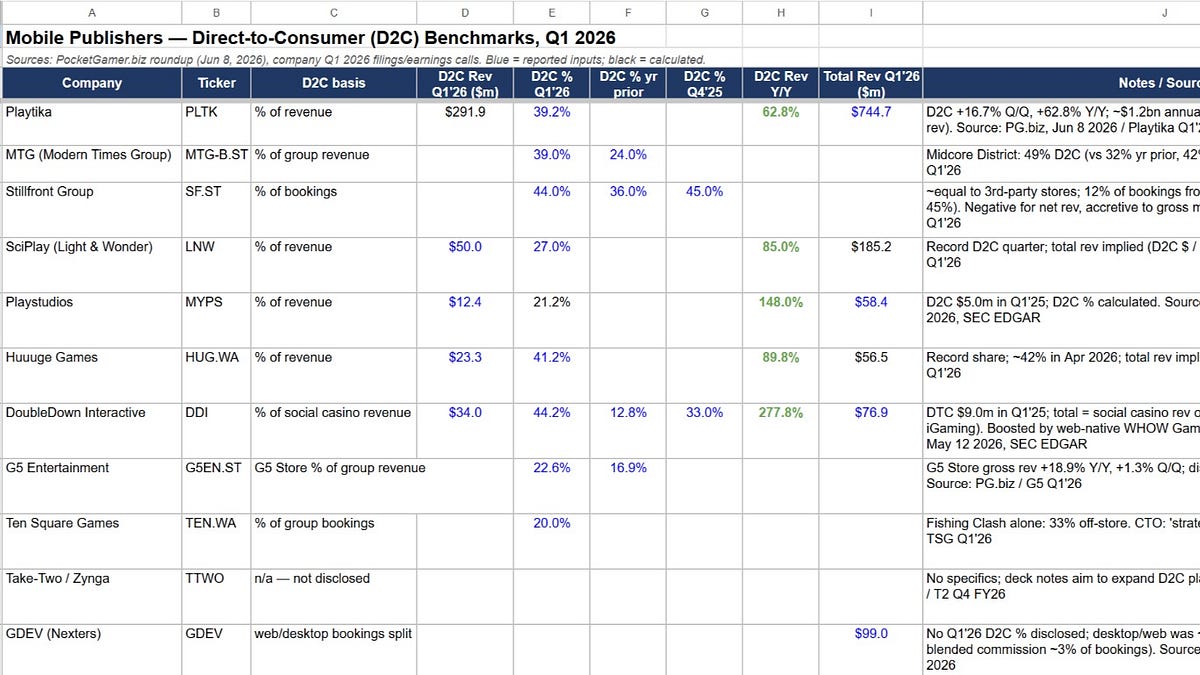
The article also discusses the current Direct‑to‑Consumer (D2C) window, citing publicly disclosed revenue from eight studios. Social casino and mid‑core titles lead with 44% D2C share, while casual games like Playtika achieve 39%. The piece notes that direct‑checkout links remain fee‑free for U.S. players until the pending Epic vs. Google settlement, presenting a limited opportunity to maximize D2C revenue without additional costs. It advises combining direct checkout with web‑store links and learning from high‑performing examples such as Raid Shadow Legends.
Geographically, the focus is on U.S. and Japanese markets, with a brief mention of global applicability. The post draws on industry data, anecdotal evidence from studio disclosures, and platform policy updates to argue that agile creative testing and timely exploitation of the D2C window are critical for post‑IDFA success.
The guide argues that direct‑to‑consumer (D2C) monetisation has become the highest‑margin channel for mobile publishers, now accounting for more than 40 % of revenue for leading studios. Data from public filings between Q1 2024 and early 2026 show a dramatic shift after legal barriers fell: Apple’s anti‑steering rules were struck down in April 2025, and Japan’s Mobile Software Competition Act enabled fee‑free steering in December 2025. Playtika, MTG, Huuuge, Stillfront, SciPlay, DoubleDown, G5 Entertainment, and Playstudios all lifted D2C shares from the mid‑20 % range to 30–45 %, with Playtika reaching a $1.2 bn annual run‑rate and Huuuge’s revenue doubling year‑over‑year.
The analysis categorises studios into social casino, midcore, and casual cohorts, noting that even casual titles like Playtika’s Slotomania generate the bulk of D2C income. Geographic concerns are dismissed, as US players remain the primary audience regardless of publisher location. The window for fee‑free steering is short; a 20 % linked‑payment fee is expected to take effect in the US and EU by mid‑2026, with Apple likely following shortly after.
The playbook outlines eight actionable steps: target VIPs first, use existing payment stacks such as FastSpring, combine direct checkout links with a long‑term web store, align shop aesthetics with the game, build CRM‑driven steering, enrol in External Content Links early, pilot in Japan to learn fee dynamics, and measure net impact carefully. The guide warns against over‑optimising for dead games or copying templates, emphasizing that D2C success depends on healthy player retention and disciplined live‑ops.