Atari SA
French video game publisher and owner of the Atari brand, listed on Euronext Paris.
Documents
No published documents yet
Reports about Atari SA
94 documents by other writers name Atari SA in the title or summary.
Notes on the Biographical Meaning of Games and Online-Games
Herlyn and Meister introduce a German research project, "Cultures of Gaming," launched in November 2007 under the Federal Ministry of Research and Technology, that examines the biographical meaning of games and online games.
- The study is a qualitative biographical research project begun in November 2007 under a German federal research program, using semi-structured interviews with participants in three age groups (25–35, 45–50, and 60–70), and its findings are explicitly preliminary given the limited sample size.
- The authors argue that understanding video games requires attention to offline, non-digital play and to the historical dimension of how people come to play, since play experiences are closely tied to life histories and social contexts.
- A survey of a Hamburg senior computer club found that over 150 members were present, many played computer games, but only three played online, with many preferring traditional card games and bundled titles such as Solitaire.
The Achievement Machine: Understanding the Xbox Live Metagame
Mikael Jakobsson's paper examines achievements on Microsoft's Xbox Live service, arguing that they have created a "meta-game" in which individual titles become pieces of a larger system of collection, status, and community practice.
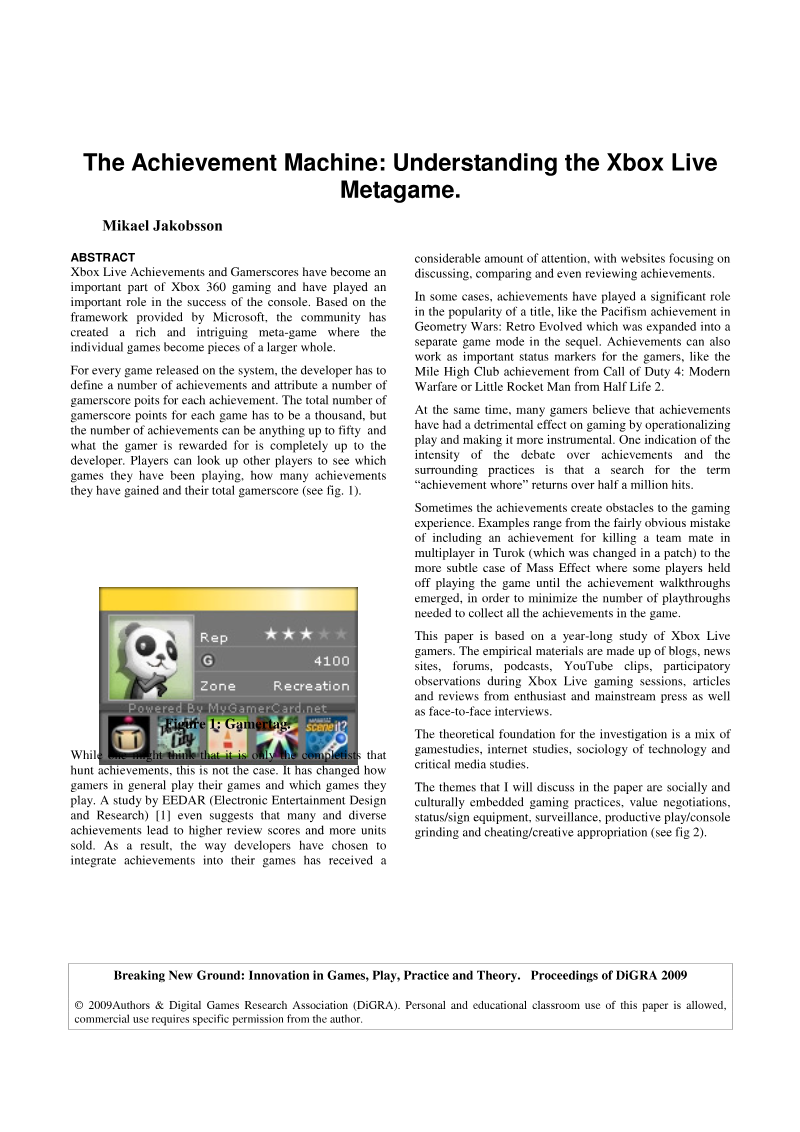
- Achievements and Gamerscore, defined by developers per game (standard total of 1,000 points, up to fifty achievements per title), have become central to Xbox's identity and to how players and critics evaluate games, forming a larger 'meta-game' of collection, status, and community practice.
- Jakobsson's paper draws on a year-long study of Xbox Live gamers, combining blogs, forums, podcasts, YouTube, participatory observation, press reviews, and face-to-face interviews.
- An EEDAR study cited in the paper suggests well-designed achievements correlate with higher review scores and stronger unit sales, leading developers to treat achievements as a commercial consideration.
The State of the Art: Western Modes of Videogame Production
The "State of the Art: Western Modes of Videogame Production" analyzes the evolution of Western videogame production, contrasting early industrial models with contemporary trends towards decentralized, participatory development.
- The study traces the producer-consumer boundary in Western videogame production from Atari's founding in 1972 through the UK home-computer boom of the early 1980s, arguing that the line between making and playing games has grown increasingly porous.
- Atari's loosely managed, Fordist-influenced production gave way to home consoles that moved play into private space, while Spectrum-era bedroom coding and cassette copying fostered a more integrated relationship between creators and players.
- Interviews with eleven industry professionals conducted in 2006 indicate that development is increasingly governed by market research, licensing arrangements, and consumer demand rather than purely creative or technical possibility, with long working hours and globally distributed teams common.
The Disappearance and Reappearance and Disappearance of the Player in Videogame Advertising
Videogame advertising has cycled through showing players, removing them, and bringing them back, and that pattern reveals how the medium was introduced into American homes and how consumers were taught to use it.
- The core thesis is that videogame ads have alternated between showing players and showing games: early ads featured players to teach consumers how to operate new hardware, while later ads dropped them once the medium became familiar.
- Early home videogame advertising, beginning with Atari's Pong in 1976, paired games with unrelated household goods such as sweaters, clocks, and garden products, reflecting uncertainty about where the new category fit in consumers' lives.
- The paper draws on Lynn Spigel's account of television's entry into the postwar home and Louis Althusser's concept of interpellation to explain how ads 'hail' particular consumers as players.
Early Games Production in New Zealand
The document examines the largely unknown history of the early digital games industry in New Zealand during the late 1970s and 1980s.
- Early digital games reached New Zealand in the late 1970s and 1980s despite geographic isolation and restrictive import policies, yet this history is largely absent from mainstream games histories focused on the US, UK, and Japan.
- Major systems including Atari, Sinclair, Commodore, Sega, and Nintendo products did reach New Zealand, typically one to two years after their overseas release, with distribution uneven across platforms.
- Local manufacturers produced at least four early consoles, most prominently the Sportronic, a Pong-style clone, and around eleven companies were involved in arcade cabinet manufacture at some point.
Push. Play: An Examination of the Gameplay Button
The document examines the pervasive role of the "gameplay button" in video game interfaces, arguing that while it has been central to the medium's development, its limitations hinder the exploration of more diverse and embodied gameplay experiences.
- Griffin's essay "Push. Play," presented at DiGRA 2005, argues that the video game button, despite its near-universal use, limits the medium's expressive development.
- The author's central thesis is that the button reflects a cognition-centered design approach that disregards the body's abilities, and he recommends revising the button rather than replacing it to add tangible, embodied interaction while preserving simplicity.
- The button succeeds because it reduces friction between player intent and in-game action, letting players focus on the game world rather than the device, a point grounded in play theory such as the "magic circle" concept.
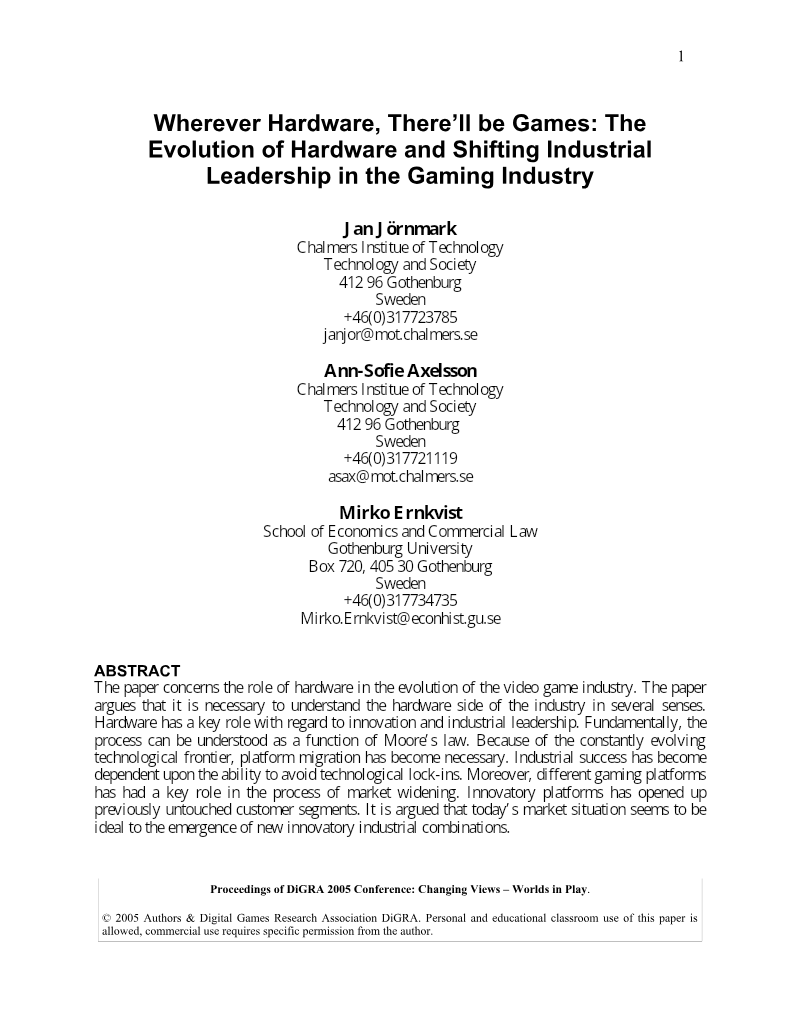
Wherever Hardware, There'll Be Games: The Evolution of Hardware and Shifting Industrial Leadership in the Gaming Industry
The video game industry's growth and resilience stem from hardware evolution driven by Moore's law and the continual widening of markets through new platforms, including arcade, console, handheld, PC, and mobile.
- Growth in the video game industry has been driven mainly by successive platform diversification, with each new hardware generation (arcades, pinball, consoles, handhelds, PCs, networked play) opening new customer segments rather than by convergence.
- Hardware transitions are treated as the central engine of industrial change, repeatedly reshaping which firms held leadership, drawing on Young's and Schumpeter's frameworks.
- Atari's pinball division failed despite technical innovation due to manufacturing disadvantages and lost talent, and the traditional pinball industry's market share collapsed from 80 percent in 1975 to 5 percent in 1984 under digital competition and rising costs.

Discover How the Video Game Industry Works in Colombia
Colombia's investment promotion agency, ProColombia, makes the case that the country's video game industry is an attractive, already-established destination for foreign investors.
- Colombia's video game industry is an established sector with experienced companies like Dreams Uncorporated, Madbricks, Teriun Games, and Timba Games, exporting games internationally.
- The video game industry is a significant part of Colombia's broader Software & IT sector, which is a key driver of the country's digital transformation and has positioned Colombia as a major regional market and supplier.
- Colombian video game developers have gained international recognition, collaborating with global companies such as Cartoon Network, Disney Interactive Studios, Atari, MGM, and Square Enix.

Thunderful Group Q2 2025 Earnings Release
Thunderful Group faces a period of significant financial instability and structural transformation as it navigates a sharp downturn in its publishing operations.
- Atari SA is set to become the majority owner of Thunderful Group by acquiring an 81.7 percent stake through a SEK 50 million directed share issue.
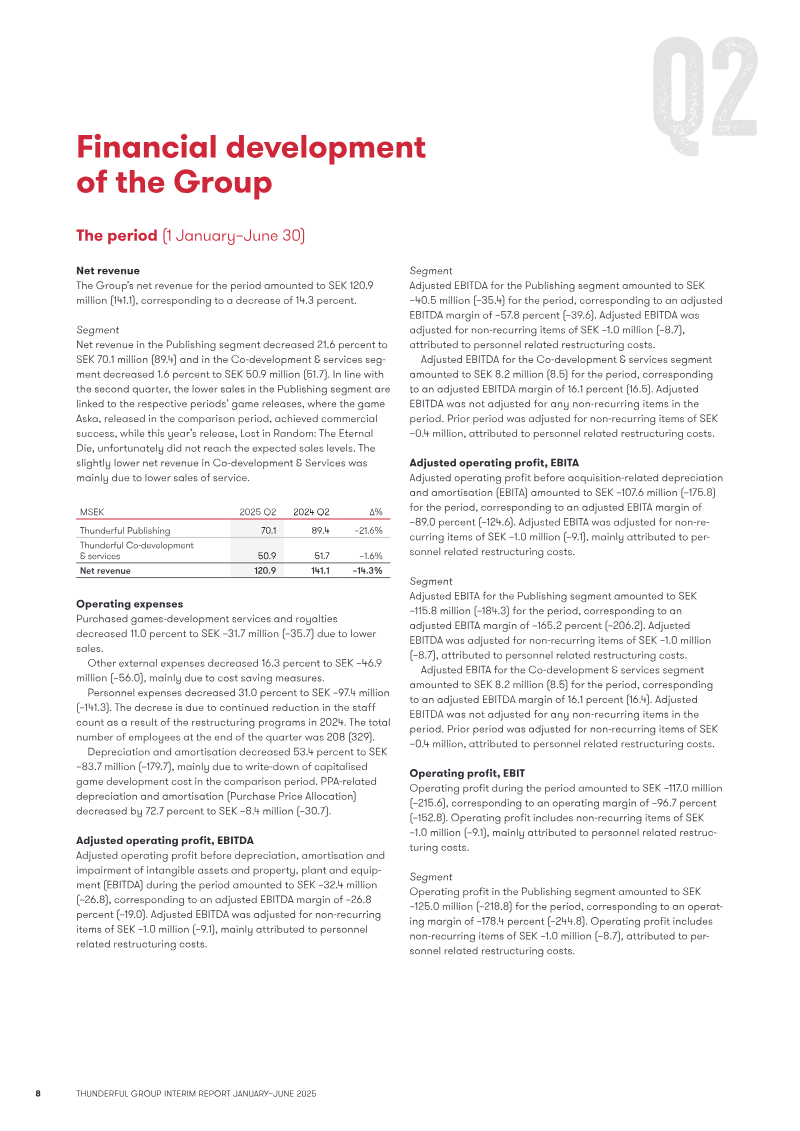
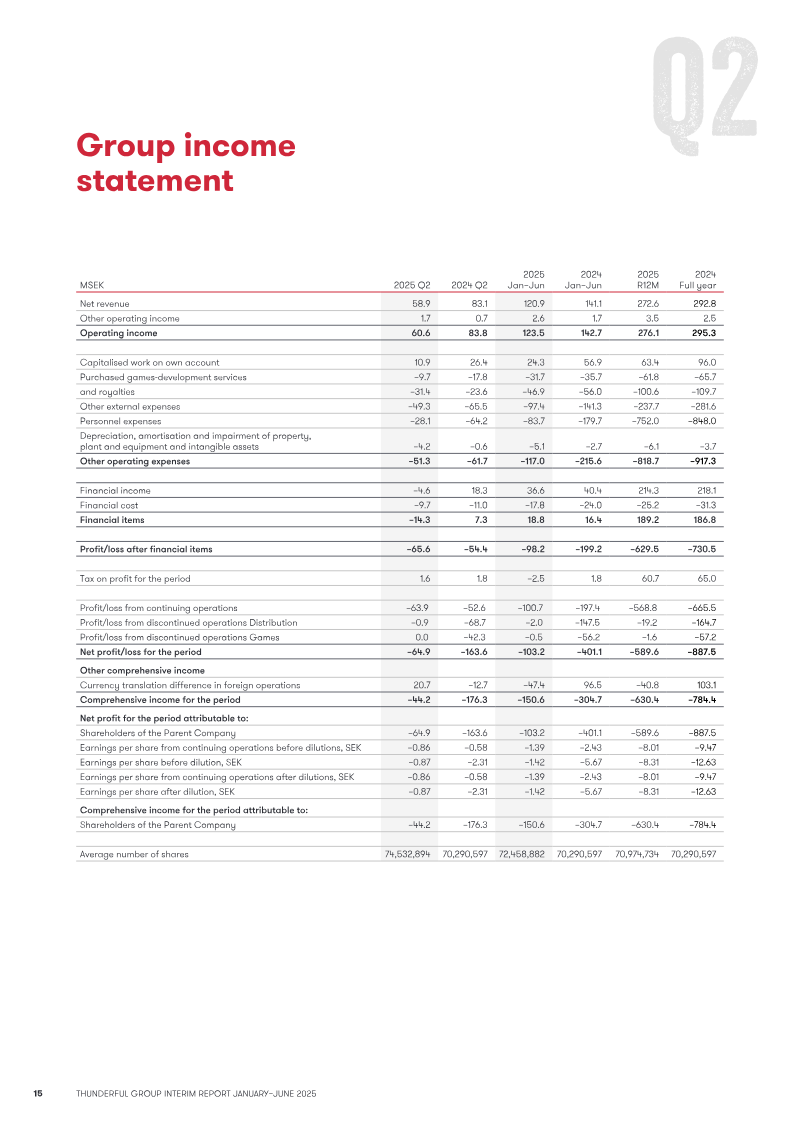
- Thunderful Group reported a 29.1 percent decline in Q2 2025 net revenue to SEK 58.9 million, resulting in a negative adjusted EBITDA of SEK -23.1 million.
- The company is implementing a restructuring program to reduce annual operating costs by SEK 40–45 million by 2026.



Annual Report and Accounts 2024
Frontier Developments' Annual Report and Accounts for the year to 31 May 2024 (FY24) describes a difficult year and a strategic reset toward creative management simulation (CMS) games.
- Frontier plans to release three self-published CMS (Creative Management Simulation) games in the next three consecutive financial years: Planet Coaster 2 in autumn 2024 (FY25), a new Jurassic World game in FY26, and a third unannounced CMS game in FY27.
- Frontier reported a loss before taxation of £28.425 million for the 12 months ending May 31, 2024, an increase from £26.509 million in the previous year.
- Net cashflows from operating activities decreased to £31.625 million in FY24 from £47.875 million in FY23, while net cashflows used in investing activities improved to (£27.868 million) from (£52.310 million).