Metroidvania
15 documents·4 publishers
Documents
Video30 min
The Salt and Sanctuary Postmortem
- Prioritize building robust, custom development tools early in the production cycle, as the quality of these tools directly dictates the quality and efficiency of the content creation process.
- Implement a 'task-switching' workflow where developers focus on a single discipline—such as music, coding, or animation—for at least 2–3 days at a time to minimize the mental overhead of context switching.
- Avoid launching with incomplete localization; the developers found that players notice and react negatively to 'faked' or missing language support, whereas professional localization significantly boosts engagement and sales.
- Maintain a consistent, iterative development loop by integrating assets into the game build frequently, which allows for immediate testing and prevents the accumulation of unverified, disconnected content.
- Leverage external partnerships for platform-specific tasks like localization and QA, as transitioning from first-party publishing to self-publishing requires managing complex operational responsibilities that were previously handled by partners.
Game Developers ConferenceMay 2017
Video30 min
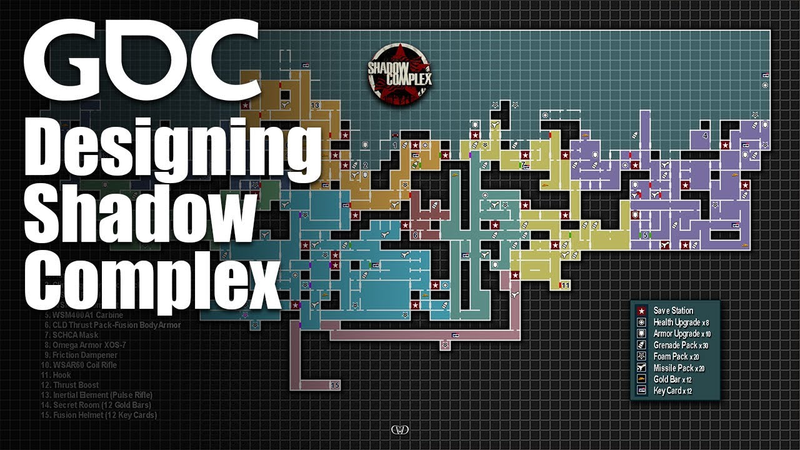
Designing Shadow Complex
- Prioritize unique gameplay experiences over technical development by leveraging existing engines like Unreal, allowing small teams to focus resources on original design rather than building foundational technology.
- Maintain a lean development process by using short, concise design documents—such as the five-page document used for Shadow Complex—to facilitate rapid team alignment and iteration.
- Define a clear core gameplay loop early in development, such as the exploration-combat balance in Shadow Complex, and ensure every feature and asset directly supports that loop to avoid unnecessary bloat.
- Utilize rapid prototyping techniques, including paper-based flow mapping and low-fidelity BSP (binary space partitioning) cubes in the game engine, to validate mechanics before committing to full production.
- Adopt a 'lean' mindset by constantly evaluating the necessity of every asset, a practice necessitated by the 50MB limit on the team's previous project, Undertoe, which helped them make disciplined cuts during the development of the 834MB Shadow Complex.
Game Developers ConferenceMay 2017
Video30 min
The Animation Process Of Ori & The Blind Forest
- The Ori & The Blind Forest animation pipeline utilized 3D models rendered as 2D sprites, allowing for perfect non-uniform bone scaling to achieve extreme squash-and-stretch effects that would be difficult to execute with traditional 2D art.
- By rendering 3D assets with an orthographic camera and removing all 3D lighting information, the team successfully mimicked the flat, silhouette-heavy aesthetic of Studio Ghibli films while maintaining the technical advantages of a 3D rig.
- The team bypassed the limitations of traditional 2D animation by baking complex 3D features—such as particle effects, motion blur, and dynamic contact shadows—directly into the sprite frames during the offline rendering process.
- Using a 3D-based workflow allowed for the implementation of root motion, which simplified the creation of complex scripted events and cutscenes by allowing the camera and character to move in sync within the 3D space.
- To handle character orientation on uneven terrain, the team used a combination of surface-normal rotation and multiple hand-animated transition states, such as creating eleven distinct versions of swimming animations to simulate fluid 360-degree movement.
Game Developers ConferenceAug 2015