Showing 30 of 2,250 results · 3.57s
Feb 2014
FY2014 Second Quarter Financial Results
GREE
decisive move away from legacy feature phone platforms toward modern mobile ecosystems. The native game segment reached a critical milestone by achieving monthly profitability in overseas operations
Financial36 pages
Jan 2018
Raport Bieżący nr 28/2018: Popremierowy Raport Sprzedażowy dot. Gry House Flipper
PlayWay
porting process for Xbox One and PlayStation 4 consoles. A mobile version of the game was already in production for several months prior to the PC launch, signaling
Legal1 pages
Nov 2024
Take-Two 10-Q — Q3 FY2024 (November 2024)
Take-Two Interactive
year 2024 (through September 30, 2024), and the analysis spans core gaming segments, digital distribution, mobile platforms, and recent acquisitions. Overall, Take‑Two demonstrates strong liquidity management amid
Financial1 pages
Goodgame Studios Celebrates 10 Years Goodgame Empire
Gamecity Hamburg
play quality, the company has successfully navigated the competitive landscape of mobile, console, and PC gaming. Furthermore, the studio emphasizes the importance of its Hamburg headquarters, citing
Article2 pages
Jan 2011
Faits Essentiels 2011 sur le Secteur Canadien des Jeux Vidéo et Informatiques
ESAC – Entertainment Software Association of Canada
Traditional console development still dominates, employing 68 % of the workforce, while mobile, social and casual games together account for just under 12 % of resources, reflecting a rapid diversification
Report19 pages
Jan 2010
Financial Results: Fiscal Year Ended 2010
Koei Tecmo
slight decline in net sales to 32.1 billion yen. While the Game Software and Online & Mobile segments continue to serve as the primary engines of revenue, the organization
Financial34 pages
Mar 2023
SciPlay Corporation Annual Report: FY 2022
SciPlay
SciPlay Corporation, a Nevada‑based developer and publisher of mobile and web social games, reported FY 2022 revenue of $671.1 million—an 11% increase driven largely
Financial1 pages
May 2023
Take-Two 10-K — FY2022 (May 2023)
Take-Two Interactive
Interactive’s FY 2022 10‑K documents a strategic pivot toward mobile and live‑service gaming, anchored by the $9.52 billion acquisition of Zynga. The deal added
Financial1 pages
2026 GDC Trends Report: 5 Insights on the Future of Game Development
Game Developers Conference
development models to manage the rising resource demands of modern game production. In the mobile segment, developers are increasingly pivoting toward dual monetization strategies, prioritizing long-term user
Article1 pages
Jun 2026
Market Model Reports: Asia & MENA
Niko Partners
survey data, and regional expertise to assess the evolving landscape of mobile, PC, and console gaming. Key findings highlight significant regional disparities in growth and maturity. China remains
Report4 pages
Jun 2026
PMGO 2026 Season 1: PUBG Mobile Viewership Analysis
Esports Charts
engagement underscores the growing mainstream appeal and commercial viability of PUBG Mobile esports, positioning the game as a viable platform for large‑scale competitive events. Competitive results highlighted
Article1 pages
Sep 2010
Namco Bandai Holdings Annual Report 2010
Bandai Namco
sales. Strategic priorities include a "selection and concentration" approach to game development, expanding into mobile and social networking markets, and leveraging global IP projects such as the 30th
Financial72 pages
Mar 2026
BGIS 2026 Sets New Viewership Record for BGMI Esports
Esports Charts
health and commercial viability of mobile esports. The data confirms that Battlegrounds Mobile India remains a central pillar of the competitive gaming industry, with its influence continuing
Article1 pages
Jul 2026
Games and Numbers: July 14 – July 28, 2026
GameDev Reports
Mound: Omen of Cthulhu has exceeded 800,000. In the mobile sector, the PvP strategy game Ludus: Merge Arena has generated $50 million in net revenue since
Article1 pages
Jan 2023
State of Mobile 2023
data.ai
year‑over‑year growth. The data underscore a continued dominance of mobile advertising, resilience of non‑gaming verticals amid economic headwinds, and the importance of diversified monetization strategies
Report93 pages
Jul 2005
Square Enix Annual Report FY2005
Square Enix
units. However, the most significant growth occurred in digital segments, with mobile phone content and online games increasing by 63.2% and 55.2% respectively. Final Fantasy XI reached
Financial64 pages
Annual Report 2025: IGG Inc
IGG
nearly HK$590 million net profit. The flagship mobile title “Lords Mobile” contributed HK$2.17 billion, while mid‑generation games “Doomsday: Last Survivors” and “Viking Rise” added
Financial237 pages
Jan 2013
Financial Highlights for the Fiscal Year Ending March 2014 (FY2013)
Koei Tecmo
toward digital and diversified entertainment segments within the Japanese and global gaming markets. The Online and Mobile segment emerged as a primary driver of profitability, recording
Financial2 pages
Jan 2024
Games Market Trends 2024
Newzoo
premium releases. Other major trends include the slowing growth of multi-game subscriptions, the expansion of mobile developers into the PC space to combat rising user acquisition costs
Report27 pages
Bilan du Marché Français: 2025
SELL – Syndicat des Éditeurs de Logiciels de Loisirs
mobile sector, which reached €1.792 billion. The market maintains a balanced ecosystem, with consoles commanding a 44% share, followed by mobile at 31% and PC gaming
Report39 pages
Mar 2025
Game Developers Investment Report: March 2025
DDM
studios captured the largest share of investment volume (42 %), followed by mobile (31 %) and mass‑community games (12 %). Smaller studios dominate the investor base, with 90 % employing fewer
Financial11 pages
Feb 2025
Honkai: Star Rail Player Count, Revenue & Statistics
Udonis
analysis, which utilizes data from AppMagic and Similarweb, focuses on the game’s performance across global mobile markets, highlighting its evolution from a high-growth launch phase
Article1 pages
Jan 2025
Global Gaming Report 2025
Drake Star Partners
buyers. The breadth of activity spans traditional console and PC publishers, mobile‑first developers, and emerging gaming‑tech startups, indicating a convergence of content, distribution, and underlying technology
Report28 pages
Feb 2024
Xbox’s Cross-Platform Play
Video Games Industry Memo
platform-agnostic service that delivers content across consoles, PC, and mobile devices. By leveraging the Game Pass subscription model, Microsoft aims to create a unified ecosystem that integrates
Article1 pages
Jan 2023
Global Gaming Report Q2 2023
Drake Star Partners
markets across North America, Europe, and Asia, segmenting the industry into mobile, PC/console, esports, and blockchain gaming. Data was compiled using sources such as CapIQ, Pitchbook, and proprietary
Financial19 pages
Jan 2024
Supercharged: Powering the Future of the UK Video Game and Interactive Entertainment Industry
Ukie
broad collaboration to deliver its ambitious objectives across the UK’s mobile, console, core and casual game segments throughout the 2024‑2030 horizon
Report11 pages
Summary of Financial Results for First Quarter: Fiscal Year Ended December 31, 2024
KLab
divestiture of BLOCKSMITH&Co. The company continues to pursue large‑scale mobile titles and hybrid casual games, while cutting outsourcing and personnel costs to improve cash flow. Recent
Financial10 pages
Jun 2022
Two & a Half Gamers Session #20: The Ants Creative Analysis
Brutally Honest
This analysis examines the creative strategy and market performance of the mobile base-building strategy game, The Ants: Underground Kingdom. The primary focus is on identifying effective visual
Article1 pages
Feb 2026
Aream & Co. Gaming CEO Survey 2025
Aream & Co
remains a concern. The data derive from a global sample of gaming CEOs, reflecting perspectives across mobile, PC, console, and various functional departments. The findings suggest a cautiously
Report13 pages
Feb 2020
Zuck's Achilles Heel: Disney's Renewed Interest in Games and EA's Spending Spree
SuperJoost
testing programs. This tension suggests that while in-game advertising is established in mobile markets, it remains a "perverse" fit for immersive VR environments. Furthermore, while platforms like
Article
FY2014 Second Quarter Financial Results
Feb 201436 pages4k words
Summary
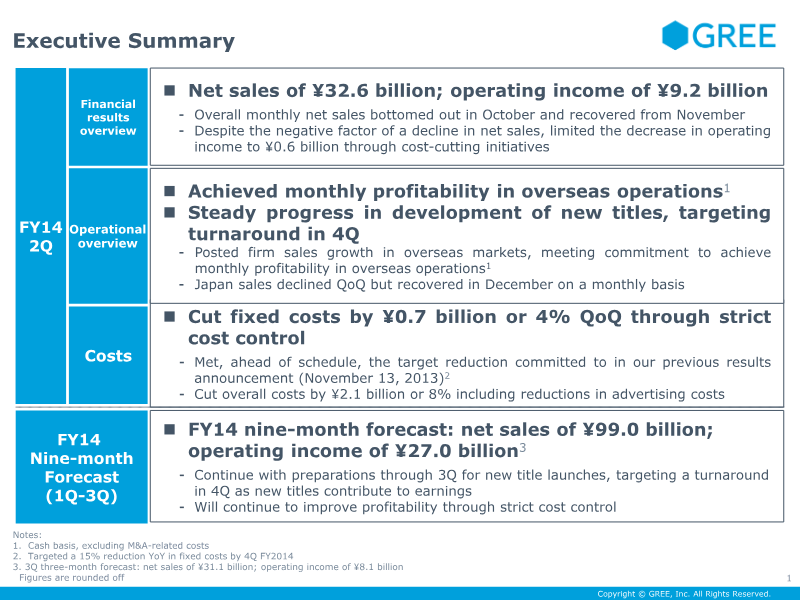
GREE reported second-quarter net sales of ¥32.6 billion and operating income of ¥9.2 billion for the 2014 fiscal year, reflecting a strategic focus on stabilizing profitability amidst a shifting mobile landscape. By implementing a 15% reduction in fixed costs and achieving ¥2.1 billion in total cost savings, the company successfully mitigated profit declines. A significant transition in consumer behavior is evident as smartphone coin consumption rose to 68% of the total mix, signaling a decisive move away from legacy feature phone platforms toward modern mobile ecosystems.
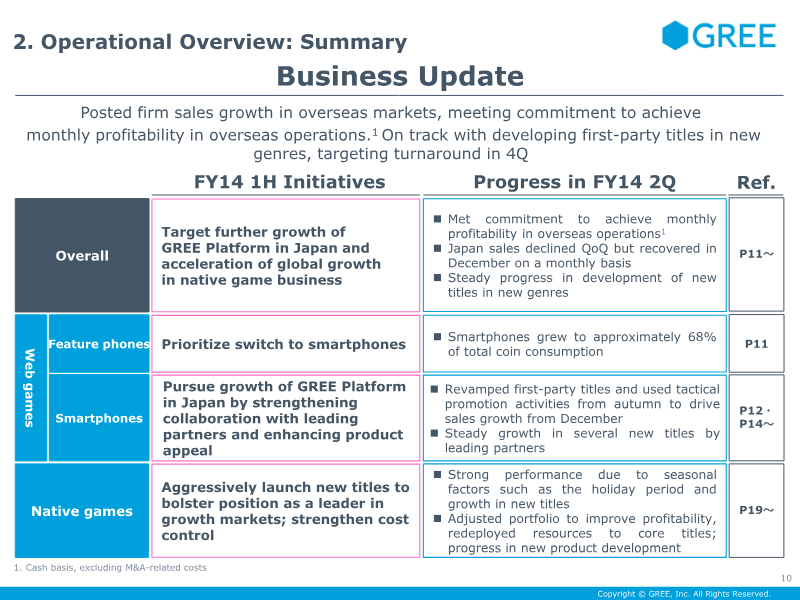
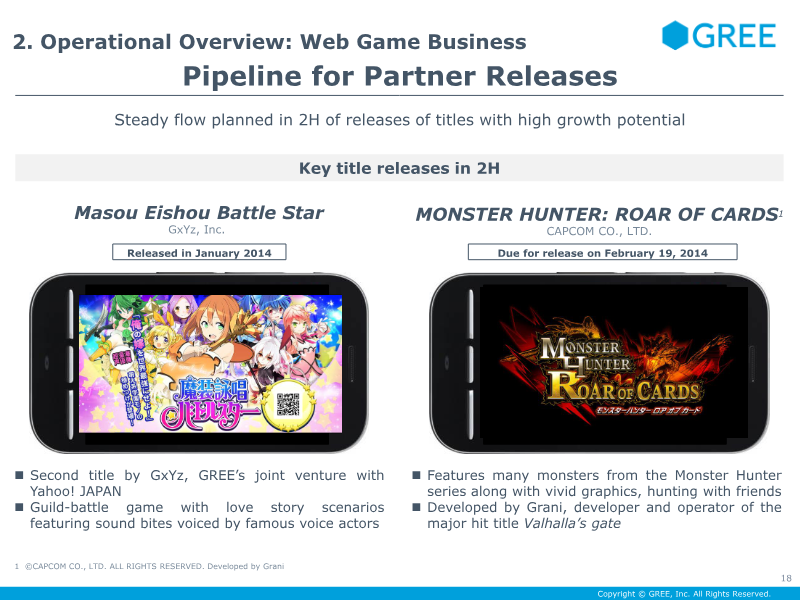
The native game segment reached a critical milestone by achieving monthly profitability in overseas operations as of December 2013. This international growth was largely propelled by the success of titles such as Knights & Dragons, which generated over $5 million in revenue within a 30-day window. Domestically, the web game business showed signs of recovery with a 15% month-over-month increase in coin consumption, supported by the launch of several high-performing partner titles. These operational successes are bolstered by a robust pipeline of upcoming releases across diverse genres, which management expects will drive a full turnaround by the fourth quarter.
Beyond its core gaming operations, the company is diversifying into advertising, venture capital, and offline entertainment to broaden its revenue base. Organizational adjustments include a total headcount of 2,051 employees and the establishment of a new customer support center in Sendai to improve service quality. As the company enters its tenth year of operation, it remains focused on maintaining strict cost controls while expanding its global footprint and diversifying its business domains to ensure long-term sustainability in the competitive digital entertainment market.
Pages
Insights
- GREE reported Q2 FY2014 net sales of ¥32.6 billion and operating income of ¥9.2 billion, supported by a 15% reduction in fixed costs that yielded ¥2.1 billion in savings.
- Smartphone coin consumption now accounts for 68% of the total mix, marking a definitive shift away from legacy feature phone platforms.
- The native game segment achieved monthly profitability in overseas operations by December 2013, driven by titles like Knights & Dragons, which generated over $5 million in 30 days.
- Domestic web game performance showed recovery with a 15% month-over-month increase in coin consumption, bolstered by the launch of new partner titles.
- Management is diversifying revenue streams beyond core gaming into advertising, venture capital, and offline entertainment to ensure long-term sustainability.