Showing 30 of 2,246 results · 2.88s
Apr 2015
FY 2015 Third Quarter Financial Results
GREE
third quarter of fiscal year 2015 reflect a strategic pivot toward native mobile games amid a softening web-based game market. The company reported net sales
Financial30 pages
Jan 2023
Mobile Growth & Monetization Report 2023
Unity
mobile gaming landscape in 2023 reflects a strategic pivot toward operational efficiency as developers navigate softening in-app purchase (IAP) and advertising revenues. Success currently hinges on capturing
Report41 pages
The Gaming App Insights Report: 2026 Edition
Adjust
mobile gaming industry is undergoing a fundamental strategic transition, moving away from a reliance on high-volume user acquisition toward a model centered on long-term retention
Report35 pages
NetEase 1Q26 Investor Presentation
NetEase
house research and development capabilities to manage a portfolio of mobile, PC, and console games. Beyond its core gaming business, the company operates diversified segments including intelligent learning
Financial13 pages
Middle East & Africa Gaming Review 2025
Lucidity Insights
positioning the region as a growing share of the global gaming economy. Mobile dominance, government‑backed visions, and esports infrastructure are reshaping competitive dynamics across the region. Funding
Report52 pages
Sep 2020
Raport Bieżący Nr 36/2020: Zamiar Połączenia Spółki 3R Studio Mobile z Hubstyle
PlayWay
consolidating these resources, the management aims to leverage the technical capabilities of the mobile gaming sector alongside the capital market experience of the acquiring firm. This strategic alignment
Legal1 pages
Apr 2025
Meta’s Ad ROAS: A 101 Guide for UA Managers
Brutally Honest
high-value audiences who engage with advertisements within mobile applications. This methodology addresses the evolving needs of mobile game developers and publishers who rely heavily on hybrid monetization
Article1 pages
Jan 2026
Two & a Half Gamers Session #54: Eric Kress
Two & a Half Gamers
mobile gaming industry is currently navigating a period of significant structural upheaval, characterized by shifting user acquisition strategies and a challenging macroeconomic environment. Central to this transformation
Article
The Take-Two Diaspora: Why Alumni Win Big in Mobile, Not AAA
InvestGame, GDev
Dream Games’ $2.5 billion sale in July 2025. The portfolio spans mobile casual titles, instant‑play games, sports apps, and publishing ventures, but shows a pronounced skew toward
Report8 pages
Jan 2021
Mobile Ad Creative Report: August 2021
Sensor Tower
Mobile gaming creative trends in August 2021 centered on humanizing digital experiences and leveraging high-profile cultural partnerships. Analysis of top-performing ads across platforms like YouTube, Instagram
Report30 pages
Jan 2022
State of Mobile 2022
data.ai
individual titles that each surpassed $100 million in annual consumer spend. Mobile gaming remains the primary engine of monetization, reaching a record $116 billion in spend. While hypercasual
Report73 pages
Jan 2021
Store Intelligence Data Digest: Q4 2021
Sensor Tower
these installs, representing a 2.7 percent year-over-year increase. While the mobile gaming sector remained a primary driver of volume, led by the global success of Garena
Report80 pages
Jun 2024
Q2’24 Gaming Deals Report
InvestGame
instability and turbulence in gaming stocks. Geographically, Asia remains the primary driver for mobile gaming hits, with titles like Dungeon & Fighter: Origin generating significant in-app purchase revenue
Report19 pages
May 2026
Vietnam Domestic Gaming Industry Report: 2025
Ocean Entertainment Group, Meridian Play
Vietnamese mobile gaming market represents a significant growth sector in Southeast Asia, reaching a valuation of approximately $825 million in 2025. With an estimated 54 to 58.5 million
Report15 pages
FY2019 Q1 Financial Results Briefing
GREE
future growth and an acquisition of ORATTA. Strategic initiatives focus on expanding overseas mobile game distribution, launching new titles such as Wild Arms: Million Memories and DanMachi
Financial4 pages
Jul 2025
Creative Trends: June 2025
Brutally Honest
mobile gaming industry is experiencing a significant shift in creative advertising strategies as of June 2025, characterized by a move toward longer video formats, AI-driven production
Article1 pages
MDM Tips: Mobile Analytics, Metrics, and Monetization
Mobile Dev Memo
mobile gaming and application landscape relies on a sophisticated framework of quantitative analysis to drive sustainable growth and profitability within the freemium ecosystem. Success in this sector
Article
Jan 2024
Brutally Honest #90: User Acquisition in the Post IDFA World
Brutally Honest
gameplay-tailored marketing assets. The scope of the discussion focuses on the global mobile gaming industry, with specific attention to the European market and the rise of hybrid
Article
Jul 2025
The Simulation Game Ad Playbook: What's Working
Brutally Honest
mobile simulation game sector is currently leveraging highly effective, psychologically driven advertising strategies to capture user attention and drive engagement. The primary objective of these campaigns
Article1 pages
Jan 2022
Two & a Half Gamers Session #35: Charge Champions, Facebook UA Tech Checklist, Amplify Update
Two & a Half Gamers
marketplace. This indicates a continued, albeit cautious, interest in blockchain integration within mobile gaming ecosystems. Overall, the findings suggest that success in the current mobile climate depends
Article
Jul 2026
It’s Been a Great Year for Black-and-White Video Games
Game File
experimenting with ad-supported cloud streaming on Xbox, a model traditionally reserved for mobile gaming, to lower barriers to entry for console users. These developments suggest a broader
Article1 pages
Jan 2022
Video Games Development Industry in Romania – 2022 (Summary & Key Insights)
RGDA – Romanian Game Developers Association
Amber Studio | Cluj‑Napoca | 38 % of market share (≈ €80 M) | Focus on mobile & mid‑core games; rapid hiring. | | 4 | Gameloft Romania | Turda, Târgu Mureș
Report3 pages
Jun 2026
Moonton and ESIC Build Integrity Framework for Mobile Legends Esports
The Esports Advocate
Moonton Games has established a formal integrity framework for its mobile esports title, Mobile Legends: Bang Bang (MLBB), in collaboration with the Esports Integrity Commission (ESIC). The initiative
Article1 pages
Jan 2022
Uso de Videojuegos Didácticos en el Aula: Pautas para el Éxito del Aprendizaje
EUN Partnership AISBL
measurable gains in mathematics, geography, health, ethics and language outcomes. Serious‑game applications range from mobile‑AR health simulators to environmental awareness titles, while game‑jam events
Report98 pages
Jun 2022
Mobile Version of Apex: Another Tencent Battle Royale Game
SocialPeta
counterpart while streamlining controls with mobile‑specific shortcuts such as auto‑loot and quick‑mark. Early beta testing indicated that the game’s UI is more concise
Article1 pages
Nov 2024
Charting the Rise of Survivors-likes
GameDiscoverCo
Game Pass, moving away from a console-exclusive paradigm. Furthermore, data regarding mobile gaming indicates that a small fraction of users—approximately 2%—accounts for nearly half
Article1 pages
Jan 2025
Games Industry Region Report: China 2025
PocketGamer.biz
platforms such as WeChat Mini Games, which provide unique avenues for engagement alongside traditional gaming segments. Looking toward the future, the Chinese games industry is poised to lead
Report20 pages
Jan 2022
Gaming Deals Activity Report: H1 2022
InvestGame, Hiro Capital
pandemic era toward a more disciplined investment environment that prioritizes established mobile platforms and robust, sustainable gaming ecosystems
Report25 pages
The Great Mobile Reversal: Why Buyers Pay Billions for What VCs Abandoned
InvestGame
analysis examines the evolution of mobile gaming investment and M&A activity from 2020 through the first half of 2025. Mobile platforms have dominated the sector, accounting
Report12 pages
Jan 2024
Africa Games Industry Report 2024
Maliyo Games
than doubled from 77 million in 2015 to 186 million in 2021, with mobile gaming accounting for 95 % of players and nearly 90 % of the region
Report72 pages
FY 2015 Third Quarter Financial Results
Apr 201530 pages3k words
Summary
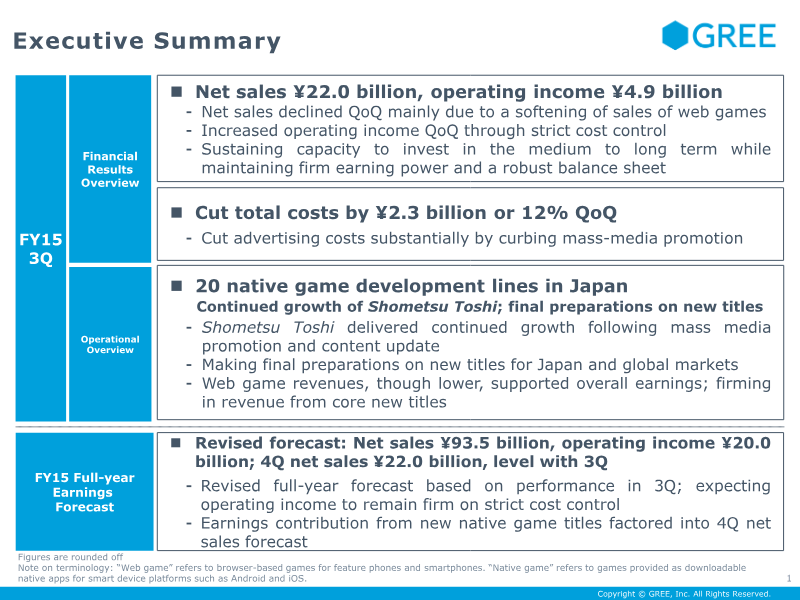
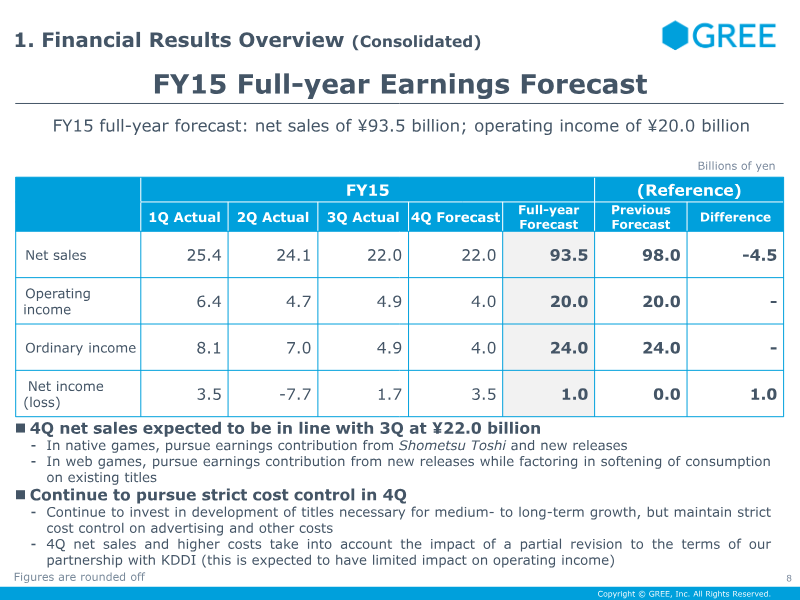
GREE’s financial results for the third quarter of fiscal year 2015 reflect a strategic pivot toward native mobile games amid a softening web-based game market. The company reported net sales of ¥22.0 billion and an operating income of ¥4.9 billion. While net sales declined quarter-over-quarter, operating income saw a slight increase due to aggressive cost-cutting measures, including a 12% reduction in total costs and a substantial decrease in mass-media advertising expenditures.
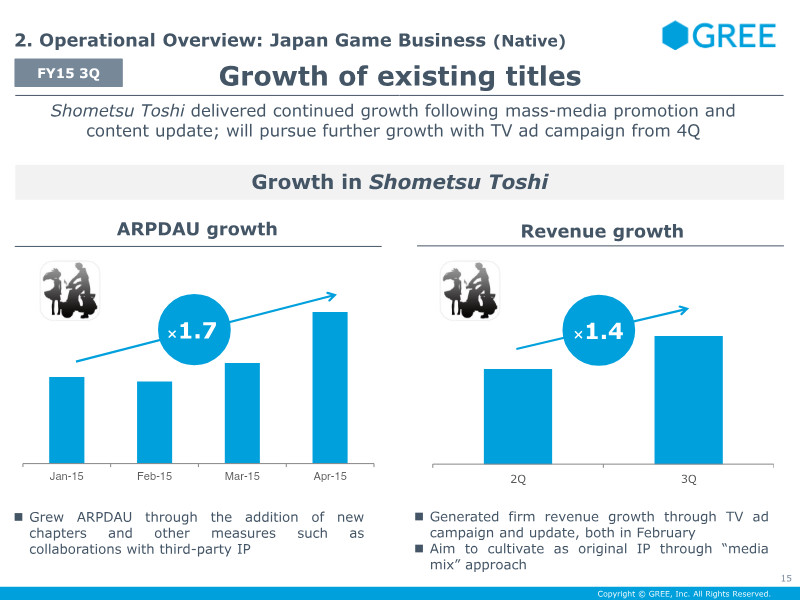
The data indicates a clear transition in user behavior and business focus. Overall coin consumption fell 10% to 31.3 billion coins, with web games experiencing an 11% decline. However, smartphone consumption now accounts for 77% of the total. To address these shifts, the company expanded its native game development operations in Japan to 20 pipelines and 600 personnel. Key performance drivers included the continued growth of Shometsu Toshi and the steady performance of titles like The SAMURAI Kingdom. The company is also preparing for global expansion by localizing U.S. titles for European markets and launching cross-border titles in China and South Korea.
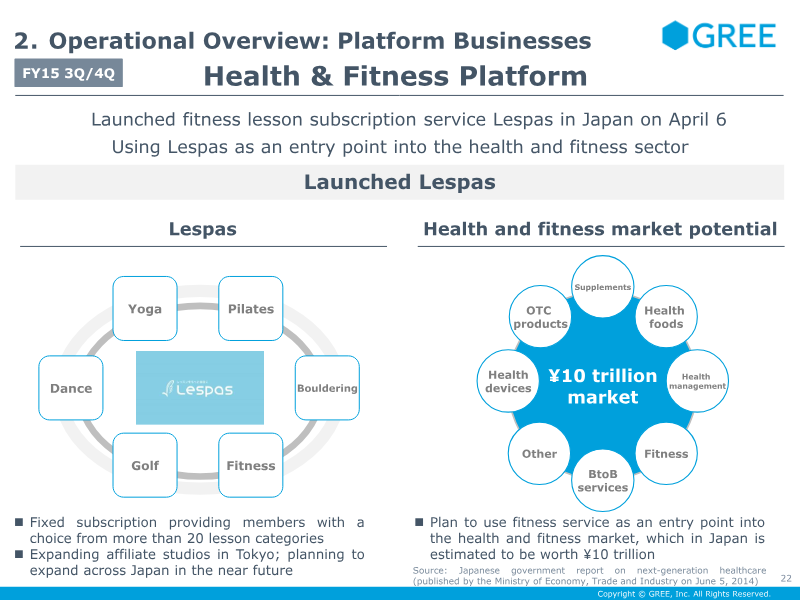
Beyond gaming, the scope of operations includes emerging platform businesses in home-related services and health and fitness. The home renovation platform reached ¥100 million in monthly orders, while the Lespas fitness subscription service launched in April 2015 to tap into the broader wellness market. For the full fiscal year, the company revised its net sales forecast to ¥93.5 billion while maintaining an operating income target of ¥20.0 billion, signaling a continued reliance on strict cost controls and the anticipated contribution of new native game releases in the fourth quarter.
Pages
Insights
- GREE reported Q3 FY2015 net sales of ¥22.0 billion and operating income of ¥4.9 billion, with full-year sales forecasts revised downward to ¥93.5 billion.
- Operating income increased quarter-over-quarter despite declining sales, driven by a 12% reduction in total costs and significant cuts to mass-media advertising.
- Total coin consumption fell 10% to 31.3 billion, with web-based games declining 11% while smartphone-based consumption grew to represent 77% of the total.
- The company is aggressively pivoting to native mobile games, expanding its Japanese development operations to 20 pipelines and 600 personnel.
- Growth is currently supported by titles such as Shometsu Toshi and The SAMURAI Kingdom, with international expansion efforts underway in Europe, China, and South Korea.