Showing 30 of 654 results · 1.01s
Jan 2025
Newzoo's Generations Report: How Different Generations Engage with Games
Newzoo
players prioritize relaxation. Platform preferences differ markedly; Gen Z spends 77% of gaming spend on mobile, whereas Baby Boomers allocate 73% to PC. Younger gamers also engage more
Report21 pages
Jan 2020
2020 Global Games Market Report
Newzoo
generate $159.3 billion in 2020, representing a 9.3% year-on-year increase. Mobile gaming remained the largest segment, accounting for $77.2 billion (48% of the market), driven
Report31 pages
Summary of main supplementary explanations questions and answers at the FY2021 Second Quarter GREE results briefing held on February 12, 2021
GREE
undertaken as circumstances allow. The briefing covered domestic and international markets, focusing on mobile gaming and online communication services over the 2021 fiscal year
Report1 pages
Jan 2020
Asia Spotlight Report: The Impact of COVID-19 on China’s Video Game Market in Q1 2020
Niko Partners
depth of this shift: 97.2% of respondents reported spending more time on mobile games, while 94.6% increased their time on PC titles. Spending also rose, with
Report21 pages
Jan 2025
Hyper-Casual Games – Industry Snapshot 2020
GameIntel
snapshot presents a quantitative overview of the hyper‑casual mobile game sector for 2020, drawing on data from over 140 000 titles and more than 2 billion monthly
Report10 pages
Jan 2025
Championing the 25 Retailers and Digital Services Who Connect Music, Video and Games Creators with UK Fans Yearbook
ERA
overwhelmingly digital, with 98.6% of consumer spend occurring through online channels, particularly via mobile gaming and digital subscriptions. Music emerged as the fastest-growing sector, reaching a record
Report112 pages
Jan 2022
Mobile Ad Creative Index: 2022
Liftoff
Mobile Ad Creative Index analyzes performance trends and benchmarks across four major mobile app verticals: gaming, e-commerce, entertainment, and finance. The report focuses on the strategic importance
Report30 pages
Mar 2025
Mobile App Trends: 2025 Edition
Adjust
mobile gaming sector remains the most popular category, expected to reach $126.1 billion in 2025. Although gaming faces retention challenges in North America and Europe, strategy games have
Report42 pages
Jan 2021
Turkey Game Market 2021 Report
Gaming in Turkey
Web3 technologies, including blockchain, NFTs, and Play-to-Earn (P2E) frameworks. While mobile gaming remains the dominant force, there is a burgeoning esports ecosystem supported by approximately
Report222 pages
Jun 2021
India: Mobile Market Spotlight: A Booming Mobile Economy
data.ai
hours in 2019 to 4.8 hours by the third quarter of 2021. Mobile gaming represents a significant pillar of this growth, with India becoming the largest market
Report40 pages
Jan 2024
Interactive Entertainment 2025: Global Market Sizing & Forecast
Aldora
period spanning 2023 through 2025. Software publishing remains the primary market driver, with mobile gaming leading as the largest category, forecasted to reach $115.7 billion in 2025. While
Report15 pages
Mar 2022
Casual Gaming Trends Snapshot Report March 2022
GameRefinery
This analysis examines the evolving landscape of the casual mobile gaming market as of March 2022, focusing primarily on the United States iOS market. The central thesis posits
Report33 pages
Is There a Shift from Content to Tech Startups Among Gaming VCs?
InvestGame, GDev
markets with a concentration in North America and Europe, covering all major gaming segments—mobile, PC, console, and emerging platform technologies. The methodology aggregates publicly disclosed
Report4 pages
Jan 2020
Store Intelligence Data Digest: Q2 2020
Sensor Tower
whole saw installations peak at 176 percent above pre-pandemic levels. The mobile gaming sector served as a primary beneficiary of stay-at-home orders, with Google Play
Report66 pages
Jan 2021
Newzoo’s Global Games Market Report 2021
Newzoo
This analysis explores the trajectory of the global games, esports, and mobile markets for 2021, forecasting a year of sustained engagement despite the easing of pandemic-related lockdowns
Report23 pages
Jan 2026
Festive Season 2025: App Marketing Trends and Strategies for India
InvestGame
digital advertising spend, making it a pivotal period for app marketers. In 2024, mobile games alone attracted over 3.2 billion downloads and generated $151 million in‑app purchase
Report32 pages
Jan 2025
State of Mobile 2025
Sensor Tower
million and the subgenre generating nearly $1.3 billion in revenue. The mobile gaming sector demonstrated a robust recovery in 2024, reaching $80.9 billion in internal purchase revenue. Although
Report95 pages
Jan 2021
2021 H1 Global Mobile App Marketing Whitepaper
SocialPeta
solidified their global dominance during this period, accounting for 70% of top-charting mobile game media buying and over 25% of the total global market share. These developers
Report93 pages
Jan 2020
The Past, Present and Future of Games: Global and Local Opportunities
Newzoo
this growth, leading to a $16 billion upward adjustment in 2020 revenue forecasts. Mobile gaming has emerged as the dominant segment, accounting for 49% of global consumer revenues
Report33 pages
Jan 2026
Key Insights and Data: 2023–2025
InvestGame
Mobile gaming drives the global industry’s growth through 2025, accounting for more than half of worldwide revenue and over eighty percent of players. Global gaming income
Report128 pages
Mar 2023
Esports Live-Streaming Trends Report: Q1 2023
Stream Hatchet
broadcasts. Mobile esports also showed strength, particularly Mobile Legends: Bang Bang, which saw a 273% increase in esports viewership despite a general downturn in the mobile gaming sector
Report18 pages
Jan 2011
Essential Facts: About the Canadian Computer and Video Game Industry
ESAC – Entertainment Software Association of Canada
workforce, though resources for social (2 %), casual (2 %) and mobile (7 %) gaming are expanding rapidly. Development costs vary by platform, with traditional console projects averaging C$10.1 million
Report19 pages
Jan 2022
Data Digest Q2 2022
Sensor Tower
inclusion of Subway Surfers propelled it to sixth place in worldwide mobile game downloads, achieving 472 million installs and $194 million in consumer spending, with a May spike
Report75 pages
Jan 2023
How Different Generations Engage with Video Games Today
Newzoo
Gaming has evolved into the primary entertainment medium for younger generations, with 94% of Gen Alpha identifying as game enthusiasts. This shift signifies a transition from gaming
Report42 pages
FY2018 2Q Result Presentation
GREE
Fishing Star” slated for Nintendo Switch and a global release in development. Mobile game performance was bolstered by the launch of “Library Cross Infinite” and ongoing content updates
Report5 pages
Jan 2025
Japan’s World of Gaming & Influencer Marketing 2025
Nintendo
characterized by the highest average revenue per user globally at approximately $580. While mobile gaming currently commands 75% of consumer spending, the market is undergoing a structural transition
Report74 pages
Jan 2022
Mobile Games on iOS: Winter Results and Forecasts for Spring 2022
Apptica
This analysis examines the performance and distribution of iOS mobile applications during the winter of 2021–2022 while providing a strategic forecast for the spring 2022 season
Report15 pages
Jan 2020
2020–2022: The Most Exciting Time in the Gaming Industry
InvestGame
segmentally, the scope is global, with specific attention paid to the decline of mobile gaming hype post-IDFA and the rising interest in PC, console, and AI-driven
Report29 pages
Dec 2024
Digital Market Index: Q4 2024
Sensor Tower
three-quarters of the 34.1 billion global downloads recorded during the period. The mobile gaming landscape underwent a notable structural shift as consumer preferences migrated from traditional RPGs
Report46 pages
Jun 2010
El Futuro del Videojuego: Informe de Resultados (España)
AEVI
genre development, social dimensions, technological advances, and the role of online and mobile gaming. It surveyed internet users aged 14‑44 who play at least once a month
Report24 pages

Newzoo's Generations Report: How Different Generations Engage with Games
Jan 202521 pages4k words
Summary
The report examines how gaming engagement varies across generational cohorts, drawing on a representative online sample of 72,068 respondents from 33 global markets (North America, EMEA, APAC). Data were collected via Computer Assisted Web Interviewing between January and April 2021. Findings show that younger generations devote a larger share of leisure time to gaming, with Gen Z and Millennials spending 11–12% of their free time on games versus 18% for Baby Boomers. Weekly playtime averages 7 hours and 20 minutes for Gen Z, 6 hours and 30 minutes for Millennials, dropping to just over 2 hours for Baby Boomers. Gaming remains the dominant entertainment medium across all ages, though motivations shift: younger players cite competition, socializing and achievement, while older players prioritize relaxation.
Platform preferences differ markedly; Gen Z spends 77% of gaming spend on mobile, whereas Baby Boomers allocate 73% to PC. Younger gamers also engage more with game‑related content, with 71–67% of Gen Z and Millennials both playing and watching games, compared to 44–51% for older cohorts. Persona segmentation reveals that “Ultimate Gamers” and “Community Gamers” dominate among Gen Z, whereas older groups are more likely to be “Time‑Fillers” or “Bargain Buyers.”
The report highlights the metaverse as a growing trend, with 70% of Gen Z and 63% of Millennials expecting to spend more time in virtual worlds. Overall, the study underscores a generational shift toward immersive, social gaming experiences and signals expanding opportunities for brands to reach diverse gamer audiences.
Pages


Insights
- Gen Z and Millennials spend significantly more time gaming weekly, averaging 7 hours 20 minutes and 6 hours 30 minutes respectively, compared to just over 2 hours for Baby Boomers.
- Platform spending habits are polarized by generation, with Gen Z allocating 77% of their gaming budget to mobile while Baby Boomers direct 73% of their spend toward PC.
- Engagement with game-related content is higher among younger cohorts, as 67–71% of Gen Z and Millennials both play and watch games, compared to 44–51% for older generations.
- Motivations for gaming diverge by age, with younger players prioritizing competition, socializing, and achievement, while older players primarily seek relaxation.
- The metaverse is a significant growth area, with 70% of Gen Z and 63% of Millennials anticipating increased time spent in virtual worlds.
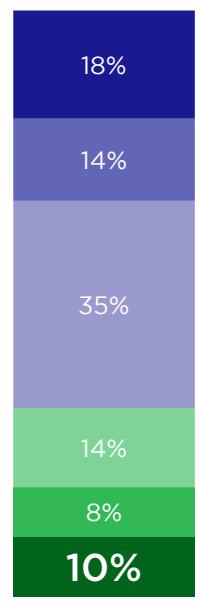
This image displays a stacked bar chart representing the percentage distribution of a specific metric within the game industry, with segments ranging from 8% to 35%. It illustrates how a total value is divided across six distinct categories, providing a visual breakdown of their relative proportions.