Showing 30 of 406 results · 0.65s
Investor Presentation: August 2026
Take-Two Interactive
Redemption, and Borderlands with a robust mobile presence, the organization is strategically positioned to capture significant market share across all major gaming platforms. Financial performance reflects the success
Financial35 pages
May 2014
FY 2014 Third Quarter Financial Results
GREE
challenges in international markets, the broader native game segment reached a profitable milestone globally. To diversify revenue streams beyond traditional gaming, expansion is underway into commerce, advertising
Financial35 pages
Sep 2023
Games Investment Review: Q3 2023
DDM
continued appetite for large‑scale mobile publishers. Microsoft’s $68.7 billion acquisition of Activision Blizzard, cleared after the divestiture of cloud‑gaming rights to Ubisoft, dominated the corporate
Financial43 pages
Apr 2013
Annual Report of 11 bit studios S.A. for 2012
11 bit studios
systems such as PC and mobile. Despite facing a competitive labor market for experienced developers in Poland, the company intensified its game development activity, nearly doubling its work
Financial71 pages
Nov 2022
Form 10-Q: Q3 2022
Playtika
reliance on third-party mobile distribution platforms and a concentrated portfolio of free-to-play titles. While non-slot games and the acquisition of Reworks Oy provided growth
Financial1 pages
Apr 2018
FY2018 Third Quarter Financial Results
GREE
rankings for new mobile releases. Beyond mobile platforms, the company is actively expanding its console presence via the Nintendo Switch and leveraging its internal game engines and intellectual
Financial43 pages
Jan 2013
Management Policy & Strategy: Fiscal Year Ended March 2013 Financial Results
Koei Tecmo
profit increases. The game software segment remained the primary driver, though the company noted a strategic need to rebuild its online, mobile, and media rights businesses. Geographically, Japan
Financial27 pages
Feb 2018
Summary of Main Questions and Answers at the FY2018 Second Quarter GREE Results Briefing
GREE
designed as a one-time downloadable purchase without planned in-game transactions. The move into console gaming is intended to reach a broader demographic of gamers while maintaining
Financial2 pages
May 2023
Electronic Arts Annual Report: FY 2023
Electronic Arts
generate significant in‑game purchases. Geographically, revenue is heavily weighted toward North America ($3.15 billion) and console platforms ($4.44 billion), with mobile sales growing 18 % year‑over‑year
Financial1 pages
Nov 2022
Take-Two 10-Q — Q3 FY2022 (November 2022)
Take-Two Interactive
virtual‑currency and in‑game purchases. The company’s portfolio remains concentrated, with five franchises contributing nearly 80 % of net revenue; however, mobile and digital channels now provide
Financial1 pages
Jan 2014
Fiscal Year Ending March 2014 Financial Results
Koei Tecmo
units. The Game Software segment remained the primary revenue driver, contributing 25.4 billion yen in sales, followed by the Online & Mobile segment at 6.4 billion yen. Geographically, Japan
Financial29 pages
Mar 2014
Financial Highlights for the First Half of the Fiscal Year Ending March 2014 (FY2013)
Koei Tecmo
Game Software segment remained the primary revenue driver, contributing 9.77 billion yen in sales, a 10.8% increase. However, the Online & Mobile and Media & Rights segments showed the strongest
Financial2 pages
May 2023
CD Projekt Group Q1 2023 Earnings
CD Projekt
Witcher game) and Project Sirius. Notably, the period included an 18.8 million PLN impairment adjustment related to Project Sirius. Additionally, the mobile title The Witcher: Monster Slayer
Financial14 pages
Sep 2023
Interim Report 2023
IGG
pivot toward new game titles and operational efficiency. The company generated HK$2.5 billion in revenue, maintaining stability through its flagship title, Lords Mobile, while successfully scaling newer
Financial99 pages
Aug 2023
IGG Inc. 2023 Interim Report
IGG
surge in the mobile application business, which reached monthly gross billings of HK$63 million by July 2023, signaling successful diversification beyond the core gaming portfolio. Despite stable
Financial99 pages
Jan 2014
Financial Highlights for the 3rd Quarter of the Fiscal Year Ending March 2014 (FY2013)
Koei Tecmo
reporting period. The Game Software segment remained the primary driver of revenue, contributing 17.03 billion yen in sales, a 16% increase. However, the Online & Mobile segment showed
Financial2 pages
May 2025
Kakao Games Q1 2025 Earnings Results
Kakao Games
mobile segment experienced the sharpest decline, with revenue dropping 41% year-over-year to 96.1 billion KRW. In contrast, the PC gaming segment provided a strategic offset, growing
Financial7 pages
May 2022
Electronic Arts 10-K: FY 2022
Electronic Arts
propelled by acquisitions of Glu Mobile and Playdemic and new mobile launches. EA emphasizes a multi‑channel, multi‑device strategy—console, PC, mobile, free‑to‑play and subscription
Financial1 pages
Feb 2019
FY2019 Second Quarter Financial Results
GREE
Game and Entertainment segment to support its multiplatform and global expansion initiatives. Ultimately, the current fiscal performance underscores a transition from domestic mobile dominance toward a global, multi
Financial32 pages
Jul 2021
Financial Results for the First Quarter of the Fiscal Year Ending March 2022
Koei Tecmo
online and mobile segments. The entertainment segment remained the primary revenue driver, contributing 19.65 billion yen to total sales. Within this segment, smartphone and social game revenues nearly
Financial13 pages
Nov 2024
NEOWIZ Q3 2024 Earnings Results Presentation
Neowiz
while mobile revenue grew 19.7 % QoQ to KRW 45.7 billion, driven by seasonal events and the launch of “The Legend of Heroes: Gagharv Trilogy.” Non‑gaming income contributed
Financial8 pages
Jun 2025
Drake Star Global Gaming Report Q2 2025
Drake Star Partners
global gaming industry experienced a significant financial resurgence during the first half of 2025, characterized by a 28 percent increase in the Drake Star Gaming Index. This performance
Financial20 pages
Aug 2013
FY2013 Fourth Quarter Financial Results
GREE
centric web games and high-performance native apps. The company is also diversifying its revenue streams by expanding into advertising, merchandise, and other non-gaming ventures. Operational stability
Financial38 pages
Jun 2006
NetEase 20-F: Fiscal Year Ended December 31, 2005
NetEase
gaming; pending approvals and evolving e‑commerce rules could constrain operations. Currency volatility, limited payment infrastructure in China, and dependence on key partners such as China Mobile
Financial1 pages
Mar 2021
SciPlay 10-K — FY2020 (March 2021)
SciPlay
million largely driven by a 29 % increase in mobile sales and a shift of players from web to mobile platforms. Operating expenses grew 18 % to $427.2 million
Financial1 pages
Q2 2026 Earnings Release: NC Corporation
NC Corporation
gaming remains a cornerstone of the business, achieving a record quarterly high of KRW 343.8 billion, largely supported by the sustained momentum of Lineage Classic. Simultaneously, the Mobile
Financial12 pages
FY2022 Financial Results: Koei Tecmo Holdings
Koei Tecmo
mobile. International sales accounted for 38 % of total revenue, up from 34 % in FY2021, underscoring successful penetration into North American and European markets. In addition to core game
Financial38 pages
Jan 2024
Electronic Arts Inc. Q3 FY24 Results
Electronic Arts
game bookings declined 5 percent to $654 million, reflecting a shift toward service‑based monetisation. Platform‑level performance showed console bookings up 2 percent to $1.61 billion, mobile
Financial17 pages
Aug 2021
Summary of Main Supplementary Explanations: FY2021 Fourth Quarter Results Briefing
GREE
gaming while implementing localized events and expanded language support. Despite this long-term optimism, the heavy upfront investment in the Metaverse and development costs for new mobile titles
Financial2 pages
May 2023
Summary of Main Supplementary Explanations Questions and Answers at the FY2023 Third Quarter GREE Results Briefing Held on May 11, 2023
GREE
gaming profitability while aggressively scaling a monetized metaverse ecosystem for a global audience. The geographic scope emphasizes a shift toward international markets, particularly as the domestic Japanese mobile
Financial2 pages
Investor Presentation: August 2026
35 pages4k words
Summary
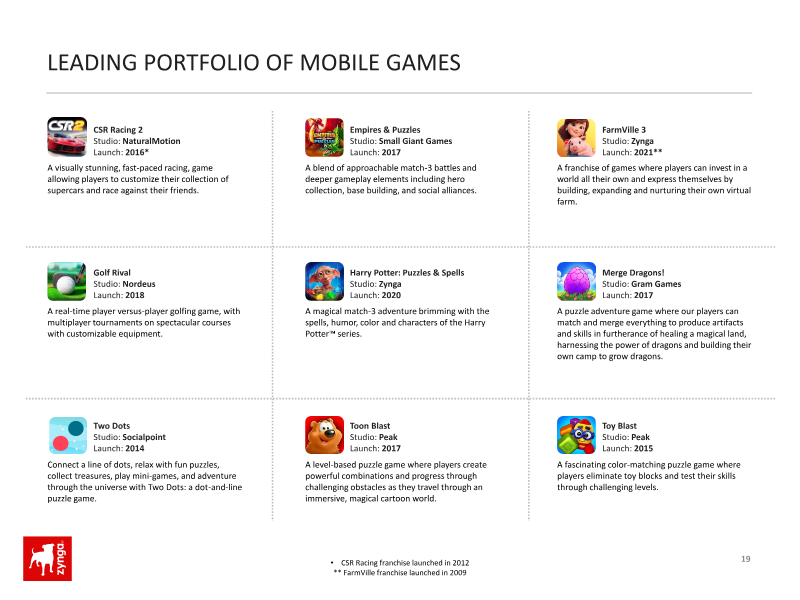
Take-Two Interactive occupies a dominant position in the global video game market, which is projected to reach a valuation of $208 billion by the end of 2026. The company’s primary objective is to leverage its extensive portfolio of industry-leading intellectual property to drive long-term growth and recurrent consumer spending. By maintaining a diversified development pipeline that balances massive console-based franchises like Grand Theft Auto, Red Dead Redemption, and Borderlands with a robust mobile presence, the organization is strategically positioned to capture significant market share across all major gaming platforms.
Financial performance reflects the success of this diversified strategy, with net bookings reaching $6.721 billion by fiscal year 2026. Revenue distribution highlights a balanced ecosystem, where mobile operations account for 49% of total bookings, followed by console at 40% and PC and other segments at 11%. This revenue mix is bolstered by a consistent mergers and acquisitions strategy and a transition toward live services, which ensure sustained engagement and monetization across the company’s vast catalog of titles, including NBA 2K and Civilization.
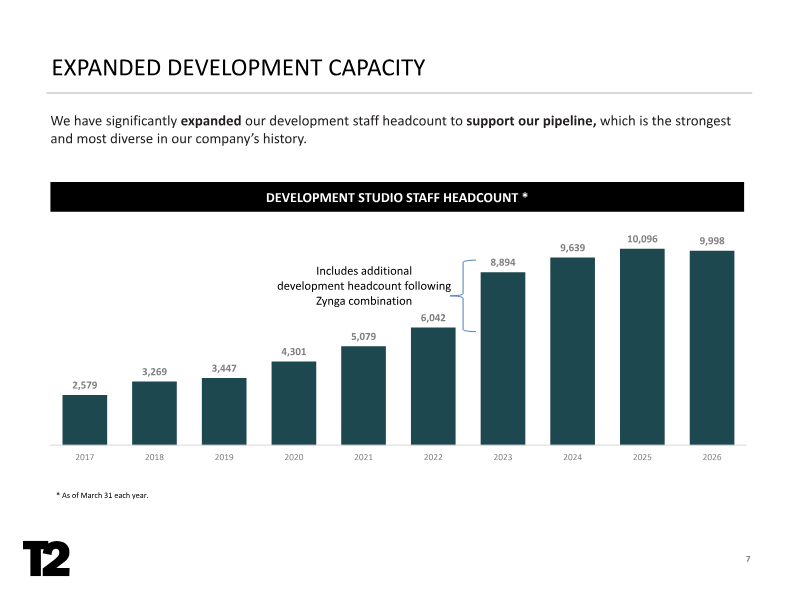
The company is currently managing its largest development pipeline in history, supported by a significantly expanded workforce. A critical milestone for this growth trajectory is the highly anticipated launch of Grand Theft Auto VI in November 2026. By integrating high-profile console releases with the massive scale of its mobile segment, the company maintains a resilient business model capable of navigating the evolving demands of the global interactive entertainment industry.
Pages
Insights
- Take-Two Interactive is scheduled to launch Grand Theft Auto VI in November 2026, serving as a critical milestone for the company's largest development pipeline in history.
- The company achieved $6.721 billion in net bookings for fiscal year 2026, supported by a diversified portfolio including major franchises like Red Dead Redemption, Borderlands, NBA 2K, and Civilization.
- Revenue distribution is balanced across platforms, with mobile operations accounting for 49% of total bookings, followed by console at 40% and PC/other at 11%.
- Take-Two is strategically positioning itself within a global video game market projected to reach a valuation of $208 billion by the end of 2026.
- The organization is prioritizing long-term growth through a combination of consistent mergers and acquisitions and a transition toward live services to sustain consumer engagement.
DEVELOPMENT STUDIO STAFF HEADCOUNT