Report21 pages
Game Developer Collective Survey Results: November 2024
The November 2024 Game Developer Collective Survey examines how game developers allocate resources to software tools and services, focusing on the adoption of game engines, cloud platforms, and ancillary technologies. The central thesis is that while the market now offers a broader array of solutions than ever before, studios face divergent realities: many are eager to leverage these options to boost efficiency and output, yet a substantial portion confronts tightening budgets that limit further investment. This tension is reflected in the “Industry Conditions and Performance” findings, which portray a challenging commercial environment for the sector.
Key observations indicate that developers increasingly view diversified toolsets as pathways to improved productivity, but cost pressures are intensifying across regions. The survey highlights a split between studios that can expand their technology stack and those that must defer additional spending, underscoring a growing disparity in capability to innovate. The analysis also signals that forthcoming research on “Working Environments,” slated for release in January 2025, will delve deeper into how these financial constraints intersect with workplace dynamics and talent management.
The study spans a global developer base, encompassing respondents from the Americas, Europe‑Middle East‑Africa, and Asia‑Pacific, and captures sentiment as of November 2024. Although specific sample sizes and data sources are not disclosed in the excerpt, the findings are presented under the Omdia research umbrella, with standard disclaimer language indicating that the material is provided “as‑is” and reflects the original publication date. The survey’s conclusions serve as a barometer of current investment trends and the fiscal pressures shaping the game development landscape.
- As of November 2024, the game development sector is defined by a growing disparity between studios capable of expanding their technology stacks and those forced to defer spending due to tightening budgets.
- Developers increasingly view the adoption of diversified software tools, cloud platforms, and ancillary technologies as the primary pathway to improving productivity and output.
- Intensifying cost pressures across global regions are creating a challenging commercial environment that limits the ability of many studios to invest in new innovation.
- The current market offers a broader array of software solutions than ever before, yet these options are being met with fiscal constraints that restrict widespread adoption.
- Future industry analysis, scheduled for release in January 2025, will examine how these ongoing financial constraints specifically impact workplace dynamics and talent management.
+1
Game Developer CollectiveNov 2024
Report21 pages
Tools & Services Survey: November 2024
This analysis examines the evolving landscape of game development tools and services amidst a period of significant market volatility. Based on a November 2024 survey of the Game Developer Collective, the findings track shifts in engine preference, cloud infrastructure, and overall industry sentiment. The survey includes a global sample of developers, with 48% based in North America and 39% in Europe, primarily representing roles in programming, management, and game design.
A primary focus is the game engine market, which continues to react to Unity’s 2023 "runtime fee" controversy. Despite Unity eventually scrapping the fee, the company has steadily lost market share to Unreal Engine. While the percentage of Unity users planning to switch engines dropped from a peak of 70% in late 2023 to 36% in late 2024, this remains significantly higher than the 14% switch rate seen among users of competing engines. Sentiment toward Unity has moderated, but only 30% of developers report being happy with the company, suggesting a lasting impact on brand trust.
The broader industry environment is characterized by increasing financial pressure and underperformance. Approximately 55% of developers now describe market conditions as "bad," a notable increase from 47% six months prior. Business performance has also declined, with 41% of studios reporting they are underperforming against expectations. Consequently, while investment in tools remains steady for most, there is a growing emphasis on productivity and efficiency as the primary drivers for new purchases. AI-powered tools are a rare area of growth, with studios more likely to increase spending in this category compared to traditional services.
In specialized segments, Blender has emerged as the leading 3D modeling tool, used by 50% of studios. Cloud platform usage is at an all-time high, led by AWS and non-hyperscaler options, though these services remain highly "sticky" with low intent to switch providers. Conversely, specialist backend platforms struggle with low penetration, as only 38% of studios currently utilize these centralized solutions. Overall, the findings depict a cautious industry prioritizing efficiency and stability while navigating a difficult commercial climate.
- Market sentiment is increasingly negative, with 55% of developers describing current conditions as 'bad' and 41% of studios reporting underperformance against expectations.
- Unity continues to lose market share following its 2023 runtime fee controversy, with 36% of its users still planning to switch engines compared to only 14% for competitors.
- Brand trust in Unity remains damaged, as only 30% of developers report being happy with the company despite the reversal of its controversial fee policy.
- Studios are prioritizing efficiency and productivity in their purchasing decisions, with AI-powered tools being the only category seeing increased spending compared to traditional services.
- Blender has become the dominant 3D modeling tool, currently utilized by 50% of surveyed studios.
+1
Game Developer CollectiveNov 2024

Report68 pages
Game Development and the Green Transition: Code, Climate, Creativity
Executive Summary – “Code, Climate, Creativity: Game Development and the Green Transition”
1. Rapid Industry Growth, Low Relative Carbon Footprint Turnover: €427 M (2012) → €3.1 B (2023) – a ≈ 900 % increase. Employment: > 9 000 people across 1 000+ firms; 87 % are micro‑enterprises (≤10 staff). Carbon Profile: Despite the boom, the Swedish games sector’s emissions remain modest compared with other Swedish industries. Electricity & travel: only a slight rise. Scope 3 (down‑stream) emissions dominate, mainly from the energy used while players are gaming.
Key Insight: The sector’s carbon intensity is low, but the sheer scale of downstream use means total emissions can still be significant.
2. A Dense, Emerging Climate‑Action Network Handbooks & Alliances: Nordic PlayCreateGreen guide, UN‑backed Playing for the Planet Alliance, European Sustainable Games Alliance. Industry Footprint: Global gaming ≈ 14 Mt CO₂e (≈ Sweden’s total industrial emissions). Swedish Share: 2.3 kt CO₂e (2022) – 0.015 % of national industry output. Emission Distribution: 90‑99 % of Swedish games‑sector emissions are Scope 3.
Take‑away: A well‑connected ecosystem of NGOs, academia, and industry is already mobilising around measurement, best‑practice sharing, and player engagement.
3. Scope 3 Dominance & Regulatory Pressure Average Intensity: ≈ 99 t CO₂e per MEUR of turnover → ≈ 302 kt CO₂e total for Swedish firms. Potential Reduction: Up to 90 % cut if all players switch to fossil‑free electricity. Policy Landscape: Science‑Based Targets initiative (SBTi): Requires Scope 3 reduction targets for developers. EU Corporate Sustainability Reporting Directive (CSRD): Will soon mandate detailed Scope 1‑3 disclosures.
Implication: Companies must embed Scope 3 accounting into strategy now, not later.
4. Where Scope 3 Emissions Come From Primary Sources: Production & use of consoles and PCs. Emerging Mitigation: Cloud‑gaming and thin‑client streaming can lower the energy needed for high‑performance gaming, but the net impact depends on data‑center efficiency and network load.
5. Sweden’s R&D Strength – A Launchpad for Green Tech Opportunities: Strong certification schemes and a culture of open innovation. Existing digital‑tool stack (game engines, GPUs, XR platforms,
- The Swedish games industry grew nearly 900% in turnover between 2012 and 2023, reaching €3.1 billion while maintaining a relatively low carbon footprint compared to other industrial sectors.
- Scope 3 emissions—primarily generated by energy consumption during player use—account for 90–99% of the Swedish games sector's total carbon footprint.
- Global gaming emissions are estimated at 14 Mt CO₂e annually, roughly equivalent to the total industrial emissions of Sweden.
- Regulatory pressure is mounting, as the EU Corporate Sustainability Reporting Directive (CSRD) and Science-Based Targets initiative (SBTi) will soon mandate detailed Scope 1–3 disclosures and reduction targets for developers.
- Transitioning players to fossil-free electricity could reduce the sector's total carbon impact by up to 90%.
+1
Swedish Games IndustryOct 2024

Report13 pages
Game Development Studie 2024: Die wirtschaftliche Bedeutung der österreichischen Spieleentwicklungsbranche, ihre Dynamiken und Einflüsse auf die Gesamtwirtschaft
The study evaluates the state of Austria’s game‑development sector in the first half of 2024, tracing its evolution since a comparable survey in 2018 and quantifying its economic contribution. By updating the Institute of Industrial Research’s developer database to 149 active firms and collecting completed questionnaires from 80 companies (a 53.7 % response rate), the analysis combines firm‑level survey data with input‑output modelling to assess employment, turnover and multiplier effects.
The industry has expanded rapidly: the number of firms rose 71.3 % to 149, with 81 % classified as micro‑enterprises (≤9 employees) and 54 % located in Vienna. Turnover reached €92.8 million in 2023—a nominal increase of 285 % since 2017—and employment grew from 474 jobs in 2017 to 1 080 in 2024 (128 % rise). Direct, indirect and induced effects generate a total of €188.7 million in revenue and support roughly 2 260 jobs across the Austrian economy, a multiplier of about 2.0 for both revenue and employment.
Product portfolios remain dominated by entertainment titles (85 % of respondents), while serious and educational games have gained prominence (29 % and 30 %). Development focuses on PC and mobile platforms, with Unity used by 55 % of firms. The workforce is young and highly educated—nearly half are aged 25‑34 and 80 % hold tertiary degrees. Export orientation is strong, 82 % of firms sell to the EU‑27/UK and substantial shares reach the Americas and Asia. Financing relies chiefly on internal funds (92 % deem it very important); public subsidies rank second (62 %). One‑third of firms applied for public funding in the past two years, achieving a 65 % success rate.
Looking ahead, respondents anticipate a slowdown in growth; projections suggest 2029 revenues of €149 million and employment of about 1 540, still representing robust expansion. Nevertheless, the sector rates Austria’s location policy poorly, calling for stronger governmental support, clearer financing mechanisms and improved tax conditions
- Austria’s game development sector has experienced rapid growth since 2017, with turnover increasing 285% to €92.8 million in 2023 and employment rising 128% to 1,080 jobs by 2024.
- The industry generates a total economic impact of €188.7 million in revenue and supports approximately 2,260 jobs across the Austrian economy, reflecting a multiplier effect of 2.0.
- The sector consists of 149 active firms, 81% of which are micro-enterprises with nine or fewer employees, and 54% are concentrated in Vienna.
- Development is highly export-oriented, with 82% of firms selling to the EU-27 and UK markets, while financing remains heavily reliant on internal funds (92%) rather than external investment.
- While the workforce is highly educated—with 80% holding tertiary degrees—the industry anticipates a growth slowdown, projecting revenues of €149 million and 1,540 jobs by 2029.
+1
PGDA – Pioneers of Game Development AustriaOct 2024

Report1 pages
CEDEC 2025 Schedule Announcement
The announcement establishes the official timetable for CEDEC 2025, Japan’s premier three‑day conference for computer‑entertainment developers organized by the Computer Entertainment Developers Association (CESA). By moving the event to July 22‑24, 2025—approximately one month earlier than the traditional late‑August slot—the schedule compresses several preparatory phases, prompting participants to adjust their planning accordingly.
Key milestones are detailed: the public call for proposals opens on January 6, 2025, followed by the launch of sponsor and partnership programs in early‑to‑mid February. The final deadline for submissions is set for February 17 at 10 a.m. JST, with selection results communicated in late March. An early‑application deadline for sponsorships occurs on March 31, while ticket‑sale dates remain pending and will be announced later. The conference itself occupies three consecutive days, Tuesday through Thursday, in late July.
The scope is national, targeting Japanese developers, studios, and related stakeholders within the computer‑entertainment sector, and it outlines a timeline that spans from early January through late July 2025. Although the schedule is provisional and subject to minor adjustments, contact information for the CEDEC operations office and the official website are provided for inquiries and future updates.
- CEDEC 2025 will take place from July 22–24, 2025, shifting the conference approximately one month earlier than its traditional late-August schedule.
- The call for session proposals opens on January 6, 2025, with a strict submission deadline of February 17, 2025, at 10 a.m. JST.
- Selection results for proposed sessions will be communicated to applicants in late March 2025.
- Sponsorship and partnership programs launch in early-to-mid February 2025, with an early-application deadline for sponsors set for March 31, 2025.
- The conference is organized by the Computer Entertainment Developers Association (CESA) and targets Japanese developers, studios, and computer-entertainment stakeholders.
+1
Computer Entertainment Developers AssociationSept 2024

Report39 pages
State of the Game Industry 2025
The global game industry entered 2025 defined by a paradox of technological advancement and profound structural instability. While PC remains the dominant platform for 80% of projects, the workforce faces significant volatility, with 41% of developers impacted by layoffs or studio closures over the past year. This instability has triggered a shift in studio composition, marked by a decline in AAA representation to 15% and a corresponding rise in solo developers, who now constitute 21% of the workforce. Despite these pressures, the industry continues to diversify, with women and non-binary individuals making up 32% of the workforce and LGBTQ+ representation reaching 25%.
Operational trends indicate a cooling of the initial fervor surrounding generative AI. Although 52% of developers utilize the technology, 51% express deep ethical concerns regarding intellectual property theft and job displacement, leading 27% of companies to abandon interest in the tools entirely. Simultaneously, the market is pivoting away from the live-service model due to saturation and burnout, with 42% of developers expressing no interest in the format. This strategic shift coincides with a tightening of the financial landscape; 56% of all developers and 82% of independent creators now rely on self-funding as traditional venture capital and publishing deals become increasingly scarce.
Labor conditions have tightened for the first time in several years, with the average workweek lengthening and the percentage of developers working 40 hours or less dropping to 57%. While 58% of the workforce supports unionization as a remedy for crunch and job insecurity, active organizing remains limited to 22% of respondents. Furthermore, external environmental factors are becoming a tangible operational risk, as 16% of developers report that natural disasters such as wildfires and floods have directly impacted their productivity. These combined factors suggest an industry in a state of cautious restructuring, balancing ethical and financial hurdles against a diversifying talent pool.
- The industry is experiencing significant instability, with 41% of developers affected by layoffs or studio closures and a shift toward smaller teams, as AAA representation drops to 15% while solo developers rise to 21%.
- Financial access is tightening, forcing 56% of all developers and 82% of independent creators to rely on self-funding due to a scarcity of venture capital and publishing deals.
- Generative AI adoption is cooling; while 52% of developers use the technology, 51% cite ethical concerns regarding IP theft and job displacement, leading 27% of companies to abandon the tools.
- Market sentiment is shifting away from live-service models due to saturation and burnout, with 42% of developers expressing no interest in pursuing the format.
- Labor conditions are deteriorating, as the percentage of developers working 40 hours or less has dropped to 57%, prompting 58% of the workforce to support unionization.
+2
InformaMay 2024

Report21 pages
DevOps Report
The report presents a comprehensive analysis of the global DevOps ecosystem, emphasizing its rapid evolution, investment dynamics, and the strategic role of emerging technologies such as artificial intelligence, low‑code platforms, and serverless computing. By integrating market performance data, transaction activity, and funding trends, it argues that DevOps has become a primary growth engine for technology firms, outpacing traditional operations and broader equity benchmarks.
Quantitative findings show that Dev‑focused companies have delivered a 23 percent total return over the past four quarters, surpassing the S&P 500, while Ops‑centric peers lagged with an 11 percent gain. Revenue growth multiples for leading Dev firms range from 12‑to‑20‑times, with Atlassian, GitLab, HashiCorp and DataDog commanding premium valuations. The sector’s M&A volume rebounded to $27.6 billion in the first half of 2024, highlighted by marquee deals such as Cisco’s $31 billion acquisition of Splunk and IBM’s $7.7 billion purchase of HashiCorp. Private‑market activity remains robust, with the ten best‑funded DevOps startups raising a cumulative $4.3 billion, and low‑code solutions projected to account for more than 65 percent of new applications.
Geographically, the analysis spans North America, Europe, the Middle East and Asia, covering transactions from 2013 onward and focusing on the 2023‑2024 period. Data sources include Capital IQ, Pitchbook, Gartner, DS Research and other industry databases, providing a multi‑source foundation for the performance and valuation metrics presented. The findings underscore the accelerating convergence of development and operations, driven by AI‑enhanced automation, open‑source integration, and the shift toward serverless architectures, positioning DevOps as a central pillar of modern technology investment strategies.
- Dev-focused companies significantly outperformed the broader market with a 23 percent total return over the past four quarters, doubling the 11 percent gain seen by Ops-centric peers.
- Leading DevOps firms currently command premium revenue growth multiples ranging from 12-to-20-times, with Atlassian, GitLab, HashiCorp, and DataDog identified as top performers.
- M&A activity in the DevOps sector rebounded to $27.6 billion in the first half of 2024, driven by major acquisitions including Cisco’s $31 billion purchase of Splunk and IBM’s $7.7 billion acquisition of HashiCorp.
- Private-market investment remains highly active, with the ten best-funded DevOps startups securing a cumulative $4.3 billion in capital.
- Low-code platforms are becoming a dominant development standard, with projections indicating they will account for more than 65 percent of all new applications.
+1
Drake Star PartnersMar 2024

Report53 pages
The State of Play: Summer 2024 Edition
The summer 2024 Xsolla analysis argues that the game‑development ecosystem has entered a phase of unprecedented democratization, driven by low‑cost engines, open‑source tools and third‑party services that lower technical and financial barriers for creators. Unity now powers 38 % of developers, up eight percent year‑over‑year, while Unreal enjoys a ten‑percent growth and Godot records a 69 % surge. More than 40 % of indie studios rely on five or more premade asset packages, and cross‑platform toolchains enable a quarter of developers to launch on PC, console and mobile, reaching the 60 % of players who game across multiple devices. Indie titles generate 29 % of Steam revenue in 2023, up from 25 % in 2018, and the average in‑house backend spend of $21 million is reduced through services such as Xsolla.
Emerging studios continue to view market entry as challenging, emphasizing the need for health‑focused initiatives and localized support networks, exemplified by growing ecosystems in regions such as Wisconsin. Gender‑specific preferences reveal that women developers prioritize completion, fantasy and design elements, underscoring the importance of inclusive design considerations.
The edutainment segment is projected to expand at a 65‑75 % compound annual growth rate through 2034, with the global MOOC market expected to reach $279.3 billion and 1.12 billion participants by 2029; the United States alone accounts for $87.5 billion in 2024. Concurrently, influencer
- Indie studios are capturing a larger share of the market, generating 29% of total Steam revenue in 2023 compared to 25% in 2018.
- Game development is becoming increasingly democratized as Unity usage grows by 8% year-over-year, Unreal grows by 10%, and Godot experiences a 69% surge.
- The edutainment sector is poised for significant expansion, with a projected compound annual growth rate of 65–75% through 2034.
- Cross-platform development is becoming standard, with 25% of developers utilizing toolchains to reach the 60% of players who game across multiple devices.
- Over 40% of indie studios now rely on five or more premade asset packages, while third-party services are actively replacing the $21 million average in-house backend spend.
+1
XsollaMar 2024

Report14 pages
The True Cost of Building a Mobile Game Backend
This analysis examines the financial and operational costs associated with developing in-house backend technology for mobile games. The primary thesis suggests that while third-party game engines have become industry standards, backend infrastructure is currently undergoing a similar shift as the technical demands of live-service games outpace the practicality of internal development.
The findings are based on a survey of 125 C-level executives and tech leads at US-based mobile game studios with at least 50 employees, conducted in April 2024. Data indicates that the average leading US studio employs 52 developers for 36 months to build and maintain an internal backend. With an average annual salary of $138,864 per developer, the direct financial investment for a custom backend is estimated at approximately $21.6 million. The research notes that strategy and shooter genres are most likely to require these complex systems, while hypercasual games are increasingly adopting them to support "hybridcasual" live-ops models.
Beyond direct costs, the analysis identifies significant "hidden" human and operational tolls. Approximately 50% of surveyed studios reported that diverting gameplay programmers to backend tasks slowed overall game development. Furthermore, one-third of respondents experienced higher employee turnover and increased "crunch" periods, while 20% reported direct revenue loss. The study concludes that the decision to build internal tech often results in negative knock-on effects across departments, suggesting that third-party solutions offer a more sustainable path for scaling live-service titles without sacrificing personnel well-being or development velocity.
- Building an in-house mobile game backend costs an average of $21.6 million, requiring 52 developers working over a 36-month period.
- Diverting gameplay programmers to backend infrastructure tasks slows overall development velocity for 50% of surveyed studios.
- Internal backend development contributes to negative organizational outcomes, including increased employee turnover, higher rates of crunch, and direct revenue loss for 20% of studios.
- The technical demands of live-service games are driving a shift toward third-party backend solutions, mirroring the industry-wide adoption of third-party game engines.
- While strategy and shooter genres have the highest requirement for complex backend systems, the rise of 'hybridcasual' models is expanding this need to the hypercasual sector.
+2
MetaplayMar 2024

Report30 pages
The Golden Age of Video Game Remakes and Remasters
The video game industry has entered a definitive era of remakes and remasters, fueled by a risk-averse development climate and the significant purchasing power of nostalgic Millennial consumers. These projects serve as a strategic hedge against the rising costs of original intellectual property, allowing developers to re-engage dormant fanbases while attracting new audiences through modernized graphics and gameplay. Success in this sector depends heavily on timing and the specific nature of the renewal. Remasters perform most effectively when released within five years of an original title to capitalize on hardware transitions. Conversely, full remakes require a longer gestation period, typically between nine and twenty-five years, to ensure that technological advancements are substantial enough to justify a full-price purchase.
Effective remakes must strike a delicate balance between preservation and modernization. Developers are encouraged to maintain the core essence and iconic moments of a title—such as specific art styles or dialogue—while aggressively updating outdated mechanics like quick-time events. Leveraging contemporary hardware capabilities, such as 3D audio and advanced rendering, is essential for meeting modern player expectations. By aligning these updates with a clear vision for modernization, studios can successfully bridge the gap between historical authenticity and current industry standards.
This 2024 analysis provides a comprehensive overview of the global gaming landscape, focusing on the strategic advantages of revitalizing established franchises. While the findings highlight clear pathways to commercial success through market-tested IPs, the data is intended for informational purposes and reflects the broader trends shaping the current development cycle. Ultimately, the strategic deployment of remakes and remasters reduces financial volatility for studios while ensuring that classic gaming experiences remain accessible and relevant in a rapidly evolving technological environment.
- Remakes and remasters serve as a strategic financial hedge against the rising costs of developing original intellectual property in a risk-averse industry.
- Full remakes require a gestation period of nine to twenty-five years to ensure technological advancements are significant enough to justify a full-price purchase.
- Remasters are most commercially effective when released within five years of the original title to capitalize on hardware transitions.
- Successful revitalization requires balancing the preservation of iconic elements, such as art style and dialogue, with the aggressive modernization of outdated mechanics like quick-time events.
- Studios must leverage contemporary hardware capabilities, including 3D audio and advanced rendering, to meet modern player expectations for updated titles.
+1
VirtuosMar 2024

Report171 pages
Brazilian Gaming Industry Report 2023
The Brazilian gaming industry represents a rapidly maturing ecosystem that defied global trends in 2022, growing by 3% to reach 103 million players while the international market experienced its first contraction. With 1,042 active studios as of 2023—a 177% increase over five years—the sector is primarily composed of micro and small enterprises concentrated in the Southeast and South regions. Despite this expansion, local studio revenue accounts for only 10% of domestic consumption, highlighting a significant gap between local production and the country’s status as the world’s fifth-largest online gaming population.
Development trends show a shift toward multi-platform strategies, with computers and mobile devices serving as the primary targets for the 1,009 games produced in 2022. While 93% of studios develop proprietary intellectual property, there is a burgeoning reliance on international markets; 65% of studios active abroad derive more than half of their revenue from exports. Furthermore, the industry has seen a 62% surge in outsourcing services, particularly in 3D art and animation, signaling a transition toward high-value service provision for the global entertainment sector.
The workforce expanded to over 13,000 professionals in 2022, characterized by a 70% remote work rate and an increasing focus on administrative roles that suggest greater corporate maturity. However, the industry faces persistent structural and social challenges. The lack of a specific national economic classification complicates data collection, while diversity remains a critical area for improvement. Women represent only 24.3% of the workforce, and minority groups remain underrepresented. While external initiatives and diversity councils aim to foster inclusivity, 82% of companies still lack formal internal inclusion policies, indicating that the sector’s social evolution has yet to match its rapid economic and technical acceleration.
- Brazil’s gaming market grew 3% in 2022 to 103 million players, even as the global market contracted, yet local studios capture only 10% of domestic consumption.
- The number of active gaming studios in Brazil reached 1,042 in 2023, representing a 177% increase over the previous five years.
- The industry is increasingly export-oriented, with 65% of studios operating abroad generating more than half of their revenue from international markets.
- Outsourcing services, particularly in 3D art and animation, surged by 62% in 2022, marking a shift toward providing high-value services to the global entertainment sector.
- The workforce grew to over 13,000 professionals in 2022, with a 70% remote work rate and a growing emphasis on administrative roles indicating increased corporate maturity.
+1
AbragamesMar 2024

Report56 pages
Paving Ways to the Games Industry: 2024
The Swedish games industry stands at a critical juncture, balancing rapid expansion with systemic structural challenges that threaten its long-term competitiveness. As of 2022, the sector encompasses 939 companies and over 8,400 employees, yet it remains heavily reliant on international labor to compensate for a persistent domestic skills gap. The primary thesis posits that sustainable growth depends on transitioning from a reliance on traditional recruitment toward a more inclusive, flexible, and collaborative ecosystem that integrates diverse talent, including newly arrived immigrants and individuals from non-traditional backgrounds.
To bridge the gap between current educational outputs and industry requirements, the sector must overcome significant bureaucratic and social barriers. While a robust network of regional incubators and innovation hubs provides a foundation for entrepreneurship, the industry is hindered by restrictive migration policies, a lack of standardized skill validation for international applicants, and insufficient senior mentorship for junior staff. Addressing these issues requires the implementation of innovative educational models, such as micro-credentials and intensive reskilling programs, which prioritize professional potential over rigid, legacy hiring requirements.
Ultimately, the industry’s future success hinges on a unified effort between public sector agencies, educational institutions, and private studios. By fostering greater awareness of game development as a viable career path and dismantling administrative hurdles, the sector can cultivate a more diverse and psychologically safe workforce. Prioritizing inclusive hiring strategies, language flexibility, and targeted outreach to underrepresented groups is not merely a social imperative but a strategic necessity to ensure that Sweden maintains its position as a global leader in game innovation and economic development.
- As of 2022, the Swedish games industry comprises 939 companies and over 8,400 employees, but it faces a critical skills gap that necessitates a heavy reliance on international labor.
- Sustainable long-term growth requires shifting from traditional recruitment models toward an inclusive ecosystem that integrates immigrants and individuals from non-traditional backgrounds.
- The industry is currently hindered by restrictive migration policies, a lack of standardized skill validation for international applicants, and a shortage of senior mentorship for junior staff.
- To align educational outputs with industry needs, the sector must adopt innovative models like micro-credentials and intensive reskilling programs that prioritize professional potential over rigid hiring requirements.
- Maintaining Sweden's position as a global leader in game innovation requires a unified strategy between public agencies, educational institutions, and private studios to dismantle administrative and social barriers.
+1
The Swedish Games IndustryJan 2024

Report56 pages
Fler vägar in i spelbranschen: 2024
The Swedish game industry faces a critical structural challenge as a persistent skills shortage threatens its long-term growth and international competitiveness. While the sector benefits from a robust domestic ecosystem of educational institutions ranging from vocational schools to universities, these traditional pathways are insufficient to meet the rising demand for talent. To sustain expansion, the industry must pivot toward more inclusive recruitment strategies that actively integrate untapped talent pools, including immigrants, professionals from adjacent sectors, and underrepresented groups.
A primary obstacle to this integration is the lack of established mechanisms for validating non-traditional skills and experience. Bureaucratic hurdles, such as complex work permit regulations and rigid migration policies, further complicate the recruitment of international experts. Simultaneously, a lack of industry awareness among public employment agencies and career counselors prevents potential candidates from recognizing game development as a viable career path. Addressing these gaps requires a multifaceted approach, including the implementation of micro-credentials to document specialized competencies, the creation of targeted bridge programs, and the development of flexible, part-time educational models that allow for concurrent employment.
Long-term success depends on deepening the collaboration between private studios, the public sector, and educational providers. By fostering inclusive leadership, promoting diverse role models, and simplifying administrative processes for new arrivals, the industry can effectively lower the barriers to entry. Ultimately, the transition toward a more open and welcoming professional culture is essential to harness the full potential of the available workforce, ensuring that the Swedish gaming sector remains a global leader by successfully bridging the divide between current labor market structures and the evolving needs of the digital economy.
- The Swedish game industry is facing a critical structural skills shortage that threatens its long-term international competitiveness and growth.
- Traditional educational pathways are insufficient to meet talent demand, necessitating a shift toward recruiting from untapped pools like immigrants, adjacent sector professionals, and underrepresented groups.
- Complex work permit regulations and rigid migration policies create significant bureaucratic barriers to hiring international experts.
- A lack of industry awareness among public employment agencies and career counselors prevents potential candidates from viewing game development as a viable career path.
- The industry must implement micro-credentials to validate non-traditional skills and develop flexible, part-time educational models that allow for concurrent employment.
+1
DataspelsbranschenJan 2024

Report53 pages
The Xsolla Report: State of Play – Summer Edition 2024
The Summer Edition of the Xsolla Report demonstrates that indie game development has entered a phase of rapid democratization and commercial viability. Accessible engines such as Unity, Unreal, and the fast‑growing Godot now dominate production pipelines, enabling more than 8 000 titles to launch in 2023. Coupled with free or low‑cost asset stores and cloud backend services, indie studios can cut development time and costs dramatically, accelerating time‑to‑market and allowing them to compete with larger studios.
Sales data confirm the shift: indie titles generated over $15 million in lifetime revenue on Steam alone, and now account for 31 % of total Steam earnings. Action, adventure, and RPG genres remain the most lucrative, while indie games enjoy higher average Steam ratings (≈72 %) than AAA titles. The market share of indie games on PC and console platforms rose from 13 % in 2021 to 18 % in the United States, underscoring a growing consumer appetite for independent titles.
Influencer marketing has become the primary driver of discovery and purchase decisions, with YouTube still commanding the highest impact but TikTok and Instagram offering more cost‑effective alternatives. The sector’s marketing spend is projected to triple, reaching $24 billion by 2024. Meanwhile, the convergence of education and gaming—through MOOCs, online academies, and immersive technologies—has expanded the talent pipeline, raising average developer salaries from $60 k in 2010 to $95 k in 2024.
Geographically, the report focuses on North America and Europe, with a particular emphasis on U.S. market dynamics, while the time frame spans 2021–2024. The findings highlight that strategic adaptability, influencer partnerships, and cloud‑based commerce tools are essential for publishers, developers, and investors to capture the expanding indie market.
- Indie games now account for 31% of total Steam earnings, with their U.S. market share on PC and console platforms rising from 13% in 2021 to 18% in 2024.
- Marketing spend for the indie sector is projected to triple to $24 billion by 2024, with influencer partnerships on YouTube, TikTok, and Instagram serving as the primary drivers of discovery.
- Indie titles are outperforming AAA games in quality perception, maintaining an average Steam rating of approximately 72%.
- The democratization of development via engines like Unity, Unreal, and Godot, alongside cloud backend services, enabled the launch of over 8,000 indie titles in 2023.
- The talent pipeline has expanded through educational convergence, contributing to a rise in average developer salaries from $60,000 in 2010 to $95,000 in 2024.
+1
XsollaJan 2024

Report72 pages
Africa Games Industry Report 2024
The Africa Games Industry Report 2024 presents a data‑driven assessment of the continent’s gaming ecosystem, targeting investors, policymakers, developers and the broader public. It argues that Africa’s youthful demographics, rapid mobile penetration and cultural diversity create a fertile environment for game development and monetisation. The report identifies fre‑to‑play with in‑app purchases as the dominant revenue model, while premium titles, ad‑based income, subscriptions and licensing remain viable alternatives for developers willing to overcome higher entry barriers.
Key findings show that the Sub‑Saharan gamer base has more than doubled from 77 million in 2015 to 186 million in 2021, with mobile gaming accounting for 95 % of players and nearly 90 % of the region’s $778.6 million revenue in 2022. Approximately one‑third of players make in‑app purchases, underscoring significant monetisation potential. The industry is largely composed of small to medium studios and solo developers, with Unity the preferred engine and mobile/PC platforms dominating. Yet only 36 % of respondents earn income from games, and infrastructure challenges—unreliable power (71 %) and costly internet (57 %)—continue to impede growth.
The report calls for coordinated action from investors, studios, policymakers and the public. It highlights mobile network operators and alternative payment systems as critical partners for expanding reach, while outlining a five‑factor ecosystem—reliable infrastructure, talent pathways, informed investors, connected industry and evidence of success—to unlock high‑value jobs, cultural exports and foreign investment. The overarching thesis is that Africa’s gaming sector is poised for rapid expansion, offering substantial economic and creative opportunities if these systemic barriers are addressed.
- The Sub-Saharan gamer base grew from 77 million in 2015 to 186 million in 2021, with mobile gaming driving 95% of the player base and nearly 90% of the region's $778.6 million revenue in 2022.
- Free-to-play with in-app purchases is the dominant revenue model, with approximately one-third of players currently making in-app purchases.
- Infrastructure remains the primary barrier to growth, with 71% of developers citing unreliable power and 57% citing high internet costs as significant impediments.
- Despite the sector's scale, only 36% of surveyed developers currently earn income from their games.
- The industry is primarily composed of small-to-medium studios and solo developers who predominantly utilize the Unity engine for mobile and PC platforms.
Maliyo GamesJan 2024

Report53 pages
State of Play: Xsolla Report
The report argues that the indie game sector has become a dominant force in the global market, driven by lowered entry barriers, widespread use of accessible engines, and a shift toward influencer‑led discovery. Data show that 2024 indie sales surpassed AAA titles, generating over $15 million in lifetime revenue across PC, Xbox, and Steam, with action, adventure, and RPG genres leading. Indie titles now account for 18 % of U.S. PC/console players and achieve higher average Steam ratings (≈72 %) than AAA games, reflecting a 12‑month YoY growth spike in early 2024 that continues to push positive momentum.
Key enablers include Unity’s 38 % market share, Unreal’s steady growth, and Godot’s sharp rise, which together support the release of 8 000–10 000 titles annually. Free or low‑cost asset stores and backend services such as Xsolla Backend reduce development time and cost, with studios reporting average backend build costs of $21 million versus in‑house development. Cross‑platform publishing and a 29 % share of Steam revenue in 2023 further accelerate market penetration.
The U.S. remains the largest gaming market, but regional hubs like Wisconsin are emerging through local publisher support and flexible work models. QA professionals increasingly influence inclusive design, while systemic barriers to gender and LGBTQ+ representation persist. Average U.S. developer salaries rose from $88,010 in 2023 to $91,009 in 2024, and the edutainment sector is projected to grow from $9.1 B in 2020 to $30.7 B by 2025, driven by online learning platforms.
Online education and influencer marketing are rapidly expanding; MOOCs are expected to reach $279 billion by 2029, and the global influencer market is projected at $36 billion in 2024. These trends underscore continuous skill development and targeted influencer partnerships as cost‑effective channels for monetization, marketing, and distribution. The synthesis highlights the need for strategic adaptability among publishers, developers, and investors to capitalize on the evolving indie landscape.
- Indie games surpassed AAA titles in 2024, generating over $15 million in lifetime revenue and accounting for 18% of U.S. PC/console players with an average Steam rating of approximately 72%.
- The indie sector is supported by an annual output of 8,000–10,000 titles, driven by engine market shares led by Unity (38%) and the rapid adoption of Godot.
- Outsourcing backend services to providers like Xsolla reduces development costs significantly, with studios reporting average build costs of $21 million compared to the higher expense of in-house development.
- The edutainment sector is projected to grow from $9.1 billion in 2020 to $30.7 billion by 2025, while the global influencer market is expected to reach $36 billion in 2024.
- Average U.S. developer salaries increased from $88,010 in 2023 to $91,009 in 2024, reflecting ongoing labor market shifts alongside the emergence of regional hubs like Wisconsin.
XsollaJan 2024

Report33 pages
State of Game Technology Report 2024
The report demonstrates that game technology is increasingly permeating non‑traditional sectors, with half of surveyed teams employing real‑time 3D engines beyond game development. This cross‑industry diffusion is accompanied by persistent funding constraints and collaboration bottlenecks, notably slow file transfers, remote coordination difficulties, and asset feedback challenges. The data reveal a trend toward consolidating toolsets to enhance productivity amid economic uncertainty and the rise of remote work.
Engine usage remains dominated by Unreal Engine (63 %) while Unity follows at 47 %; Godot is gaining traction mainly among indie developers. Version control practices show Perforce Helix Core leading (51 %) with widespread adoption of Git‑based solutions, though Google Drive remains a common secondary storage option.
Asset management practices differ markedly between AAA and indie studios. Custom‑built solutions are common in both, yet 23 % of AAA teams and 17 % of indie studios rely on them, diverting resources from core development. Indie teams more frequently use Perforce (55 %) compared to AAA studios (3 %). Generative AI adoption is high, with 65 % of respondents using an organizational AI tool; ChatGPT leads at 47 %, especially among indie/mid‑size studios (50 % versus 26 % in AAA). Other AI tools such as Midjourney, DALL‑E, and GitHub Copilot also see notable usage.
Cloud infrastructure is embraced by nearly half of respondents (49 %), with AWS leading at 30 % and Azure at 18 %; hybrid cloud adoption remains minimal (6 %).
Talent acquisition trends underscore a premium on specialized experience (≈95–100 %) and continuous learning ability (≈71–82 %), while presentation skills and portfolio strength, though important, receive comparatively lower emphasis. These findings highlight a shift toward adaptable, skill‑rich talent pools across highly technical industries.
- Real-time 3D engines are expanding beyond gaming, with 50% of surveyed teams now applying this technology to non-traditional sectors.
- Generative AI adoption is widespread, with 65% of organizations utilizing AI tools, led by ChatGPT at 47% usage, particularly among indie and mid-size studios.
- Unreal Engine remains the market leader at 63% usage, followed by Unity at 47%, while Perforce Helix Core dominates version control at 51%.
- Cloud infrastructure adoption has reached 49%, with AWS holding a 30% market share compared to 18% for Azure.
- Asset management remains inefficient, as 23% of AAA studios and 17% of indie teams divert core development resources to maintain custom-built solutions.
+2
PerforceJan 2024
Report4 pages
Company Profiles: Slovakia 2024
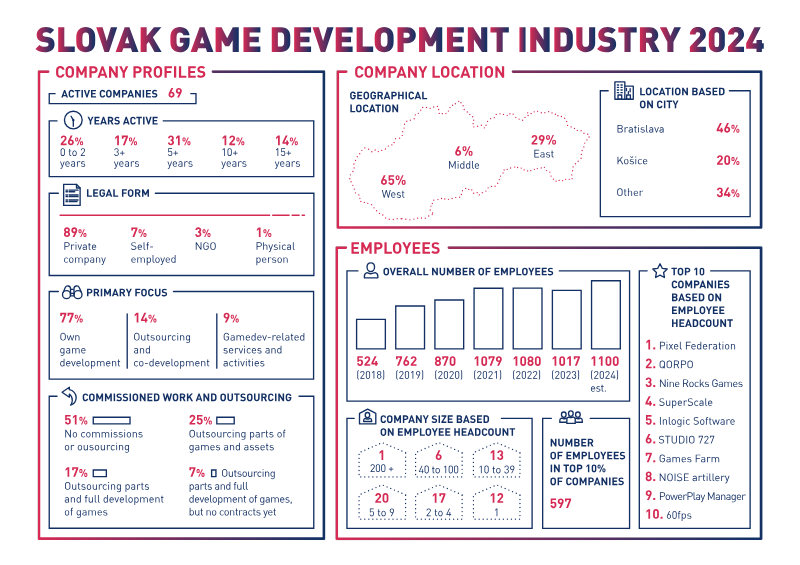
The Slovak game development industry in 2024 is characterized by a stable ecosystem of 69 active companies, primarily concentrated in the western region of the country, particularly Bratislava. The sector is dominated by private companies, with 77% focusing on original game development rather than outsourcing. While the industry experienced a slight contraction in headcount during 2023, it is projected to rebound to approximately 1,100 employees by the end of 2024. The workforce is relatively young, with a median age of 31, and women represent 21% of the total labor force, primarily occupying roles in graphic arts and marketing.
Financial data indicates a mature but concentrated market. The overall industry turnover for 2023 reached over 70 million EUR, a figure expected to remain stable through 2024. However, wealth is highly centralized, with the top 10% of companies—led by major players like Pixel Federation and Nine Rocks Games—accounting for 83.5% of total revenue. Funding remains largely internal, as 65.2% of projects are self-funded, though public funding supports roughly one-third of the industry.
Technologically, PC remains the primary development platform, utilized by 72.5% of developers, followed by mobile and console platforms. Despite the industry's creative success, developers face significant hurdles in recruitment, particularly for programming and game design roles. To foster future growth, industry stakeholders express a strong desire for increased state support, specifically in the form of R&D funding, tax incentives, and improved educational infrastructure to streamline the employment of both domestic and foreign talent.
- The Slovak game industry is highly concentrated, with the top 10% of companies—including Pixel Federation and Nine Rocks Games—generating 83.5% of the sector's 70 million EUR annual turnover.
- The industry consists of 69 active companies, 77% of which focus on original game development rather than outsourcing services.
- After a slight contraction in 2023, the workforce is projected to reach approximately 1,100 employees by the end of 2024, with a median age of 31 and 21% female representation.
- Financial independence is the industry standard, as 65.2% of projects are self-funded, while public funding supports approximately one-third of the market.
- PC remains the dominant development platform, utilized by 72.5% of Slovak studios, followed by mobile and console platforms.
+1
Swiss Game Developers AssociationJan 2024

Report39 pages
Art Direction in Game Remakes: An Analysis of 7 Case Studies
The pursuit of a successful game remake requires a delicate equilibrium between honoring the original creative spirit and meeting the heightened technical expectations of modern audiences. Analysis of high-profile titles released through 2024, including Metroid Prime Remastered and Resident Evil 4, indicates that critical and fan reception serves as the primary metric for quality, often superseding raw financial performance. Developers find the most success when they rebuild visual assets from scratch, leveraging contemporary lighting and 3D environments to recreate the atmospheric immersion that original technical constraints once limited.
Modernization strategies vary based on the age and mechanical relevance of the source material. While some titles benefit from subtle control refinements, others require a total overhaul of core systems to remain viable. Capcom’s approach to the Resident Evil series exemplifies this by replacing dated tank controls and fixed cameras with fluid 3D movement and strategic lighting. Similarly, Square Enix transitioned the static backgrounds and turn-based combat of Final Fantasy VII into expansive environments and action-oriented hybrid systems. These shifts demonstrate that adhering to the "pillars of experience" is more vital than preserving obsolete functional elements.
Ultimately, the most effective remakes prioritize the recreation of a specific feeling or "spirit" over mere resolution increases. While visual fidelity must be modernized to maintain immersion, gameplay adjustments should be handled selectively to avoid alienating the core fanbase. Industry leaders like Nintendo and specialized external development partners emphasize that leveraging modern hardware to amplify a game's original intent is the most reliable path to critical acclaim. By focusing on atmospheric depth and evolved control schemes, developers can ensure that classic titles resonate with both nostalgic players and new audiences within the current AAA landscape.
- Successful remakes prioritize the recreation of a game's original 'spirit' and atmospheric intent over simple increases in visual resolution.
- Critical and fan reception serves as the primary metric for quality in modern remakes, often outweighing raw financial performance.
- Developers achieve the highest success by rebuilding visual assets from scratch to leverage contemporary lighting and 3D environments, overcoming the technical constraints of original releases.
- Modernization strategies must distinguish between preserving 'pillars of experience' and replacing obsolete functional elements, such as Capcom’s transition from fixed cameras to fluid 3D movement in Resident Evil 4.
- Square Enix’s approach to Final Fantasy VII demonstrates that transitioning from static backgrounds and turn-based combat to expansive, action-oriented systems can effectively modernize legacy titles.
+1
Room 8 GroupJan 2024

Report20 pages
The Austrian Game Industry 2024
The Austrian game sector is portrayed as a youthful, fast‑growing cluster of predominantly small and micro enterprises whose economic relevance has expanded dramatically over the past six years. A 2023‑2024 survey commissioned by the Austrian Professional Association of Management Consultancy, Accounting and IT and executed by the Institute of Industrial Research gathered responses from roughly 150 active developers, with detailed data supplied by 78 firms on production output and by 23 firms on serious‑game activities. The study combines firm‑level questionnaires with macro‑economic modelling to assess direct, indirect and induced effects on the national economy.
Revenue generated by domestic developers reached €92.8 million in 2023, a nominal increase of more than 285 % compared with 2017, and still represents a 180 % rise after price‑level adjustment. Employment rose from 474 jobs in 2017 to 1 080 in 2024, a 128 % increase, and the sector’s multiplier effect creates roughly 2 260 jobs across Austria. Projections that assume a slowdown to one‑third of recent growth still forecast revenues of €149 million and a workforce of over 1 500 by 2029. In the preceding three years, the surveyed firms produced 405 games, while serious‑game developers now number 20‑30 companies employing 130‑150 staff, chiefly to raise awareness of social issues such as climate change.
The workforce is highly qualified: almost 80 % hold tertiary degrees, with the 25‑34 age group dominating. Educational provision is concentrated in three regional hubs—Salzburg, Upper Austria and Carinthia—where 25 university programmes supply the bulk of IT talent. Financing remains largely internal, with self‑funding cited by 92 % of firms; public subsidies rank second but are considered insufficient, reflected in the finding that 77 % of developers rate Austria’s location policy as poor or very poor. Nonetheless, only 5 % contemplate relocation, and the majority anticipate continued employment growth over the next three years.
- The Austrian game industry generated €92.8 million in revenue in 2023, marking a 285% nominal increase since 2017.
- Direct employment in the sector grew 128% over seven years, rising from 474 jobs in 2017 to 1,080 in 2024, with a total economic multiplier effect supporting 2,260 jobs.
- Projections for 2029 estimate industry revenue will reach €149 million and the workforce will exceed 1,500 employees, even assuming a significant slowdown in growth.
- The industry is characterized by small and micro enterprises that rely heavily on internal financing, with 92% of firms self-funding their operations.
- Despite 77% of developers rating Austria’s location policy as poor or very poor, only 5% of firms are considering relocation.
+1
Austrian Professional Association of Management ConsultancyJan 2024