
Report98 pages
Uso de Videojuegos Didácticos en el Aula: Pautas para el Éxito del Aprendizaje
The central aim is to furnish educators with an evidence‑based framework for selecting, deploying and assessing video‑games that serve pedagogical goals, arguing that, when moderated and integrated with clear learning objectives, digital games can substantially enrich cognition, spatial‑motor development, ICT competence and student motivation. The thesis contends that well‑designed, age‑appropriate games are not merely supplementary tools but can function alongside—or in some cases replace—traditional textbooks, provided that implementation follows structured guidelines and post‑play debriefing.
Empirical studies cited across the material demonstrate that personalization of difficulty and immediate feedback sustain engagement and translate into measurable gains in mathematics, geography, health, ethics and language outcomes. Serious‑game applications range from mobile‑AR health simulators to environmental awareness titles, while game‑jam events are shown to boost technical confidence, collaborative skills and coding proficiency. A detailed taxonomy links specific genres—action, puzzle, RPG, simulation—to targeted competencies, and a practical checklist emphasizes low‑spec technical requirements, PEGI age ratings, intuitive interfaces and progress monitoring. Accessibility adaptations for visual, auditory, cognitive and physical impairments are outlined, though further development is needed for visually‑impaired learners.
The scope encompasses Spanish‑language initiatives and broader international examples, covering primary to secondary education and spanning the period up to the early 2020s. It addresses multiple industry segments, including educational software, serious‑game developers, AR/VR health applications, learning‑management systems and community‑driven game‑jam platforms. Data from national campaigns such as “The Good Gamer” indicate adoption in over a thousand schools, with documented improvements in engagement metrics, competency tracking and interdisciplinary learning.
Conclusions stress that balanced, safe play—limited by time, monitored for health concerns, and anchored by teacher‑led debriefs—maximizes the cognitive, affective and behavioral benefits of game‑based learning. The provision of curated lesson plans, MOOCs, and extensive resource lists equips teachers to integrate games effectively, fostering creativity, empathy and social interaction while supporting academic achievement and well‑being.
- Structured integration of video games into curricula—supported by teacher-led debriefing and clear learning objectives—significantly improves student performance in mathematics, geography, health, ethics, and language.
- National initiatives like 'The Good Gamer' have successfully scaled game-based learning to over 1,000 schools, demonstrating measurable gains in student engagement, competency tracking, and interdisciplinary learning.
- Effective pedagogical deployment relies on selecting age-appropriate titles based on PEGI ratings and utilizing a taxonomy that matches specific genres, such as RPGs or simulations, to targeted cognitive and technical competencies.
- Game-jam events serve as a proven method for increasing student technical confidence, coding proficiency, and collaborative skills.
- Maximizing cognitive and behavioral benefits requires a balanced approach that includes time-limited play, health monitoring, and the use of curated lesson plans to anchor digital experiences in academic goals.
+1
EUN Partnership AISBLJan 2022

Report23 pages
Pesquisa da Indústria Brasileira de Games 2022
The 2022 Brazilian Games Industry Survey demonstrates that Brazil’s gaming sector has entered a phase of rapid expansion and increasing global relevance. Between 2018 and 2022 the number of domestic development studios more than doubled, rising from 375 to 1,009, while domestic digital‑game sales reached over US $2.3 billion in 2021, accounting for roughly three‑quarters of the market’s total revenue. This growth reflects a maturing ecosystem that now includes a full spectrum of domestic and foreign participants, from independent creators to multinational publishers.
The analysis highlights a dual‑track outlook in which private investment is expected to intensify, driving higher levels of international publishing, scaling of emerging opportunities, and greater promotion of Brazilian events abroad. Concurrently, public agencies such as Abragames, Brazil Games and ApexBrasil are projected to expand quantitative support through export missions, business‑matching initiatives and promotional campaigns, reinforcing the sector’s export potential. A broad portfolio of recent Brazilian titles illustrates the country’s expanding talent pool and creative versatility, positioning Brazil as a competitive player on the world stage.
Overall, the findings underscore a robust, export‑oriented trajectory for Brazil’s gaming industry, driven by a surge in studio formation, strong domestic sales, and coordinated public‑private efforts aimed at amplifying international visibility and market access. The survey’s scope encompasses the national market from 2018 through 2022, covering studio demographics, revenue figures, and the institutional framework supporting the sector’s growth.
- The number of domestic game development studios in Brazil more than doubled between 2018 and 2022, growing from 375 to 1,009.
- Domestic digital game sales in Brazil reached over US $2.3 billion in 2021, representing approximately 75% of the total market revenue.
- The Brazilian gaming sector is shifting toward an export-oriented model supported by coordinated efforts from public agencies including Abragames, Brazil Games, and ApexBrasil.
- Public-private initiatives are prioritizing international market access through export missions, business-matching programs, and promotional campaigns.
- Private investment is expected to increase, focusing on scaling emerging opportunities and expanding the international publishing of Brazilian titles.
+1
AbragamesJan 2022
Report11 pages
Rapport Annuel 2022 de l'ALD: Canada
The Association canadienne du logiciel de divertissement (ALD) presents an overview of its 2022 activities, emphasizing the organization’s mandate to champion the Canadian video‑game sector through policy advocacy, industry research and public‑relations initiatives. Central to the narrative is the 2021 economic study conducted with Nordicity, which quantifies the sector’s contribution to the national economy and underscores its resilience amid pandemic‑induced disruptions.
The study reveals that the industry expanded from fewer than 700 active studios in 2019 to nearly 1 000 in 2021, employing more than 32 000 full‑time workers and supporting an additional 23 000 indirect jobs. Direct output now adds $5.5 billion to Canada’s gross domestic product, the highest level recorded to date. Survey participation reached a record 160‑plus responses, representing over 150 studios that supplied employment and financial data. Diversity and inclusion policies are in place at more than 80 % of studios with 100 or more employees, indicating a sector‑wide commitment to balanced talent pipelines.
Complementary efforts include a bilingual “#MyWhy” vaccination campaign that mobilized seven influencers to produce eight videos, and a newly funded guide outlining electronic‑waste recycling obligations for members. Media outreach, coordinated with Hill & Knowlton Strategies, generated roughly 39 million impressions, 66 000 Twitter impressions, 11 000 Instagram impressions and 42 000 YouTube views, translating into over 1 200 hours of video consumption. Virtual engagements with federal officials covered economic impact, immigration, skills development and cultural funding, while plans are under way for an in‑person “Games on the Hill” event in November 2022.
Overall, the report demonstrates that despite pandemic constraints, the Canadian video‑game industry has continued to grow, diversify and increase its cultural and economic influence, positioning Canada as
- The Canadian video-game industry contributed $5.5 billion to the national GDP in 2021, marking the highest economic output recorded to date.
- The sector experienced significant growth between 2019 and 2021, with the number of active studios increasing from fewer than 700 to nearly 1,000.
- The industry currently supports 32,000 full-time direct employees and an additional 23,000 indirect jobs.
- Over 80% of studios with 100 or more employees have implemented formal diversity and inclusion policies to support talent development.
- Media outreach initiatives generated approximately 39 million impressions across various platforms, including 42,000 YouTube views totaling over 1,200 hours of consumption.
+1
ESAC – Entertainment Software Association of CanadaJan 2022
Report148 pages
Campo da Gioco Equo
The guide argues that gender equity is both a commercial necessity and a social responsibility for the European video‑game sector, which employs roughly 90 000 people while women constitute only about 20 % of developers despite half of Europe’s population being gamers. It frames equitable hiring, compensation, and workplace culture as strategic imperatives that can unlock talent, improve product relevance, and enhance profitability across development, publishing, and community‑management functions.
Key findings reveal a persistent 14.1 % gender‑pay gap within the EU and a pronounced promotion disparity linked to biased “potential” assessments. Transparent salary bands, gender‑bias‑checked job descriptions, and data‑driven monitoring are shown to narrow these gaps, as illustrated by Outplay’s partnership with InGAME, which produced a policy kit aligning compensation, career growth, and flexible work with equity goals. Hybrid‑flexible work models, mental‑health support, and targeted health initiatives—such as menopause pledges—further sustain inclusion, with Wooga’s five‑year parity programme cited as a successful example.
The document outlines concrete actions for building inclusive cultures: senior‑leadership commitment, merit‑based hiring, regular employee surveys, and zero‑tolerance harassment policies. Effective employee‑resource groups, exemplified by Take‑Two’s “Women in Gaming” ERG, amplify under‑represented voices and drive mentorship, innovation, and retention. Community‑safety measures, including AI‑enhanced moderation and diversified moderator teams, reduced toxic chat by 5 % in a pilot, demonstrating the impact of proactive, data‑driven interventions.
Education and pipeline initiatives span Europe, from the AWS GetIT programme that has reached over 23 000 students to national diversity pledges in France, Germany, Spain, Sweden, and the UK. These efforts aim to address the projected need for 500 000 software engineers and double girls’ interest in technical careers through early exposure and role‑model visibility. The guide stresses that measurable KPIs, positive‑action hiring practices, and compliance with EU legal frameworks are essential for tracking progress and ensuring lasting gender‑parity across the games industry.
- Women currently represent only 20% of the 90,000-person European video-game workforce, despite comprising half of the continent's gaming population.
- A persistent 14.1% gender-pay gap exists within the EU gaming sector, exacerbated by promotion disparities rooted in biased assessments of employee potential.
- Proactive, data-driven interventions—such as AI-enhanced moderation and diversified teams—successfully reduced toxic in-game chat by 5% in pilot programs.
- Industry-wide pipeline initiatives, such as the AWS GetIT programme, have reached over 23,000 students to address a projected demand for 500,000 software engineers.
- Companies like Outplay and Wooga have demonstrated that formalizing salary transparency, flexible work models, and long-term parity programmes effectively narrows gender gaps and improves retention.
+1
IIDEA – Italian Interactive Digital Entertainment AssociationJan 2022
Whitepaper191 pages
Global White Paper on Mobile Advertising & Marketing Game H1 2022
The first half of 2022 saw a contraction across the mobile‑app advertising ecosystem, with the total number of advertisers falling 5.79 % to a historic low of roughly 83 400 and creative volume dropping 27 % to 40 million assets. This downward pressure was most pronounced among mobile‑game advertisers, whose pool shrank to about 83 000 in January, while non‑game categories such as shopping apps retained the largest share of spend (≈12.5 % of advertisers and 17.2 % of creatives). Regional variation was stark: Europe and North America dominated non‑game advertising, whereas the Asia‑Pacific region, excluding China, was the only market with a net increase in advertisers.
Mobile‑game advertising displayed divergent cost dynamics. The United States and Japan posted the highest average CPMs at $27.54 and $25.93 respectively, with iOS campaigns costing roughly 15 % more than Android. Female users and the 55‑64 age cohort commanded a 13 % premium on impressions, while South Korea recorded the peak CPI at $13.90. Playable ads delivered the lowest CPI but suffered the weakest return on ad spend, whereas banner formats generated the strongest ROAS. Strategy titles leaned heavily on video‑only creatives (>90 %) and began integrating casual‑puzzle mechanics to broaden appeal; interest in emerging formats remained modest, with only 16 % of players expressing curiosity about NFTs and 32 % about metaverse features.
Creative strategies are shifting toward motivation‑driven, user‑centric formats such as rewarded video and playable ads to counter post‑IDFA fragmentation. Narrative‑driven ads are proving effective for simulation games targeting female audiences, delivering $12 million in revenue across key Western markets. AR‑enhanced placements on platforms like Snapchat achieve double the attention and 1.7 × the immersion of standard formats, while friend‑based recommendations outperform celebrity influencers by a factor of four. Regional opportunities are emerging in Tier‑2/3 India through vernacular campaigns and OEM inventory, and Turkey’s
- The mobile advertising ecosystem contracted in H1 2022, with the total number of advertisers falling 5.79% to approximately 83,400 and creative volume dropping 27% to 40 million assets.
- Mobile-game advertising costs remain high in key markets, with the U.S. and Japan recording average CPMs of $27.54 and $25.93, while iOS campaigns command a 15% price premium over Android.
- While playable ads offer the lowest cost-per-install (CPI), banner formats currently generate the strongest return on ad spend (ROAS).
- Audience targeting premiums are significant, with impressions for female users and the 55–64 age demographic costing 13% more than other segments.
- Consumer interest in emerging tech remains low, with only 16% of players expressing curiosity about NFTs and 32% about metaverse features.
+2
SocialPetaJan 2022
Report42 pages
The State of Mobile Game and App Markets: Global Report on App Marketing for H1 2022
Document Title: The State of Mobile Game and App Markets: H1 2022
Executive Overview
Market Contraction, but Not Uniform: Overall mobile‑app and game ecosystem shrank – 6.2 % YoY drop in the number of advertisers and a 27 % decline in total creatives. The contraction was regional: Europe, North America, and Oceania bore the brunt, while Tier‑2/3 markets (especially Hong Kong, Macau, and Taiwan) surged – advertiser counts rose 37 % YoY.
Creative Strategy Shift: Marketers moved away from “quantity‑over‑quality” to higher‑quality, user‑generated‑content (UGC)‑style creatives. This pivot drove a 27.8 % YoY reduction in total mobile‑game creatives (down to 15.8 M), while the advertiser base remained relatively stable (≈ 45.1 K).
Performance‑Driven Campaigns: Adoption of cost‑per‑play (CPP) and in‑app‑purchase‑return‑on‑ad‑spend (IAP‑ROAS) optimization grew sharply. Machine‑learning‑powered tools—predictive analytics, automated bidding, and the new SKAdNetwork 4.0 attribution framework for iOS—helped offset rising cost‑per‑install (CPI) pressures and improve early‑stage ROI measurement.
App‑Store Search Dominance: 64.7 % of all app installs in H1 2022 originated from App Store search. Consequently, publishers and marketers doubled‑down on App Store Optimization (ASO) and Apple Search Ads, treating search visibility as a primary acquisition channel.
Growth Outlook: Future expansion is expected to be driven by emerging markets (Tier‑2/3 regions) and increased reliance on AI/ML‑based campaign automation. Continued investment in high‑impact, UGC‑styled creatives and search‑centric acquisition will be critical to sustain performance as CPI trends upward.
Section‑by‑Section Highlights
| Section | Core Findings | |---------|----------------| | 1 – Market Landscape | • 6.2 % YoY decline in advertisers; 27 % drop in creatives.<br>• Steepest losses in Europe, NA, Oceania.<br>• 37 % YoY advertiser surge in Hong Kong, Macau, Taiwan (Tier‑2/3).<br>• Shift to higher‑quality, UGC‑style creatives and predictive‑analytics‑driven campaigns (incl. SKAdNetwork 4.0). | | 2 – Creative & Optimization Trends | • 27.8 % YoY reduction in total mobile‑game creatives → 15.8 M.<br>• Advertiser count stable at ~45.1 K.<br>• Widespread adoption of CPP and I
- App Store search accounted for 64.7% of all mobile app installs in H1 2022, cementing search visibility and ASO as the primary acquisition drivers.
- The mobile ecosystem experienced a contraction in mature regions, evidenced by a 6.2% year-over-year decline in advertisers and a 27% drop in total creatives.
- Tier-2/3 markets, specifically Hong Kong, Macau, and Taiwan, bucked the global trend with a 37% year-over-year increase in advertiser counts.
- Marketers pivoted from high-volume creative strategies to high-quality, UGC-style content, resulting in a 27.8% year-over-year reduction in total mobile game creatives to 15.8 million.
- Publishers increasingly adopted machine-learning-powered tools, including predictive analytics and the SKAdNetwork 4.0 framework, to mitigate rising CPI and improve IAP-ROAS measurement.
+2
AdQuantumJan 2022

Report53 pages
Mobile Market Forecast 2022‑2026
The forecast projects a decisive shift in the global mobile app economy between 2022 and 2026, positioning the United States as the pre‑eminent App Store market for both consumer spending and download volume, overtaking China for the first time. While the United States already leads Google Play revenue, India continues to register the highest adoption rates, and Brazil is expected to break into the top tier of markets by the mid‑term horizon. Growth is predicted to decelerate in 2022, reflecting macro‑economic headwinds, but a robust rebound is anticipated from 2023 onward, driven by renewed consumer confidence and expanding monetisation strategies across emerging regions.
The analysis draws on comprehensive data covering major geographic territories—including North America, Europe, East Asia, South Asia, and Latin America—and spans the full spectrum of mobile industry segments, from app store transactions and download activity to advertising spend and software‑development‑kit performance. By integrating these variables, the forecast delivers a granular view of revenue trajectories, market share dynamics, and user‑acquisition trends that inform strategic planning for developers, marketers, and investors.
Underlying the outlook is Sensor Tower’s suite of intelligence products—Store, App, Ad, Usage, and Benchmark Intelligence—designed to support organic growth, optimise paid acquisition, and evaluate SDK efficacy. The firm’s proprietary data and analytical tools underpin the projections, while usage policies restrict unauthorised redistribution of the findings. Contact channels for demonstrations, media, and sales are provided to facilitate deeper engagement with the platform’s capabilities.
- The United States is projected to overtake China as the global leader in both total consumer spending and download volume by 2026.
- Global mobile app market growth is expected to decelerate in 2022 due to macroeconomic headwinds before rebounding in 2023.
- The United States currently maintains the lead in Google Play revenue, while India holds the highest global adoption rates for mobile apps.
- Brazil is forecast to emerge as a top-tier market for mobile app activity by the 2026 mid-term horizon.
- Future market expansion will be driven by a combination of renewed consumer confidence and the implementation of new monetization strategies in emerging regions.
Sensor TowerJan 2022
Report46 pages
Newzoo Trend Report 2022: The Metaverse, Blockchain, Gaming, and NFTs
The metaverse represents a persistent, three-dimensional evolution of the internet, driven by a fundamental cultural shift toward virtual socialization among digital natives. As Gen Z and Gen Alpha increasingly prioritize digital identities, major global brands are pivoting toward direct-to-avatar strategies and virtual real estate to maintain relevance. This transition is characterized by the transformation of gaming platforms into multi-layered social ecosystems, where high-fidelity simulations and blockchain technology enable new forms of digital ownership and direct fan engagement across the fashion, music, and sports industries.
While platforms like Roblox demonstrate massive scale with over 50 million daily active users, the broader ecosystem faces significant structural and technical hurdles. The current blockchain gaming landscape is heavily influenced by play-to-earn models and scholarship guilds, yet these models struggle with financial sustainability during market downturns and often fail to prioritize core gameplay enjoyment. Furthermore, the industry remains fragmented by high platform fees and a lack of interoperability between "walled garden" environments. Emerging web3 challengers aim to solve these issues through open protocols, but achieving mass concurrency and cross-platform standards remains a long-term technical challenge.
The path toward a fully realized metaverse will be gradual and contingent upon mobile accessibility and modernized intellectual property laws. Significant risks regarding user safety, decentralized content moderation, and political fragmentation must be addressed to prevent the centralized abuse of power. Ultimately, the blurring of physical and digital identities will continue to reshape global commerce, provided that the industry can move beyond speculative assets toward functional, interoperable digital identities and secure, user-centric social environments.
- The metaverse is evolving into a persistent, 3D social ecosystem driven by Gen Z and Gen Alpha's prioritization of digital identities and direct-to-avatar commerce.
- Gaming platforms like Roblox have achieved significant scale, currently maintaining over 50 million daily active users.
- Current blockchain gaming models, particularly play-to-earn and scholarship guilds, face critical challenges regarding long-term financial sustainability and core gameplay quality.
- Industry growth is currently hindered by fragmented 'walled garden' environments, high platform fees, and a lack of technical interoperability.
- The transition to a fully realized metaverse depends on mobile accessibility, modernized intellectual property laws, and the development of open protocols to support mass concurrency.
+1
NewzooJan 2022
Whitepaper191 pages
2022 Global White Paper on Mobile Advertising & Marketing Game
The global mobile market in the first half of 2022 underwent a significant transition, characterized by a contraction in total advertising volume alongside a strategic pivot toward high-quality, video-centric content. While the total number of advertisers and ad creatives declined year-over-year, emerging markets in the Middle East, South America, and Southeast Asia experienced robust growth. This period saw a sharp rise in advertising costs, with the average CPM reaching $19.31 and the United States and South Korea emerging as the most expensive regions for user acquisition.
Casual and puzzle games dominated the advertising landscape by volume, yet RPGs and strategy titles commanded the highest revenue and advertising spend. A notable trend involved mid-core developers utilizing "lightweight" or drama-based video creatives to lower entry barriers for broader audiences. Video formats now constitute over 86% of all creatives, with interactive AR filters and short-form content on platforms like Snapchat and TikTok challenging the traditional dominance of Meta. In the non-gaming sector, shopping and finance apps led in advertiser activity, while reading apps produced the highest volume of individual creatives.
The industry faced headwinds from Apple’s IDFA privacy changes, prompting a shift toward "motivation-based" creative strategies and localized global launches, particularly by Chinese firms seeking relief from domestic regulatory pressures. Despite rising costs and a 27% drop in creative volume, the market remains dynamic, driven by the expansion of esports, cross-platform play, and a growing consumer interest in the metaverse. Success is increasingly defined by down-funnel conversion optimization and the use of immersive, emotionally resonant storytelling to engage diverse global demographics.
- The global mobile advertising market saw a 27% decline in creative volume during the first half of 2022, accompanied by rising costs that pushed the average CPM to $19.31.
- Video content now dominates the advertising landscape, accounting for over 86% of all creatives as developers shift toward high-quality, drama-based storytelling to lower entry barriers.
- While the total number of advertisers decreased, emerging markets in the Middle East, South America, and Southeast Asia showed robust growth, contrasting with the high-cost user acquisition environments of the United States and South Korea.
- Apple’s IDFA privacy changes forced a strategic pivot toward motivation-based creative strategies and localized global launches, particularly among Chinese firms facing domestic regulatory constraints.
- Casual and puzzle games led in total advertising volume, but RPG and strategy titles commanded the highest advertising spend and revenue generation.
+2
SocialPetaJan 2022

Report30 pages
Mobile Ad Creative Index: 2022
The 2022 Mobile Ad Creative Index analyzes performance trends and benchmarks across four major mobile app verticals: gaming, e-commerce, entertainment, and finance. The report focuses on the strategic importance of ad creative excellence in a privacy-first landscape following Apple’s IDFA changes. It evaluates five primary ad formats—banners, interstitials, playables, native, and video—across both iOS and Android platforms.
The findings are based on a massive dataset spanning January 1, 2021, to January 1, 2022, encompassing 805 billion impressions, 12.6 billion clicks, and 200 million installs. Data points indicate that while Android remains more cost-effective, with iOS costs often doubling those of Android for the same formats, specific creative types offer distinct advantages. In gaming, playable ads provide the lowest cost-per-install (CPI) at $1.98, though banner ads deliver the highest return on ad spend (ROAS), reaching nearly 22% by day 30. In the e-commerce and finance sectors, banner ads emerge as the most value-driven format, offering the lowest CPIs and high install-to-action rates.
A significant portion of the analysis, supported by GameRefinery and VisualMind technology, examines player motivations. Despite the potential of tailoring creative to specific psychological drivers like "thinking and solving" or "excitement and thrill," the data reveals a massive gap in execution: only 4% of casual game video ads and less than 1% of midcore ads successfully tap into these motivations. The conclusion emphasizes that future performance marketing success depends on "hyper-localization," interactive elements like gamification for non-gaming brands, and iterative creative testing to combat ad fatigue.
- Playable ads in the gaming sector achieve the lowest cost-per-install (CPI) at $1.98, while banner ads generate the highest 30-day return on ad spend (ROAS) at nearly 22%.
- iOS advertising costs are frequently double those of Android, making Android the more cost-effective platform for mobile user acquisition.
- There is a significant disconnect between player psychology and creative execution, with only 4% of casual game video ads and less than 1% of midcore ads successfully targeting specific player motivations.
- Banner ads are the most value-driven format for the e-commerce and finance sectors, consistently delivering the lowest CPIs and the highest install-to-action rates.
- The 2022 index is derived from a dataset covering 805 billion impressions, 12.6 billion clicks, and 200 million installs between January 2021 and January 2022.
+2
LiftoffJan 2022
Report16 pages
Modern Mobile Consumer 2022: App Discovery Report
The Modern Mobile Consumer 2022: App Discovery Report examines the evolving journey of mobile users from initial app discovery to daily usage and long-term engagement. The primary thesis suggests that the traditional distinction between gamers and non-gamers is increasingly obsolete, as consumer behaviors and attitudes toward advertising are remarkably consistent across different app categories. Findings indicate that mobile gaming has become a universal hobby, with 60% of non-gaming app users playing mobile games daily, tying with social media for the top usage category.
Data highlights the dominance of in-app advertising as a discovery tool, with 70% of gaming audiences and 78% of a control group reporting they have downloaded apps after seeing mobile advertisements. While most users maintain over 20 apps on their devices, the majority only engage with five to ten apps daily. To break into this limited rotation, the research suggests that video ads, app store promotions, and interactive formats are the most effective. Furthermore, rewarded ads—traditionally associated with gaming—show broad appeal, with 33% of non-gaming audiences paying more attention to ads that offer in-app incentives.
The research methodology involved a large-scale survey of 30,457 respondents conducted in April and May 2022. The sample included 18,894 consumers from gaming apps and 11,563 from non-gaming apps within the ironSource network, supplemented by a 500-person third-party control group to eliminate bias. All participants were verified adults aged 18 or older. The geographic scope is global, focusing on the broader mobile app economy. Conclusions emphasize that successful user acquisition strategies must prioritize interest-based relevance, humor, and rewarded engagement to capture the attention of the modern mobile consumer.
- Mobile gaming has become a universal behavior, with 60% of non-gaming app users playing mobile games daily, matching social media as the top usage category.
- In-app advertising is a primary driver for app discovery, leading to downloads for 70% of gaming audiences and 78% of non-gaming control group users.
- While users typically maintain over 20 apps on their devices, the majority limit their daily engagement to only five to ten apps.
- Rewarded ads have broad appeal beyond gaming, with 33% of non-gaming audiences reporting they pay more attention to advertisements that offer in-app incentives.
- To successfully acquire users in a crowded market, developers should prioritize interest-based relevance, humor, and interactive ad formats.
+3
ironSourceJan 2022
Report15 pages
Ad Intelligence: An Overview 2022
Analysis of mobile advertising intelligence from 2022 reveals a rapidly expanding market, with the number of advertisers doubling since 2019 to exceed 120,000. Data collected from 35 countries across the Apptica platform indicates a significant platform disparity, as Android accounts for 71% of advertisers and over 80% of the 14.6 million total creatives tracked during the period. While Android publishers outnumber those on iOS by a factor of two, the gaming sector remains the dominant force on both platforms, capturing 69.02% of advertising traffic on the App Store and 55.58% on Google Play.
The gaming landscape is primarily led by the Casual and Puzzle genres. Casual games represent the largest traffic share on iOS at 23.8%, while Puzzles lead on Android at 25.4%. Beyond gaming, the Shopping and Social categories emerge as the other primary drivers of high-volume traffic. Top individual advertisers by traffic share include Meta Platforms, Playrix, and TikTok, while NewsBreak and ITI Inc. lead in the sheer volume of unique creatives.
Methodological findings highlight distinct creative strategies between operating systems. On iOS, video is the preferred format, accounting for 59.9% of creatives. Conversely, Android relies more heavily on static images, which make up 58.8% of its ad inventory. Interactive or playable ads remain a niche but consistent segment, representing less than 3% of the total share on both platforms. The data suggests that publishers are significantly more aggressive with creative testing on Android, often running between 2 and 124 times more creative variations than they do on iOS. Playrix, Easybrain, and Tripledot Studios are identified as the most consistent market leaders, appearing in the top ten for buying share across both ecosystems.
- The mobile advertising market has doubled since 2019, with over 120,000 active advertisers identified across 35 countries in 2022.
- Android dominates the advertising landscape, accounting for 71% of advertisers and over 80% of the 14.6 million creatives tracked.
- Gaming remains the primary advertising sector, capturing 69.02% of traffic on the App Store and 55.58% on Google Play, with Casual and Puzzle genres leading their respective platforms.
- Creative strategies differ by platform: iOS favors video (59.9% of creatives), while Android relies heavily on static images (58.8% of creatives).
- Android publishers are significantly more aggressive in testing, running between 2 and 124 times more creative variations than their iOS counterparts.
+1
AppticaJan 2022
Report18 pages
Annual Survey of Video Games in France 2022
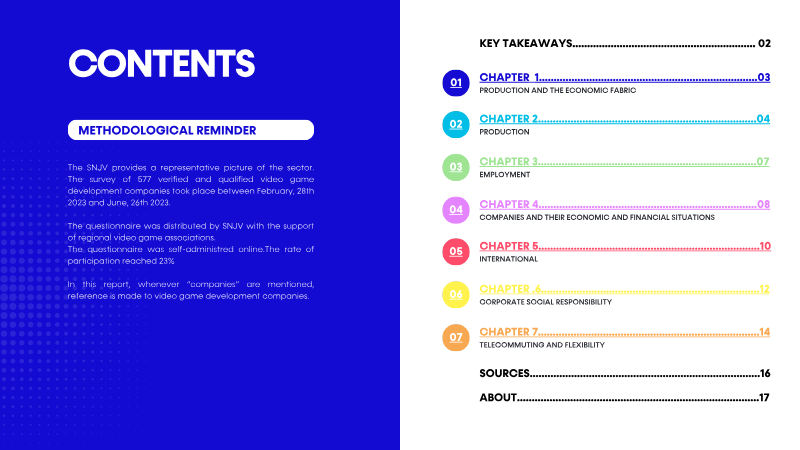
The 2023 annual survey of the French video game industry provides a comprehensive analysis of the sector’s economic health, production trends, and workforce dynamics during 2022. Conducted by the Syndicat National du Jeu Vidéo (SNJV) between February and June 2023, the study relies on a self-administered online questionnaire sent to 577 qualified development companies, achieving a 23% participation rate. The scope covers approximately 1,000 companies across France, including 580 development studios, with a significant concentration of 44.6% located in the Île-de-France region.
Findings indicate a robust but maturing production landscape, with nearly 1,260 games in development and over 850 new intellectual properties created. While the number of games in production fell by 7% compared to 2020, the industry saw a rise in professionalization, with 62% of studios working with publishers. Financial growth is evident, as 27% of studios now generate over 1 million euros in revenue, a 9-point increase from 2020. However, the sector remains dominated by smaller entities, with 55% of companies earning less than 300,000 euros annually. Despite this growth, optimism has tempered; only 28.6% of respondents expect revenue growth in the coming year, compared to 66% in 2020.
Employment remains stable with 76% of staff on permanent contracts, though gender diversity shows slow progress, with women making up 24% of the workforce. The industry is also navigating structural shifts in work culture, as 33% of companies have adopted full-time remote work. Corporate Social Responsibility is emerging as a priority, with 65.5% of companies implementing gender equality actions and nearly half planning carbon footprint assessments. France remains highly attractive to 85% of studios, primarily due to tax incentives and the quality of specialized training.
- The French video game industry is maturing financially, with 27% of studios generating over 1 million euros in revenue, a 9-point increase since 2020.
- Despite revenue gains, industry optimism has declined significantly, with only 28.6% of studios expecting growth compared to 66% in 2020.
- The production landscape remains highly concentrated in the Île-de-France region, which hosts 44.6% of the nation's development studios.
- While the industry is professionalizing—evidenced by 62% of studios working with publishers—the total volume of games in development fell by 7% compared to 2020.
- The sector is dominated by small-scale operations, as 55% of companies continue to generate less than 300,000 euros in annual revenue.
Syndicat National du Jeu VidéoJan 2022
Report64 pages
Game Developer Index: Sweden 2022
The Swedish games industry underwent a period of rapid expansion in 2021, characterized by a 22% increase in domestic revenue to €2.7 billion and a 43% surge in global revenue to €5.8 billion. This growth was fueled by a record-breaking year of international acquisitions, with 81 public transactions led by major groups such as Embracer and Stillfront. By late 2022, Swedish-owned entities operated 197 studios across 49 countries, employing approximately 28,000 people worldwide. This international footprint is reflected in consumer reach, as an estimated one in four players globally has engaged with a Swedish-developed title, and Swedish-associated games accounted for 6% of all Twitch watchtime in 2021.
The domestic workforce grew by 17% to nearly 8,000 employees, with women representing 22.1% of the total staff and 26% of new hires. While gender diversity is improving—evidenced by 29 companies achieving at least 50% female representation—the industry continues to struggle with a severe domestic skills shortage. This talent gap has forced Swedish firms to expand their foreign subsidiaries aggressively, with over 11,000 staff members now based abroad. Although regional hubs in Stockholm and Skåne remain dominant, growth is increasingly supported by specialized educational clusters and post-secondary programs designed to cultivate local talent.
Despite its commercial success and cultural influence, the sector faces structural hurdles that could impact future scalability. Critical challenges include complex work permit processes for international recruits and a lack of early-stage financing compared to other global markets. Methodological shifts in industry tracking now prioritize national group turnover to ensure better comparability with other sectors, revealing a robust ecosystem of 785 active companies. While the industry remains a powerhouse of the Swedish economy, its long-term sustainability depends on addressing recruitment barriers and maintaining the momentum of its global acquisition strategy.
- The Swedish games industry experienced significant financial growth in 2021, with domestic revenue rising 22% to €2.7 billion and global revenue surging 43% to €5.8 billion.
- Driven by 81 international acquisitions led by groups like Embracer and Stillfront, Swedish-owned entities now operate 197 studios across 49 countries, employing approximately 28,000 people globally.
- Swedish-developed titles maintain a massive international reach, with an estimated one in four global players engaging with these games and Swedish-associated content accounting for 6% of all Twitch watchtime in 2021.
- The domestic workforce grew by 17% to nearly 8,000 employees, though the industry faces a severe skills shortage that has forced firms to employ over 11,000 staff members through foreign subsidiaries.
- Gender diversity is gradually improving, with women representing 22.1% of the total workforce and 26% of new hires, while 29 companies have achieved at least 50% female representation.
+1
Swedish Games IndustryJan 2022
Report32 pages
Gaming in Europe: Key Facts 2022
The European video game industry demonstrated significant economic resilience and social expansion in 2022, generating €24.5 billion in revenue and achieving a 5% year-on-year growth rate. This sector now engages approximately 126.5 million people, representing 53% of the population aged 6 to 64. Demographic shifts indicate a maturing and diversifying market, as women now comprise nearly 47% of the player base and the 45-64 age group has emerged as the largest playing demographic. While engagement has stabilized at an average of 8.8 hours of weekly playtime, the industry’s economic footprint is bolstered by a workforce of over 110,000 employees, which saw a 12% increase in staffing levels.
Despite this robust growth, the industry faces a critical talent shortage that threatens future expansion. Projections suggest a widening digital skills gap, exemplified by Sweden’s anticipated deficit of 25,000 developers by 2031. To sustain its trajectory, the sector is increasingly focusing on workforce diversity—where women currently hold 23.7% of roles—and the implementation of comprehensive social responsibility frameworks. These include the expansion of the PEGI rating system and the deployment of advanced parental control tools to ensure a safe environment for the evolving player base.
Environmental sustainability has also become a central pillar of the European gaming landscape. Through collaborative efforts like the Games Consoles Voluntary Agreement, the industry achieved a reduction of 54TWh in energy consumption across previous console generations. Major publishers and trade associations across 18 countries are now prioritizing carbon neutrality, with sector-wide initiatives successfully offsetting significant carbon footprints. These combined economic, social, and environmental strategies reflect a maturing industry that is balancing rapid commercial growth with long-term ecological and demographic responsibilities.
- The European gaming industry generated €24.5 billion in revenue in 2022, marking a 5% year-on-year growth rate and supporting a workforce of over 110,000 employees.
- The player base has reached 126.5 million people, with the 45-64 age group now representing the largest demographic and women accounting for 47% of all players.
- A critical talent shortage threatens future expansion, highlighted by a projected deficit of 25,000 developers in Sweden alone by 2031.
- Industry staffing levels grew by 12% in 2022, though women remain underrepresented in the workforce, currently holding only 23.7% of roles.
- Environmental initiatives, such as the Games Consoles Voluntary Agreement, have successfully reduced energy consumption by 54TWh across previous console generations.
+2
European Games Developer FederationJan 2022
Report149 pages
Brazil Games Industry Report 2022
Brazil has established itself as the preeminent games market in Latin America and the 12th largest globally, generating approximately USD 2.3 billion in 2021. The ecosystem is defined by rapid professionalization and internationalization, evidenced by a 102% increase in active studios since 2018. With over 1,000 companies and a workforce exceeding 12,000 professionals, the industry has transitioned from a historical period of informality to a sophisticated hub for original intellectual property and high-quality external development services. While the Southeast and South regions remain the primary geographic hubs, the sector’s reach is global, with over half of local companies serving international markets, particularly in the United States and Europe.
The industry demonstrates increasing maturity through longer studio lifespans and a shift toward diverse platforms. While mobile and PC development remain dominant, console production grew significantly to 17% of the market by 2021. Beyond entertainment, Brazilian studios maintain a strong presence in educational and corporate gamification. Despite this growth, structural challenges persist, including a lack of formal inclusion policies for underrepresented groups and a "wage war" for senior talent driven by the rise of remote work for foreign firms. Furthermore, the workforce is navigating a transition where 93% of companies now focus on proprietary IP, moving away from a pure service-provider model.
Economic and regulatory hurdles continue to shape the landscape. Federal funding has reached historic lows, forcing a reliance on founder capital and state-level initiatives. Developers face significant "legal insecurity" due to the absence of a specific regulatory category for games and a tax system that treats development hardware as luxury entertainment rather than capital goods. Nevertheless, the resilience of the sector is underscored by a 336% revenue increase in USD since 2015 and the emergence of "unicorns" like Wildlife. The industry remains a vital component of the global value chain, increasingly recognized for its technical proficiency in engines like Unity and its expanding role in emerging technologies such as blockchain and the metaverse.
- Brazil is the 12th largest games market globally and the leader in Latin America, generating approximately USD 2.3 billion in 2021.
- The industry has experienced rapid expansion, with a 102% increase in active studios since 2018 and a 336% revenue increase in USD since 2015.
- The sector is shifting toward original intellectual property, with 93% of companies now focusing on proprietary IP rather than a pure service-provider model.
- The ecosystem comprises over 1,000 companies and 12,000 professionals, with more than half of these businesses exporting services to international markets, primarily in the U.S. and Europe.
- Console production has grown to represent 17% of the market, diversifying a landscape previously dominated by mobile and PC development.
+1
AbragamesJan 2022
Report19 pages
State of Anime Gaming 2022
The analysis evaluates the global mobile market for games that employ an anime art style, focusing on performance metrics from 2018 through 2021. By applying data.ai’s Game IQ feature‑tag system to isolate titles with anime aesthetics across all genres, the study aggregates download and consumer‑spend data from iOS and Google Play (iOS‑only for China) and presents a comprehensive view of audience behavior, revenue trends, and regional dynamics.
Anime‑themed titles generated one‑fifth of all mobile‑game spend in 2021 while capturing only about one percent of overall usage, highlighting a highly engaged but niche user base. Worldwide downloads rose 15 % year‑over‑year in 2021 and 50 % since 2018, with South Korea leading growth (170 % increase in downloads, 85 % rise in spend), followed by the United Kingdom (30 % downloads, 75 % spend) and the United States (40 % downloads, 70 % spend). Japan remained the largest market, accounting for 55 % of anime‑game spend in 2021, though its share fell by nine percentage points from 2018. RPG, simulation and action subgenres dominate both downloads and revenue, while breakout titles such as Genshin Impact (top global spender) and Pokémon GO (top downloader in the US and UK) illustrate cross‑regional appeal.
Demographic profiling shows a strong Gen‑Z skew, with anime gamers on U.S. iPhones 217 % more likely to use Discord and 52 % more likely to use Snapchat than the average mobile gamer; similar patterns appear in Japan and other markets. Gender preferences vary by subgenre, and certain genres—particularly idol‑training simulations and open‑world RPGs—recorded double‑digit year‑over‑year revenue growth (e.g., Uma Musume Pretty Derby +117 %, Genshin Impact +233
- Anime-themed mobile games generated 20% of total global mobile game consumer spend in 2021 despite accounting for only 1% of total usage.
- Japan remains the dominant market, representing 55% of global anime-game spend in 2021, though its market share has declined by nine percentage points since 2018.
- Global downloads for anime-style games grew 50% between 2018 and 2021, with South Korea emerging as a top growth market showing a 170% increase in downloads and 85% increase in spend.
- RPG, simulation, and action subgenres drive the majority of revenue and downloads, with high-performing titles like Genshin Impact and Pokémon GO demonstrating significant cross-regional appeal.
- Specific subgenres are seeing massive revenue acceleration, led by titles like Genshin Impact (+233% year-over-year) and Uma Musume Pretty Derby (+117% year-over-year).
+1
data.aiJan 2022
Report75 pages
Store Intelligence Data Digest: Q2 2022
The global mobile application market experienced a pivotal transition in the second quarter of 2022, characterized by a 2.5% year-over-year decline in total downloads to 35 billion. While Google Play maintained the largest volume with 27.2 billion installs, the most significant development occurred within the United States, where consumer spending on non-gaming applications surpassed gaming revenue on the App Store for the first time. This shift was fueled by a 40% compound annual growth rate in subscriptions, with non-game subscription revenue soaring 129% above 2019 levels. This trend underscores a fundamental change in consumer behavior as 400 non-game titles generated over $1 million in quarterly revenue, signaling a maturation of the subscription economy.
The gaming landscape remained highly competitive, led by the resurgence of Subway Surfers, which achieved its best performance since 2014 with over 80 million downloads. While Garena Free Fire continued its dominance on Google Play, particularly in Asia, the quarter was defined by the successful entry of mid-core titles like Apex Legends Mobile and Diablo Immortal. Regional growth was most pronounced in Indonesia, which surpassed 2 billion quarterly downloads for the first time, while the U.S. market saw a resurgence in travel and ticketing sectors as consumers returned to pre-pandemic activities.
Publisher dynamics remained concentrated among established giants, with Meta and Google maintaining their global leadership. Meta saw an 11% year-over-year increase in downloads, driven by its ownership of four of the top five most-installed apps worldwide. The industry also witnessed significant consolidation and strategic shifts, notably Take-Two Interactive’s rise to the top of the U.S. gaming market following its acquisition of Zynga, and Miniclip’s acquisition of the Subway Surfers franchise. These movements, combined with the rising influence of domestic publishers in China and the U.S., illustrate a market balancing global scale with localized dominance.
- In a historic shift for the U.S. App Store, consumer spending on non-gaming applications surpassed gaming revenue for the first time, driven by a 129% increase in non-game subscription revenue compared to 2019 levels.
- The global mobile market saw a 2.5% year-over-year decline in total downloads to 35 billion in Q2 2022, though Google Play retained the largest share with 27.2 billion installs.
- Meta solidified its market dominance by owning four of the top five most-installed apps globally, contributing to an 11% year-over-year increase in the company's total downloads.
- Take-Two Interactive became the top U.S. gaming publisher following its acquisition of Zynga, while Miniclip expanded its portfolio by acquiring the Subway Surfers franchise.
- Subway Surfers experienced a major resurgence, recording over 80 million downloads—its strongest performance since 2014—while new mid-core titles like Apex Legends Mobile and Diablo Immortal successfully entered the market.
+1
Sensor TowerJan 2022
Report34 pages
Japan Mobile App Trends 2022
The Japanese mobile app market experienced a period of significant expansion between 2020 and 2022, characterized by a 19% surge in total installs and a dominant 52% growth rate within the gaming sector. While the pandemic-driven peak of 2021 led to a stabilization of gaming sessions in 2022, the market remains robust across multiple verticals. Hyper-casual and RPG titles continue to lead in volume, though simulation games have emerged as highly efficient options for developers, offering lower acquisition costs and superior return on ad spend compared to puzzle games.
Beyond gaming, the fintech and e-commerce sectors have demonstrated remarkable resilience and growth. Fintech sessions increased by 13% year-over-year in the first half of 2022, while e-commerce activity reached record highs during the same period. The dating app category also saw a 13% uptick in engagement, with notable discrepancies in user acquisition costs between platforms; Android registrations proved more cost-effective at $8.47 compared to $10.20 for iOS. These trends indicate a maturing digital economy where user engagement is diversifying across utility and lifestyle applications.
A pivotal shift in the Japanese advertising landscape is the rapid rise of Connected TV (CTV), which is projected to reach 23.2% user penetration and ¥58.8 billion in ad spend by 2024. This emerging frontier is reshaping user acquisition strategies, necessitating sophisticated cross-device measurement and multi-touch attribution to link large-screen impressions to mobile conversions. As local broadcasters and analytics platforms form deeper integrations, CTV is transitioning from an experimental channel to a permanent, data-driven fixture of the Japanese mobile marketing ecosystem.
- The Japanese mobile market saw a 19% surge in total installs between 2020 and 2022, with the gaming sector experiencing a dominant 52% growth rate.
- Connected TV (CTV) is a critical emerging channel in Japan, projected to reach 23.2% user penetration and ¥58.8 billion in ad spend by 2024.
- Simulation games have become highly efficient for developers, offering lower acquisition costs and superior return on ad spend compared to traditional puzzle games.
- Fintech sessions grew by 13% year-over-year in the first half of 2022, while e-commerce activity reached record highs during the same period.
- Dating app engagement increased by 13%, with Android user acquisition costs ($8.47) proving more cost-effective than iOS ($10.20).
AdjustJan 2022
Report61 pages
State of Mobile 2022 – Indonesia
Indonesia emerged as one of the world’s most mobile-centric markets in 2021, with users averaging 5.4 hours daily on mobile devices, representing a 38% increase since 2019. This engagement translates to roughly one-third of total waking hours, fueling 7.31 billion new app downloads and $532 million in consumer spending. While social, communication, and video applications captured 70% of total time spent, the gaming sector remained the primary economic driver, accounting for 42% of all downloads and 61% of total consumer expenditure. Titles such as Mobile Legends: Bang Bang and Free Fire led the market in both engagement and monetization, while Hypercasual games dominated the download charts.
Beyond entertainment, the Indonesian mobile landscape experienced transformative growth in utility and commerce sectors. Finance app downloads surged by 82% year-over-year, and time spent in shopping applications reached 5.5 billion hours, a 52% increase. The Food and Drink category saw the most explosive growth, with sessions increasing by over 480% due to the rise of quick-service restaurant brands and delivery services. Additionally, the video streaming market nearly doubled its engagement levels since 2019, driven by a shift toward mobile-first content and the continued dominance of platforms like YouTube and TikTok, the latter of which saw 75% year-over-year growth.
Niche sectors also demonstrated significant momentum as the market matured. Consumer spending on dating apps rose 188% since 2018, while Health and Fitness engagement remained 56% higher than pre-pandemic levels. Business and utility apps like BukuWarung and PLN Mobile emerged as breakout leaders, signaling a deeper integration of mobile solutions into daily professional and civic life. As travel restrictions eased in late 2021, the recovery of travel and sports applications further solidified the mobile device as the central hub for the Indonesian consumer's digital and physical interactions.
- Gaming remains the primary economic driver in Indonesia, accounting for 42% of all app downloads and 61% of total consumer expenditure, with titles like Mobile Legends: Bang Bang and Free Fire leading the market.
- Indonesian mobile users averaged 5.4 hours of daily screen time in 2021, a 38% increase since 2019, totaling 7.31 billion downloads and $532 million in consumer spending.
- The Food and Drink category experienced the most explosive growth, with session counts increasing by over 480% due to the rise of delivery services and quick-service restaurant brands.
- Finance app downloads surged by 82% year-over-year, while time spent in shopping applications reached 5.5 billion hours, reflecting a 52% increase.
- TikTok saw 75% year-over-year growth in engagement, contributing to a near-doubling of the total video streaming market since 2019.
+1
data.aiJan 2022