Report6 pages
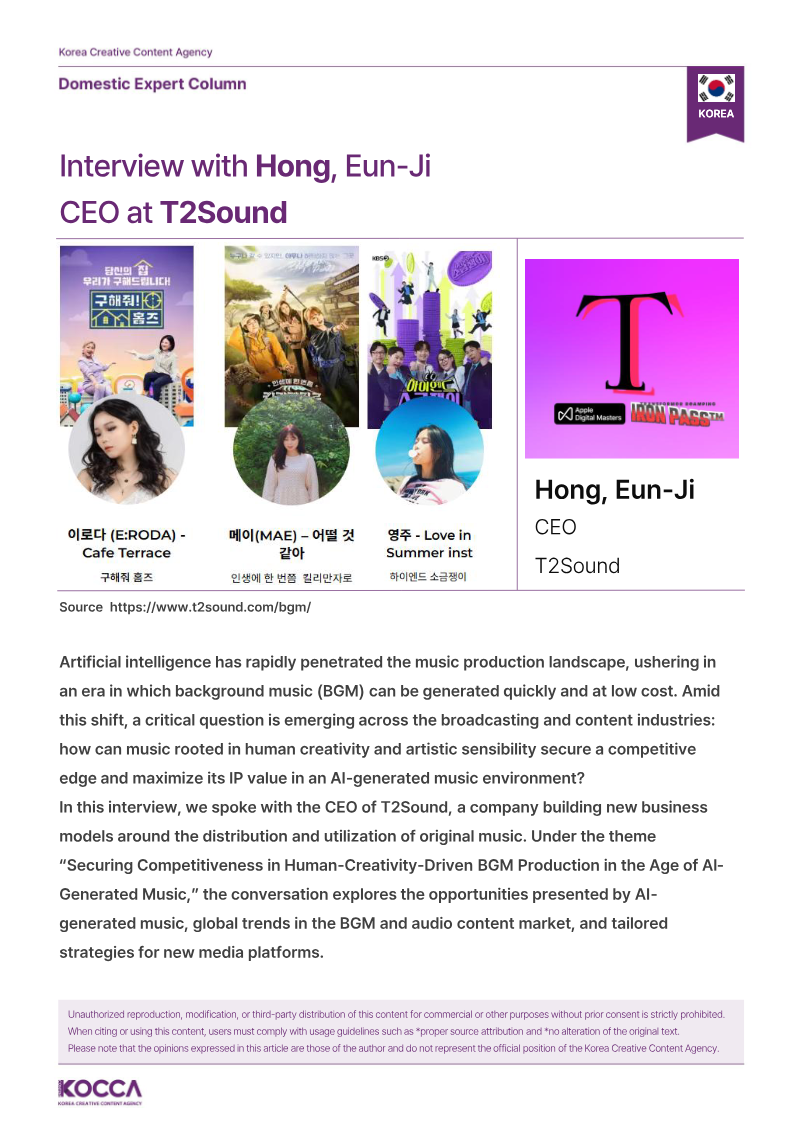
Securing Competitiveness in Human-Creativity-Driven BGM Production in the Age of AI-Generated Music: South Korea
The interview with Hong Eun‑Ji, CEO of T2Sound, examines how background‑music (BGM) producers in South Korea can preserve competitive advantage as AI‑generated music becomes increasingly affordable and rapid. The central thesis is that human creativity—particularly the ability to convey authentic emotion and intent—remains the decisive factor that AI cannot replicate, and that leveraging AI as a collaborative tool rather than a threat can enhance, not replace, the artistic value of BGM.
Key insights emphasize that quality and emotional resonance, achieved through meticulous mixing and mastering, are the core values guiding T2Sound’s work. The company prioritises collaboration with external creators, believing that collective expertise yields richer nuance than isolated in‑house production. Market trends reveal a shift among overseas buyers toward tracks with distinctive sonic signatures rather than generic pleasantness, and Korean BGM’s success abroad is linked to its unique emotional line and texture. In short‑form media, the interview highlights the necessity of an immediate, memorable hook within the first few seconds to secure brand recognition and audience immersion.
Looking ahead to 2026, the conversation predicts a consolidation around financially proven genres such as hip‑hop and trot in Korea, reflecting an industry increasingly driven by economic sustainability. The interview’s qualitative methodology—direct dialogue with a leading BGM provider—offers a focused perspective on the evolving interplay between AI tools, human artistry, and global market demands within the South Korean audio‑content sector.
- Human creativity remains the primary competitive advantage for BGM producers, as the ability to convey authentic emotion and intent cannot be replicated by AI.
- T2Sound maintains market competitiveness by prioritizing meticulous mixing and mastering to ensure high-quality emotional resonance, rather than competing solely on speed or cost.
- Global demand is shifting away from generic background music toward tracks with distinctive sonic signatures, with Korean BGM gaining traction due to its unique emotional texture.
- Short-form media content requires an immediate, memorable hook within the first few seconds to successfully secure brand recognition and audience immersion.
- T2Sound leverages a collaborative model with external creators to achieve richer artistic nuance than what is typically produced through isolated in-house workflows.
+1
KOCCA – Korea Creative Content AgencyJan 2025
Report15 pages
Interview with Yi Yuan, at Hiverlab: Southeast Asia
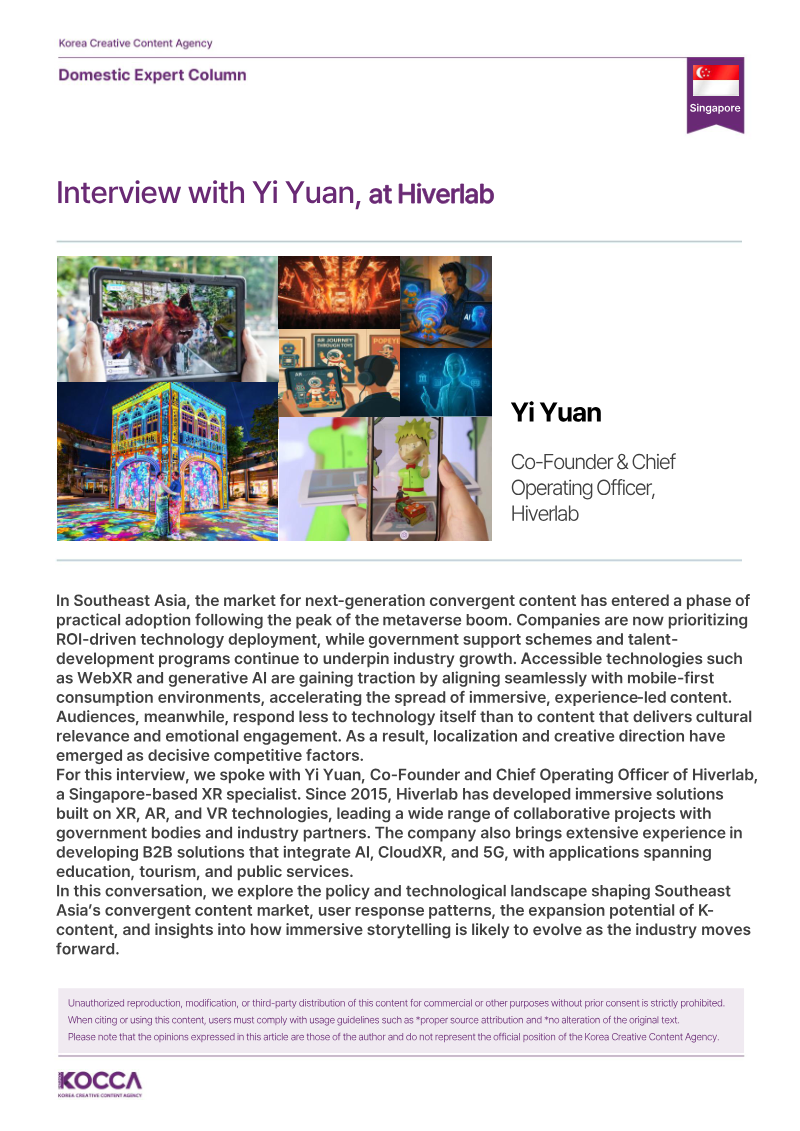
The interview underscores a shift in Southeast Asia’s convergent‑content market from speculative metaverse enthusiasm to a pragmatic, ROI‑driven landscape where augmented reality has become the primary vehicle for marketing and tourism initiatives. Growth is anchored in measurable outcomes such as cost‑reduction ratios and increased foot‑traffic, supported by government funding and a mobile‑first infrastructure that leverages WebXR and expanding 5G networks. Large‑scale AR deployments at heritage and tourist sites illustrate the sector’s scalability, emphasizing the necessity of culturally resonant storytelling, clear narrative structures, and quantitative metrics like dwell time and interaction density to assess engagement.
Effective experiences consistently incorporate gamified micro‑games and selfie‑style interactions that encourage user participation and social sharing. These design elements amplify interaction density and foster virality, reinforcing the importance of narrative quality over pure technological novelty. The chief operating officer highlights that AI‑generated, personalized storytelling—through digital humans and generative‑AI scripts—remains the chief catalyst for sustained user interest, with success measured by dwell time, interaction density and social‑virality indicators.
A principal commercial obstacle is the high bandwidth demand of simultaneous, large‑scale XR experiences. The rollout of 5G and cloud‑native architectures such as CloudXR has already mitigated latency and loading challenges, as demonstrated by the AR broadcast of Singapore’s Chingay festival in 2020. Continued expansion across the region will depend on further high‑bandwidth network deployment, sustained government infrastructure investment, and deeper integration of AI technologies to produce adaptive, immersive content.
- Southeast Asia’s convergent-content market has shifted from speculative metaverse projects to a pragmatic, ROI-driven focus on augmented reality for marketing and tourism.
- Success in the region is measured by quantitative metrics including dwell time, interaction density, and social-virality indicators rather than technological novelty.
- Large-scale AR deployments are currently anchored by government funding and mobile-first infrastructure, utilizing WebXR and 5G networks to ensure scalability.
- AI-generated personalized storytelling, including digital humans and generative-AI scripts, is identified as the primary catalyst for sustaining long-term user interest.
- High-bandwidth demands for simultaneous XR experiences are being addressed through cloud-native architectures like CloudXR, as evidenced by the 2020 AR broadcast of Singapore’s Chingay festival.
+1
KOCCA – Korea Creative Content AgencyJan 2025

Report10 pages
Interview with Lee, Su-Hyun: South Korea
The interview with Professor Lee Su‑Hyun of Seoul National University articulates digital transformation (DX) as a comprehensive restructuring of the Korean fashion value chain, extending beyond e‑commerce to encompass AI‑driven design, smart‑factory automation, and data‑centric marketing. By leveraging generative AI for 3‑D virtual prototyping, automated sewing, digital twins, and metaverse‑enabled retail experiences, the industry can cut sample costs, shorten lead times, and enhance personalized consumer interactions while supporting carbon‑neutral objectives such as on‑demand production and circular‑economy tracking.
Professor Lee emphasizes that smart apparel remains in early commercial stages, with functional niches in sports, healthcare, and disaster safety already demonstrating pilot deployments. Critical technical barriers include washability and durability of conductive fibers, sensor performance after repeated laundering, and the need for flexible, miniaturized battery solutions. Rapid advances in printed textile batteries and energy‑harvesting technologies are narrowing these gaps, yet mass‑production capacity and system integration lag behind leading markets in the United States and Germany.
Strategic recommendations focus on three business models: subscription‑based health and fitness services, interoperable platform modules detachable across garments, and specialized ceremonial wear where visible technology adds value. Successful scaling will require coordinated industry‑academia curricula, a robust talent pipeline, national standardization participation (e.g., IEC TC124), shared testing facilities, and proactive IP support to translate Korea’s strong patent portfolio into globally competitive products.
Looking ahead to 2026, AI and sustainability are projected to dominate the fashion sector. AI will become an essential capability across design, inventory, and personalization, while sustainability will drive digital traceability, carbon‑neutral manufacturing, and circular‑economy initiatives, together reshaping competitiveness criteria for the Korean fashion industry.
- South Korea’s fashion industry is undergoing a comprehensive digital transformation (DX) that integrates generative AI for 3-D virtual prototyping, smart-factory automation, and data-centric marketing to reduce sample costs and lead times.
- The adoption of on-demand production and digital traceability is being prioritized to meet carbon-neutral objectives and support circular-economy initiatives within the fashion value chain.
- Smart apparel development is currently limited to functional niches in sports, healthcare, and disaster safety, with technical progress hindered by the durability of conductive fibers and the need for miniaturized, flexible battery solutions.
- To achieve global competitiveness by 2026, the industry must overcome current lags in mass-production capacity and system integration compared to the United States and Germany.
- Strategic business models for smart apparel include subscription-based health services, modular, detachable technology components, and high-value ceremonial wear.
KOCCA – Korea Creative Content AgencyJan 2025
Report7 pages
Interview with Keunkyo Kim, Head of Global Business at NC AI
The interview articulates NC AI’s transformation from a game‑focused research lab into a national industrial‑AI hub, positioning Korea as a global center for “K‑AI.” It outlines the company’s ambition to leverage fourteen years of game‑AI expertise to drive cross‑industry innovation, emphasizing that AI has moved from a supporting role to a core driver of gameplay, content creation, and broader economic competitiveness.
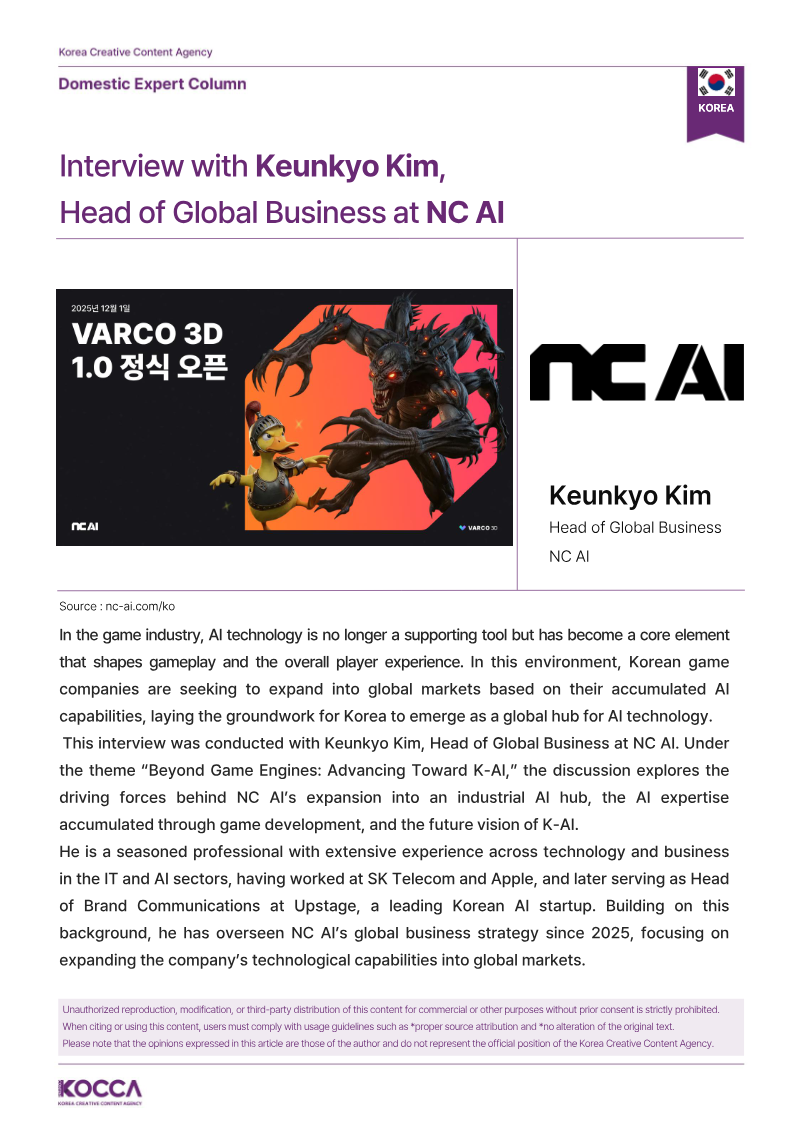
NC AI, a subsidiary of NCSoft, has built a proprietary large‑language model called VARCO and the VARCO 3D engine, which can generate near‑realistic, physics‑based 3D environments from text or images. The firm was selected as one of five leaders in Korea’s Independent Foundation Model project and became the first Korean entity to deploy its LLM on AWS. An open‑source release of VARCO Vision 2.0 attracted over 10 000 downloads within ten days, reflecting a strategic push for global adoption and a vibrant developer ecosystem.
The company’s real‑time processing and reinforcement‑learning capabilities, honed in massive MMORPG settings, are now applied to digital twins for manufacturing, robotics, smart‑city, and defense sectors. NC AI pursues a dual‑track model—developing a 200‑billion‑parameter LLM while simultaneously creating lightweight, edge‑optimized multimodal diffusion models—to balance scale with field efficiency. Its proprietary safety filter, Safeguard, has been integrated into NCSoft’s NCER chatbot, underscoring a commitment to AI trustworthiness and standards collaboration.
Looking ahead, NC AI leads a consortium of 54 organizations to produce industry‑specific AI that validates in real‑world environments, aiming for Korean AI sovereignty and global leadership. By enabling user‑generated content through VARCO 3D, Voice, and animation tools, the firm promotes a “everyone can be a creator” ethos, encouraging young talent to contribute to a vertically integrated AI ecosystem that links industry, government, and academia and positions Korea as a powerhouse in the international AI landscape.
- NC AI is leveraging 14 years of MMORPG-based reinforcement learning and real-time processing expertise to expand from gaming into industrial sectors, including manufacturing, robotics, smart cities, and defense.
- The company is developing a dual-track AI strategy that balances a 200-billion-parameter large language model with lightweight, edge-optimized multimodal diffusion models for field efficiency.
- NC AI’s proprietary VARCO 3D engine enables the generation of physics-based 3D environments from text or images, while the open-source VARCO Vision 2.0 achieved over 10,000 downloads within ten days of release.
- As a leader in Korea’s Independent Foundation Model project, NC AI is the first Korean entity to deploy its proprietary LLM on AWS and currently heads a 54-organization consortium to drive industry-specific AI adoption.
- The firm is prioritizing AI safety and trustworthiness through its proprietary 'Safeguard' filter, which is already integrated into the NCER chatbot.
+1
KOCCA – Korea Creative Content AgencyJan 2025
Report71 pages
State of AI Apps Report 2025
The analysis quantifies the rapid expansion of generative‑AI applications in the first half of 2025, documenting 1.6 billion downloads and $1.2 billion in in‑app‑purchase revenue. This represents a 67 percent increase in downloads and a 200 percent jump in revenue compared with the second half of 2024, indicating a pronounced acceleration in user adoption and monetisation. Engagement metrics rose in tandem, underscoring the sector’s heightened activity during this period.
User demographics reveal a pronounced male and youth bias: roughly 60 percent of users are male and nearly 70 percent are under 35. While flagship services such as ChatGPT and Google Gemini attract comparatively balanced audiences and exhibit strong cross‑app overlap, niche offerings—including Grok and DeepSeek—tend to cluster with privacy‑focused, crypto‑trading, and gaming user personas. This segmentation highlights divergent appeal across the generative‑AI landscape.
Advertising investment intensified, with OpenAI’s major campaign propelling it into the top‑ten spenders in key markets such as the United States, India and South Korea. AI‑driven ad creatives increasingly employ light‑hearted, animal‑centric visuals while emphasizing concrete everyday utilities, exemplified by Google Gemini’s car‑warning guidance and Microsoft Copilot’s quiz‑making and recipe‑generation tools. Spend estimates, tracked across U.S. platforms including Reddit, LinkedIn, TikTok and YouTube, illustrate the breadth of digital‑advertising channels leveraged.
Overall, the findings portray a sector experiencing explosive growth, a skewed yet evolving user base, and a surge in AI‑powered marketing activity across major global markets during H1 2025.
- Generative AI applications experienced explosive growth in H1 2025, reaching 1.6 billion downloads and $1.2 billion in in-app purchase revenue.
- Revenue growth significantly outpaced adoption, with a 200 percent increase in in-app purchase revenue and a 67 percent rise in downloads compared to H2 2024.
- The user base is heavily skewed toward younger males, with approximately 60 percent of users being male and nearly 70 percent under the age of 35.
- While flagship services like ChatGPT and Google Gemini maintain broad appeal, niche AI apps such as Grok and DeepSeek are increasingly associated with privacy-focused, crypto-trading, and gaming demographics.
- OpenAI has become a top-ten advertising spender in major markets including the United States, India, and South Korea.
+2
Sensor TowerJan 2025
Report46 pages
Yearly Live Streaming Trends Report 2024
The live streaming industry experienced a period of stabilization and strategic maturation throughout 2024, characterized by a modest 3% year-over-year increase in total hours watched across major platforms. This growth brought the global annual viewership to approximately 35 billion hours, signaling a shift from the volatile surges of previous years toward a more sustainable, long-term trajectory. While Twitch maintained its position as the market leader in terms of total hours watched, its market share faced increasing pressure from YouTube Gaming and Kick, the latter of which saw a 45% increase in viewership as it successfully attracted high-profile creators through non-exclusive contracts and aggressive revenue-sharing models.
Geographically, the Asia-Pacific region remains the primary engine for mobile streaming growth, while North American and European markets show a deepening preference for high-production "eventized" content. Non-gaming content, specifically the Just Chatting category, continues to dominate the landscape, accounting for nearly 15% of all platform activity. However, the competitive gaming sector saw a resurgence driven by the massive success of tactical shooters and the expansion of co-streaming rights for major esports tournaments. These community-driven broadcasts often outperformed official channels, representing a fundamental shift in how audiences consume professional competitive play.
The integration of artificial intelligence and enhanced monetization tools defined the technological landscape of the year. Creators increasingly utilized AI-driven moderation and clip-generation tools to maximize reach across short-form video platforms like TikTok and Instagram Reels, which now serve as the primary discovery funnel for live broadcasts. Brands have responded by shifting budgets toward long-term creator partnerships rather than one-off sponsorships, seeking to capitalize on the high engagement rates of mid-tier streamers who boast more dedicated, niche communities. As the industry moves into 2025, the convergence of live commerce and interactive broadcasting is expected to become the next major frontier for platform revenue.
- The live streaming industry reached 35 billion hours watched in 2024, reflecting a stable 3% year-over-year growth rate as the market shifts toward long-term sustainability.
- Kick grew its viewership by 45% in 2024 by leveraging aggressive revenue-sharing models and non-exclusive contracts to challenge Twitch’s market leadership.
- The 'Just Chatting' category remains the dominant content type, accounting for nearly 15% of all platform activity across the industry.
- Co-streaming rights for major esports tournaments have fundamentally changed consumption habits, with community-driven broadcasts frequently outperforming official tournament channels.
- Short-form video platforms like TikTok and Instagram Reels have become the primary discovery funnels for live streaming, driven by the adoption of AI-powered clip-generation tools.
+2
Stream HatchetJan 2025

Report29 pages
The State of Games QA
This analysis explores the current state and future trajectory of quality assurance (QA) within the video game industry, specifically focusing on the integration of artificial intelligence and automation. The central thesis posits that modern game development—characterized by the complexity of games-as-a-service and accelerated release cycles—has outpaced traditional manual QA capabilities. Consequently, there is a critical need for AI-driven solutions to bridge the gap between increasing content volume and stagnant testing budgets.
The findings are based on a September 2024 survey of 303 US-based game development professionals across various disciplines, including QA, production, and design, supplemented by interviews with industry experts from companies such as Netflix and Indium Play. Data indicates a significant strain on current resources: 77% of developers admit to conducting less QA than necessary for their most recent releases, and 50% believe budgets are failing to keep pace with game complexity. While 94% of studios use some form of non-AI automation, there is a near-unanimous consensus (94%) that AI will be essential for the future of the field.
Key statistics highlight a strong industry appetite for AI adoption, with 88% of respondents viewing AI as equal to or better than traditional methods for bug detection. Developers identify faster bug detection, automated reporting, and 24/7 testing as the primary advantages of the technology. However, a significant implementation gap exists; while 87% of studios feel "somewhat ready" for AI, only 18% feel fully prepared. Primary barriers to adoption include setup complexity, high initial costs, and a lack of skilled staff. The analysis concludes that while AI is vital for scalability and stress testing, it serves as a complement to—rather than a replacement for—human intuition and creative exploratory testing.
- 77% of game developers report conducting insufficient QA for their recent releases, highlighting a critical gap between traditional manual testing and the demands of modern, complex game development.
- While 94% of studios currently utilize non-AI automation, there is a near-unanimous consensus (94%) that AI integration is essential for the future of quality assurance.
- 88% of industry professionals believe AI-driven testing is equal to or superior to traditional methods, specifically citing faster bug detection, automated reporting, and 24/7 testing as key advantages.
- Despite high interest, only 18% of studios feel fully prepared to implement AI, with setup complexity, high initial costs, and a lack of skilled staff serving as the primary barriers to adoption.
- Half of all surveyed developers report that current QA budgets are failing to keep pace with the increasing complexity of games-as-a-service models and accelerated release cycles.
+1
modl.aiJan 2025

Report19 pages
How Developers Are Using Generative AI to Create a New Generation of Games
This research, conducted by Google Cloud and The Harris Poll in mid-2025, examines the transformative role of generative AI within the global games industry. Based on a survey of 615 developers across the United States, South Korea, Norway, Finland, and Sweden, the study finds that 97% of professionals believe generative AI is actively reshaping the sector. The primary thesis suggests that while the industry faces rising development costs and market saturation, AI serves as a critical tool for innovation, democratization, and operational efficiency.
Key findings indicate that 90% of developers have already integrated AI into their workflows, primarily to automate repetitive tasks and accelerate playtesting, localization, and coding. A significant trend is the rise of AI agents—autonomous systems capable of reasoning and planning—which 44% of respondents use for content optimization and 34% for advanced NPC behavior. These technologies are shifting player expectations, with 89% of developers noting that gamers now demand more lifelike, responsive, and personalized experiences. Furthermore, 94% of developers anticipate that AI will lead to long-term reductions in development costs over the next three years.
Despite this optimism, the industry faces notable hurdles regarding legal and ethical standards. Approximately 63% of developers expressed concerns over data ownership and intellectual property, while 35% cited worries regarding player data privacy. To navigate these challenges, the study recommends that studios start with small-scale pilots, align AI use with their core creative visions, and invest in staff upskilling. Ultimately, the data portrays AI not just as a productivity booster, but as a fundamental shift in game design that enables smaller studios to compete more effectively while fostering new levels of player immersion.
- 97% of game developers believe generative AI is actively reshaping the industry, with 90% already integrating the technology into their workflows to automate tasks like coding, localization, and playtesting.
- 94% of developers anticipate that the adoption of generative AI will lead to long-term reductions in game development costs over the next three years.
- AI agents are increasingly used for advanced game mechanics, with 44% of developers utilizing them for content optimization and 34% for creating more responsive NPC behaviors.
- 89% of developers report that player expectations have shifted, with gamers now demanding higher levels of personalization and lifelike interactivity in their experiences.
- Legal and ethical concerns remain a primary barrier to adoption, as 63% of developers cite worries regarding intellectual property and data ownership, while 35% express concerns over player data privacy.
+1
Google CloudJan 2025
Report36 pages
Gaming Industry Report: Q3 2024
• 2024 market size: $188bn (+2.1% YoY) Total gamers in 2024 by region (millions): • Public markets: leading public gaming ETFs up 22- • 36% YTD (vs S&P 500 = 21%) Middle East & Africa Venture funding in Q3‘ 24: $517m across 92 deals 559 (funding +1% QoQ, number of deals -14% QoQ) (16%) • Epic sidesteps Apple in the EU, sues Google Europe (454 3,422m • Discord launches Activities ...
- The gaming market size in 2024 is $188 billion, showing a 2.1% year-over-year growth. Asia-Pacific accounts for the largest share of gamers with 1,809 million (53%), followed by Europe with 454 million (13%).
- Venture funding in Q3 2024 reached $517 million across 92 deals, marking a 1% increase in funding quarter-over-quarter but a 14% decrease in the number of deals. Total private market funding for 2024 is $3,739 million, with a 15% QoQ increase in Q3.
- Public market gaming ETFs are significantly outperforming the S&P 500, with leading ETFs up 22-36% year-to-date compared to the S&P 500's 21%.
- Unity has fully removed its Runtime Fee, reverting to a seat-based subscription model with increased revenue and funding ceilings for Unity Personal (up to $200k) and price increases for Unity Pro (+8%) and Unity Enterprise (+25%).
- Epic Games is actively challenging platform policies, launching its own iOS app store in the EU with a maximum 12% commission and suing Google and Samsung over anti-competitive practices related to app distribution on Android.
+5
KonvoyOct 2024

Report39 pages
State of the Game Industry 2025
The global game industry entered 2025 defined by a paradox of technological advancement and profound structural instability. While PC remains the dominant platform for 80% of projects, the workforce faces significant volatility, with 41% of developers impacted by layoffs or studio closures over the past year. This instability has triggered a shift in studio composition, marked by a decline in AAA representation to 15% and a corresponding rise in solo developers, who now constitute 21% of the workforce. Despite these pressures, the industry continues to diversify, with women and non-binary individuals making up 32% of the workforce and LGBTQ+ representation reaching 25%.
Operational trends indicate a cooling of the initial fervor surrounding generative AI. Although 52% of developers utilize the technology, 51% express deep ethical concerns regarding intellectual property theft and job displacement, leading 27% of companies to abandon interest in the tools entirely. Simultaneously, the market is pivoting away from the live-service model due to saturation and burnout, with 42% of developers expressing no interest in the format. This strategic shift coincides with a tightening of the financial landscape; 56% of all developers and 82% of independent creators now rely on self-funding as traditional venture capital and publishing deals become increasingly scarce.
Labor conditions have tightened for the first time in several years, with the average workweek lengthening and the percentage of developers working 40 hours or less dropping to 57%. While 58% of the workforce supports unionization as a remedy for crunch and job insecurity, active organizing remains limited to 22% of respondents. Furthermore, external environmental factors are becoming a tangible operational risk, as 16% of developers report that natural disasters such as wildfires and floods have directly impacted their productivity. These combined factors suggest an industry in a state of cautious restructuring, balancing ethical and financial hurdles against a diversifying talent pool.
- The industry is experiencing significant instability, with 41% of developers affected by layoffs or studio closures and a shift toward smaller teams, as AAA representation drops to 15% while solo developers rise to 21%.
- Financial access is tightening, forcing 56% of all developers and 82% of independent creators to rely on self-funding due to a scarcity of venture capital and publishing deals.
- Generative AI adoption is cooling; while 52% of developers use the technology, 51% cite ethical concerns regarding IP theft and job displacement, leading 27% of companies to abandon the tools.
- Market sentiment is shifting away from live-service models due to saturation and burnout, with 42% of developers expressing no interest in pursuing the format.
- Labor conditions are deteriorating, as the percentage of developers working 40 hours or less has dropped to 57%, prompting 58% of the workforce to support unionization.
+2
InformaMay 2024

Report31 pages
AI Apps Market Insights 2024
The 2024 AI Apps Market Insights report provides a comprehensive analysis of the global mobile artificial intelligence sector, focusing on download and revenue trends across the App Store and Google Play. Covering the period from January to August 2024, the study examines market distribution, sub-genre performance, and user engagement metrics. Data is derived from Sensor Tower’s proprietary intelligence platforms, excluding advertising revenue and third-party Android store sales.
Global adoption of AI applications has accelerated significantly, with downloads reaching 2.2 billion in the first eight months of 2024 and projected to hit 3.3 billion by year-end. In-app purchase revenue is expected to grow 51% year-over-year to $3.3 billion. While India leads in total downloads with a 21% market share, North America and Europe remain the primary financial drivers, accounting for 68% of total global revenue.
The market is segmented into several high-performing categories, with AI Art Generators emerging as the most profitable sub-genre, capturing 53% of total industry revenue. AI Chatbots follow at 29%, having already surpassed their total 2023 revenue by 1.5 times. A notable trend is the rise of companion AI apps like Character AI and Talkie AI, which boast high user retention; Character AI users average over 1.5 hours of daily use, with a heavy concentration among the 18-24 age demographic.
ChatGPT maintains a dominant position as the leading AI application, reaching a record $45 million in monthly revenue in August 2024 following the launch of GPT-4o. With over 190 million monthly active users and $270 million in cumulative revenue, it serves as the industry benchmark. Beyond general assistants, AI technology is increasingly integrated into specialized fields including education, dating, and music, signaling a broader diversification of the mobile AI ecosystem.
- Global AI app downloads are projected to reach 3.3 billion by the end of 2024, with in-app purchase revenue expected to grow 51% year-over-year to $3.3 billion.
- AI Art Generators dominate the market as the most profitable sub-genre, capturing 53% of total industry revenue, followed by AI Chatbots at 29%.
- ChatGPT remains the industry benchmark with 190 million monthly active users and a record $45 million in monthly revenue as of August 2024.
- North America and Europe generate 68% of total global revenue, while India leads in volume with a 21% share of total downloads.
- AI Chatbot revenue has grown rapidly, already surpassing its total 2023 performance by 1.5 times within the first eight months of 2024.
+1
Sensor TowerMar 2024

Report21 pages
DevOps Report
The report presents a comprehensive analysis of the global DevOps ecosystem, emphasizing its rapid evolution, investment dynamics, and the strategic role of emerging technologies such as artificial intelligence, low‑code platforms, and serverless computing. By integrating market performance data, transaction activity, and funding trends, it argues that DevOps has become a primary growth engine for technology firms, outpacing traditional operations and broader equity benchmarks.
Quantitative findings show that Dev‑focused companies have delivered a 23 percent total return over the past four quarters, surpassing the S&P 500, while Ops‑centric peers lagged with an 11 percent gain. Revenue growth multiples for leading Dev firms range from 12‑to‑20‑times, with Atlassian, GitLab, HashiCorp and DataDog commanding premium valuations. The sector’s M&A volume rebounded to $27.6 billion in the first half of 2024, highlighted by marquee deals such as Cisco’s $31 billion acquisition of Splunk and IBM’s $7.7 billion purchase of HashiCorp. Private‑market activity remains robust, with the ten best‑funded DevOps startups raising a cumulative $4.3 billion, and low‑code solutions projected to account for more than 65 percent of new applications.
Geographically, the analysis spans North America, Europe, the Middle East and Asia, covering transactions from 2013 onward and focusing on the 2023‑2024 period. Data sources include Capital IQ, Pitchbook, Gartner, DS Research and other industry databases, providing a multi‑source foundation for the performance and valuation metrics presented. The findings underscore the accelerating convergence of development and operations, driven by AI‑enhanced automation, open‑source integration, and the shift toward serverless architectures, positioning DevOps as a central pillar of modern technology investment strategies.
- Dev-focused companies significantly outperformed the broader market with a 23 percent total return over the past four quarters, doubling the 11 percent gain seen by Ops-centric peers.
- Leading DevOps firms currently command premium revenue growth multiples ranging from 12-to-20-times, with Atlassian, GitLab, HashiCorp, and DataDog identified as top performers.
- M&A activity in the DevOps sector rebounded to $27.6 billion in the first half of 2024, driven by major acquisitions including Cisco’s $31 billion purchase of Splunk and IBM’s $7.7 billion acquisition of HashiCorp.
- Private-market investment remains highly active, with the ten best-funded DevOps startups securing a cumulative $4.3 billion in capital.
- Low-code platforms are becoming a dominant development standard, with projections indicating they will account for more than 65 percent of all new applications.
+1
Drake Star PartnersMar 2024
Report103 pages
State of Mobile 2024
The global mobile economy experienced a significant recovery in 2023, with consumer spending rising 3% to $171 billion and daily engagement surpassing five hours per user in leading markets. While mobile gaming faced a slight 2% contraction in spending due to economic headwinds and a shift toward longer title life cycles, the broader industry was bolstered by a resilient non-gaming sector. This growth was primarily driven by social media "tipping," video streaming subscriptions, and the rapid emergence of generative AI. Mobile advertising also remained a cornerstone of the ecosystem, reaching $362 billion with projections to exceed $400 billion in the coming year.
The landscape is increasingly defined by a shift in consumer behavior and monetization strategies. Non-gaming apps reached a record $64 billion in spend, led by TikTok, which became the first non-game app to surpass $10 billion in lifetime revenue. In contrast, the gaming market saw a decline in new hit releases, with the industry consolidating around established high-fidelity IPs and social multiplayer genres like Creative Sandbox and Battle Royale. Despite this consolidation, breakout successes like Monopoly GO and Honkai: Star Rail demonstrated that high-quality debuts can still disrupt saturated markets.
Across various sectors, mobile integration has reached unprecedented levels. Travel and ticketing apps saw record-breaking demand as consumers returned to in-person events, while the finance sector experienced a surge in personal loan apps and "Super Apps" amid global inflation. Retail also underwent a structural shift as China-based platforms like Temu gained significant global market share. Ultimately, the 2023 data reflects a mature mobile market where growth is increasingly tied to sophisticated AI integration, creator-driven economies, and the transition of traditional services into comprehensive digital hubs.
- The global mobile economy grew 3% to $171 billion in 2023, supported by a $362 billion advertising market projected to exceed $400 billion in the coming year.
- Mobile gaming spending contracted by 2% as the industry consolidated around established high-fidelity IPs and social multiplayer genres, though titles like Monopoly GO and Honkai: Star Rail proved that high-quality debuts remain viable.
- Non-gaming apps reached a record $64 billion in consumer spend, highlighted by TikTok becoming the first non-game app to surpass $10 billion in lifetime revenue.
- Daily user engagement in leading markets surpassed five hours, driven by social media tipping, video streaming subscriptions, and the rapid integration of generative AI.
- The finance sector saw a surge in personal loan apps and 'Super Apps' as a response to global inflation, while travel and ticketing apps experienced record-breaking demand.
+1
data.aiJan 2024

Report33 pages
State of Game Technology Report 2024
The report demonstrates that game technology is increasingly permeating non‑traditional sectors, with half of surveyed teams employing real‑time 3D engines beyond game development. This cross‑industry diffusion is accompanied by persistent funding constraints and collaboration bottlenecks, notably slow file transfers, remote coordination difficulties, and asset feedback challenges. The data reveal a trend toward consolidating toolsets to enhance productivity amid economic uncertainty and the rise of remote work.
Engine usage remains dominated by Unreal Engine (63 %) while Unity follows at 47 %; Godot is gaining traction mainly among indie developers. Version control practices show Perforce Helix Core leading (51 %) with widespread adoption of Git‑based solutions, though Google Drive remains a common secondary storage option.
Asset management practices differ markedly between AAA and indie studios. Custom‑built solutions are common in both, yet 23 % of AAA teams and 17 % of indie studios rely on them, diverting resources from core development. Indie teams more frequently use Perforce (55 %) compared to AAA studios (3 %). Generative AI adoption is high, with 65 % of respondents using an organizational AI tool; ChatGPT leads at 47 %, especially among indie/mid‑size studios (50 % versus 26 % in AAA). Other AI tools such as Midjourney, DALL‑E, and GitHub Copilot also see notable usage.
Cloud infrastructure is embraced by nearly half of respondents (49 %), with AWS leading at 30 % and Azure at 18 %; hybrid cloud adoption remains minimal (6 %).
Talent acquisition trends underscore a premium on specialized experience (≈95–100 %) and continuous learning ability (≈71–82 %), while presentation skills and portfolio strength, though important, receive comparatively lower emphasis. These findings highlight a shift toward adaptable, skill‑rich talent pools across highly technical industries.
- Real-time 3D engines are expanding beyond gaming, with 50% of surveyed teams now applying this technology to non-traditional sectors.
- Generative AI adoption is widespread, with 65% of organizations utilizing AI tools, led by ChatGPT at 47% usage, particularly among indie and mid-size studios.
- Unreal Engine remains the market leader at 63% usage, followed by Unity at 47%, while Perforce Helix Core dominates version control at 51%.
- Cloud infrastructure adoption has reached 49%, with AWS holding a 30% market share compared to 18% for Azure.
- Asset management remains inefficient, as 23% of AAA studios and 17% of indie teams divert core development resources to maintain custom-built solutions.
+2
PerforceJan 2024
Report7 pages
AI's Everyday Evolution: The Expanding Role of Chatbots in Consumer Life
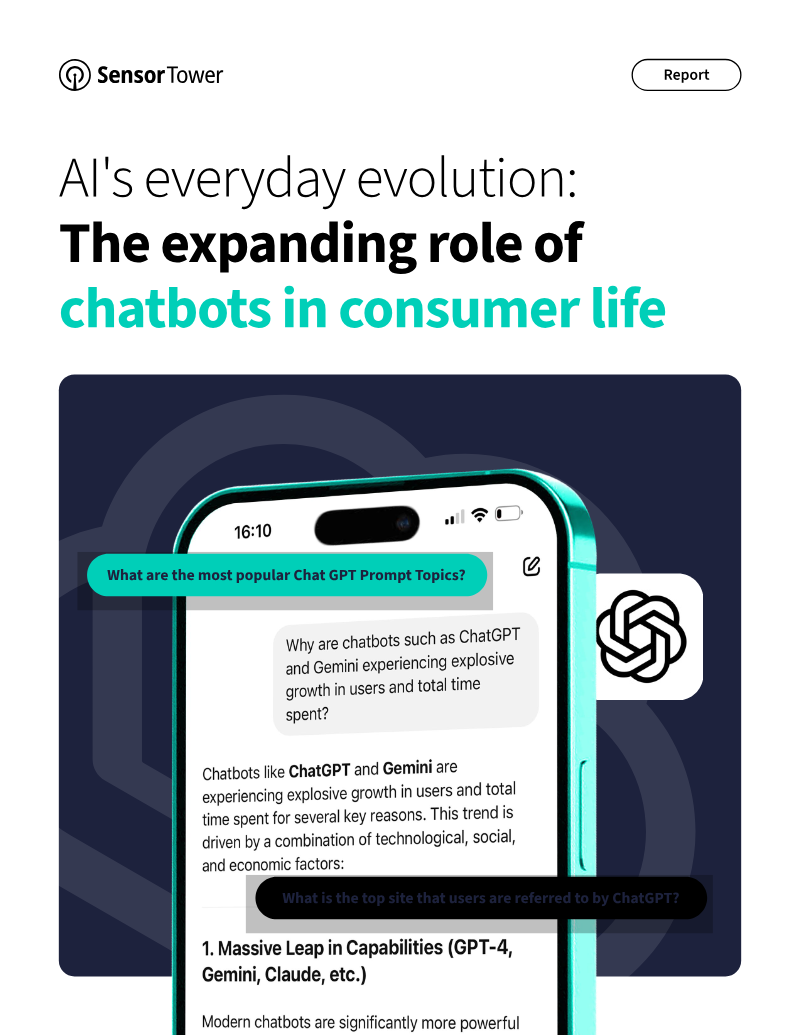
The rapid expansion of artificial intelligence chatbots is fundamentally altering consumer behavior, signaling a shift away from the long-standing dominance of traditional search engines. By early 2025, OpenAI’s ChatGPT reached 500 million global monthly active users, achieving this milestone faster than any app in the last decade. This growth is accompanied by a significant increase in engagement; in April 2025, ChatGPT saw a 60% rise in session frequency and a 270% jump in web visits, while traditional search engines experienced a 3% decline in user engagement metrics.
The demographic profile of AI users is evolving from technical early adopters to mainstream consumers. This transition is reflected in the shifting nature of user prompts. While software development queries accounted for 44% of prompts in early 2024, they fell to 29% by 2025. Conversely, categories such as economics, finance, and taxes saw a substantial increase, rising 9 percentage points year-over-year. This suggests that consumers are increasingly relying on AI for complex personal tasks, including investment planning and tax preparation.
Data indicates that chatbots are becoming powerful engines for web traffic and commerce. The top referral destinations from ChatGPT include YouTube, Wikipedia, and the National Library of Medicine, with Amazon ranking fourth. This positioning highlights the growing role of AI in driving purchase intent and informational discovery. While early adopters of AI have already reduced their time spent on Google apps by approximately 6%, more recent converts have yet to show a material change in search habits, suggesting that the erosion of traditional search dominance may accelerate as user habits solidify over time.
- ChatGPT reached 500 million global monthly active users by early 2025, marking the fastest growth for any application in the last decade.
- In April 2025, ChatGPT experienced a 60% increase in session frequency and a 270% jump in web visits, while traditional search engine engagement declined by 3%.
- The utility of AI is shifting from technical tasks to complex personal management, with software development prompts dropping from 44% to 29% of the total share between early 2024 and 2025.
- Consumer reliance on AI for finance, economics, and tax preparation grew by 9 percentage points year-over-year, signaling a move toward mainstream adoption for high-stakes personal tasks.
- Chatbots are emerging as significant drivers of web traffic and commerce, with YouTube, Wikipedia, the National Library of Medicine, and Amazon serving as the top referral destinations.
+1
Sensor TowerJan 2024
Report37 pages
State of the Game Industry 2024
The global game industry entered 2024 in a state of profound volatility, defined by a painful market correction following post-pandemic overexpansion. This period of instability is marked by widespread layoffs affecting one-third of the workforce and a surge in studio closures linked to rapid corporate conglomeration. While North America remains the primary hub for development and PC continues to be the dominant platform, the workforce is increasingly preoccupied with job security and the ethical implications of emerging technologies. Generative AI has seen rapid adoption, with nearly half of developers utilizing these tools, yet 84% express deep concern regarding copyright infringement and the potential for further job displacement.
Labor dynamics are shifting as developers react to economic pressures and perceived corporate mismanagement. Support for unionization has climbed to 57%, with particularly high enthusiasm among younger professionals aged 18 to 24 who are grappling with inflation and precarious employment. This desire for collective bargaining coincides with a growing rejection of mandatory return-to-office policies and a decline in confidence regarding corporate diversity and sustainability initiatives. Furthermore, the technical landscape is fracturing; significant dissatisfaction with Unity’s recent policy changes has led one-third of developers to consider switching engines, often favoring open-source alternatives like Godot.
Business models remain centered on digital premium downloads, favored by 51% of the industry, even as marketing strategies face disruption due to overwhelming negative sentiment toward major social media platforms like Twitter/X. Despite the internal turmoil, there is a measurable increase in the implementation of accessibility features, which now appear in nearly half of all projects. However, the industry’s demographic makeup remains largely stagnant, continuing to be predominantly White and male. Ultimately, the current landscape reflects a workforce caught between the necessity of financial stability through consolidation and a growing demand for systemic reform to address ethical, technical, and labor-related grievances.
- The industry is undergoing a severe market correction characterized by widespread layoffs affecting one-third of the global workforce and a surge in studio closures.
- Support for unionization has reached 57%, driven largely by younger professionals (ages 18–24) facing economic instability and dissatisfaction with corporate management.
- While 49% of developers have adopted generative AI, 84% of the workforce reports significant concerns regarding copyright infringement and potential job displacement.
- Technical infrastructure is shifting, with one-third of developers considering engine migrations—often toward open-source options like Godot—following recent policy changes at Unity.
- Digital premium downloads remain the primary business model for 51% of the industry, even as marketing strategies struggle with declining sentiment toward major social media platforms.
+3
Game Developers ConferenceJan 2024
Report95 pages
Integrated Report: Value Creation Story 2023
DeNA is undergoing a fundamental strategic evolution, transitioning from a primary focus on entertainment and gaming toward a diversified "Serve" approach that addresses complex social issues. This shift leverages the company’s core competencies in internet technology and artificial intelligence to drive growth across healthcare, medical digital transformation, and urban development. While the capital market historically viewed the organization as a hit-driven game company, the current strategy emphasizes a multi-segment portfolio designed for sustainable, long-term value creation. This transformation is centered in Japan, particularly through its "Home Base" in Yokohama, but maintains a global reach through international medical platforms and strategic intellectual property partnerships.
Financial performance in FY2022 reflects this transition, with consolidated revenue reaching ¥134.9 billion. While the game segment faced revenue declines, prompting a shift toward a global pipeline of major IP and partnerships with Nintendo and Shueisha, other sectors showed robust growth. The Live Streaming segment, bolstered by the Vtuber app IRIAM, and the Healthcare & Medical segment, driven by the expansion of the "Join" communication platform and a health database covering 18 million people, have become significant growth engines. The company aims for ¥20 billion in healthcare revenue by FY2024, utilizing M&A and medical IoT to capture a domestic market potential valued in the hundreds of billions of yen.
The organizational structure supports this diversification through a sophisticated human capital strategy and a rigorous governance framework. DeNA emphasizes autonomous career development and internal mobility to optimize its workforce across sports, AI, and healthcare initiatives. Governance is maintained through a board with 43% independent representation and a performance-linked compensation structure that aligns management incentives with shareholder interests. Furthermore, the company has integrated sustainability and risk management into its core operations, monitoring climate-related emissions and maintaining robust cybersecurity protocols to protect its expanding digital and medical data ecosystems.
- DeNA is pivoting from a hit-driven gaming model to a diversified 'Serve' strategy, focusing on healthcare, digital transformation, and urban development to ensure long-term sustainable growth.
- The Healthcare & Medical segment is a primary growth engine, targeting ¥20 billion in revenue by FY2024 by leveraging a health database of 18 million people and medical IoT expansion.
- Consolidated revenue for FY2022 reached ¥134.9 billion, with the gaming segment experiencing declines that are now being addressed through a global pipeline of major IP partnerships with Nintendo and Shueisha.
- The Live Streaming segment has emerged as a key revenue driver, specifically bolstered by the performance of the Vtuber application IRIAM.
- DeNA’s corporate governance structure includes a board with 43% independent representation and a performance-linked compensation system designed to align management with shareholder interests.
+1
DeNA Co., LtdSept 2023
Report30 pages
Gaming Industry Report: Q1 2023
The gaming industry experienced a resilient start to 2023, with a projected global market size of $201 billion, representing a 9% year-over-year increase. Public markets showed strength, with gaming-focused exchange-traded funds (ETFs) recording gains between 10% and 23% year-to-date. While private market venture funding saw a total of $761 million across 109 deals in the first quarter, activity remains concentrated in early-stage investments, as late-stage funding has slowed significantly compared to the peak levels of 2021.
Geographically, Asia led global venture funding in the first quarter, followed by North America and Europe. Emerging markets such as Africa and South America saw sporadic but notable deal activity, highlighting a broader global interest in gaming infrastructure and content. Major industry players currently hold approximately $48 billion in cash and equivalents, suggesting a stable environment for potential future mergers and acquisitions despite ongoing regulatory scrutiny regarding large-scale consolidation.
Key industry trends in early 2023 include the integration of artificial intelligence for asset generation and conversational tools, alongside a strategic shift by major tech firms toward cloud-based gaming infrastructure. Competitive dynamics are evolving as Epic Games introduces self-publishing tools to challenge Steam’s market dominance and integrates user-generated content into its Fortnite ecosystem. Furthermore, platforms like Roblox are successfully expanding their reach by aging up their user demographic. These developments, supported by a robust schedule of global industry conferences, indicate a focus on platform scalability, content diversification, and the optimization of developer tools to sustain long-term growth.
- The global gaming market is projected to reach $201 billion in 2023, reflecting a 9% year-over-year growth rate.
- Major industry players possess $48 billion in cash reserves, signaling a stable environment for future M&A activity despite regulatory headwinds.
- Venture capital funding totaled $761 million across 109 deals in Q1 2023, with investment heavily concentrated in early-stage ventures rather than late-stage rounds.
- Gaming-focused ETFs demonstrated strong performance in early 2023, recording year-to-date gains ranging from 10% to 23%.
- Asia currently leads global venture funding, followed by North America and Europe, with emerging activity appearing in African and South American markets.
+3
KonvoyApr 2023
Report66 pages
How UGC, AI, & Cloud Are Transforming Gaming
The gaming industry is currently undergoing a fundamental transformation driven by the social behaviors of Gen Alpha and Gen Z, over 90% of whom utilize gaming as their primary interactive outlet. This demographic shift has catalyzed the rise of User-Generated Content (UGC), artificial intelligence, and cloud infrastructure, collectively democratizing development and allowing indie titles to compete with AAA productions. The cloud gaming market is expanding rapidly, reaching nearly 400 million users within four years, while the integration of AI in gaming is projected to achieve a $4.2 billion valuation by 2029.
UGC has emerged as a critical driver of retention, with dominant platforms like Roblox, Minecraft, and Fortnite accounting for 19% of total global playtime and distributing over $1.3 billion to creators in 2023. To overcome the technical and legal hurdles of content creation, the industry is increasingly turning to generative AI, a sector expected to reach $1.8 billion by 2025. These tools automate complex processes such as texture upscaling and level generation, lowering the barrier to entry for creators across diverse genres.
While cloud technology offers the potential for real-time updates and massive concurrency, infrastructure limitations remain a significant bottleneck. Approximately 76% of players identify latency as a primary concern, suggesting that while 5G will eventually facilitate mass consumer adoption, the immediate utility of the cloud lies in B2B applications like secure playtesting and instant discoverability. The convergence of these technologies is ultimately moving the industry toward a live-service ecosystem of "endless games," where the boundaries between traditional media and interactive community-driven platforms continue to blur.
- User-generated content (UGC) is a primary driver of player retention, with Roblox, Minecraft, and Fortnite accounting for 19% of global playtime and distributing $1.3 billion to creators in 2023.
- The integration of AI in gaming is projected to reach a $4.2 billion valuation by 2029, while the generative AI sector specifically is expected to hit $1.8 billion by 2025.
- Cloud gaming has scaled to nearly 400 million users in four years, though 76% of players cite latency as a primary barrier to mass adoption.
- Generative AI is lowering development barriers by automating complex technical tasks like texture upscaling and level generation, enabling indie titles to compete with AAA productions.
- Over 90% of Gen Alpha and Gen Z now utilize gaming as their primary interactive outlet, forcing a shift toward live-service ecosystems and community-driven platforms.
+2
NewzooJan 2023

Report108 pages
Creative Industries in the UK Report
The United Kingdom’s entertainment market reached a historic peak of £11.1 billion in 2022, representing a 6.9% year-on-year increase and nearly doubling its total value since 2015. This growth is fundamentally underpinned by a comprehensive transition to digital consumption, with digital services now commanding a 91% market share across the video, music, and gaming sectors. While physical formats generally continue a long-term decline, specific niches such as vinyl and 4K UHD Blu-ray demonstrate notable resilience, with vinyl revenue surpassing CD sales for the first time this century.
The video games sector remains the largest individual segment, valued at £4.66 billion. Digital software sales account for 90% of this spend, led by mobile gaming and console downloadable content. Although hardware sales faced challenges due to global supply chain constraints, the market remains robust, with digital sales for major titles like Elden Ring and FIFA 23 significantly outperforming physical retail. Similarly, the video market reached a record £4.43 billion, fueled by a 17.6% surge in subscription video-on-demand services. Approximately 68% of UK households now maintain an average of 2.5 streaming subscriptions, cementing the dominance of online distribution.
The music industry mirrors these trends, with subscription streaming accounting for 84% of its £1.99 billion valuation. Interestingly, 2022 saw a nuanced recovery for physical retail as high-street specialists and independent shops experienced a 12.6% growth in sales following the normalization of post-pandemic trading. Despite this resurgence of local brick-and-mortar outlets, online channels still facilitate nearly 95% of total music spending. Strategic initiatives like Record Store Day and the implementation of advanced data tracking continue to support the industry's evolution, ensuring that both digital innovation and traditional retail advocacy remain central to the UK’s creative economy.
- The UK entertainment market reached a record £11.1 billion in 2022, a 6.9% year-on-year increase that nearly doubles its 2015 valuation.
- Digital services now dominate the landscape with a 91% market share across video, music, and gaming sectors.
- The video games sector is the largest segment at £4.66 billion, with digital software sales—driven by mobile and console DLC—accounting for 90% of that total.
- The video market grew to £4.43 billion, supported by a 17.6% surge in subscription video-on-demand services, with 68% of UK households now averaging 2.5 subscriptions each.
- Music industry revenue reached £1.99 billion in 2022, with subscription streaming accounting for 84% of total valuation.
+1
ERAJan 2023