
Presentation33 pages
FY2025.3 4Q Financial Results Presentation: Round One Corporation
FY2025.3 4Q Financial Results Presentation [Company Name] ROUND ONE Corporation [Company ID] 4680-QCODE [Event Type] Earnings Announcement [Event Name] Financial Results Briefing for the Fiscal Year Ended March 2025 [Fiscal Period] FY2025 4Q [Date] May 12, 2025 [Time] 15:30 – 16:30 (Total: 60 minutes, Presentation: 37 minutes, Q&A: 23 minutes) [Venue] Webcast President and Chief Executive ...
- ROUND ONE Corporation exceeded its FY2025.3 financial plan, achieving ¥27.22 billion in Ordinary Profit (8.6% above plan) and ¥27.00 billion in Operating Profit (5.0% above plan) on total sales of ¥177.05 billion (3.3% above plan).
- The company plans to adopt IFRS from FY2026.3, projecting a consolidated operating profit of ¥31.22 billion (IFRS), up from ¥27.00 billion (JGAAP) in FY2025.3, with the USA segment contributing ¥14.68 billion (IFRS) and Japan ¥18.18 billion (IFRS).
- ROUND ONE is considering price revisions of approximately 3% for Japan (excluding Amusement) and 4-5% for the USA, both starting from Q2 FY2026.3, to mitigate rising costs, including potential impacts from Trump tariffs on amusement prizes.
- The company is expanding its 'Delicious Project' in Japan, having signed contracts with 17 high-end cooperating merchants as of May 1, 2025, to offer Japanese B-grade/C-grade gourmet in a Food Hall format, targeting inbound American tourists.
- Capital allocation for FY2026.3 includes ¥9.6 billion for existing store facility investments (¥7.1 billion in the USA for amusement machines) and ¥33.9 billion for new store facility investments (¥27.9 billion in the USA).
+1
Round One CorporationMay 2025
Presentation46 pages
Consolidated Financial Results Briefing Materials: FY3/25
Akatsuki Inc. demonstrated significant financial resilience in FY3/25, characterized by a 46% year-over-year surge in consolidated operating profit to ¥3,915 million. While total sales experienced a marginal 1% decline, the core Games segment maintained stability through high-performing legacy titles such as Dragon Ball Z Dokkan Battle and Romancing SaGa Re;univerSe. Strong overseas performance and successful large-scale events effectively offset nearly ¥6 billion in development expenses for upcoming projects. This period also marked a strategic turning point as the Comics and IP Solutions segments achieved profitability, driven by the international launch of the MANGA MIRAI service and the rapid expansion of the Slash Gift online lottery platform.
The company’s investment arm further bolstered the balance sheet, realizing ¥2,840 million in proceeds during the fiscal year with additional capital gains anticipated from the IPO of LIFE CREATE Co., Ltd. in early FY3/26. Despite a reduction in total headcount from 803 to 697, primarily within the Games division, permanent staffing levels remained consistent, reflecting a shift toward operational efficiency. This lean organizational structure supports a robust financial position, with ¥33.3 billion in cash reserves earmarked for a ¥35 billion growth investment plan over the next three years, focusing on mergers, acquisitions, and next-generation game development.
Looking toward FY3/26, the group anticipates sustained growth in sales and profit, anchored by the upcoming release of Kaiju No. 8 The Game and the continued scaling of its digital content divisions. To reflect this positive outlook and strong liquidity, the shareholder return policy has been revised upward, increasing the target Dividend on Equity from 3% to 4%. This strategy signals a transition into a new growth phase where diversified IP solutions and global service expansions complement the established mobile gaming portfolio.
- Akatsuki Inc. achieved a 46% year-over-year increase in consolidated operating profit to ¥3,915 million for FY3/25, despite a 1% decline in total sales.
- The company maintains ¥33.3 billion in cash reserves to fund a ¥35 billion growth investment plan over the next three years, targeting M&A and next-generation game development.
- Shareholder returns are increasing as the target Dividend on Equity (DOE) has been raised from 3% to 4% due to strong liquidity and a positive outlook.
- The Comics and IP Solutions segments reached profitability, supported by the international launch of MANGA MIRAI and the expansion of the Slash Gift online lottery platform.
- Investment activities generated ¥2,840 million in proceeds during FY3/25, with further capital gains expected from the upcoming IPO of LIFE CREATE Co., Ltd. in early FY3/26.
AkatsukiMay 2025
Report2 pages
Press Start on Growth: Unlocking the Full Potential of the UK Video Games Industry
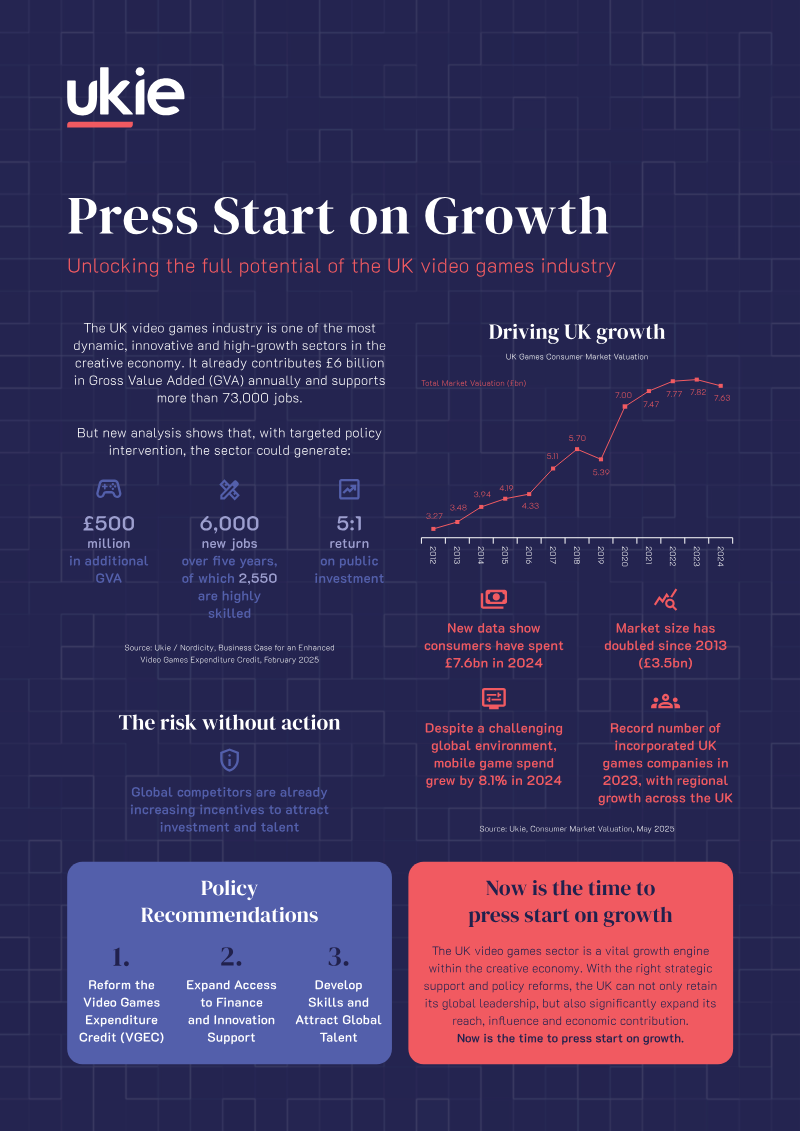
The analysis argues that the United Kingdom’s video‑games sector is a high‑growth pillar of the creative economy, already delivering roughly £6 billion in gross value added (GVA) and supporting more than 73 000 jobs, and that strategic policy action could lift its contribution to about £7.6 billion in 2024 and generate an additional £5.7 billion GVA and up to 5.4 million jobs over the next five years. The assessment covers the full UK market from 2022 through 2024, spanning software, hardware, live events, esports, ancillary merchandise and related media, and benchmarks performance against Western‑European averages.
Key findings show a continued erosion of physical boxed software, which fell 34 % year‑on‑year and now accounts for only 4 % of total spend, while mobile games grew 8 %—still below the 13 % regional average. Full‑game digital purchases slipped due to a thin slate of blockbuster releases, yet overall game volume remained stable. Live‑event spending contracted 15 % after pandemic‑related cancellations, whereas esports surged 44 % YoY, driven by a rise in UK‑based tournaments. Subscription revenue rose modestly as price hikes offset a near‑saturation of console subscriber bases. Hardware sales weakened for PS5 disc and Xbox consoles and for the Nintendo Switch, while the PS5 digital edition posted record software sales at a lower price point. Game‑culture engagement declined 13 % across PC and console categories, and related toy and merchandise sales fell 8.5 %.
The conclusions stress that without targeted reforms—particularly in financing, skills development, and talent support—the sector risks losing its global leadership. Conversely, coordinated policy could unlock further growth, broaden international reach, and reinforce the UK’s position as a leading hub for video‑games innovation and cultural influence. Data are drawn from industry sources such as Omdia, Ukie, NielsenIQ/GfK Entertainment, BFI, Comscore and the Official Charts Company, reflecting a comprehensive market‑valuation approach across multiple
- The UK video games industry currently contributes £6 billion in gross value added (GVA) and supports over 73,000 jobs, with the potential to add £5.7 billion in GVA and 5.4 million jobs over the next five years through strategic policy intervention.
- Physical boxed software sales have collapsed, falling 34% year-on-year to represent only 4% of total market spend.
- Esports experienced a significant surge of 44% year-on-year, driven by an increase in UK-based tournaments, contrasting with a 15% contraction in live-event spending.
- Mobile gaming in the UK grew by 8%, though this remains below the 13% regional Western-European average.
- Hardware sales for major consoles, including the PS5 disc edition, Xbox, and Nintendo Switch, weakened, while the PS5 digital edition achieved record software sales at a lower price point.
+1
UkieMay 2025

Presentation19 pages
People Can Fly Q4 2024 Financial Results Presentation
People Can Fly presents a strategic pivot toward cash flow optimization and a refined production focus as of April 2025. The primary thesis centers on transitioning away from the virtual reality segment to concentrate exclusively on AAA and compact-AAA video games. This shift is driven by changes in the global VR business model, specifically the cessation of platform subsidies. Consequently, the company will conclude its VR publishing activities following the release of Project Bison in late 2025.
Financial data for the 2024 fiscal year shows cumulative revenue of PLN 190.4 million, an increase from PLN 150.1 million in 2023. This growth was supported by work-for-hire contributions from Project Maverick and Project Echo, alongside the launches of Bulletstorm VR and Green Hell VR Co-op. However, the group reported a significant net loss of PLN 175.3 million, largely attributed to one-off write-offs for Project Red, Project Bifrost, and the impairment of the Incuvo subsidiary.
The strategic roadmap emphasizes securing new work-for-hire contracts, including a recently signed project with Sony Interactive Entertainment, with a target of adding two more projects this year. In the self-publishing segment, Lost Rift is scheduled for early access in 2025. Notably, Krafton Inc. has waived its right of first refusal for Projects Bifrost and Victoria, granting the company freedom to seek new publishing partners.
Operational efficiency measures include optimizing team structures and office spaces while limiting disbursements to critical investments. As of late 2024, the group maintained a workforce of 756 employees across global studios in Warsaw, Montreal, Newcastle, and other locations. The company is currently evaluating various scenarios to secure additional financing to support its revised development pipeline.
- People Can Fly is exiting the virtual reality market following the release of Project Bison in late 2025, citing the cessation of platform subsidies as the primary driver.
- The company reported a net loss of PLN 175.3 million for fiscal year 2024, driven by significant one-off write-offs for Projects Red and Bifrost and the impairment of its Incuvo subsidiary.
- Annual revenue grew to PLN 190.4 million in 2024, up from PLN 150.1 million in 2023, bolstered by work-for-hire contributions from Project Maverick and Project Echo.
- The company is prioritizing work-for-hire revenue, having recently signed a new contract with Sony Interactive Entertainment with a goal to secure two additional projects in 2025.
- Krafton Inc. has waived its right of first refusal for Projects Bifrost and Victoria, allowing People Can Fly to seek new publishing partners for these titles.
+2
PCF GroupApr 2025
Report19 pages
Global Gaming Report: Q1 2025
The global gaming industry experienced a significant resurgence in financial activity during the first quarter of 2025, marked by a substantial rebound in mergers, acquisitions, and private placements. Total deal value for the quarter reached $4.4 billion across 48 announced transactions, representing the highest quarterly valuation in nearly two years. This momentum was primarily driven by large-scale strategic consolidations, such as the $3.5 billion acquisition of Niantic’s games division by Scopely and AppLovin’s $900 million studio spin-off. Simultaneously, private investment surged to $3.5 billion across 149 deals, anchored by a landmark $3 billion investment into Infinite Reality at a $12.25 billion valuation.
Investment trends during this period shifted toward AI-driven entertainment and mobile user acquisition technologies. Strategic players like Savvy Games Group and Tencent maintained leadership roles in capital deployment, while venture capital firms such as BITKRAFT and Andreessen Horowitz remained the most prolific investors by volume. Geographically, the Asian developer market demonstrated steady stability with a median revenue growth of 9%, while the hardware and tools sector outperformed broader segments with a 20% average revenue increase. This growth was heavily influenced by the dominance of NVIDIA, which saw a 114% year-over-year revenue surge, positioning it as a cornerstone of the industry’s infrastructure with a $2.6 trillion market capitalization.
Despite the overall recovery reflected in the 16.37% return of the Drake Star Gaming Index, the market exhibited extreme volatility among individual public companies. While Sea Limited experienced a dramatic 223% increase, established entities like Unity and Ubisoft faced significant downturns, with valuations falling by over 50%. This divergence highlights a period of intense transition where hardware providers and AI-integrated platforms are capturing the majority of market gains, while traditional software developers and engine providers navigate a more challenging and fragmented economic landscape.
- The gaming industry saw a major financial rebound in Q1 2025, with $4.4 billion in M&A deal value across 48 transactions and $3.5 billion in private investment.
- NVIDIA has become a critical industry infrastructure pillar, achieving a 114% year-over-year revenue surge and a $2.6 trillion market capitalization.
- Private investment was anchored by a $3 billion funding round for Infinite Reality, which reached a $12.25 billion valuation.
- Market performance is highly polarized: while the Drake Star Gaming Index rose 16.37%, companies like Sea Limited grew 223% while Unity and Ubisoft saw valuations drop by over 50%.
- Strategic consolidation was led by major deals including Scopely’s $3.5 billion acquisition of Niantic’s games division and AppLovin’s $900 million studio spin-off.
+1
Drake Star PartnersApr 2025
Report17 pages
Games Investment Review: Q1 2025 Executive Summary Report
The Q1 2025 Games Investment Review provides a comprehensive analysis of global financial activity within the video game industry, covering investments, mergers and acquisitions (M&A), and initial public offerings (IPOs). The report identifies a significant recovery in market activity, noting that the combined value of investments and M&As reached $7.8 billion across 245 transactions. This represents the largest quarterly total since late 2023 and the second consecutive quarter of growth, signaling a stabilizing investment landscape.
Key findings highlight a massive surge in investment value, which rose 370% quarter-over-quarter to $4.4 billion. This growth was primarily driven by a $3.0 billion mid-to-late-stage investment in Infinite Reality. While M&A volume hit a two-year high with 55 transactions, the total reported value fell to $3.3 billion, largely because 80% of these deals did not disclose financial terms. The exit market showed strength through Asmodee’s $2.2 billion IPO and several billion-dollar acquisitions, such as Miniclip’s purchase of Easybrain. Additionally, new fund announcements reached a three-year peak of $21.8 billion, with 65% of that capital concentrated in five major funds.
The scope of the research encompasses diverse industry segments, including Console/PC, Mobile, Tech/Other, eSports, and Web3/Blockchain. Geographically, activity was led by Asia and Europe, while North America contributed high transaction volume with lower disclosed values. Methodology relies on a proprietary database tracking officially closed deals rather than mere announcements, ensuring data reflects actual capital deployed. The analysis emphasizes that artificial intelligence and blockchain remain primary areas of investor enthusiasm, with AI-related game investments totaling $3.1 billion during the quarter.
- Global gaming investment and M&A activity reached $7.8 billion across 245 transactions in Q1 2025, marking the highest quarterly total since late 2023.
- Investment value surged 370% quarter-over-quarter to $4.4 billion, largely driven by a single $3.0 billion mid-to-late-stage investment in Infinite Reality.
- New fund announcements hit a three-year peak of $21.8 billion, with 65% of that capital concentrated within just five major funds.
- Artificial intelligence remains a primary investment driver, accounting for $3.1 billion in game-related funding during the quarter.
- M&A volume reached a two-year high of 55 transactions, though total disclosed value was limited to $3.3 billion because 80% of deals did not report financial terms.
+1
Digital Development ManagementMar 2025
Report13 pages
Gaming CEO Survey: 2024 in Review
Industry leadership maintains a cautiously optimistic outlook for 2025, with 98% of executives expecting consumer spending to either increase or remain stable. Growth expectations are strongest in the mobile sector, where 41% of leaders anticipate expansion in in-app purchases and 31% expect growth in advertising revenue. While the PC segment remains relatively healthy with a 33% growth projection, the console market appears more stagnant, as 70% of respondents forecast stable performance and only 15% predict growth. This outlook is tempered by concerns regarding content saturation and a challenging user acquisition environment, which are cited as the primary hurdles facing the industry.
Operational strategies for the coming year signal a shift toward expansion and increased investment. A majority of companies plan to initiate more game development projects in 2025 compared to the previous year, supported by higher or stable budgets and increased marketing spend. Talent acquisition remains a priority, particularly in game development and engineering roles. Furthermore, the mergers and acquisitions landscape is expected to intensify, with 71% of executives anticipating more opportunities in 2025 and none predicting a decrease in activity.
Artificial intelligence has reached a significant level of penetration within the sector, with 84% of companies reporting either limited implementation or advanced integration across multiple functions. Executives identify art, game design, and engineering as the areas where AI will provide the most significant value. These findings, compiled by a leading global investment bank specializing in gaming, reflect a sector transitioning from a period of consolidation toward a renewed focus on production, technological integration, and strategic deal-making.
- Industry leadership is optimistic for 2025, with 98% of executives expecting consumer spending to increase or remain stable.
- AI adoption is widespread, with 84% of companies already implementing the technology across functions like art, game design, and engineering.
- The M&A landscape is expected to intensify, as 71% of executives anticipate more deal-making opportunities in 2025 compared to the previous year.
- Mobile gaming is the primary growth driver, with 41% of leaders expecting increased in-app purchases and 31% projecting growth in advertising revenue.
- The console market is largely stagnant, with 70% of respondents forecasting stable performance and only 15% predicting growth.
+1
Aream & CoJan 2025
Report19 pages
Global Gaming M&A and Growth Financing Advisory: Q1 2025
The global gaming industry experienced a notable resurgence in early 2025, characterized by a rebound in merger and acquisition activity and sustained interest in private financing. During the first quarter, 48 announced acquisitions reached a total value of $4.4 billion, anchored by the significant $3.5 billion acquisition of Niantic’s games division by Scopely. Simultaneously, the private placement market remained active, recording 149 deals worth $3.5 billion. These investments were primarily concentrated in mobile-focused developers and companies integrating artificial intelligence into their entertainment platforms, with major strategic entities like Savvy Games Group and Tencent continuing to drive market momentum.
Despite this activity, the financial landscape remains bifurcated. While the broader sector shows signs of recovery, with the Drake Star Gaming Index posting a 16.37% gain, performance remains highly volatile across the top 35 public gaming companies. Valuation disparities are particularly pronounced; industry leaders such as NVIDIA and AppLovin command premium revenue multiples, while many other firms face a more challenging environment. Furthermore, while early-stage funding remains accessible, later-stage financing continues to present significant hurdles for companies seeking capital.
Looking forward, the industry is positioned for a gradual increase in consolidation as public markets stabilize. Strategic focus is shifting toward the integration of AI and advanced technological platforms, which are expected to serve as primary catalysts for future growth. As market conditions improve, the sector is likely to see a renewed pipeline of initial public offerings, signaling a transition toward a more mature and diversified investment climate for global gaming stakeholders.
- Q1 2025 saw 48 M&A deals totaling $4.4 billion, headlined by Scopely’s $3.5 billion acquisition of Niantic’s games division.
- The private placement market recorded 149 deals worth $3.5 billion, with capital primarily flowing into mobile developers and AI-integrated entertainment platforms.
- The Drake Star Gaming Index rose 16.37% in Q1 2025, though performance remains volatile across the top 35 public gaming companies.
- Valuation gaps are widening, with industry leaders like NVIDIA and AppLovin commanding premium revenue multiples while other firms face significant capital constraints.
- While early-stage funding remains accessible, companies seeking later-stage financing continue to face substantial hurdles.
+2
Drake StarJan 2025

Report20 pages
Global Gaming Report Q2 2025
Public gaming equities surged in the first half of 2025, with the Drake Star Gaming Index climbing 28 % compared to a modest 5 % gain in the S&P 500. Leading performers included Square Enix, Roblox and Konami, underscoring a robust rebound in the sector. M&A activity remained steady at 46 deals, highlighted by Krafton’s $516 million purchase of ADK and Epic Games’ acquisition of AI studio Loci. Private‑market financing reached $3 billion across 110 placements, driven by high‑profile exits such as Dream Games’ $2.5 billion minority stake sale to CVC and Apple’s acquisition of RAC7 for its arcade portfolio. Projections indicate a continued rise in M&A and IPO activity through 2026, with artificial intelligence and technology platforms identified as primary growth catalysts.
Private‑placement capital in Q2 2025 totaled $2.6 billion across 24 deals, with the largest transaction—a $5 billion minority stake sale—valuing its target at nearly $5 billion. Deal distribution spanned mobile ($1.5 billion), PC/console ($0.8 billion), platform/tools ($0.4 billion), esports ($0.3 billion) and blockchain/VR‑AR ($0.2 billion). Key investors included CVC, Blackstone, Tencent and Bessemer Venture Partners. Notable exits such as Dream Games’ $2.5 billion minority sale and Arrowhead’s $80 million investment provided significant liquidity for early‑stage venture capitalists.
Valuation analysis reveals a pronounced divergence between high‑growth Asian titles and mature Western peers. Tencent (EV/EBITDA ≈ 5.7x, revenue growth 10%) and Sea Limited (EV/EBITDA ≈ 4.1x, revenue growth 30%) command premium multiples and robust double‑digit growth, reflecting investor appetite for fast‑growing Asian firms. In contrast, U.S. hardware and platform players such as NVIDIA (EV/EBITDA ≈ 17.9x, revenue growth 43%) and Unity (EV/EBITDA ≈ 6.2x, revenue growth –17%) exhibit lower multiples and mixed performance, indicating more modest valuations amid fluctuating earnings. This geographic and segmental disparity underscores the continued premium placed on rapid growth in emerging markets while mature Western companies face a more cautious valuation environment.
- Public gaming equities significantly outperformed the broader market in H1 2025, with the Drake Star Gaming Index rising 28% compared to a 5% gain in the S&P 500.
- Private-market financing reached $3 billion across 110 placements in H1 2025, bolstered by major exits such as Dream Games’ $2.5 billion minority stake sale to CVC.
- M&A activity remains steady with 46 deals recorded in H1 2025, including Krafton’s $516 million purchase of ADK and Epic Games’ acquisition of AI studio Loci.
- Investor sentiment shows a clear geographic divide, with high-growth Asian firms like Sea Limited (30% revenue growth) commanding premium multiples compared to the mixed performance of mature Western platform players like Unity.
- Q2 2025 private-placement capital totaled $2.6 billion, with mobile gaming leading the sector at $1.5 billion, followed by PC/console at $0.8 billion.
+1
Drake StarJan 2025
Report139 pages
The Game Industry of Poland: 2025
Collective work under the direction of dr Jakub Marszałkowski dr Jakub Marszałkowski, Indie Games Poland, Poznan University of Technology (chapters 3, 5, 8, 9) Eryk Rutkowski, Polish Agency for Enterprise Development (chapters 2, 4, 6) Wojciech Trusz, Creative Industries Institute (chapters 1) Piotr Milewski, Sirius Game Studio, Gdynia Maritime University (chapters 7) Game Industry Conference team: Olga Matej, Agnieszka Wołoszyn, Kacper Żubryk, Hanna Marszałkowska, Dominik Latos Extra data minin...
- The provided report content contains only the title and author credits, lacking the body text, statistical data, or specific industry findings required to generate factual insights.
- Due to the absence of substantive data in the provided source, it is impossible to extract growth rates, company performance metrics, or industry trends for the Polish game industry in 2025.
- The source material consists exclusively of administrative metadata regarding the report's contributors and institutional affiliations.
- No concrete takeaways regarding market size, employment figures, or economic impact can be derived from the provided text.
- The input provided is insufficient to fulfill the request for a data-driven summary of the Polish game industry.
+3
Polish Agency for Enterprise DevelopmentJan 2025
Report8 pages
Global Gaming Industry Takes Center Stage
The provided text does not contain the content of the document titled Global Gaming Industry Takes Center Stage, as the source link is restricted and inaccessible. Consequently, it is impossible to extract the main thesis, key findings, or methodological details required for an analytical summary. The available information consists solely of a server-side error message indicating a lack of authorization to view the requested file.
To provide a professional and accurate summary, the full text of the report must be made available. Once the content is accessible, the analysis will focus on identifying the primary industry trends, geographic scope, and statistical data points presented by the authors. Please provide the complete text or a functional link to the document to facilitate a comprehensive review of the gaming industry's current market position and future outlook.
- The provided report content is currently inaccessible due to a server-side authorization error.
- No factual data, market statistics, or industry trends are available for analysis from the provided source text.
- The document failed to load, preventing the extraction of any concrete insights regarding the global gaming industry.
- A comprehensive summary cannot be generated until the full text of the report is provided.
- The current input contains only an error message rather than the intended industry research.
+1
Morgan StanleyJan 2025

Report8 pages
Dynamics of Gaming Deals
The analysis tracks global venture‑capital activity in the video‑game sector from the first quarter of 2019 through the second quarter of 2024, focusing on deals funded by VCs, strategic investors and publishers. It quantifies total capital deployed and deal counts, revealing a rapid expansion from $2 billion across 117 transactions in 2019 to a peak of $5.3 billion in 2021 (186 deals), followed by a sharp contraction in 2022 to $1.8 billion (126 deals) and a further dip to $874 million in 2023 (148 deals). Early‑stage financing remained relatively stable throughout, while the decline was driven primarily by fewer Series A‑plus rounds, creating a scarcity of growth‑stage capital. The report notes a modest rebound in 2024, with new funds entering the market and higher expected returns despite lingering marketing and user‑acquisition challenges.
Geographically, investors increasingly target emerging regions such as South America, Eastern Europe, Southeast Asia and China, seeking cost‑efficient teams and pre‑seed opportunities. Mobile games continue to dominate the funding landscape, yet interest in mid‑tier “AA” titles is growing, reflecting a shift toward projects that promise shorter payback periods and stronger ROI. The pandemic‑driven hyper‑casual boom accelerated user‑acquisition technology, while post‑pandemic privacy changes (e.g., Apple’s IDFA restrictions) and macro‑economic headwinds have dampened overall spend and slowed M&A and IPO activity.
Methodologically, the 2019 figures are derived from the Games Fund team’s synthesis of publicly available sources, while data for 2020‑2024 come from the investgame.net analytical platform. The combined dataset provides a comprehensive view of deal volume, value and regional distribution, supporting the conclusion that the gaming VC market exhibits pronounced cyclical dynamics, with early‑stage resilience and emerging‑region optimism offset by a constrained growth‑stage pipeline and broader economic uncertainty.
- Global gaming VC investment peaked at $5.3 billion across 186 deals in 2021 before contracting sharply to $874 million in 2023.
- The decline in total capital was primarily driven by a scarcity of Series A-plus growth-stage funding, even as early-stage financing remained relatively stable.
- A modest market rebound is underway in 2024, supported by the entry of new funds and expectations for higher returns despite ongoing user-acquisition challenges.
- Investors are shifting focus toward emerging regions including South America, Eastern Europe, Southeast Asia, and China to access cost-efficient development teams and pre-seed opportunities.
- While mobile games remain the dominant funding category, there is a growing investor preference for mid-tier 'AA' titles that offer shorter payback periods and stronger ROI.
+1
The Games FundJan 2025

Report29 pages
InvestGame Q4'24 Report (Unknown Time)
The gaming industry experienced a strategic shift in 2024, moving away from short-term financial arbitrage toward long-term, objective-driven transactions. While the broader market faced a stricter environment characterized by layoffs and the offloading of non-core assets, total deal-making activity remained above pre-pandemic levels. A significant trend emerged in the work-for-hire sector, highlighted by the $2.8 billion Keywords buyout. Additionally, venture capital interest notably pivoted from game development studios toward platform and technology startups, leaving corporate venture arms to fill the gap in studio financing.
The analysis identifies a stabilization phase following the post-pandemic "hangover." Private investments saw a 22% year-over-year increase in funding during Q4 2024, while the M&A market recorded one of its strongest quarters in two years. Although the public market remained volatile, a three-quarter recovery trend in public offerings suggests a gradual reopening of the IPO window. Geographically, North America and Europe led early-stage studio fundraising, accounting for the vast majority of capital raised, while Asian developers dominated new top-tier mobile releases.
The outlook for 2025 anticipates sustained M&A momentum driven by lower interest rates, significant cash reserves among public strategics, and increased private equity involvement. Investment in AI-driven solutions and web3 is expected to rise, fueled by renewed crypto enthusiasm. While high-profile gaming teams will continue to command strong valuations, such deals may become less frequent as investors prioritize "picks and shovels" technology over pure content.
This report covers global gaming industry segments including PC, console, mobile, and hardware, with a specific focus on M&A, private equity, and public offerings. Data is derived from public media, business partners, and market insights, tracking closed transactions while excluding pure gambling and non-gaming blockchain ventures.
- The gaming industry is shifting toward long-term, objective-driven transactions, evidenced by a strong Q4 2024 M&A market and a 22% year-over-year increase in private investment funding.
- Venture capital is pivoting away from game development studios in favor of platform and technology startups, forcing corporate venture arms to become the primary source of studio financing.
- The work-for-hire sector is seeing major consolidation, underscored by the $2.8 billion buyout of Keywords.
- Public markets are showing signs of a gradual recovery, with a three-quarter trend suggesting the IPO window is beginning to reopen despite ongoing volatility.
- Investment strategies for 2025 are expected to prioritize 'picks and shovels' technology—specifically AI and web3 solutions—over pure content development.
+1
InvestGameJan 2025

Report12 pages
Financing Video Games: Spain
The guide aims to equip Spanish video‑game developers and publishers with a practical framework for securing external financing beyond traditional bank credit. It argues that investment agreements (IAs) represent a flexible, hybrid model that can bridge the gap between shareholders’ equity and debt, allowing investors to fund projects while retaining political and economic rights comparable to shareholders without immediate capital‑increase obligations.
Key content outlines the typical structure of an IA: investors provide lump‑sum or milestone‑linked capital, receive a defined share of commercial revenues, and obtain voting, dividend and information rights. Comparative analysis shows that, unlike standard debt, IAs do not impose fixed repayment schedules, instead tying returns to project profitability and offering conversion mechanisms that can transform credit into equity if revenues fall short. The guide enumerates standard clauses—profitability timeframes, capitalisation rights, representations and warranties, confidentiality, “bad‑leaver” provisions, and pre‑emptive rights—to protect both parties and manage risk. An illustrative example notes that a €100 investment with a 20 % return target is achieved once the project generates €120 in revenue.
The scope is national, targeting the Spanish video‑game sector and addressing developers of any size who seek alternative funding. Authored by legal counsel from Pérez‑Llorca and the Asociación Española de Videojuegos, the document draws on industry practice rather than empirical surveys, presenting a checklist and glossary to support contract drafting and due‑diligence processes. Its conclusion stresses that, as acquisitions and external investments rise, IA investors will increasingly influence project governance despite not holding formal share capital.
- Investment agreements (IAs) serve as a hybrid financing model for Spanish developers, bridging the gap between equity and debt by granting investors shareholder-like rights without requiring immediate capital increases.
- Unlike traditional bank loans, IAs replace fixed repayment schedules with returns tied directly to project profitability, often including conversion mechanisms that turn credit into equity if revenue targets are missed.
- IAs typically structure capital as lump-sum or milestone-linked payments, with returns defined by a percentage of commercial revenues, such as a €100 investment targeting a €120 return.
- Standard contractual protections in these agreements include profitability timeframes, capitalisation rights, confidentiality clauses, pre-emptive rights, and 'bad-leaver' provisions to mitigate risk for both parties.
- Investors utilizing IAs gain significant influence over project governance, including voting, dividend, and information rights, despite not holding formal share capital.
+1
AEVIJan 2025

Report15 pages
Insurance in the Video Game Sector: Spain
The guide explains that insurance is a critical safeguard for video‑game development in Spain, where tight schedules, complex technical workflows and the involvement of multiple parties create a range of legal and financial exposures. Its central thesis is that appropriate coverage not only mitigates the impact of unforeseen events but also functions as an indirect prevention tool, protecting both small studios and independent creators from liabilities that could jeopardise a project’s completion and commercial success.
Key risks identified include failure to meet delivery deadlines, software bugs, transmission of computer viruses, cyber‑attacks, data‑protection breaches, intellectual‑property infringements, defamation, and malicious acts by employees. Each risk is linked to potential legal consequences such as contractual liability, third‑party compensation claims, regulatory penalties from the Spanish Data Protection Agency, and reputational damage. The guide matches these exposures to specific insurance solutions: Professional Liability Insurance (PLI) and Errors & Omissions (E&O) for contractual and professional errors; Cybersecurity Insurance for hacking, ransomware and data‑loss incidents; Multi‑Risk and General Civil Liability policies for broader operational hazards; and specialised coverage for intellectual‑property disputes, defamation and employee misconduct.
The scope is national, focusing on the Spanish video‑game sector and addressing developers of all sizes, from freelancers to larger studios. While the guide does not present original empirical research, it draws on prevailing market offerings and legal frameworks to construct a practical risk‑assessment matrix. Recommendations emphasize engaging insurance brokers to conduct tailored assessments, compare policy terms, and periodically review coverage, with clear procedural steps for application, policy issuance, amendment periods and premium payment.
Overall, the guide provides a comprehensive checklist for selecting and maintaining insurance that aligns with the specific vulnerabilities of video‑game projects, underscoring the importance of proactive risk management in a highly competitive and technically demanding industry.
- Spanish video game developers face critical financial and legal exposures from project delays, software bugs, cyber-attacks, and intellectual property infringements.
- Professional Liability Insurance (PLI) and Errors & Omissions (E&O) policies are essential to mitigate risks related to contractual failures and professional errors.
- Cybersecurity insurance is required to address specific threats including ransomware, data-protection breaches, and the transmission of computer viruses.
- General Civil Liability and Multi-Risk policies provide necessary coverage for broader operational hazards and physical or malicious acts by employees.
- Developers should engage insurance brokers to conduct tailored risk assessments and perform periodic reviews of policy terms to ensure coverage aligns with evolving project vulnerabilities.
+1
AEVIJan 2025

Report17 pages
Taxation in the Video Game Sector: Spain
The guide explains the tax framework that applies to video‑game companies operating in Spain, outlining both mandatory obligations and the range of incentives available to reduce fiscal burdens. It establishes that resident legal entities must pay corporate income tax at 25 % of profit, value‑added tax generally at 21 %, and the Economic Activities Tax, which is exempt for the first two years or for turnover below €1 million. Non‑resident individuals and firms are subject to the non‑resident income tax, with rates of 25 % when a permanent establishment exists and 19‑24 % otherwise, and must file the appropriate IRNR forms within prescribed periods. Personal income tax for self‑employed developers ranges from 19 % to 47 % depending on income level, and withholding obligations apply to employee and contractor payments.
Key fiscal incentives include a research and development and technological innovation deduction that allows a 12 % credit on qualifying expenses, capped at 25‑50 % of the tax liability, and a patent‑box regime that reduces the taxable base on income from patents, utility models, designs, and advanced software. The Start‑ups Law offers a reduced corporate tax rate of 15 % for four periods and defers advance instalments, while small entities with turnover under €10 million benefit from accelerated depreciation, finance‑lease deductions, and an equalisation reserve that can lower the tax base by up to 10 %. Companies located in the Canary Islands can access the REF and ZEC regimes, featuring a 4 % corporate tax rate and exemptions on property‑transfer and IGIC taxes when specific investment and employment criteria are met.
The guide also lists practical tools to support compliance, such as the tax‑agency’s query database, an annual calendar of filing deadlines, virtual assistance services, and a telephone help line. It emphasizes the need for proper registration, reporting of activity start‑up and cessation, and electronic filing using certified certificates, ensuring that video‑game developers can meet statutory requirements while exploiting available tax efficiencies.
- Resident video game companies in Spain are subject to a 25% corporate income tax rate, while qualifying start-ups can access a reduced 15% rate for four tax periods.
- The Canary Islands offer a highly competitive 4% corporate tax rate and exemptions on property-transfer and IGIC taxes for companies meeting specific investment and employment criteria.
- R&D and technological innovation expenses qualify for a 12% tax credit, capped at 25–50% of total tax liability, alongside a patent-box regime that reduces the taxable base for advanced software.
- Small entities with an annual turnover under €10 million are eligible for fiscal benefits including accelerated depreciation, finance-lease deductions, and an equalisation reserve that lowers the tax base by up to 10%.
- Non-resident firms without a permanent establishment face income tax rates between 19% and 24%, while resident entities must generally apply a 21% value-added tax.
+2
AEVIJan 2025

Report17 pages
La Fiscalidad en el Sector de los Videojuegos: España
The guide aims to clarify the tax framework that applies to video‑game developers, publishers and related service providers operating in Spain, outlining both mandatory obligations and available fiscal incentives. It serves as a practical reference for resident legal entities, self‑employed professionals and non‑resident firms that generate income in the Spanish market, helping them meet compliance deadlines while exploiting deductions that can significantly lower the effective tax burden.
Key obligations are mapped to the principal Spanish taxes: corporate income tax (IS) at a standard 25 % rate, personal income tax (IRPF) ranging from 19 % to 47 % for individuals, value‑added tax (IVA) generally set at 21 %, the economic activities tax (IAE) with fixed tariffs and exemptions for the first two years or turnover below €1 million, and withholding obligations on salaries and payments to non‑resident contractors. Filing deadlines are detailed for each model form (e.g., Model 200/210 for IS, Model 303/390 for IVA, Model 111/190 for IRPF withholdings) and the guide notes the possibility of fiscal consolidation for groups of related companies.
The most valuable incentives for the sector include a 12 % deduction on qualifying research, development and innovation (R&D +i) expenses, which can rise to 45 % for projects carried out in the Canary Islands, and a patent‑box regime that reduces taxable income from intangible assets such as patents and advanced software. The 2022 Spanish Video‑Game Development White Paper underpins the emphasis on genuine technological advancement. Start‑up companies meeting ENISA criteria benefit from a reduced corporate rate of 15 % for four years, exemption from advance payments, and deferred tax liabilities. Small and medium‑sized entities with turnover under €10 million can also apply accelerated depreciation, enhanced lease deductibility and loss‑carry‑forward mechanisms.
Operational guidance covers the procedural steps required to register for a tax identification number, declare activity commencement or cessation, and submit electronic filings via the Agencia Tributaria’s portal using a digital certificate. Complementary tools include a searchable tax‑question database, an annually updated taxpayer calendar, virtual assistance services for the main tax types, and a dedicated helpline. Together, these resources aim to streamline compliance, reduce administrative risk and enable video‑game firms to maximize the fiscal advantages embedded in Spanish law.
- Video game companies in Spain can access a 12% tax deduction for qualifying R&D+i expenses, which increases to 45% for projects developed in the Canary Islands.
- Start-ups meeting ENISA criteria qualify for a reduced 15% corporate tax rate for four years, along with exemptions from advance payments and deferred tax liabilities.
- The standard corporate income tax (IS) rate in Spain is 25%, while personal income tax (IRPF) for self-employed professionals ranges from 19% to 47%.
- A patent-box regime is available to reduce taxable income derived from intangible assets, including patents and advanced software.
- Small and medium-sized enterprises with an annual turnover under €10 million are eligible for accelerated depreciation, enhanced lease deductibility, and loss-carry-forward mechanisms.
+2
AEVIJan 2025
Report13 pages
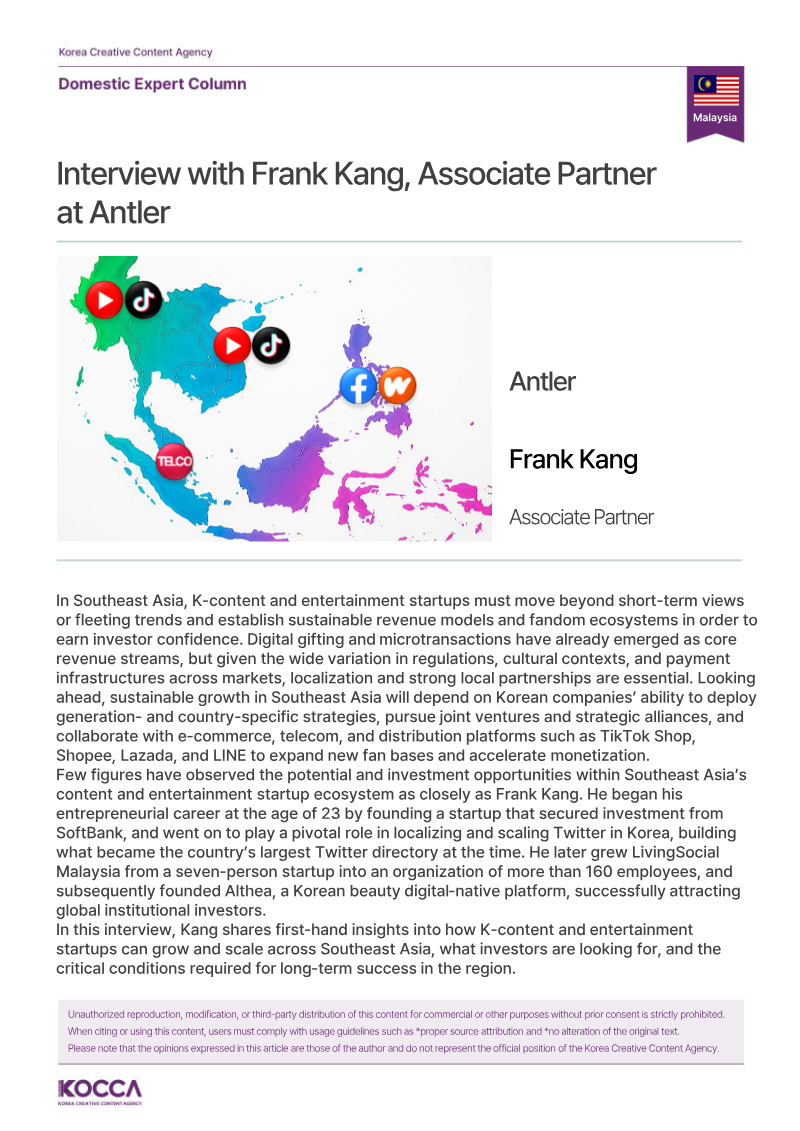
Interview with Frank Kang, Associate Partner at Antler: Malaysia
Korean content and entertainment startups are being urged to treat Southeast Asia as a primary growth engine rather than a peripheral market. Success hinges on deep localisation that goes beyond subtitles, requiring partnerships with local “co‑pilots” that can navigate fragmented linguistic, regulatory and payment landscapes in cities such as Jakarta, Manila and Bangkok. By embedding region‑specific monetisation schemes—micro‑transactions, live‑commerce, and hybrid free‑plus‑premium models—companies can align with the mobile‑wallet‑driven habits of Southeast Asian fans and convert grassroots enthusiasm into sustainable revenue streams.
The region’s fandom operates as a decentralized, grassroots network where fans act as unpaid marketers, driving earnings through digital stickers, low‑priced concert tickets and other micro‑purchases that often outpace traditional subscription revenues seen in Korea or Japan. Promising niches include short‑form video, webtoons and IP‑centric ecosystems, mobile‑first games, and live‑commerce platforms, all of which benefit from early community testing and strong local alliances. Trust capital built by global Korean acts such as BTS and BLACKPINK demonstrates the willingness of Southeast Asian audiences to pay for authentic, culturally resonant experiences.
Investors now demand proven revenue traction and genuine localisation before committing capital, and scalable startups are expected to adopt modular, locally adapted business models. Exits are likely to occur through mergers and acquisitions rather than public listings, underscoring the strategic importance of establishing a resilient foothold in Southeast Asia as a launchpad for broader global expansion.
- Korean entertainment and content startups must treat Southeast Asia as a primary growth engine rather than a peripheral market to achieve sustainable expansion.
- Success requires deep localisation through local 'co-pilots' to navigate fragmented linguistic, regulatory, and payment landscapes in key hubs like Jakarta, Manila, and Bangkok.
- Revenue models should shift toward mobile-wallet-driven micro-transactions, live-commerce, and hybrid free-plus-premium structures to align with local consumption habits.
- Startups should leverage decentralized, grassroots fan networks that drive revenue through digital stickers and low-priced micro-purchases, which often outperform traditional subscription models.
- High-growth niches include short-form video, webtoons, IP-centric ecosystems, and mobile-first games that utilize early community testing and local alliances.
+1
KOCCA – Korea Creative Content AgencyJan 2025

Report26 pages
Global Sports Tech Market Report H1 2025
In the first half of 2025 the global sports‑technology sector recorded approximately $52 billion in announced or closed transactions, underscoring a rapid acceleration of both merger‑and‑acquisition activity and capital raising. Roughly $32 billion stemmed from 233 M&A deals, while a record‑high $6.6 billion was secured through 239 private‑placement rounds, more than 80 % of which involved early‑stage companies. The capital influx was driven by a mix of strategic consolidations—most notably TSG Consumer’s $1.5 billion acquisition of EOS Fitness and RTL’s $613 million purchase of Sky Deutschland—alongside a wave of targeted investments such as Valeas’s $110 million majority stake in Ticketmanager, Genstar’s acquisition of Playmetrics for integration with Stack Sports, and IMG’s takeover of SportsRecruits. Deal multiples varied across subsectors, reflecting divergent growth trajectories within wearables, fan‑engagement platforms, and performance‑analytics solutions.
Geographically, the activity spanned North America, Europe and emerging markets, with transaction processing centralized through Drake Star Securities LLC in the United States and its UK affiliate, Drake Star UK Limited, both operating under FINRA regulation and SIPC membership. This infrastructure ensures compliance and investor protection for institutional participants. The concentration of early‑stage financing and the prevalence of large‑scale consolidations together signal a market transitioning from fragmented innovation toward integrated platforms capable of delivering end‑to‑end sports experiences. The data suggest that investors and strategic acquirers view the sector as a high‑growth arena, positioning it for continued expansion and deeper consolidation throughout the remainder of 2025.
- The global sports tech market reached a total deal value of $51.9 billion in H1 2025 across 503 announced or closed transactions.
- M&A activity dominated the sector with $32.2 billion in disclosed deal value across 233 deals, led by TSG Consumer’s $1.5 billion acquisition of EōS Fitness.
- Private placements hit a record $6.6 billion across 239 deals, highlighted by Infinite Reality raising $3 billion and DAZN securing $1.8 billion.
- Investor appetite for new sports-focused capital remains high with over $3.5 billion in new funds announced, including the $1.2 billion Checketts Sports fund.
- Disney acquired a 70% stake in FuboTV for $220 million in cash and a $145 million loan, creating a provider with 6.2 million subscribers.
+1
Drake Star PartnersJan 2025

Report28 pages
Global Gaming Report 2025
The analysis focuses on the accelerating consolidation of the worldwide gaming ecosystem, emphasizing the unprecedented scale of mergers and acquisitions (M&A) and private‑placement financing observed in the final quarter of 2025 and projecting a further surge into 2026. In Q4 2025, a record‑high 43 announced transactions totaled $83 billion, highlighted by Netflix’s $82.7 billion purchase of Warner Bros.’ avatar‑technology portfolio and Kakao Games’ $78 million strategic stake aimed at expanding its PC and console footprint. Private‑placement activity complemented the M&A wave, with 137 deals raising $1.5 billion, underscoring heightened investor appetite for growth‑stage gaming ventures.
The data reveal a clear shift toward acquisition of immersive‑technology assets, particularly avatar and metaverse‑related capabilities, as major platform operators seek to deepen engagement across streaming and interactive media. Geographic distribution remains truly global, with North American and Asian firms leading both deal origination and capital provision, while sovereign wealth entities such as the Public Investment Fund (PIF) emerge as influential buyers. The breadth of activity spans traditional console and PC publishers, mobile‑first developers, and emerging gaming‑tech startups, indicating a convergence of content, distribution, and underlying technology.
Looking ahead to 2026, the outlook anticipates a sharp acceleration in gaming‑tech M&A, driven by a roster of “buyers to watch” that includes PIF‑backed Scopely, Netflix, Paramount, Tencent, Krafton and NCSoft. The forecast suggests that strategic imperatives—namely, securing avatar‑tech, expanding cross‑platform ecosystems, and leveraging data‑driven monetisation—will fuel continued dealmaking at volumes exceeding the historic Q4 2025 peak. Overall, the findings point to an industry in the midst of rapid structural realignment, with capital flowing toward assets that enable deeper, more immersive player experiences and broader monetisation opportunities.
- The gaming M&A market reached a landmark $161 billion in total disclosed value across 759 announced deals in 2025.
- Netflix announced a major $82.7 billion acquisition of Warner Bros. and its gaming division, which triggered a hostile $108.4 billion bid for Warner Bros. Discovery by Paramount–Skydance.
- A consortium led by PIF completed a $55 billion leveraged buyout of Electronic Arts (EA) in September 2025.
- Private company financings totaled $6.2 billion across 509 deals, led by Luma AI’s $900 million Series C and a $2.5 billion investment in Dream Games by CVC and Blackstone.
- The Drake Star Gaming Index rose 12% in 2025, significantly bolstered by Unity's 92% stock price increase and NEXON's 63% growth.
+1
Drake Star PartnersJan 2025