
Report31 pages
The Dual Frontier: A Retailer’s Framework for Agentic Commerce
Retailers frequently adopt LLM‑powered chat widgets without addressing the core friction points that shape shopper behavior. The analysis argues that meaningful agentic commerce emerges when AI is tailored to a retailer’s specific product categories, customer profiles, and pain points. By deploying onsite ambient intelligence that proactively surfaces assistance when shoppers display confusion, retailers can intervene before friction escalates. Off‑site agent commerce remains nascent; catalog data quality and the availability of structured attributes are critical bottlenecks that must be resolved to enable reliable recommendations and transactions.
Data quality is identified as a pivotal differentiator. In an agentic environment, insufficient data can prevent a retailer from entering a shopper’s consideration set entirely, whereas in traditional e‑commerce it merely dampens conversion rates. The framework stresses the need to provide agent platforms with enough data for accurate recommendations while protecting proprietary signals from competitors. A calibrated approach—balancing “share freely,” “share selectively,” and “protect” signals—is essential to maintain trust, enhance recommendation confidence, and drive higher conversion rates.
A quantitative readiness diagnostic offers a pragmatic path forward. Four pillars—catalog, technical infrastructure, organizational capacity, and strategic urgency—are scored on a 32‑point scale. Scores of 26–32 signal mature foundations and immediate learning loops; 18–25 require focused catalog work over 8–12 weeks; 10–17 suggest a narrow pilot with partner support; and 0–9 indicate foundational improvements are needed before any agent rollout. Building these capabilities in‑house can take 12–18 months, whereas partnering with a platform such as Moloco Commerce Media accelerates deployment through catalog normalization, real‑time decisioning, and holdout‑based incrementality frameworks.
- Retailers must prioritize high-quality, structured catalog data, as insufficient data in an agentic environment causes total exclusion from a shopper's consideration set rather than just lower conversion rates.
- A 32-point readiness diagnostic across four pillars—catalog, infrastructure, organizational capacity, and strategic urgency—determines the viability of agentic commerce, with scores of 26–32 indicating immediate readiness and 0–9 requiring foundational work.
- Retailers should adopt a calibrated data-sharing strategy, categorizing signals into 'share freely,' 'share selectively,' and 'protect' to balance recommendation accuracy with the need to safeguard proprietary competitive advantages.
- Partnering with platforms like Moloco Commerce Media can bypass the 12–18 month timeline required for in-house development by providing immediate access to catalog normalization and real-time decisioning frameworks.
- Effective agentic commerce requires shifting from passive chat widgets to proactive ambient intelligence that intervenes when shoppers display signs of confusion.
+2
InvestGameFeb 2026
Report94 pages
The PC & Console Gaming Report 2025
The global PC and console gaming market is projected to reach $92.7 billion by 2027, driven by a significant recovery in the console sector. While PC growth remains modest at a 2.6% CAGR, the console segment is expected to expand by 7.0%, fueled by the anticipated launch of the Nintendo Switch 2 and blockbuster releases such as Grand Theft Auto VI. Despite a revenue dip in 2024 due to a lighter premium release schedule, total playtime grew by 6%, signaling robust engagement even as market dynamics shift toward a "near zero-sum" competition for player attention.
Player behavior is increasingly characterized by "calcification," where engagement is concentrated into a shrinking pool of established "forever games." Titles aged six years or older now command over 60% of playtime on PC and nearly half on consoles. This consolidation is most visible on PC, where just five legacy titles account for 30% of annual hours. While PlayStation has emerged as a growth leader with a 21% increase in playtime since 2021, the broader trend across all platforms shows players becoming more "unreachable," with a rising share of the audience engaging with only one to three games per year.
To combat stagnation, publishers are increasingly leveraging "recursive nostalgia" by reintroducing classic maps and mechanics. While this strategy yielded massive engagement spikes for Fortnite, its effectiveness varies, often serving as a short-term boost rather than a long-term retention tool unless structured as a permanent gameplay mode. Furthermore, the discoverability crisis has intensified as annual releases on Steam approached 19,000 in 2024. With the impact of traditional seasonal sales declining fourfold since 2019, success now requires a shift toward targeted global events, external traffic generation, and product differentiation to break through a market dominated by AAA franchises and entrenched free-to-play titles.
- The global PC and console market is projected to reach $92.7 billion by 2027, with the console segment expected to grow at a 7.0% CAGR driven by the Nintendo Switch 2 launch and Grand Theft Auto VI.
- Player engagement is increasingly 'calcified,' as titles aged six years or older now account for over 60% of PC playtime and nearly 50% of console playtime.
- Market competition for player attention has become a near zero-sum game, with a rising percentage of the audience now limiting their engagement to only one to three games per year.
- On PC, market consolidation is extreme, with just five legacy titles responsible for 30% of total annual hours played.
- Despite a 2024 revenue dip caused by a light release schedule, total player engagement grew by 6%, indicating that playtime remains robust even as monetization becomes more difficult.
+2
NewzooFeb 2026

Report94 pages
Mobile Market Landscape 2026
The mobile ecosystem is undergoing a fundamental structural transformation as the industry shifts from a volume-based growth model to one defined by monetization efficiency and technological integration. By 2026, the market has reached a state of saturation where total app releases have surged by 25% year-over-year, yet only 10% of new titles successfully secure meaningful user attention. A pivotal milestone occurred in late 2025 when non-gaming applications surpassed gaming in total revenue for the first time, largely propelled by the explosive 273% revenue growth in generative AI and the strategic expansion of utility-based tools.
Within the gaming sector, traditional genres such as Casino and RPG have faced stagnation, forcing publishers to adopt hybridization strategies that blend deeper monetization mechanics into previously hypercasual titles. This pivot has yielded significant results, with hypercasual revenue increasing by approximately 80% as developers move toward puzzle and simulation subgenres. Meanwhile, midcore gaming revenue has plateaued at $33–34 billion, prompting a reliance on intensified LiveOps and direct-to-consumer strategies. Across the broader app landscape, the integration of generative AI into creative assets has become standard, with over half of top-grossing games utilizing these tools to scale production, despite ongoing concerns regarding creative monotony.
Geographically, growth patterns are diverging as emerging markets like Indonesia continue to drive massive download volumes, while mature Western markets focus on maximizing revenue per user. The utility and social segments are similarly prioritizing premium subscription models to combat plateauing download numbers. While tools such as antivirus and cloud storage are seeing a resurgence in demand, the industry faces a broader challenge in maintaining long-term retention. Ultimately, the market is transitioning away from hypergrowth toward a sustainable, mature phase characterized by subscription-driven monetization and the strategic application of AI to optimize both user experience and operational efficiency.
- Non-gaming applications surpassed gaming in total revenue for the first time in late 2025, driven by a 273% revenue surge in generative AI and utility-based tools.
- The mobile market has reached saturation, with a 25% year-over-year increase in app releases while only 10% of new titles successfully capture meaningful user attention.
- Hypercasual gaming revenue grew by approximately 80% as developers pivoted toward hybridization, blending deeper monetization mechanics into puzzle and simulation subgenres.
- Midcore gaming revenue has plateaued at $33–34 billion, forcing publishers to rely on intensified LiveOps and direct-to-consumer strategies to maintain performance.
- Over 50% of top-grossing games now utilize generative AI to scale production of creative assets, despite industry concerns regarding potential creative monotony.
+3
AppMagicFeb 2026
Report13 pages
Aream & Co. Gaming CEO Survey 2025
The survey, conducted by Aream & Co., gauges executive optimism regarding consumer spending on gaming in 2025 across multiple channels and functional areas. Overall, 49 % of respondents view spending as “more optimistic,” another 49 % see it as unchanged, and only 2 % are less optimistic. When broken down by platform, mobile spending is perceived as more optimistic (49 %) while PC and console views are split between “more” (15–33 %) and “about the same.” In‑app purchases are viewed as more optimistic (80 %) versus in‑app advertising (41 %).
Key challenges identified include content saturation and over‑supply, with 33 % citing these as concerns; marketing environment issues affect 49 %, and macro conditions are a worry for 17 %. Despite these, 54 % anticipate more new games in 2025, and 37 % expect higher average budgets. Marketing spend is expected to rise for 48 %, while engineering and game development are seen as more optimistic (71 % and 42 %).
The survey also highlights a strong appetite for mergers and acquisitions, with 71 % expecting more M&A activity. Advanced integration across multiple functions is viewed as more optimistic (49 %) but limited implementation remains a concern.
The data derive from a global sample of gaming CEOs, reflecting perspectives across mobile, PC, console, and various functional departments. The findings suggest a cautiously optimistic outlook for 2025, tempered by supply‑side pressures and marketing challenges.
- Industry sentiment for 2025 is largely stable or positive, with 98% of CEOs reporting that consumer spending will be either unchanged (49%) or more optimistic (49%).
- M&A activity is expected to accelerate, with 71% of executives anticipating an increase in deal-making throughout 2025.
- In-app purchases are the primary revenue driver, with 80% of respondents optimistic about growth compared to only 41% for in-app advertising.
- Investment in development remains a priority, as 71% of CEOs are optimistic about engineering budgets and 42% about game development, with 37% expecting higher average project budgets.
- Marketing remains a critical pain point, with 49% of executives citing the current marketing environment as a major challenge despite 48% planning to increase their marketing spend.
+4
Aream & CoFeb 2026

Report38 pages
The AI Disruption Index: How AI Is Reshaping Consumer Discovery
The AI Disruption Index demonstrates that artificial intelligence is fundamentally altering how U.S. consumers discover and purchase brands, with one‑third of adults now using personal AI agents to find products and nearly half employing AI for purchase research. A survey of 283 marketing leaders across fifteen verticals, coupled with analysis of more than 3,000 apps that collectively amassed over 200 billion downloads, confirms that AI has already eroded traditional discovery channels and is poised to disintermediate services that depend heavily on paid search and weak customer relationships.
Generative‑AI agents pose the greatest threat to news, education, health & fitness, retail, and on‑demand services, where AI can replace conventional search and recommendation workflows. Only sectors with strong regulatory or content moats—such as financial services, media rights holders, and auto OEMs—retain a defensive advantage. The study underscores that brands must embed AI‑driven personalization and deepen direct customer relationships to counter the risk of zero‑click discovery.
Mobile applications emerge as the primary competitive advantage for brands able to own the customer journey. They provide first‑party data, closed‑loop measurement, and personalized experiences that are difficult for AI agents to replicate. The report recommends three strategic priorities: investing in superior mobile app experiences, unifying and activating customer signals through comprehensive data profiles, and rethinking channel mixes to favor resilient, direct‑engagement platforms over fragmented paid or organic search. These actions will enable brands to mitigate AI‑driven disruption and secure long‑term customer loyalty across the United States.
- One-third of U.S. adults now use personal AI agents for product discovery, while nearly 50% utilize AI for purchase research.
- AI-driven 'zero-click' discovery is actively eroding traditional paid search and organic search channels, threatening sectors like retail, education, and health & fitness.
- Sectors with strong regulatory or content moats, specifically financial services, media rights holders, and auto OEMs, currently maintain a defensive advantage against AI disintermediation.
- Mobile applications serve as the primary defense against AI disruption by enabling first-party data collection, closed-loop measurement, and personalized experiences that AI agents cannot easily replicate.
- Brands must shift strategic focus away from fragmented search channels toward direct-engagement platforms to secure long-term customer loyalty.
+2
InvestGameJan 2026
Report128 pages
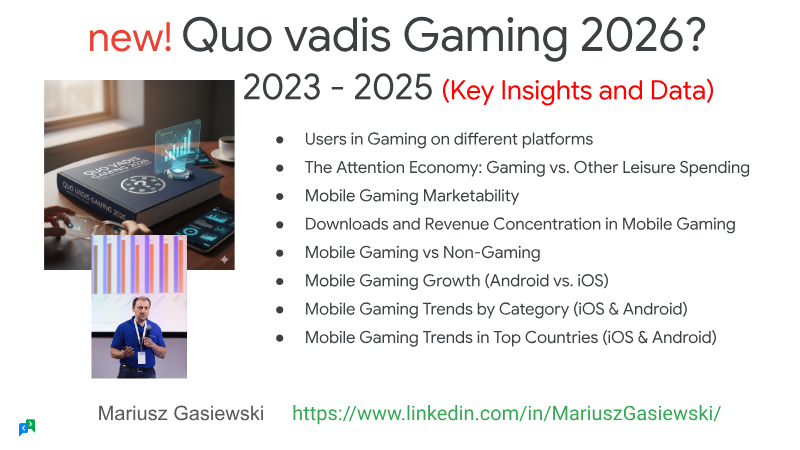
Key Insights and Data: 2023–2025
Mobile gaming drives the global industry’s growth through 2025, accounting for more than half of worldwide revenue and over eighty percent of players. Global gaming income is projected to reach $197 billion in 2025, a 7.5 % year‑over‑year rise largely powered by mobile and PC segments, while console expansion remains modest. The sector’s resilience is most pronounced in emerging markets where Android and iOS user volumes surge, yet revenue concentration persists in Western regions—particularly the United States and the United Kingdom—where iOS dominates acquisition spend.
Competitive dynamics sharpen as the top ten to fifty titles on Google Play and Apple’s App Store capture an increasing share of revenue, creating a winner‑take‑all environment. Hyper‑casual and match‑3 games concentrate U.S. spend, whereas Android strategy titles spread more evenly across Japan, Korea, and Taiwan. Sub‑genres such as chess, ludo, hidden object RPGs, and slots thrive in China, India, Brazil, and Southeast Asia, collectively commanding 15–20 % of global spend. Across most categories, day‑one retention has slipped from roughly 80 % to about 60 %, underscoring a broader challenge of sustaining early engagement.
Download patterns reveal Android’s volume advantage—about 70 % of global downloads—with the United States, India, Brazil, and Indonesia leading. iOS, though smaller in volume (30 %), delivers higher per‑download revenue, especially in China and the U.S. iOS penetration is rising in emerging markets such as Brazil and Vietnam, while Android’s share in India climbs from 18.8 % to 21.3 %. Genre‑level analysis shows modest growth (10–30 %) across most mobile categories, with occasional outliers and declines in specific niches. Overall, the landscape is characterized by rapid mobile expansion, concentrated monetization power, and shifting geographic priorities that shape strategic opportunities for developers and marketers.
- Global gaming revenue is projected to reach $197 billion in 2025, representing a 7.5% year-over-year increase driven primarily by mobile and PC segments.
- Mobile gaming remains the dominant force in the industry, accounting for over 50% of global revenue and more than 80% of the total player base.
- The mobile market is increasingly a winner-take-all environment, with the top 10 to 50 titles on Google Play and the Apple App Store capturing a growing share of total revenue.
- Android maintains a 70% share of global downloads, while iOS accounts for 30% but continues to generate significantly higher revenue per download in key markets like the U.S. and China.
- Sustaining early player engagement is becoming more difficult, as day-one retention rates have declined from approximately 80% to 60% across most categories.
+3
InvestGameJan 2026

Report36 pages
Winning with Creative: Building, Testing, and Scaling High-Performance Ads
The purpose of the analysis is to demonstrate that creative content remains the decisive lever for growth in an advertising environment increasingly fragmented by privacy constraints and platform diversity. By measuring “Return on Creative” through volume, variety, and versioning, marketers can isolate incremental value per asset and scale profitable campaigns across platforms.
High‑performance ads are defined by rapid, data‑driven testing and creative diversification. In e‑commerce and lifestyle categories, first‑person point‑of‑view walkthroughs that showcase everyday use outperform generic user‑generated content, with a 350 % lift in ad spend when winning templates are paired with top assets. TikTok’s “TikTok‑first” structure—hook, body, close—shows that 30‑second videos with sound on can raise purchase intent by up to 77 %. AI tools such as TikTok Symphony deliver a 57 % efficiency gain in content creation, underscoring the necessity of automated, localized creative testing for scaling.
The three‑stage CRAFTSMAN+ framework provides a systematic approach to creative optimization. Stage 2 refines concepts by testing talent, video duration, and demographic fit to identify the most engaging format. Stage 3 fine‑tunes assets—including intro hooks, audio, CTA copy, and visual elements—to lock in the winning creative, benchmark performance, and scale campaigns. Narrative structure (education‑focused versus social proof) and localized storytelling drive higher conversion rates and return on ad spend, while structured fatigue monitoring (CTR decay, spend decline) enables proactive creative refreshes.
Geographically the findings apply to major digital markets worldwide, with a focus on platforms such as TikTok and broader social media ecosystems. The time period covers the most recent advertising cycles, reflecting current privacy regulations and platform algorithm changes. Overall, the analysis concludes that dynamic, interactive creative—tested rapidly and scaled strategically—offers the highest growth potential for brands navigating today’s complex advertising landscape.
- High-performance ads achieve a 350% lift in ad spend when winning templates are paired with top-performing assets.
- TikTok-first video structures—comprising a hook, body, and close—can increase purchase intent by up to 77% when using 30-second, sound-on formats.
- AI-driven content creation tools, such as TikTok Symphony, provide a 57% efficiency gain in the production process.
- First-person point-of-view walkthroughs demonstrating everyday product use consistently outperform generic user-generated content.
- The CRAFTSMAN+ framework optimizes performance by systematically testing variables like talent, video duration, and demographic fit before fine-tuning specific elements like hooks and CTAs.
+3
MolocoJan 2026

Report45 pages
Why Chance-Based Mechanics Keep Us Hooked
Chance-based mechanics drive player engagement by prioritizing the psychological thrill of anticipation over the actual value of rewards. This engagement is rooted in the release of dopamine during the period of uncertainty, where the wait for a result creates more neurological stimulation than the prize itself. By utilizing unpredictable reward schedules and the "near-miss" effect, developers foster a persistent belief that a significant win is imminent. This strategy is exemplified by the commercial success of Monopoly GO!, which generates between $100 million and $125 million in monthly revenue through a "saw-tooth" gameplay loop that oscillates between resource depletion and sudden, event-driven recovery.
The effectiveness of these systems relies on a "pressure and release" cycle designed to maintain emotional tension without causing player burnout. High-volatility mechanics, such as digital wheels and randomized heists, are tuned to prioritize emotional impact over mathematical fairness. For instance, probabilities are often manipulated to limit low-tier prizes—sometimes to as little as 13%—while visually emphasizing jackpots to maximize excitement. Even traditionally negative outcomes are reframed as positive opportunities; in certain high-performing titles, escape rates from penalty mechanics like "Jail" are set as high as 80% to ensure the player remains within the rewarding flow of the game.
Ultimately, long-term retention is achieved through the careful management of sensory-rich animations and gacha-style collection systems that create frequent "emotional spikes." By blending live events with boosters that temporarily alter the odds, developers create a dynamic environment where the player feels a constant sense of progression. This sophisticated orchestration of risk, hope, and visual feedback ensures that the psychological journey toward a potential reward remains compelling enough to sustain high levels of monetization and daily active usage across the mobile gaming landscape.
- Monopoly GO! generates $100 million to $125 million in monthly revenue by utilizing a 'saw-tooth' gameplay loop that alternates between resource depletion and sudden, event-driven recovery.
- Player engagement is driven by the dopamine release associated with the anticipation of rewards rather than the intrinsic value of the prizes themselves.
- Developers manipulate game probabilities to prioritize emotional impact over mathematical fairness, such as limiting low-tier prize outcomes to as little as 13%.
- Penalty mechanics are often tuned to ensure player retention, with some titles setting escape rates from negative states like 'Jail' as high as 80%.
- High-volatility mechanics, including digital wheels and randomized heists, are paired with sensory-rich animations to create frequent 'emotional spikes' that sustain daily active usage.
+1
Sensor TowerJan 2026

Whitepaper16 pages
Beyond the App Store: A Guide to Direct Linkouts and Out-of-App Monetization
The mobile gaming industry is undergoing a structural shift as regulatory changes and legal precedents in the United States, Europe, Asia, and Latin America dismantle long-standing app store monopolies. This transition allows publishers to bypass traditional platform commissions of 15% to 30% by steering users toward direct, out-of-app payment channels. The primary thesis is that recovered margins should not be viewed merely as profit, but as a strategic reinvestment budget to enhance player value, improve live operations, and drive long-term audience growth.
Successful implementation requires a disciplined approach to user segmentation, value proposition, and interface design. Rather than inviting all players to use external payment methods, publishers should target high-propensity users—such as frequent spenders or those at higher game levels—to minimize friction for casual players. Because out-of-app flows inherently introduce more steps than native in-app purchases, publishers must provide a tangible incentive, such as bonus currency, exclusive items, or lower effective pricing, to ensure the external path remains attractive.
Operationalizing this strategy requires robust infrastructure to manage global payment routing, tax compliance, fraud protection, and reconciliation. Attempting to build these capabilities in-house often results in excessive overhead that negates the margin benefits. Data from large-scale deployments indicates that well-executed linkout programs can drive significant incremental growth, with some publishers seeing a 17% increase in webstore revenue and a 78% rise in first-time purchase rates. Ultimately, the transition to out-of-app monetization represents a move toward a more sustainable, publisher-controlled economic model that prioritizes lifetime value over single-transaction margins.
- Global regulatory shifts are dismantling app store monopolies, enabling publishers to bypass 15% to 30% platform commissions by utilizing direct, out-of-app payment channels.
- Well-executed webstore programs have demonstrated a 17% increase in total revenue and a 78% rise in first-time purchase rates for mobile game publishers.
- Publishers should treat recovered margins as strategic reinvestment capital for live operations and audience growth rather than immediate profit.
- To maintain conversion rates, publishers must offer tangible incentives such as bonus currency, exclusive items, or lower pricing to offset the increased friction of external payment flows.
- Targeting high-propensity users, such as frequent spenders or high-level players, is more effective than broad-based rollouts that risk alienating casual users.
+2
CodaJan 2026

Report39 pages
Gaming Deep Dive: Ad Monetization 2026
Mobile gaming has structurally reorganized to treat advertising as a foundational revenue model, generating $12 billion annually across 19 global markets. As of 2026, ad-supported titles account for 84% of all game downloads, underscoring the ubiquity of this monetization strategy. The landscape is characterized by significant market consolidation, with AppLovin and AdMob controlling 65% of total ad revenue. Within this ecosystem, the puzzle genre remains the primary driver of financial performance, capturing over half of all ad earnings.
The competitive environment has evolved to include a substantial presence from non-gaming sectors, as social platforms and e-commerce entities now account for 31% to 49% of ad impressions across major genres. While advertising provides a reliable revenue floor, data confirms that pure ad-only models are increasingly insufficient for maximizing profitability. Instead, top-tier publishers are shifting toward hybrid strategies that integrate in-app purchases with ad monetization. This approach allows developers to capture value from non-spending users while simultaneously protecting the experience of high-value segments.
Success in the current market requires navigating stark geographic disparities and the rise of emerging platforms like Roblox. Hybridcasual titles have emerged as a critical growth segment, leveraging deep engagement and precise audience segmentation to outperform traditional models. Ultimately, the industry is moving toward a sophisticated equilibrium where advertising serves as a strategic tool for user retention and monetization, rather than a standalone revenue stream. Publishers that fail to adopt these nuanced, hybrid monetization frameworks risk losing ground in an increasingly consolidated and competitive global landscape.
- Ad-supported titles now represent 84% of all mobile game downloads, establishing advertising as a foundational revenue model generating $12 billion annually across 19 global markets.
- The ad monetization market is highly consolidated, with AppLovin and AdMob controlling 65% of total industry ad revenue.
- Pure ad-only monetization models are increasingly insufficient, forcing top-tier publishers to shift toward hybrid strategies that integrate in-app purchases to maximize profitability.
- The puzzle genre is the primary financial driver of the sector, accounting for more than 50% of all ad earnings.
- Non-gaming sectors, specifically social platforms and e-commerce entities, now account for 31% to 49% of ad impressions across major game genres.
+2
Sensor TowerJan 2026
Report23 pages
The State of Web Gaming Report 2026: A Data-Driven Guide to the Untold Reality of Contemporary Web Gaming
Web gaming is currently undergoing a significant renaissance, driven by a growing consumer preference for frictionless, instant-access experiences that bypass the cumbersome download and update requirements characteristic of traditional PC and console platforms. This shift reflects a broader evolution in gaming habits, where time-poor users increasingly favor rapid, cross-platform engagement. As of 2026, the sector has transitioned from a legacy medium into a high-value discovery layer, serving as a vital top-of-funnel acquisition tool for the wider gaming ecosystem.
Data indicates that web gaming audiences are remarkably engaged, with 37 percent of users playing multiple times daily. This high level of interaction is complemented by a strong conversion pipeline, as 62 percent of players eventually purchase or download titles they initially encountered through a browser. Despite these compelling metrics, a persistent perception gap remains among some developers who view the web as a low-quality channel. However, the industry is actively correcting this bias, with 53 percent of developers planning to port mobile titles to the web within the coming year to mitigate widespread discoverability challenges.
The global market for web gaming is characterized by low barriers to entry and high competition, yet HTML5 development provides a cost-effective strategy for reaching deeply engaged audiences. By leveraging the web as a primary discovery channel, developers can effectively bridge the gap between casual browser play and long-term ecosystem investment. Ultimately, the integration of web-based gaming into broader distribution strategies is no longer optional but a critical growth imperative for developers seeking to maintain relevance in an increasingly fragmented digital landscape.
- Web gaming has evolved into a primary top-of-funnel acquisition tool, with 62 percent of browser-based players eventually purchasing or downloading the titles they first encountered on the web.
- The web gaming audience demonstrates high retention, with 37 percent of users engaging with content multiple times per day.
- To combat mobile discoverability challenges, 53 percent of developers plan to port their mobile titles to the web within the next year.
- The shift toward web gaming is driven by a consumer preference for frictionless, instant-access experiences that eliminate the need for traditional platform downloads and updates.
- HTML5 development serves as a cost-effective strategy for developers to reach highly engaged audiences while navigating a market defined by low barriers to entry and high competition.
+1
PokiJan 2026

Report231 pages
The State of Video Gaming: 2025
The global video game industry is currently undergoing a structural correction following a decade of rapid expansion that concluded in 2021. The primary thesis of this transition is that the industry’s previous growth engines—mobile expansion, live-service models, and pandemic-era engagement—have plateaued, leading to a 12% decline in real-term content spending. This downturn is characterized by widespread commercial underperformance, record-high layoffs, and a significant contraction in venture capital funding. As production budgets for AAA titles balloon toward $500 million, the market has become increasingly polarized, with player engagement and revenue heavily concentrated within a small cohort of long-standing, established franchises that effectively crowd out new releases.
Geographically and sectorally, the landscape is shifting as Chinese developers gain significant global market share, rising from 0.5% to 12.5% of non-domestic content spending over the last 13 years. While the mobile sector faces a 23% revenue drop due to privacy-related user acquisition costs and competition from social media, the industry is pivoting toward cross-platform accessibility and hardware-agnostic distribution. Platforms like Roblox and Steam continue to dominate engagement, though developers face increasing pressure from high platform commission fees and the necessity of navigating a saturated market where discovery is increasingly difficult.
Looking forward, the industry is attempting to mitigate these challenges through technological and business model innovation. Strategies include the integration of generative AI to enhance NPC behavior, the adoption of cloud-native simulations, and a strategic pivot toward programmatic advertising to supplement stagnant game pricing. Furthermore, regulatory pressures on app stores are expected to improve developer margins, while a resurgence in handheld hardware and cross-platform connectivity aims to unify fragmented ecosystems. Ultimately, the industry is moving toward a risk-averse, multiplatform approach, prioritizing long-term engagement and operational efficiency to survive an increasingly competitive and capital-intensive environment.
- The video game industry is undergoing a structural correction characterized by a 12% decline in real-term content spending following the post-2021 plateau of previous growth engines.
- Market polarization has intensified as AAA production budgets reach $500 million, causing revenue and engagement to concentrate within established franchises while crowding out new releases.
- Chinese developers have significantly expanded their global footprint, increasing their share of non-domestic content spending from 0.5% to 12.5% over the last 13 years.
- The mobile gaming sector has experienced a 23% revenue drop, driven by rising user acquisition costs linked to privacy regulations and increased competition from social media platforms.
- Industry players are shifting toward risk-averse, multiplatform strategies that leverage generative AI, cloud-native simulations, and programmatic advertising to counter stagnant game pricing and high production costs.
+4
EpyllionJan 2026

Whitepaper90 pages
2026 Global Mobile Apps Marketing Trends
The 2026 mobile marketing landscape is defined by a fundamental transition from media-centric targeting to creative-driven acquisition, necessitated by tightening privacy constraints and the saturation of traditional advertising channels. Competitive advantage now hinges on the speed of creative iteration and the ability to unify product development, monetization, and distribution. By leveraging early behavioral signals to predict long-term value, industry leaders are successfully aligning short-term performance metrics with sustainable user lifecycle growth. This evolution is supported by a strategic shift toward AI-powered personalization and behavior-driven gamification, as non-gaming applications increasingly adopt the engagement tactics traditionally reserved for the mobile gaming sector.
Data from 2025 reveals a period of significant market consolidation, marked by a 16.7% decline in active advertisers alongside a 73.3% surge in creative output per advertiser. Playable ads have emerged as the premier format, consistently yielding the highest attention duration, scroll-stop rates, and conversion metrics. While the AI app sector experienced a sharp 48% contraction in the number of advertisers, top-tier players have responded by aggressively scaling localized marketing efforts. Simultaneously, the finance and health sectors have maintained greater stability, focusing on service-centric, medical-grade solutions and persuasive, value-based messaging to capture mature markets in North America and Europe.
Global strategies for 2026 prioritize a balanced media mix, typically favoring video content, while emphasizing hyper-local operations in emerging regions like Southeast Asia and the Middle East. Success in these diverse markets requires intensive user education and culturally nuanced, scenario-based ad updates. As the industry moves toward subscription-based models and on-device AI integration, the focus has shifted from mere technological development to the large-scale monetization of AI-enhanced user experiences. Ultimately, the market is moving toward a future of highly segmented, interactive, and performance-driven advertising that prioritizes technical precision and regulatory compliance to foster long-term user trust.
- The mobile marketing landscape has shifted from media-centric targeting to creative-driven acquisition, evidenced by a 73.3% surge in creative output per advertiser alongside a 16.7% decline in the total number of active advertisers.
- Playable ads are currently the top-performing format, consistently delivering the highest conversion metrics, scroll-stop rates, and attention duration.
- The AI application sector underwent a significant contraction in 2025, with the number of active advertisers dropping by 48%.
- Industry leaders are prioritizing the use of early behavioral signals to predict long-term user value, effectively bridging the gap between short-term performance metrics and sustainable lifecycle growth.
- Non-gaming applications are increasingly adopting engagement tactics from the mobile gaming sector, specifically utilizing AI-powered personalization and behavior-driven gamification.
+4
SocialPetaJan 2026

Report231 pages
The State of Video Gaming in 2025
The analysis demonstrates that global video‑gaming spend has surged to roughly $200 B in 2025, a 150 % rise since 2011, yet real‑term growth has stalled and margins have slipped to single digits. Mobile remains the only rapidly expanding segment, yet its revenue fell 23 % in Q1 2024 and download volumes dropped sharply after privacy deprecations, concentrating spend among a handful of high‑margin titles. Console sales have plateaued for a decade; Nintendo’s Switch drives modest growth while PlayStation and Xbox see flat or declining sales outside Japan, and AR/VR shipments underperform forecasts. PC and cloud‑based platforms such as Steam continue to dominate full‑game purchases, yet user engagement per capita remains low despite a 250 % rise in users and a 300 % increase in releases.
Geographic analysis shows China as the largest single market ($50–65 B) and India emerging as a significant contributor, together accounting for roughly 30 % of projected $300 B spend. Western developers capture about two‑thirds of growth, but Chinese and emerging‑market titles increasingly dominate the AAA landscape. Venture capital funding has contracted sharply—only 1,500 deals worldwide with a steep decline in late‑stage investments—and studios face record layoffs and shrinking publisher share prices, underscoring heightened risk.
The sector’s future hinges on non‑core, social‑centric platforms such as Roblox and UGC ecosystems that generate billions of engagement hours and pay developers substantial sums, albeit with limited autonomy. Cloud gaming, AI‑driven content, and ad‑supported SVOD models are emerging growth levers, yet rising development costs (AAA titles now exceeding $600 M) and thin operating margins continue to pressure publishers. Overall, the industry is in a state of consolidation, with blockbuster titles and platform‑centric ecosystems capturing most revenue while new entrants struggle to sustain momentum.
- Global gaming spend has reached $200 billion in 2025, representing a 150% increase since 2011, yet real-term growth has stalled and profit margins have compressed to single digits.
- Development costs for AAA titles now exceed $600 million, contributing to a landscape of record layoffs, shrinking publisher share prices, and a sharp contraction in venture capital funding to only 1,500 global deals.
- Mobile gaming revenue fell 23% in Q1 2024 following privacy deprecations, leading to a market where spend is increasingly concentrated among a small number of high-margin titles.
- China and India are becoming central to the industry's future, collectively accounting for approximately 30% of the projected $300 billion total market spend.
- While PC and platforms like Steam dominate full-game purchases, user engagement per capita remains low despite a 250% increase in the user base and a 300% rise in total game releases.
+1
EpyllionJan 2026
Report41 pages
Mobile App Trends: 2026 Edition
The mobile app industry entered 2026 with significant momentum, characterized by a 10% year-over-year increase in global installs and a 7% rise in sessions throughout 2025. Consumer spending reached a record $167 billion, signaling a robust digital economy. This growth coincides with a fundamental technological shift where artificial intelligence has transitioned from an experimental feature to essential infrastructure for predictive segmentation and data analysis. Furthermore, the industry is moving away from a strictly mobile-first approach toward multi-platform strategies designed to capture fragmented consumer journeys across various devices. User privacy sentiment is also stabilizing, with App Tracking Transparency opt-in rates climbing to 38% by early 2026.
Sector-specific performance reveals a complex landscape of engagement and acquisition costs. While the global gaming population reached 3 billion in 2025, overall gaming installs remained flat as the cost per install rose 30% to $0.56. However, casual games outperformed the broader market with a 19% increase in installs and a 37% surge in sessions. In contrast, the e-commerce sector faced challenges as global installs fell by 10%, though Latin America emerged as a significant growth outlier with a 30% increase in user engagement. These trends suggest that while user acquisition is becoming more expensive in mature categories, specific genres and emerging markets continue to offer high-velocity growth opportunities.
The finance sector demonstrated unique resilience, with sessions increasing by 21% despite a slight decline in installs, reflecting the deep integration of digital wallets into daily consumer habits. Finance apps also led the shift toward paid acquisition, achieving a paid-to-organic ratio of 1.13 as costs per install decreased in most regions. As the industry moves through 2026, success is increasingly defined by retention-led growth and sophisticated cross-channel attribution. Future scalability will depend on the ability of developers to leverage AI-driven personalization and cross-device measurement to maintain engagement in an increasingly competitive and fragmented global market.
- The mobile app economy reached $167 billion in consumer spending in 2025, supported by a 10% year-over-year increase in global installs and a 7% rise in sessions.
- Gaming installs remained flat while costs per install surged 30% to $0.56, though casual games bucked the trend with a 19% increase in installs and a 37% rise in sessions.
- The industry is shifting from mobile-first to multi-platform strategies to address fragmented consumer journeys, supported by AI-driven predictive segmentation and cross-device measurement.
- Finance apps demonstrated high retention, with sessions increasing 21% and a paid-to-organic acquisition ratio of 1.13, even as overall installs for the sector declined.
- User privacy sentiment is stabilizing, with App Tracking Transparency opt-in rates rising to 38% by early 2026.
+2
AdjustJan 2026

Report57 pages
How to Build an Effective Offer System in Your Game
A well‑designed in‑game offer system is presented as the most potent driver of lifetime value and average revenue per paying user. By integrating a limited set of synergistic offer types—login bonuses, triggered prompts, endless streams, “1 + X” bundles, battle‑passes, stamp‑cards, and curated bundles—and optimizing their frequency, timing, pricing, segmentation, and economic balance, developers can achieve conversion rates as high as ninety‑six percent on login offers and lift repeat‑purchase value by roughly twenty percent through endless offers.
Conversion is shown to be a function of repeated exposure rather than a single impression; players typically require about seven viewings before taking action. The most effective moments to surface offers are at login, during “out‑of‑currency” events, after level failures, or in high‑momentum gameplay phases. A dynamic, tiered pricing ladder that escalates after each purchase and regresses after periods of inactivity—exemplified by a seven‑tier structure ranging from under one dollar to ninety‑nine dollars—enables precise alignment with player spend propensity while avoiding both under‑monetization of high‑potential users and alienation of low‑spenders.
Segmentation must extend beyond basic recency and frequency metrics to incorporate geographic tier, acquisition source quality, and player progression. Lower‑tier regions demand adjusted price ladders and reduced offer frequency, whereas high‑quality acquisition channels justify more complex bundles. Early‑game players respond best to inexpensive, simple offers, while mid‑ and late‑game users can be presented with higher‑value packages. Anchoring the entire shop around a stable, low‑priced entry pack establishes a reference point that shapes perceived value across all offers.
Collectively, these principles apply to mobile and casual games operating globally, reflecting current industry practices and data from recent case studies. Implementing the outlined framework promises measurable improvements in monetization efficiency, player satisfaction, and overall revenue performance.
- A tiered pricing ladder ranging from under $1 to $99, which escalates after purchases and regresses during inactivity, allows for precise alignment with individual player spend propensity.
- Conversion is driven by repeated exposure, with players typically requiring seven viewings of an offer before completing a purchase.
- Strategic implementation of a limited set of offer types can drive conversion rates as high as 96% on login offers and increase repeat-purchase value by approximately 20% through endless offers.
- Effective offer surfacing relies on high-intent moments, specifically at login, during out-of-currency events, after level failures, or during high-momentum gameplay.
- Player segmentation must incorporate geographic tier, acquisition source quality, and progression stage to adjust price ladders and offer frequency for different user profiles.
+2
Sensor TowerJan 2026
Report26 pages
2026 Predictions: Trends in Gen AI, Gaming & Digital Ad Spend
The forecast outlines how generative‑AI, short‑form video and evolving ad formats will reshape the digital economy by 2026. It argues that AI‑driven applications will move from a niche category to a core revenue engine, rivaling traditional paid‑media traffic and reshaping user‑acquisition dynamics across mobile, web and gaming. The analysis draws on Sensor Tower’s app‑store, advertising and web‑traffic datasets, applying its App IQ and Game IQ taxonomies to the top publishers, the 1,000 most‑visited U.S. sites and the leading Steam releases, with historical data through December 2025 and forward projections to 2026.
Generative‑AI apps are projected to generate more than $10 billion in worldwide in‑app‑purchase revenue, achieve 7.2 billion downloads and capture 43 billion hours of usage in 2026—an 82 % year‑over‑year increase that will place the genre among the top five for downloads, revenue and engagement. Short‑drama vertical video is forecast to overtake traditional OTT streaming in download volume, securing roughly 80 % of downloads and closing the IAP gap to 20 % of OTT’s share, driven by rapid adoption in markets such as India, Indonesia and Brazil. Meanwhile, U.S. digital ad spend will total $20 billion, with image‑based creatives outpacing video growth (35 % versus 15 % YoY) as social platforms, especially Meta’s Reels, shift budgets toward static formats.
On the web, generative‑AI traffic will surpass paid sources on more than half of the top 1,000 U.S. sites by the end of 2026, up from 37 % in late 2025,
- Generative AI apps will become a top-five category by 2026, generating over $10 billion in IAP revenue, 7.2 billion downloads, and 43 billion hours of usage, representing an 82% year-over-year growth.
- By the end of 2026, generative AI traffic will surpass paid sources on more than 50% of the top 1,000 U.S. websites, up from 37% in late 2025.
- Short-drama vertical video is projected to overtake traditional OTT streaming in download volume, capturing roughly 80% of total downloads with rapid adoption in India, Indonesia, and Brazil.
- U.S. digital ad spend will reach $20 billion in 2026, with image-based creatives growing at 35% year-over-year, significantly outpacing the 15% growth rate of video formats.
- Social platforms, specifically Meta’s Reels, are shifting advertising budgets away from video toward static, image-based formats.
+1
Sensor TowerJan 2026

Report30 pages
2025 Report on Marketing Trends of Productivity Apps
The report analyzes global marketing activity for productivity apps during the first half of 2025, drawing on a dataset of over 1.6 billion ad creatives from more than 80 channels across 80+ countries. It shows that the total pool of mobile app (non‑game) advertisers fell 17.8 % YoY to an average of 107 k per month, while new advertiser share rose to 11.7 %. In the productivity‑app segment, active advertisers declined 6 % YoY to about 8.9 k per month, yet the proportion of new entrants exceeded 30 % after Q2. Regional analysis indicates Europe and North America remain the largest markets, but both experienced declines in advertiser counts; Oceania shows the highest creatives per advertiser. Category‑level data reveal business & office apps hold 14.4 % of advertisers, whereas entertainment apps dominate creative volume at 32.7 %. Platform performance data highlight Meta, Google, and TikTok as the top three channels for cross‑platform campaigns; Google delivers the highest conversion rates, Meta offers AI‑enhanced targeting, and TikTok provides cost‑efficient Gen Z engagement with a CPM of $3.2. Creative format insights show video and playable ads outperform static creatives, with TikTok favoring short native videos (15–60 s) and Meta using a mix of carousel and video. The report recommends a cross‑platform strategy that prioritizes video and playable formats, leverages AI for rapid creative iteration, and tailors messaging to include social proof, urgency, and lifestyle integration. The data were collected from January to June 2025 through sampling of global ad channels, with statistical forecasting and industry interviews used for analysis.
- The productivity app sector saw a 6% year-over-year decline in active advertisers to 8.9k per month, though new entrants surged to over 30% of the market share following Q2 2025.
- Meta, Google, and TikTok remain the primary channels for cross-platform campaigns, with Google leading in conversion rates and TikTok offering cost-efficient Gen Z engagement at a $3.2 CPM.
- Video and playable ads consistently outperform static creatives, with TikTok favoring 15–60 second native videos and Meta utilizing a combination of carousel and video formats.
- While business and office apps account for 14.4% of productivity advertisers, entertainment apps dominate the broader market creative volume at 32.7%.
- The total pool of non-game mobile app advertisers dropped 17.8% year-over-year to 107k per month, despite a 11.7% increase in the share of new advertisers.
+2
SocialPetaDec 2025

Report28 pages
H1 2025 AIGC Mobile App Marketing Analysis
The analysis demonstrates that while the global pool of active AI‑advertisers has contracted by 35–45 % in H1 2025, the remaining players are compensating with a markedly higher creative output—an 84 % increase to an average of 416 monthly creatives per advertiser. Video advertising dominates the landscape, with 84 % of all ads and more than half of inventory in 15‑30 second formats. Geographic patterns reveal that Europe and North America maintain the largest advertiser volumes, yet exhibit lower creative density than Japan and South Korea, which show the fastest growth rates. Market saturation appears to be driving these firms toward intensified brand exposure through increased creative frequency, even as overall advertiser participation declines.
Meitu’s financial results corroborate the commercial potency of AI‑driven features. Revenue rose 12.3 % to RMB 1.8 billion, largely propelled by a 45.2 % jump in AI‑powered imaging and design subscriptions to RMB 1.35 billion, while advertising income grew modestly by 5 %. The company’s flagship AI applications—“AI Wardrobe,” “WHEE,” and “Wink”—secured top positions in App Store charts across more than twelve countries, underscoring the role of AI enhancements in global user acquisition and subscription monetization.
The broader ecosystem of AI‑powered mobile apps, including chatbots, development tools, and educational platforms, continues to enjoy strong monthly active user figures and high stickiness. However, product overlap creates fierce competition, making clear positioning and precise subscription pricing essential for successful global expansion. Rapid overseas success is achievable when apps tailor local marketing strategies to regional preferences. These conclusions are drawn from SocialPeta’s extensive dataset of 1.6 billion advertising data points, sampled across 80+ channels and regions from January 2024 to June 2025.
- The number of active AI-advertisers in the mobile market contracted by 35–45% in H1 2025, while the remaining players increased their creative output by 84% to an average of 416 monthly creatives per advertiser.
- Meitu’s revenue grew 12.3% to RMB 1.8 billion in H1 2025, driven primarily by a 45.2% surge in AI-powered imaging and design subscriptions, which reached RMB 1.35 billion.
- Video advertising currently dominates the AI mobile landscape, accounting for 84% of all ads, with over half of inventory utilizing 15–30 second formats.
- Japan and South Korea are experiencing the fastest growth in creative density for AI-advertisers, outpacing the larger but less dense markets of Europe and North America.
- Meitu’s flagship AI applications—AI Wardrobe, WHEE, and Wink—achieved top-tier App Store rankings in over twelve countries, demonstrating the effectiveness of AI features in global user acquisition.
+4
SocialPetaDec 2025

Report4 pages
CESA Game Industry Report 2025
The 2025 CESA Game Industry Report presents a comprehensive assessment of the current state of the video‑game sector, emphasizing three strategic themes: the impact of artificial‑intelligence technologies on development, the latest dynamics of the global market, and emerging regulatory issues. By expanding data coverage to include China, Australia, major Western economies, India and the MENA region, the analysis offers a multidimensional view of both domestic and international trends.
Global game‑content revenue reached 31.042 trillion yen in 2024, marking a 5.0 % year‑on‑year increase. Mobile games accounted for 18.433 trillion yen, roughly 60 % of total sales, and grew 6.0 % versus the prior year. PC titles posted the strongest platform growth over the past four years, expanding 59.7 % and overtaking console share, while console revenue showed modest contraction. In Japan, the total gaming population stood at 5.475 million in 2024, a slight decline from 5.553 million; mobile users fell 1.8 %, PC users rose 0.5 %, and console users decreased 0.7 %, with expectations of a rebound following the anticipated Switch 2 launch.
Employment estimates indicate approximately 200 000 individuals work across the Japanese gaming ecosystem. Core developers, publishers and hardware manufacturers employ between 58 000 and 83 000 people, while ancillary sectors—such as visual production, middleware, peripherals, retail and media—constitute the remainder of the workforce.
The findings derive from CESA’s own surveys, expert interviews and user studies conducted in China and Australia, supplemented by industry‑wide data sources and event reports (Tokyo Game Show, Japan Game Awards, CEDEC). The methodology blends desk research with primary fieldwork to deliver a layered, data‑rich portrait of the industry’s structure, growth drivers and regulatory landscape.
- Global game content revenue reached 31.042 trillion yen in 2024, representing a 5.0% year-on-year increase.
- Mobile gaming remains the dominant sector, generating 18.433 trillion yen—roughly 60% of total global sales—with a 6.0% annual growth rate.
- PC gaming has experienced significant momentum, expanding 59.7% over the last four years to overtake console market share.
- Console revenue saw a modest contraction in 2024, though the Japanese market anticipates a rebound following the expected launch of the Switch 2.
- The Japanese gaming population experienced a slight decline to 5.475 million users in 2024, driven by a 1.8% drop in mobile users and a 0.7% decrease in console users.
+1
CESA – Computer Entertainment Supplier's AssociationDec 2025