
The Vanishing of Ethan Carter
GameBy The Astronauts · Released Sep 2014
Documents about The Vanishing of Ethan Carter
Whitepaper3 pages
(Un)known Polish Places: Strategies of Foreignization and Domestication in Polish Video Games
This paper examines how Polish video game developers deploy two localization strategies, foreignization and domestication, borrowed from translation studies, to position their products for international markets.
- Polish video game developers use two localization strategies borrowed from translation studies: domestication (standardizing gameplay, visuals, and narrative for global accessibility) and foreignization (preserving local places, languages, and historical references to stand out).
- A 2020 industry report indicated that roughly 97% of Polish studios' revenues came from foreign players, giving domestication considerable economic weight.
- The authors treat these strategies as production-level design decisions rather than purely linguistic ones, reflecting a tension between local cultural identity and a globalized digital market.
Jagiellonian UniversityJun 2023
Whitepaper20 pages
Photogrammetry for Game Environments 2014-2019: What Happened Since The Vanishing of Ethan Carter
The document examines the integration and evolution of photogrammetry in game environment development between 2014 and 2019, with a particular focus on the period following "The Vanishing of Ethan Carter."
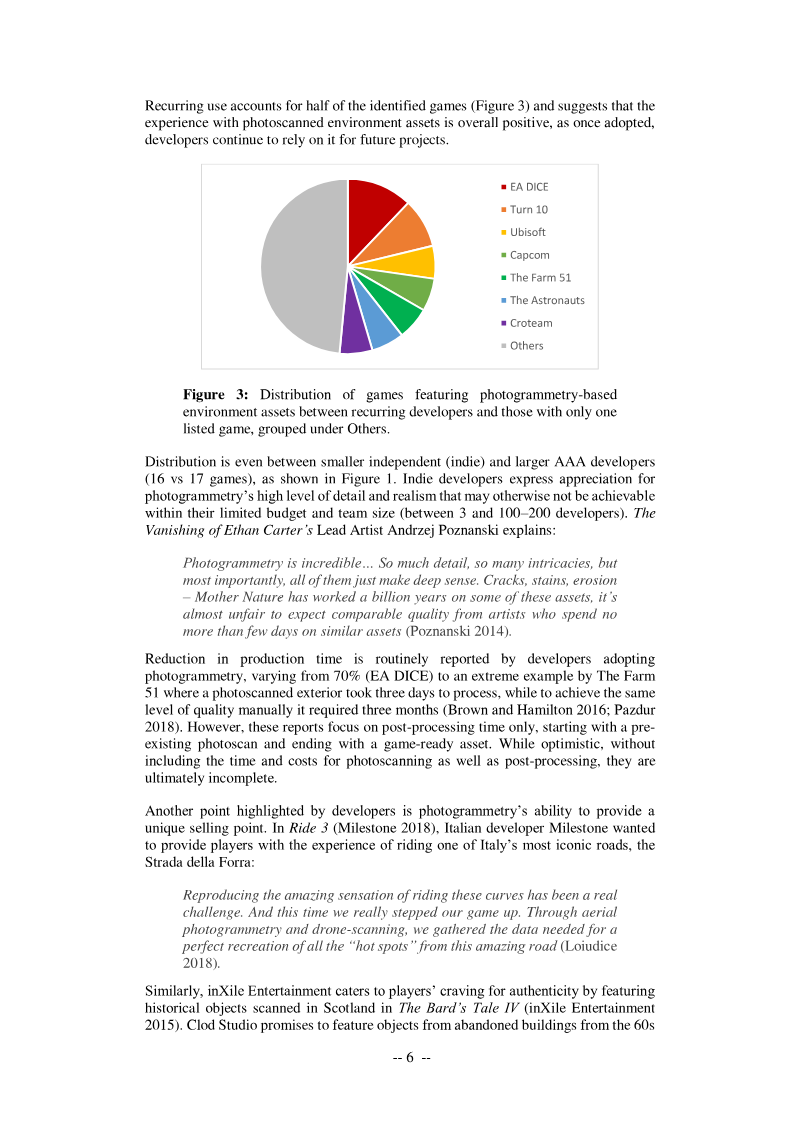
- Between 2014 and 2019, photogrammetry in game development moved from experimental practice to a standardized, team-based workflow, examined across 26 published games plus seven in development, with indie and AAA developers roughly evenly represented.
- Adoption grew sharply after 2017, and developers consistently report gains in detail and realism plus reduced production time, though those savings typically exclude the costs of scanning and processing.
- Photogrammetry is concentrated in natural assets such as landscapes, vegetation, and rocks, while man-made environments and modular assets are rarely scanned and architecture is mostly limited to small structures and key locations.
DiGRAJan 2020