SuperHot
Game
2 documents in the library are about SuperHot, from writers such as DiGRA and Replay. The Polish Journal of Game Studies. Each has a summary and key insights with the page they come from.
Connections
Each row is a game or company named alongside SuperHot, each column a document, oldest first. A mark means that document names it. Select a row to see those documents.
Documents about SuperHot
Post-cyfrowość współczesnych polskich gier komputerowych: Zarys zagadnień
Contemporary Polish game development is undergoing a significant shift toward post-digital aesthetics, a movement defined by a critical, reflexive engagement with technology that blurs the traditional boundaries between digital and analog spheres.
- Post-digital aesthetics in Polish game development involve a deliberate hybridization of digital and analog media, moving beyond simple retro-style graphics to challenge the 'new media' ideology of seamless, flawless technology.
- Games like 'SuperHot' (2016) exemplify post-digital strategies by rejecting standard 3D textures in favor of low-poly, white-model aesthetics and tactical, time-manipulation mechanics that subvert traditional FPS conventions.
- Polish titles such as 'The Invincible' (11 bit studios, 2023) and 'Observer' utilize retro-futuristic design and analog-style interfaces—such as manual window cranks and monochrome displays—to create a sense of tangible, historical materiality within a digital space.
Temporal Agency and Timeplay in Video Games
The document introduces "temporal agency" as a player's capacity to manipulate time within video games, proposing a novel framework called "Timeplay" to categorize these interactions.
- The paper argues that player control over in-game time (through rewinds, loops, pauses, and branching narratives) is a distinct, underexamined form of ludic agency that existing frameworks such as Zagal and Mateas's four temporal frames and Hanson's account of recursion and save mechanics do not adequately explain.
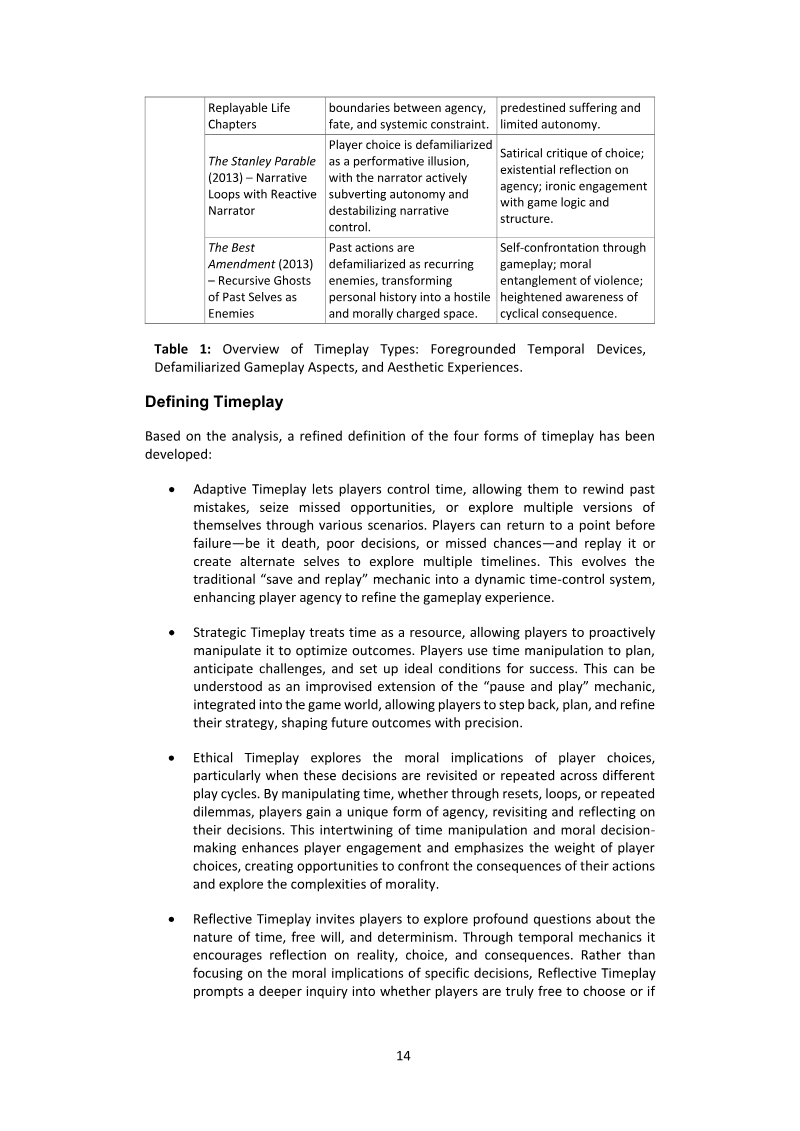
- The authors propose a four-part typology of "Timeplay" (Adaptive, Strategic, Ethical, and Reflective) to describe how time manipulation reshapes a player's sense of control.
- The study analyzes twelve games in which time manipulation is foregrounded, using gameplay analysis, Let's Play videos, and critical reviews, with detailed case studies of Prince of Persia: The Sands of Time, SUPERHOT, The Forgotten City, Undertale, Slay the Princess, The Stanley Parable, and The Life and Suffering of Sir Brante.