1 free read left. Create a free account for unlimited reading + AI research.
Create free accountWhitepaper European Conference on Games Based Learning (ECGBL)
1 free read left. Create a free account for unlimited reading + AI research.
Create free accountWhitepaperEuropean Conference on Games Based Learning (ECGBL)
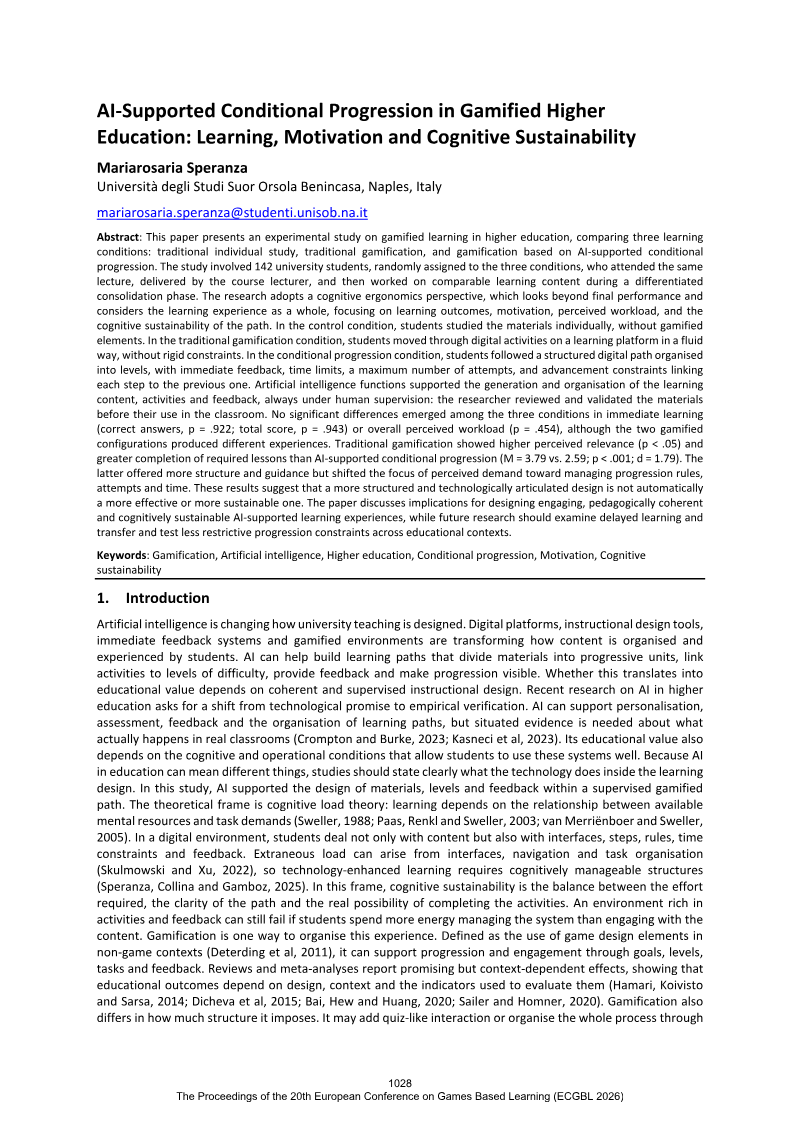
A prototype educational role-playing game, "Air Investigation: Numbers at the Scene," embeds higher-level mathematics, including trigonometry, unit conversion, and vector analysis, within an aviation accident investigation scenario designed for vocational aeronautic students. Tested with 306 post-16 learners, the study examines whether an immersive narrative can make advanced mathematical reasoning engaging and practically meaningful for students whose training is oriented toward applied work rather than academic mathematics. The work positions the game as a preliminary step in game-based learning for technical vocational education, and its authors explicitly caution against broad generalisation of their early findings.
The most consistent result is the strong relationship between prior mathematical proficiency and knowledge test performance. Participants with entry-level maths achieved average scores of around 31 percent, while those at Level 4 and above reached roughly 87 percent, a difference that was statistically significant. Greater in-game progression and prior gaming experience were also associated with higher scores, though gaming background had no significant effect on overall enjoyment. Engagement was high, with over 80 percent of participants reporting that they understood the game and about 70 percent enjoying the experience, and learners rated the scenario as authentic.
The study also identifies practical obstacles that limit accessibility and scalability. Cognitive load emerged as a central concern, particularly for students with weaker mathematical foundations, and the in-game calculator's limited functionality reduced usability. Experienced gamers, meanwhile, expected graphics standards that the prototype's hardware could not readily meet. These findings suggest that narrative engagement alone does not overcome gaps in prior attainment, and that future iterations must address interface design and technical feasibility alongside pedagogical content.
Methodologically, the research was conducted under University of Sussex ethics approval, and the authors affirm that no AI tools were used in preparing the manuscript. The work builds on Anagnostopoulou's earlier research on immersive, role-playing approaches to higher mathematics and draws on established literature in game-based learning, vocational education, and cognitive load theory. Taken together, the study offers encouraging evidence that immersive scenarios can sustain engagement in vocational mathematics, while clearly marking the need for further development and larger, more representative testing before stronger claims of effectiveness can be made.



European Conference on Games Based Learning (ECGBL) · 2026



European Conference on Games Based Learning (ECGBL) · 2026



European Conference on Games Based Learning (ECGBL) · 2026



European Conference on Games Based Learning (ECGBL) · 2026



European Conference on Games Based Learning (ECGBL) · 2026



European Conference on Games Based Learning (ECGBL) · 2026



European Conference on Games Based Learning (ECGBL) · 2026



European Conference on Games Based Learning (ECGBL) · 2026



European Conference on Games Based Learning (ECGBL) · 2026



European Conference on Games Based Learning (ECGBL) · 2026



European Conference on Games Based Learning (ECGBL) · 2026



European Conference on Games Based Learning (ECGBL) · 2026



European Conference on Games Based Learning (ECGBL) · 2026
European Conference on Games Based Learning (ECGBL) · 2026
European Conference on Games Based Learning (ECGBL) · 2026