1 free read left. Create a free account for unlimited reading + AI research.
Create free accountWhitepaper DiGRA
1 free read left. Create a free account for unlimited reading + AI research.
Create free accountWhitepaperDiGRA
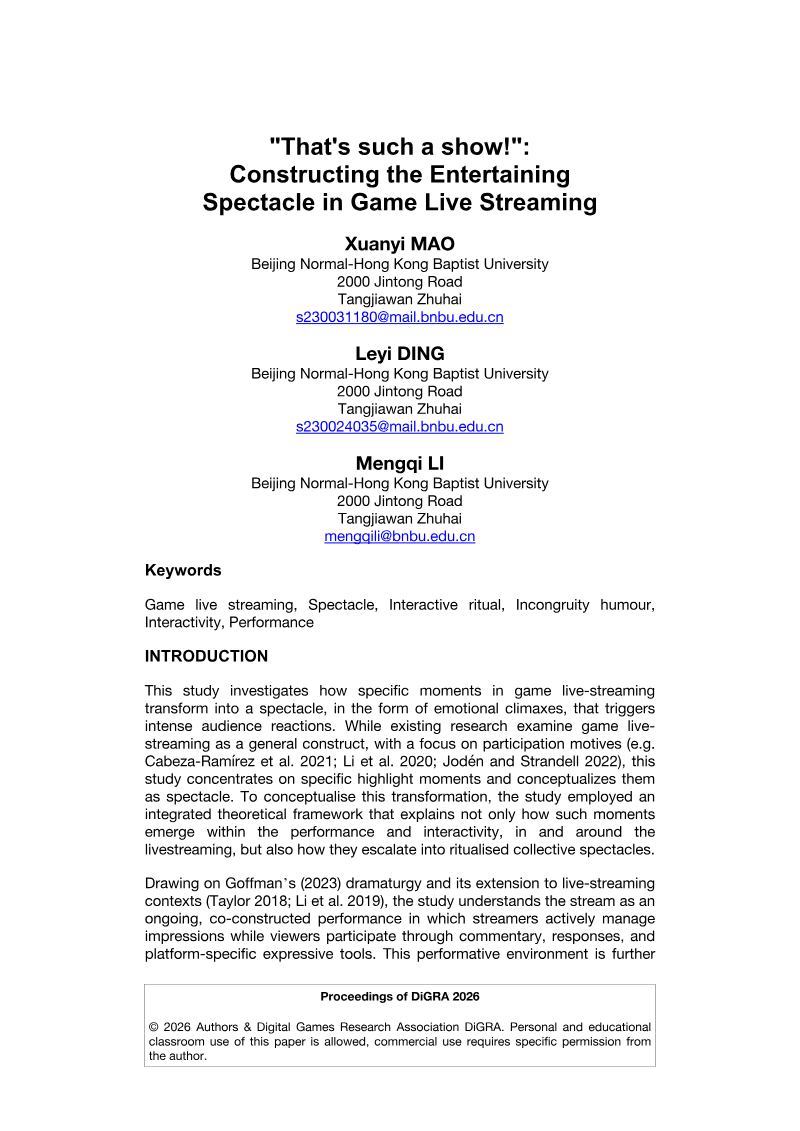
This paper examines how time shapes game streaming on Twitch, arguing that temporal considerations are deeply embedded in gaming-related content creation yet have received little scholarly attention, particularly outside the formal games industry. Drawing on semi-structured interviews with popular Australian game streamers, the study investigates when streamers choose to broadcast, when they believe they should broadcast, and how competition and the value placed on consistency organise their schedules. The analysis is framed through the sociological work of Hartmut Rosa, which helps articulate the complex temporal dynamics experienced by these creators.
The findings indicate that most respondents stream in the evenings, a choice justified both practically, through work or caring commitments, and discursively, as evenings being understood as "gaming time." Notably, although most streamers go live in the evenings, many believe mornings would be the optimal time to broadcast. This tension is linked to Twitch's international character and the desire to reach large audiences, particularly in the United States, and reveals sometimes intricate reasoning about strategic timing. The study also finds that competition varies across the day and that consistency is central to how streamers organise their time.
Throughout, the research emphasises the interplay between pragmatic constraints and discursive framings in determining broadcasting schedules, and highlights the significant role of happenstance in shaping streamers' routines. The study concludes that temporality is a fundamental, rather than peripheral, dimension of Twitch streaming practice. Its contribution lies in extending understanding of game streamers' lived experiences and offering a foundation for future research on time and gaming content creation.
Each row is a game or company this document names, each column a document, oldest first. A mark means that document names it. Select a row to see those documents.

DiGRA · 2026

DiGRA · 2026



DiGRA · 2026



DiGRA · 2026



DiGRA · 2026



DiGRA · 2026



DiGRA · 2026



DiGRA · 2026

DiGRA · 2026



DiGRA · 2026



DiGRA · 2026

DiGRA · 2026
DiGRA · 2024
DiGRA · 2023
DiGRA · 2023