
Homo Ludens (Polish Game Research Society)
Open-access journal of the Polish Game Research Society (Polskie Towarzystwo Badania Gier), in Polish and English.
Documents
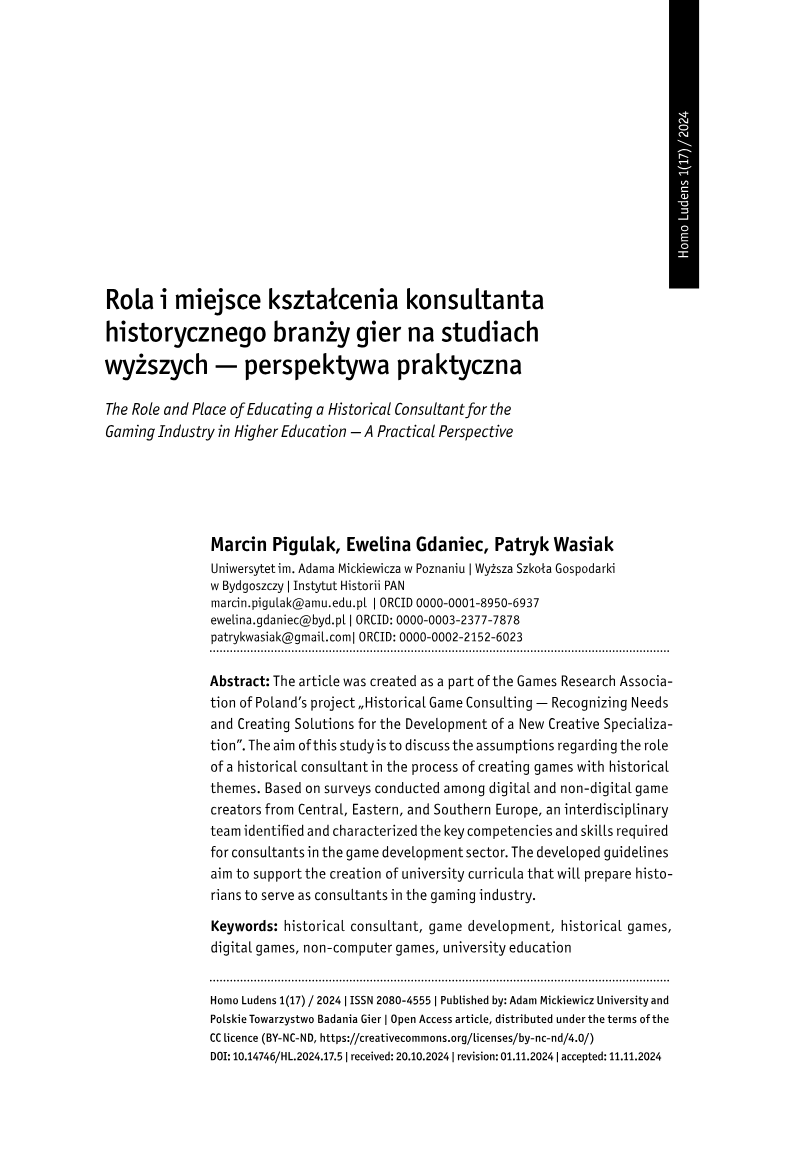
The Role and Place of Educating a Historical Consultant for the Gaming Industry in Higher Education: A Practical Perspective
This study, authored by Marcin Pigulak, Ewelina Gdaniec, and Patryk Wasiak and published in Homo Ludens in 2024, examines the emerging role of historical consultants in the game industry and argues that universities should deliberately prepare historians for this work.
- Historical games increasingly shape public perceptions of the past, so the authors argue universities should deliberately train historians to work as game consultants.
- Survey respondents across Central, Eastern, and Southern Europe, with a focus on Poland, said consultants add value by ensuring authenticity, enhancing immersion and reputation, and saving development time.
- Polish game development is dominated by small studios: in 2023, 316 of 494 Polish firms had teams under 25 people, which leaves consultant responsibilities varied and often ill-defined.
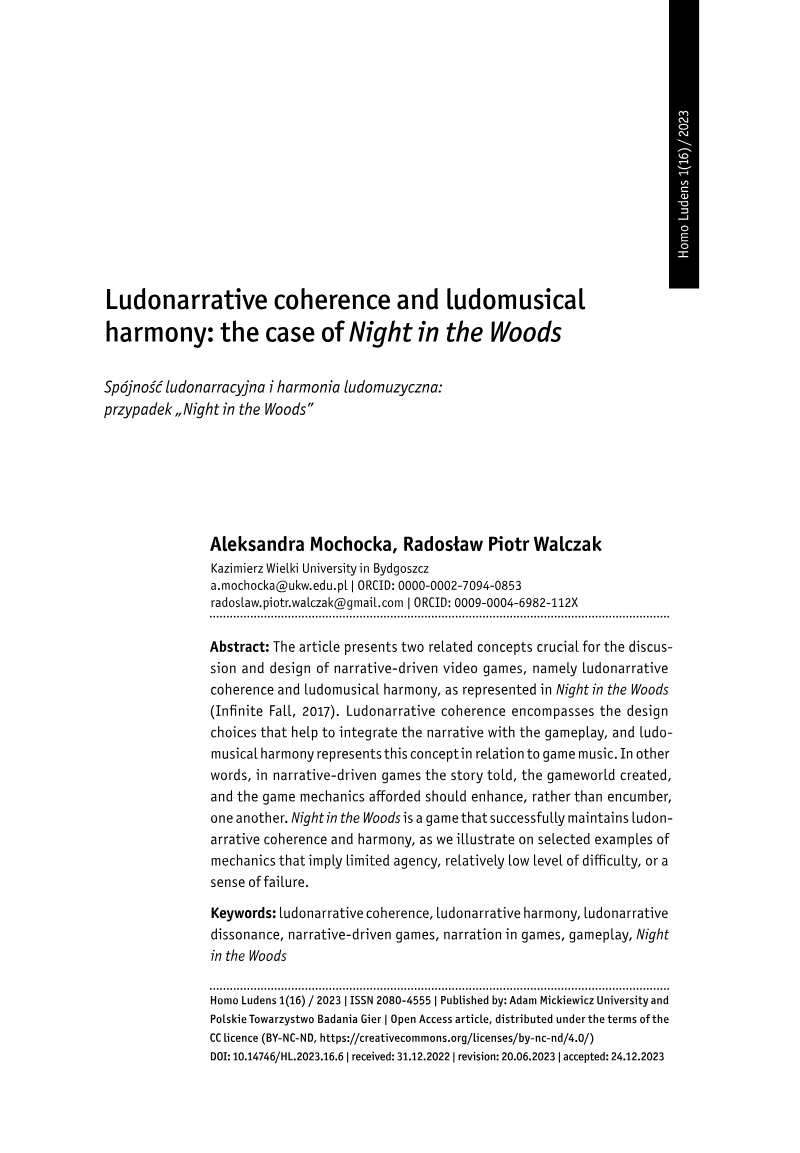
Ludonarrative Coherence and Ludomusical Harmony: The Case of Night in the Woods
This article examines ludonarrative coherence, the integration of story, game world, and mechanics, and its musical counterpart, which the authors term ludomusical harmony, using the indie game Night in the Woods (Infinite Fall, 2017) as its case study.
- The authors argue that Night in the Woods (Infinite Fall, 2017) achieves ludonarrative coherence, meaning its story, game world, and mechanics reinforce one another, with restrictive design mirroring a young woman's entrapment by mental illness and economic decline in a Rust Belt town.
- Restricted movement, a constrained town space, limited player agency, and an autosave system that forbids reversing decisions are identified as deliberate strategies that echo the protagonist's sense of being trapped.
- The game emphasizes affective rather than strictly narrative choices, foregrounding emotional immersion as a central design priority.
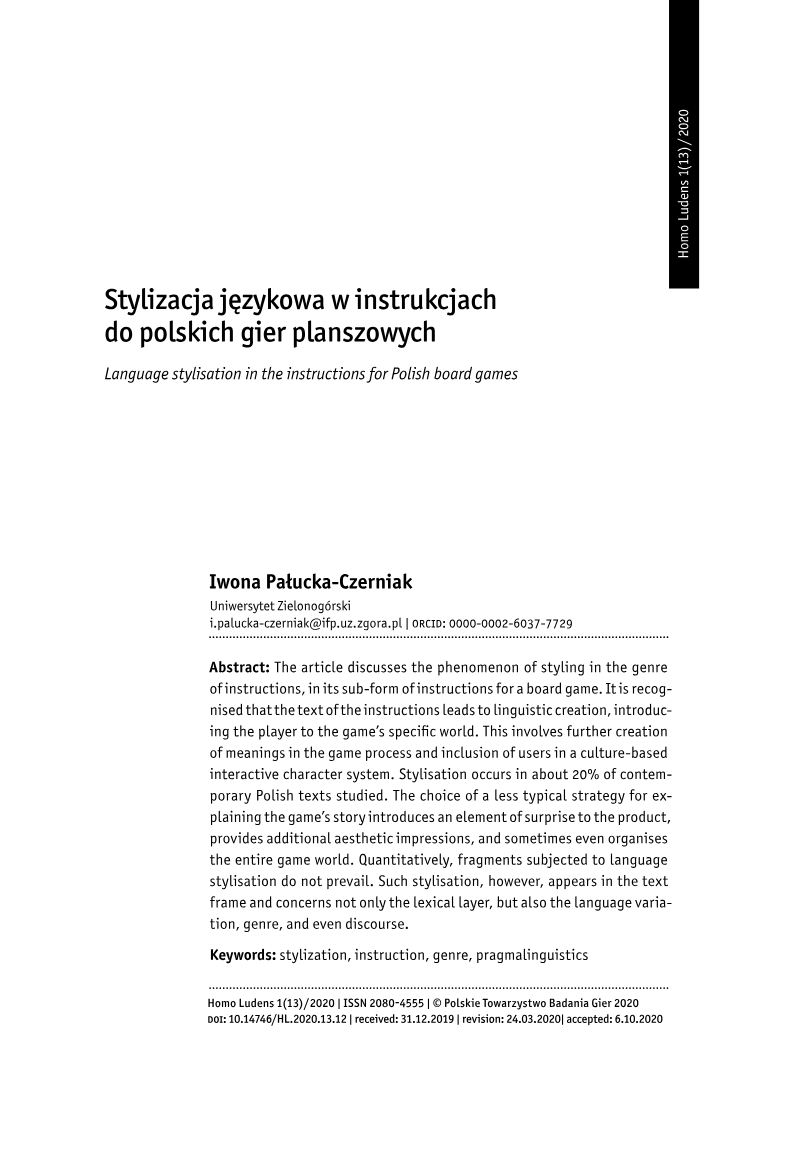
Language Stylisation in the Instructions for Polish Board Games
Iwona Pałucka-Czerniak's study examines language stylisation in the instructions accompanying Polish board games, arguing that such stylisation, though not the norm, plays a meaningful role in building a game's distinctive world and in inviting players into a culturally grounded interactive experience.
- Stylised language appears in about 20 percent of the 84 Polish board game instruction booklets (published 2000–2019) analysed in the study, making it a minority practice rather than the norm.
- Stylisation concentrates in the introductory framing sections, which over 85 percent of booklets contain, where most introductions are factual and impersonal while a minority adopt fairy-tale, chronicle, or news-report forms (e.g., Stworze).
- The choice of stylistic devices is driven largely by game theme: Slavic-mythology games use archaic vocabulary and gawęda-style narration, while the Achaja rulebook (based on Andrzej Ziemiański's novels) uses colloquial second-person address and inclusive "we".