1 free read left. Create a free account for unlimited reading + AI research.
Create free accountReport University of Hohenheim
1 free read left. Create a free account for unlimited reading + AI research.
Create free accountReportUniversity of Hohenheim
GAME ranks highest on in-degree and eigenvector centrality, while developers and distributors act as the principal business partners.
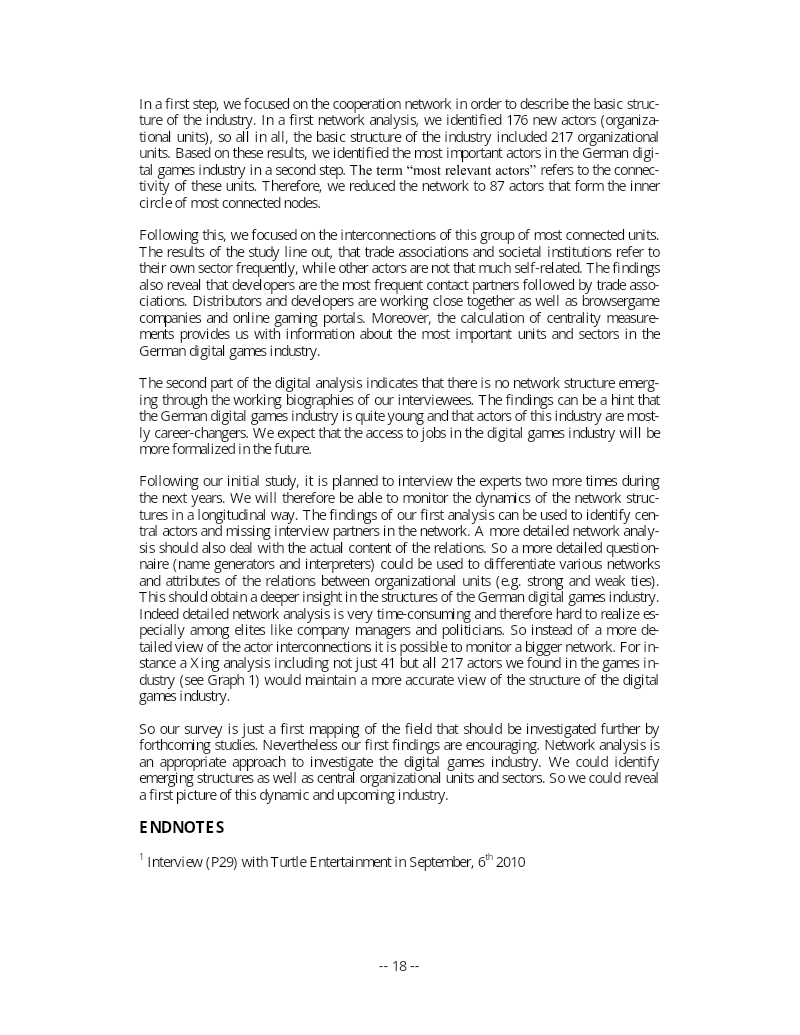
This study maps the German digital games industry through a social network analysis built on 41 guided expert interviews, 37 with men and 4 with women, conducted in 2010. Its central argument is that a full understanding of the sector requires examining both value-chain actors, such as console makers, developers, publishers, browser-game firms, portals, and distributors, and political and societal stakeholders, including regulators like USK and KJM and trade associations such as BIU and GAME. The research focuses on identifying key units, their interconnections, and how these networks change over time, using corporate interlocks drawn from members' career histories to capture longitudinal evolution.
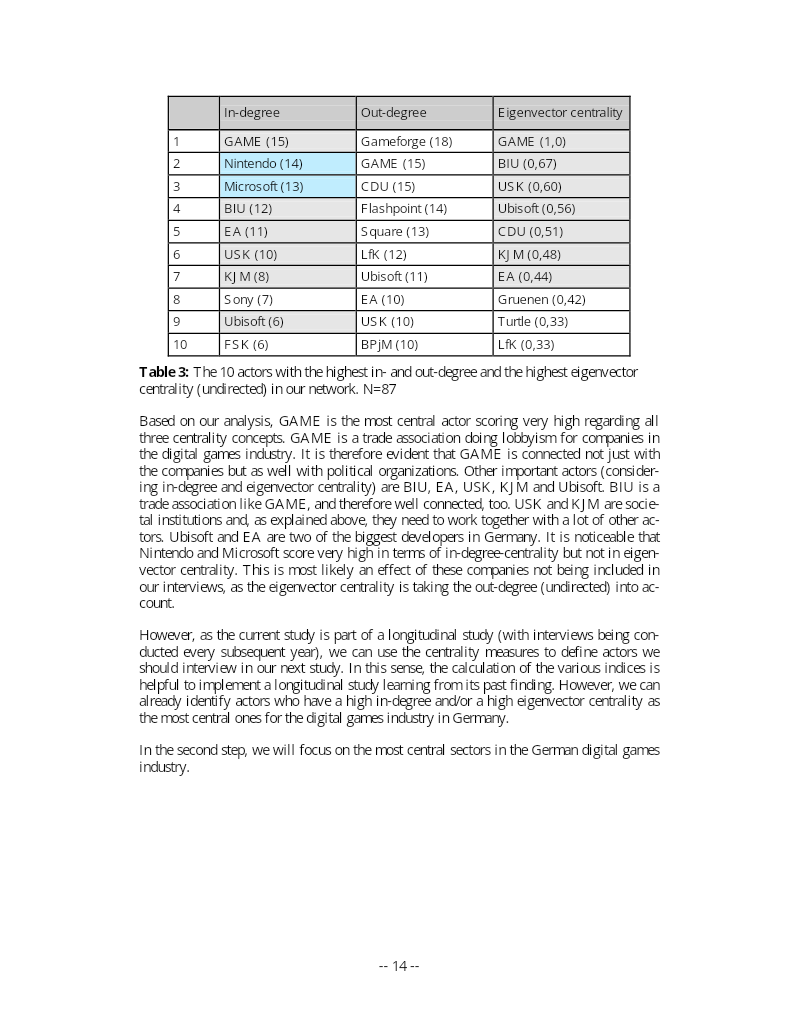
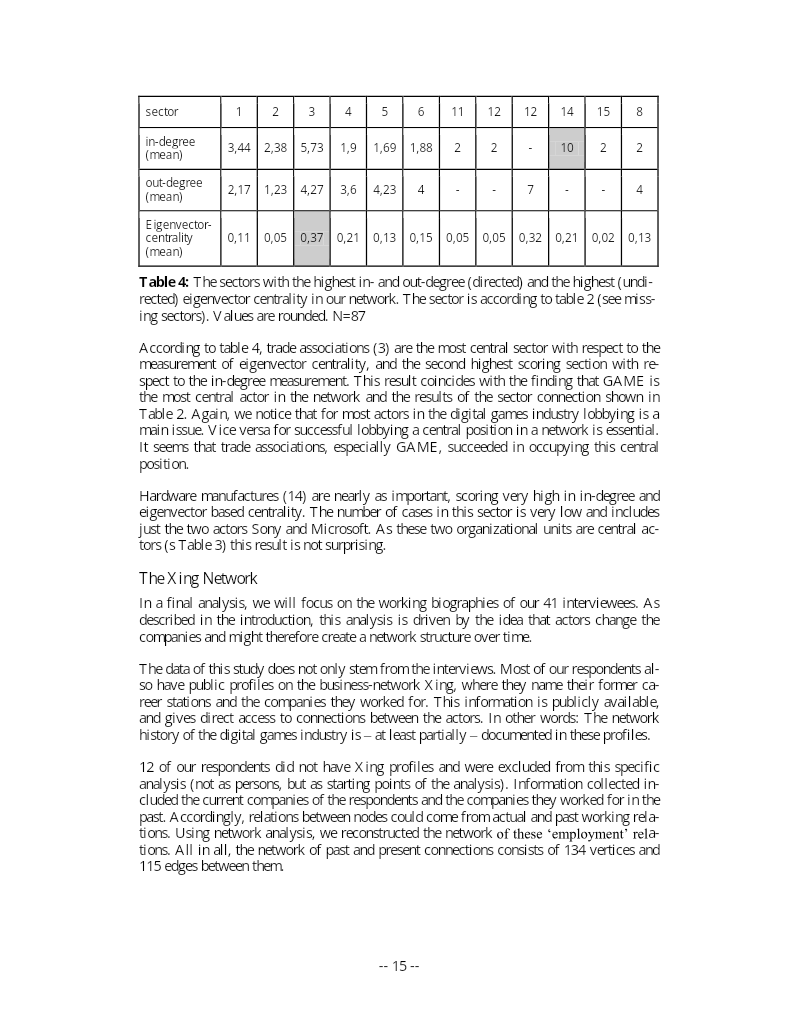
The contact network analysis identifies 217 actors and 384 relations, though the average actor has only about 1.8 connections, indicating a sparse structure. After filtering to 87 highly connected actors, trade associations emerge as the most central, with GAME ranking highest on in-degree and eigenvector centrality, while developers and distributors serve as the principal business partners. The authors note that these rankings largely reflect the ego-based sampling design, so the findings are best read as indicators of trends rather than definitive hierarchies.
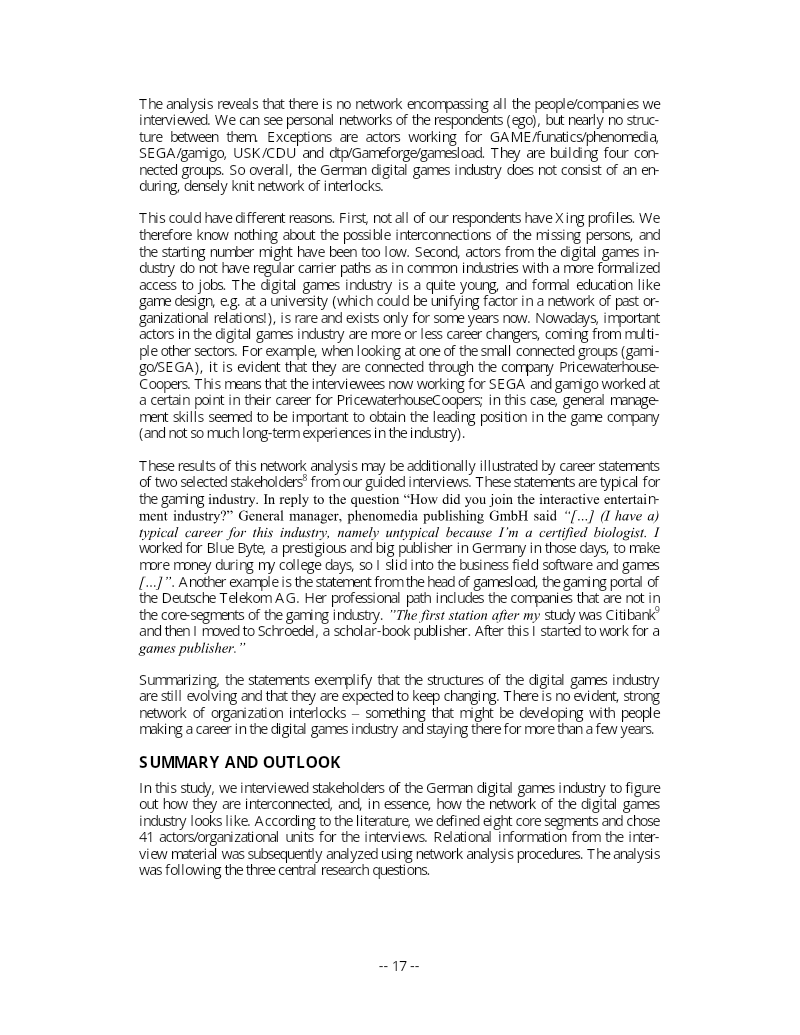
The employment network, derived from Xing profiles of the interviewees, comprises 134 vertices and 115 edges and lacks an enduring, densely connected core. Only four small clusters appear, such as GAME alongside Funatics and phenomedia, and SEGA alongside gamigo. The study attributes this fragmentation to the industry's relative youth, the large number of career-changers arriving from sectors such as consulting and banking, and the absence of formalized career paths. Overall, the research concludes that the German digital games industry remains in an evolving state, that social network analysis is well suited to mapping its emerging structures, and that longitudinal follow-up studies are needed to track its development.
Each row is a game or company this document names, each column a document, oldest first. A mark means that document names it. Select a row to see those documents.

Deconstructor of Fun · 2026
The Game Business · 2026
European Games Developer Federation · 2026
PocketGamer.biz · 2026
The Game Business · 2025
DiGRA · 2025
Remedy Entertainment · 2025

PocketGamer.biz · 2025

Italian Trade Agency · 2024
PocketGamer.biz · 2023
game – Verband der deutschen Games-Branche e. V. · 2023
CD Projekt · 2023