1 free read left. Create a free account for unlimited reading + AI research.
Create free accountArticle G|A|M|E – The Italian Journal of Game Studies
1 free read left. Create a free account for unlimited reading + AI research.
Create free accountArticleG|A|M|E – The Italian Journal of Game Studies
The field is now an established interdisciplinary area and is increasingly converging with memory studies. Its recent development is anchored by the 2014 "Challenge the Past/Diversify the Future" conference.
Historical game studies has matured into an established interdisciplinary field over roughly the past decade, and this work argues that it is increasingly converging with memory studies. The field's recent development is anchored by the 2014 "Challenge the Past/Diversify the Future" conference, and the central thesis is that history and memory scholarship are complementary rather than opposed. Concepts such as Landsberg's prosthetic memory and media memory, Nora's sites of memory, and Chapman's framing of historical games as "systems for historying" provide shared vocabulary for analyzing how digital games shape the past. Popular series such as Civilization and Assassin's Creed serve as principal case studies of how history is represented in contemporary game culture.
The analysis organizes the field into intramedial, intermedial, and plurimedial levels, and it highlights several recurring tensions. Prosthetic memory, though valuable for understanding empathy and the ideological positioning of game worlds, remains comparatively underexplored. Counter-hegemonic readings of historical games are frequently undermined by gameplay that reinforces dominant narratives, a pattern illustrated through analyses of titles such as Assassin's Creed: Freedom Cry. Bodnar's account of public memory as a means of justifying existing power structures is invoked to explain why many games reproduce established national narratives.
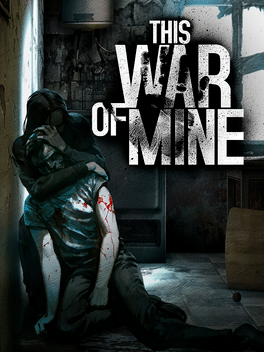
Constraints imposed by institutions, legal regimes, and market pressures lead many games to omit sensitive topics or sanitize the past, as seen in the "Clean Wehrmacht" myth and in Pötzsch's "consequence" and "conflict" filters. Pseudohistorical and alternate-history framings can address atrocities more openly, though they risk relegating them to fantasy, while titles such as This War of Mine can challenge dominant national memory narratives. Games are shown to operate on "authenticity," a felt sense of the past, rather than strict accuracy, and they increasingly function as public history through participatory engagement. Player forums, mods, and the "interactive archive" framework (Hartman et al., 2021) illustrate how authority is shared between designers and players, shifting the field's focus from accuracy toward lived experience. The work closes by calling for further research into games as historical artifacts, collective trauma, and marginalized histories.
Each row is a game or company this document names, each column a document, oldest first. A mark means that document names it. Select a row to see those documents.
G|A|M|E – The Italian Journal of Game Studies · 2026
G|A|M|E – The Italian Journal of Game Studies · 2026
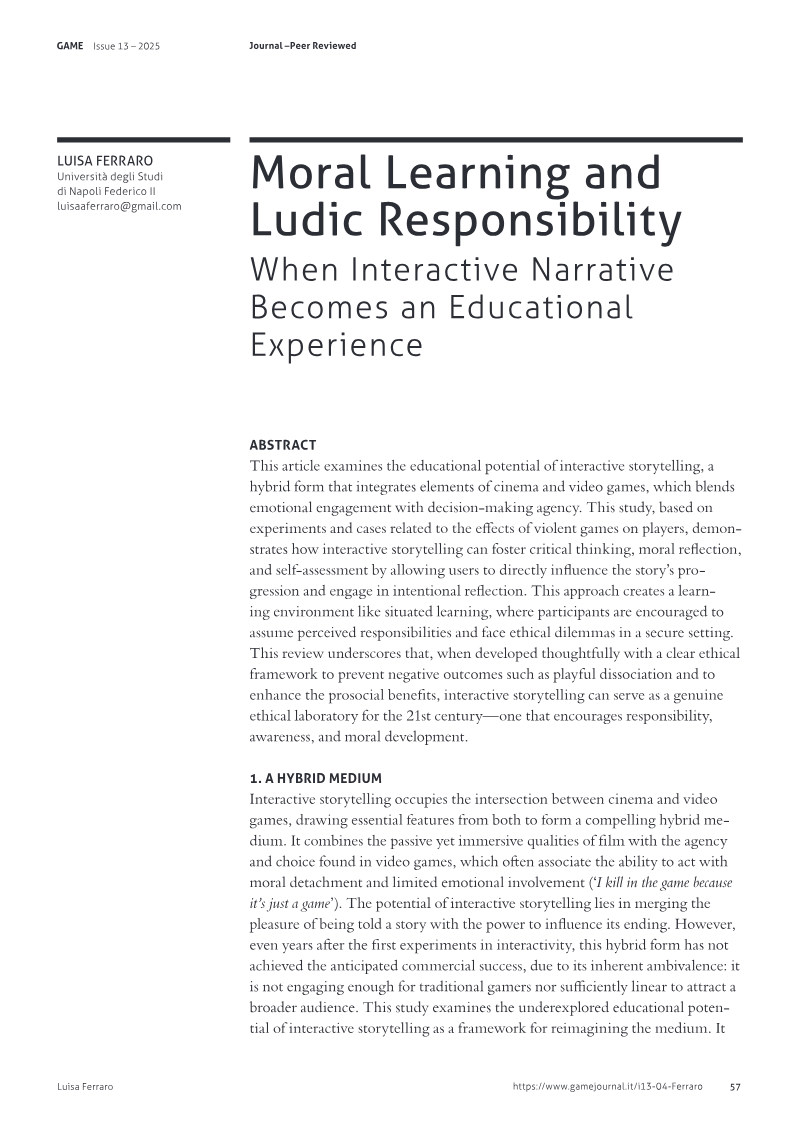
G|A|M|E – The Italian Journal of Game Studies · 2026
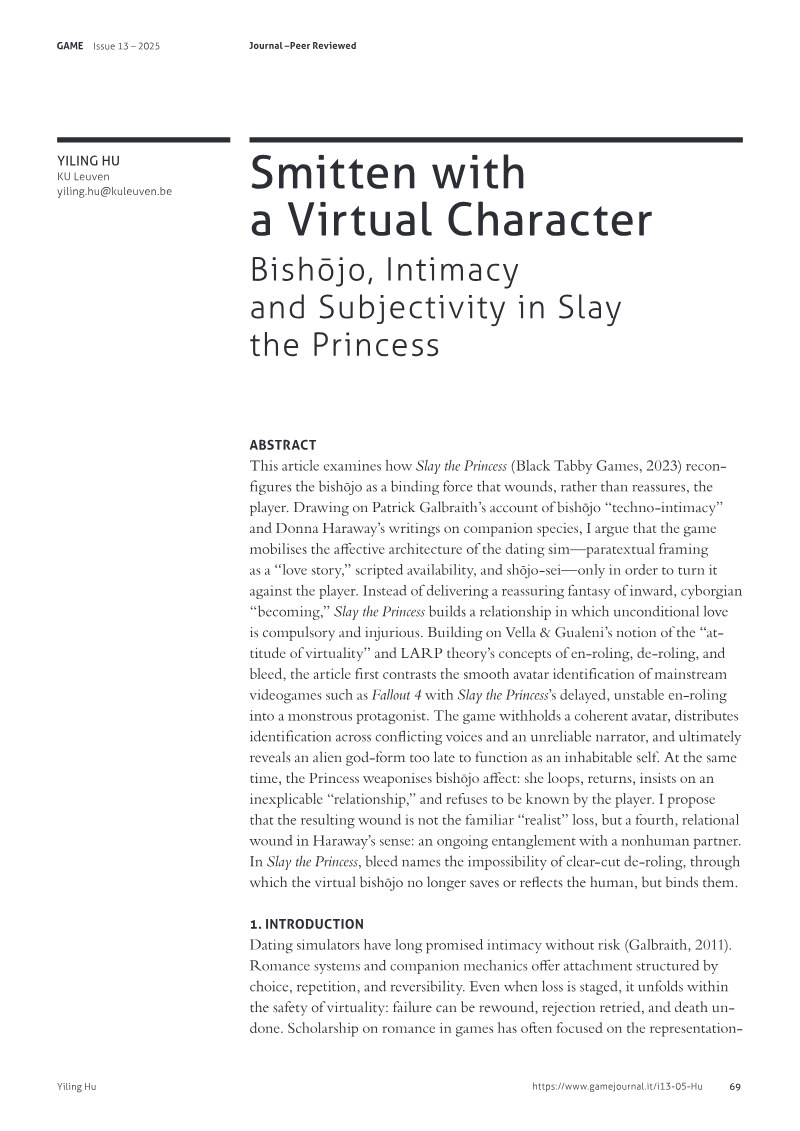
G|A|M|E – The Italian Journal of Game Studies · 2026
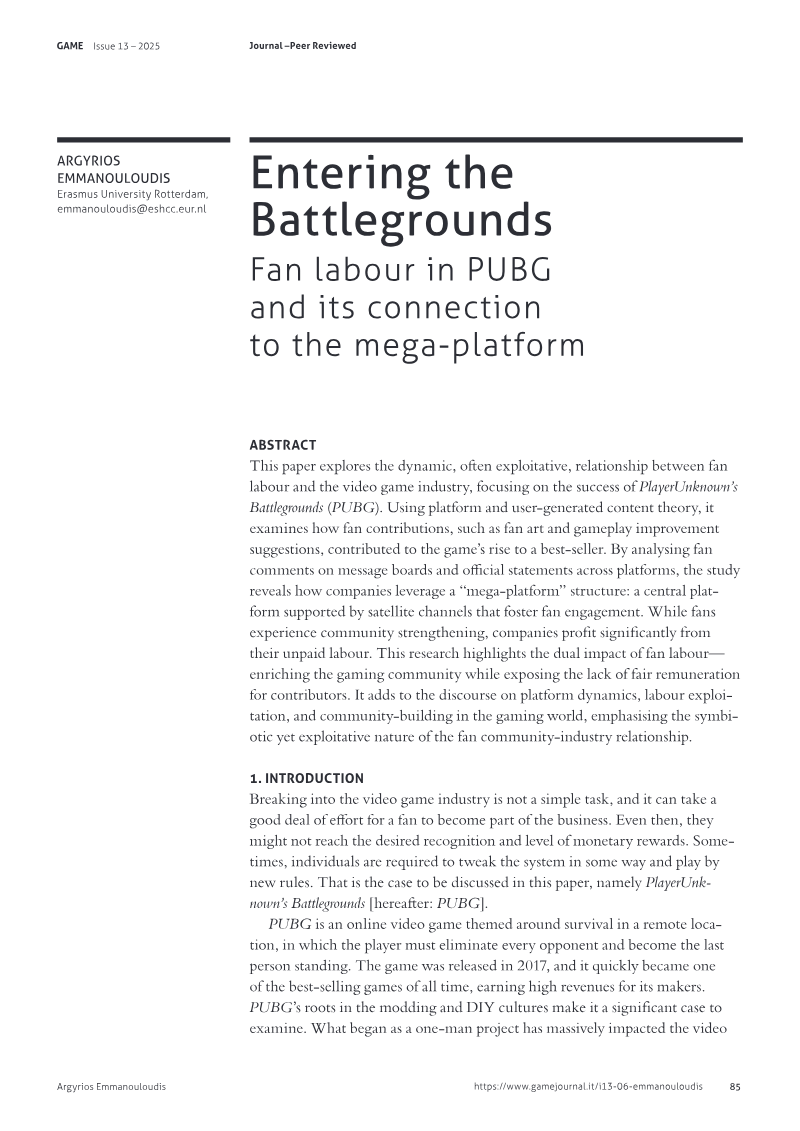
G|A|M|E – The Italian Journal of Game Studies · 2026
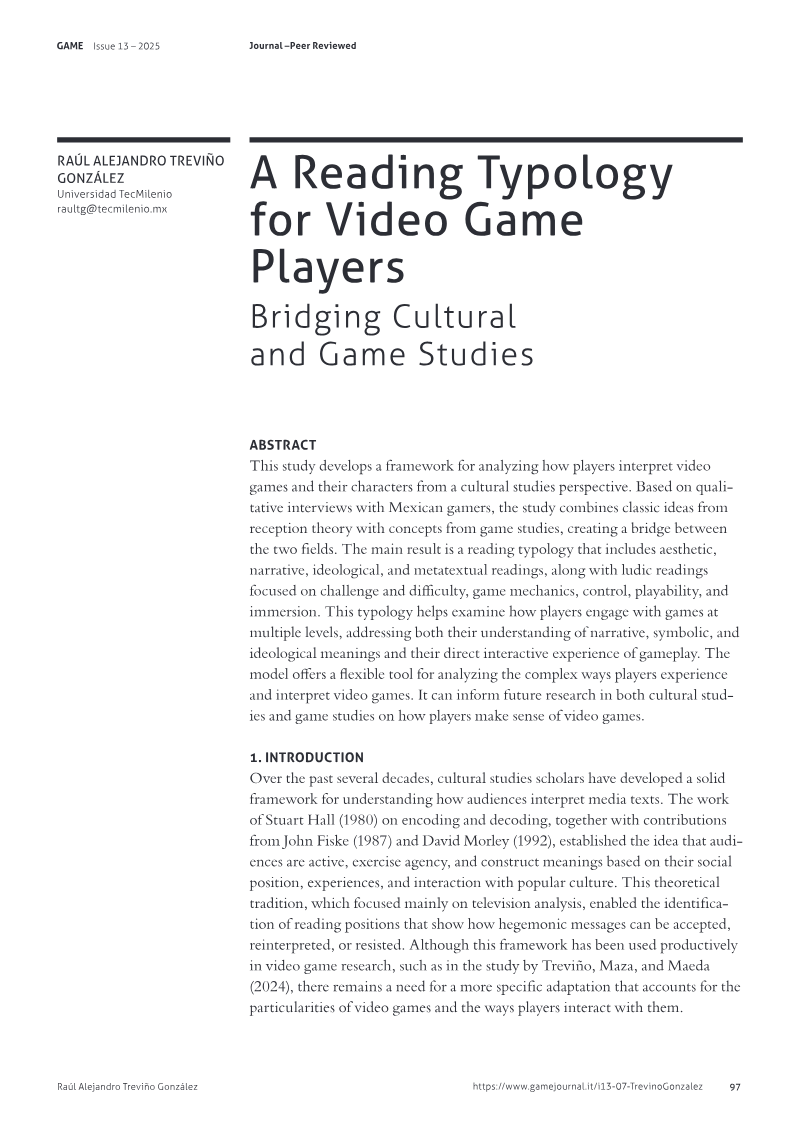
G|A|M|E – The Italian Journal of Game Studies · 2026
G|A|M|E – The Italian Journal of Game Studies · 2026
G|A|M|E – The Italian Journal of Game Studies · 2026
G|A|M|E – The Italian Journal of Game Studies · 2026
G|A|M|E – The Italian Journal of Game Studies · 2026
G|A|M|E – The Italian Journal of Game Studies · 2026
G|A|M|E – The Italian Journal of Game Studies · 2026
Breda University of Applied Sciences · 2026
DiGRA · 2024
DiGRA · 2024