Loading the document
1 free read left. Create a free account for unlimited reading + AI research.
Create free account
Superstar Session: Building Your Product Strategy Based on Market Research PG Connects Digital #2
Key insights
7 takeaways- 01Leverage core team expertise to reduce business risk, as this improves the accuracy of development cost estimates, resource allocation, and user acquisition performance.
- 02Differentiate products in broad, high-competition niches through innovative monetization or superior retention mechanics to ensure a positive return on investment.
- 03Align development methodology with product complexity: use rapid, feature-focused cycles for casual games and rigorous, long-term processes for mid-core and hardcore titles.
- 04Prioritize projects with shorter development lifecycles and lower costs when entering unfamiliar genres to facilitate faster learning and iteration.
- 05Target high-LTV genres like turn-based RPGs and 4X strategies only if you possess the substantial resources required for long-term content investment.
- 06Avoid entering monopolized segments like Match-3, where dominant publishers create a hostile environment for new entrants.
- 07Use market intelligence tools to monitor competitor performance and identify gaps, as these data-driven insights are essential for adjusting strategy in a volatile market.
Ask AI about this video
Transcript
first speaker is max some real cough thanks max just you know help me if I'm mispronouncing your name anyway these companies at magic and Max is gonna share a lot about data insights that he has in this talk building your product strategy based on market research max whenever you're ready okay can you hear me now I can hear you fine okay great so ready to go good to hear my screen now give me sick
okay this one so today sorry they want to talk about building a product strategy for mobile gaming company and an important thing that you do not only build your product strategy on the early days of your company the market is constantly evolving and you need to update your product strategy constantly and sometimes you need to completely revise your own one if it fails you succeed I'll start with pretty basic stuff and then we'll go deeper so one of the first things to do is to figure out at what game genres you have solid expertise in having the relevant expertise is definitely a powerful advantage because you're able to predict your development and operating expenses accurate enough you know how to recruit and lead team that matches the genre of your choice you know how to buy traffic for games of the genre you know you're
really with understanding how to come up with the proper game balance and proper feature set in other words having relevant expertise can help you dramatically cut business risks but what if you don't have this relevant expertise there are two obvious place for you first is to go and buy this expertise by means of recruiting specialists who do have it or you can choose to generate this expertise on your own and in this case it will be vice for you to start with products with short development life cycle and low development costs because you need to learn as fast as possible and to do that you need to trade your money and time for the poor experience with the best possible ratio another thing to you is to figure out to make up your mind on what kind of marketing is you prefer a narrow or broad one and what's more
beneficial for you to copy or to innovate conventional definition of a broad market niche usually refers market niches with broad target audience but I think that it more handy way to to define a broad market niche as the one that is represented by a lot of highly successful titles and talking about the mission not only implying game genres but only settings complexity of meta game and an art style wait is it more handsy because it's easier for you to to take any market intelligence tool and then go and check successful apps of any genre and then do what it's if analysis broad market niches are definitely highly competitive and they are usually called red oceans if you choose to go for one you need to be very clear on what exactly is going to help you to
successfully fight the competition are you going to come up with innovative magnetization or a game that will help you achieve better organization and better LTV and then by means of that to be able to buy to buy traffic with better ROI than the others do you know how to like are going to come up with a feature that will help you achieve incredible retention what is that you know or can that will help you successfully fight the competition actually all the same is applicable to narrow market niches but if you go for one you it will be much car part of the car there for you to keep the top charts but even you've heard if you are not eager to earn millions of dollars and you just an obsessed visionary who is going to develop a game you've always dreamed off you still need to be very clear on how exactly you're going to get
all right positive traffic enough to cover your development and operating costs and bring you some profit on top of it usually the developers go for one of the following approaches first to pick a game genre a successful and attractive game core mechanic and complemented with a complex meta game for monetization that you better else the game you see here on the screen is art nights a Japanese tower defense game mixed with complex meta game from Butler's and this approach helped him to achieve great LTV and this game is generating about 12 million dollars a month which is about standing result for a tower defense game another way is to find a game that is pretty successful but still has some explicit flaws the game you see on the screen is a random
dice a game by a Korean developer 111 percent it's also a tower defense game with its squirt but the core game is mixed with the merge mechanic and dices here act like towers and you can merge him and improve them and like that that's actually the innovation and also that they came up with a PvP mode one versus one and this game is doing actually really good it's generating about eight million dollars revenue monthly so I know several companies now who are working on similar games but their idea is to make this game much easier to press for new players and to make it look nicer because this game is actually looks a little bit like a prototype isn't it so that's the the strategy is to achieve better retention and that that's actually good a core
idea and the next way is just to copy a successful existing game and leverage huge amount of resources at your disposal if you have them so what you see this on the slide is a well known game mentioned to mention that is set to be run by a plugin that not only has huge amount of money but also knows a lot about users behavior their payment activities what I'm about to share with you now is a idea that is quite new for me as well it came to my mind in a conversation with a friend of mine who runs a game development studio and I was super impressed by the development kpi's they have they have a KPI of developing a game in a month who is a team of five to eight people and I'm not talking Harper Castle here we're talking about casual games with some contra some meta game and multiplayer gameplay and I was questioning him about how was it actually possible to do that and we
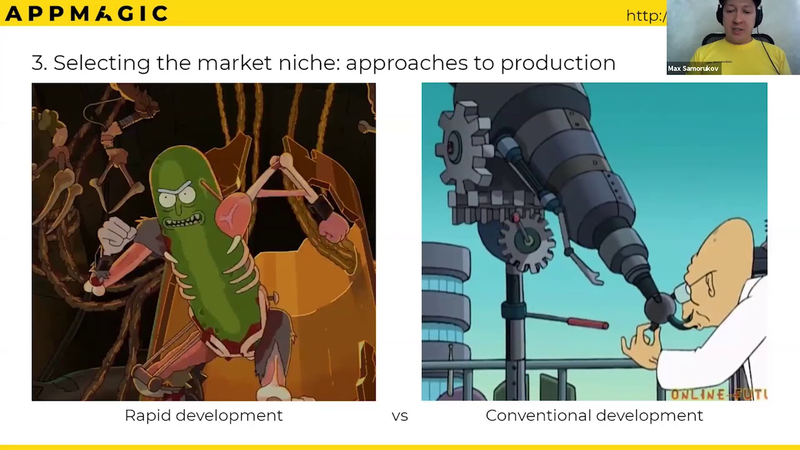
ended up with understanding that one of the cornerstones of their corporate culture is so called rapid development so rapid development is a development paradigm when all the team is strictly focused on developing the the product to the market as soon as possible it's not the same than MVP but it's a complete product but they are focused on cutting away everything that is not strictly necessary both in terms of product and product development Confessional development in comparison usually brings it comes with Bell thought code architecture I implement they implement a lot of able tests they they run a lot of did you a lot of the document they code really belt they do code reviews and so forth and if the whole takes time and I'm not saying that the national development is is worse than rapid
development this approaches are good for different types of products conventional development is good for large products with long development lifecycle those large teams and rapid development is good for smaller products and for doing prototypes the problem is that you cannot ask your team to switch from one development paradigm to another it's a kind of a DNA it's the way that people think usually it starts from your lead technical guy who takes a part in to recruitment and who builds the development pipeline at your company and usually you end up with having the whole team of the players of the same kind so what I'm going to learn trying to say here is you that you need to take the development culture in your company into consideration while working on the product strategy for your company not that long ago I delivered a whole
speech dedicated to hidden dangers of development meat core and hardcore games and today I just do a quick recap so I selected top ten thousand of successful games according to their revenues in the last 30 days and on this graph each dot stands for a game and the size of each dot stands for its revenue within the last 30 days and the exposition of each dot stands for its LCD colored rectangles highlight the areas between the 25th and the 75th percentile of the LCB distribution so you can easily identify the game genres with a very high LTV across games of the genre these are turn-based RPGs slots action RPGs and Forex strategies so if you have looked at each game of a successful game of the genre you'll figure out that all these games have huge amount of content
and metagame and you just cannot get by with relatively small budget development budget so many many developers and made the really highly underestimates it the expense that costs and difficulty of development of development games of network hardcore genre and the problem is that they're gonna take you several years before you actually realize the mistakes you made and you might turn out to be unable to correct these mistakes it'll be too late and that's what I meant when I was talking about that you need to iterate fast to learn because when it comes to mid core games it gonna take you years before you actually iterate and gain the necessary experience it takes too much or your whole lifetime and most money another problem with these games as that it gotta take a lot of money to run proper AP tests because when if when you do a
big game change or ambient changes you need a lot of paying users with long lifetime and considering the cost of CPI gonna cost you a lot for around each av-test to get submitted statistically significant results and also it gonna take a lot of time because you need to figure out the long lasting consequences of the mid-game changes you make another problem is that when it comes to game genres with high average LTV across games of the genre they usually the audience usually has very high lifetime for paying users and it it leads to significant difficulties for our estimate for our estimations and it may lead to significant money losses on user acquisition another thing to consider is that these game genres are
characterized by mmm really a comparable o based on return on investment into user acquisition I'll talk about it a little bit later so what I'm going to say here is that if you choose to pick a journal of the kind you need to you better have a really solid experience in all aspects of development and operating games of the kind now let's talk about the pace on return in user position so on the graph of the left you see two curves and that represent two imaginary games that have totally equal LTV but the second curve the red one is just stretched across the x-axis so the only difference with this games that in the first case you're gonna get one 50% ROI in 60 days and it's a second games case
in 12 months and on the graph on the right you see how your ability to scale your user acquisition budget will differ in these cases so in the first case you'll be able to scale music musician by means of reinvesting your profit back in the user position much much faster in both cases you'll be more than welcome to talk to the companies who can with borrowed capital such as Excel get Bravo tilting or Mr GB but in the first case it'll be much easier to get for you to get this borrowed funds and you will be able to get more funds because the patient returned that's is a factor that these companies considered and also the patient return affects the ease of predictability of your scale model another thing to consider is to figure out if the market niche you are heading to is actually friendly to new commerce
the new players so if you have a look at the graph on the left top corner the blue line represents the cumulative revenue of all match 3 games monthly and the red line represents the cumulative revenue of all mastery games that have been published less than 12 months ago so you see the shear of new games is very very low it's a bad sign it means that the market does not accept new players and if you have a look at the other dress for example downloads for hyper casual games you see that new games are generating about 80 percent of downloads of loads of downloads of the genre but it's kind of obvious because hyper casual games have very short life cycle ok let's have a look at the two graphs for racing our games were for FPS games so you see that nearly half of the downloads of FPS market segments is being generated by new games but then you need to ask yourself what games make
up the vast majority of this red area isn't it just one game say Call of Duty that generate the vast majority of these downloads so now that's let let's build other graphs so in each of these graphs you see top hundred games of each genre and you see that markets for FPS games were racing games from high professional games are pretty diverse and there are a lot of new players who manage to to to fight for significant share of the market but when it comes to the market for mastery games you see that nearly 70% of the revenue of the market segment is being generated by just five games that are published just by two publishers and it showed that the market is monopolized and that's another good science for new players you see that it's very hard for new players to fight for a significant market market
shear and not a good thing to do is to always stay aware of new successful products in your marketing issue that made it to the top charts and through managed to fight with the existing market leaders so what you see is two that we have in-app magic so here you can specify the time frame the region the platform and the tag so you can choose that with John Rhodes the type of setting with an art style and then always stay aware of the fastest drawing games within the market segment and if you download these games and play him and if you try to figure out what in particular helps its games to make it to stop charts it will really help your existing product that's actually all I have to say thank you so much for listening and if you have if you have any questions please don't hesitate to get in touch with me all right max great
thanks so much mother actually there are quite a few questions that came in during your session I see a lot of those questions are actually about very specific data that you presented so we might want to like go back to a few slides that these are applicable to so for example the first question that came in kind of at the beginning of your presentation was can you type the name of the Japanese and Korean games that you mentioned sure MSX so it's alright give me a second gonna check if it's leave as the spelling is correct all right great
then someone was also wondering you mentioned the studio doing rapid game development of one game per month can you share what studio does that I'm not sure actually I've talked with the guy we discussed like that I was going to mention him in my speech but I guess it's always for a task right also another Anthony was wondering where do you get your data from and how do you know it is trustworthy well like any other service of the kind they worked in similar way so we have top charts which are publicly accessible and also each customer of ours has an option to share their publisher data with us we only asked for exact numbers for revenue downloads and that would build the math model it's a weird complicated stuff but it works so we first we can check with
our data so what we in our site we have an article that is called mmm essentials of working it was that magic and the first chapter covers the accuracy how how to understand accuracy I know that many people who work with similar services they think that you cannot you cannot believe the estimations to see actually the true is sometimes there can be some anomalies but in the vast majority of cases you can believe it and they act average discrepancy can be like 10 percent but it can be worse when it comes to the top most games like number one or number two because they are hard to predict and also the accuracy goes down when it comes to important performance so if you earn $10,000 dollars a month the that the discrepancy becomes higher than the value itself all right it's good and then there were some questions about your platform and
what you showed of that someone was asking how can we plot all versus new for the other game genres so what I did yeah just go to top charts selected like address the marketing should be interest and then I just selected like top hundred apps added it to the app comparison dashboards it's to do we have in our site so we can add any number of apps up to a hundred to a single dashboard see like what it looks like and then you can download a CSV that's what I've done to build this kind of graph but actually we're going to roll out in you to a couple of weeks to allow me to build this second era graphs right on the side and I guess the follow-up question to that is does it all versus new include ad revenue no unfortunately not we have or we don't have it an accurate to to estimating the ad revenue unfortunately actually as far as I know laws are you can but we do have some
estimation based on the amount of downloads alright thank you well that was all the questions that we got during your talk so yeah I guess if people have more questions they can always reach out to you directly right you just short oh wait it feels there's someone else coming in with a question right now they're saying it feels like the mobile gaming sphere is dominated by business models decisions is there room in the mobile environment for games to be successful at least critically purely on its own merits mm-hmm so actually the market accepts all types of experiments the what I'm trying was what I was trying to show here is like a statistically based approach so is there a statistically based approach to find more friendly market segments but definitely there are a lot of successful products that went against all
statistics and this these are the companies we all know for example the supercell that two that you need to experiment to do to do brave experiments and to create market segments definitely that can work but the chances are much much worse it can be really good for you if you have huge amount of resources your disposal and there are a lot of modern tools such as arts be not not about the ad revenue part I'm talking about the demand side part when you are able to go to target on on users that you're know like what games they like and do music play or not and there are these tools are acceptable to large players and they have really significant benefits compared to small companies all right thanks yeah good good insights
for sure well no new questions came in so far so I guess it's about time that's a will just click I want more to keep coming someone is asking how does your tool help Indies well the thing I made most often as that indie game it the game developers are obsessed with their ideas like if they see a cleared feature of the game they're going to develop and if they feel it's gonna be a great game and so forth it's a problem is it the most of the cases if this developers just don't do any appropriate market analysis sometimes you are going to develop a game but you've checked at the market you see that the cumulative framing of the game so so kind is super low and you're going to compete with for a small share of the super small market so the chances for you to earn something really low you can do that I mean it's a bit so it's a funny part you can develop great
games it's a that's why your lead but if you need to return the money to invest or you need to pay salaries or to to report to investors you need to be you're more we're yeah absolutely agreed great well I think it's about time to listen to to wrap it up and start introducing Enix so the next speaker max thank you so much for the presentation everyone in the audience thinks so much for the great questions this was really a good way to round it off and also max if you want to like at your your content details and leave them for everyone I guess you can just type them in into public chat and yeah can keep in touch with you okay thank you so much Evans think it all and come up with one thanks you
Summary
Effective mobile game product strategy requires a continuous, data-driven approach that evolves alongside the market. Developers must first identify their core expertise, as this significantly reduces business risk by allowing for more accurate predictions of development costs, team requirements, and user acquisition performance. When lacking specific genre expertise, companies should prioritize products with shorter development lifecycles and lower costs to facilitate rapid learning and iteration.
Strategic positioning involves choosing between broad or narrow market niches. Broad niches, often characterized by high competition, require clear differentiation—such as innovative monetization or superior retention mechanics—to achieve a positive return on investment. Conversely, narrow niches may be easier to enter but often present challenges in scaling revenue. Regardless of the niche, developers must align their product strategy with their internal development culture. A rapid development paradigm, which prioritizes speed and essential features, is better suited for casual titles, whereas conventional, rigorous development processes are necessary for complex, long-lifecycle mid-core and hardcore games.
Market analysis is critical for identifying viable opportunities. Data indicates that genres like turn-based RPGs and 4X strategies feature high lifetime values but require substantial content and long-term investment, making them difficult for new entrants. Furthermore, some segments, such as Match-3, are highly monopolized by a few dominant publishers, signaling a hostile environment for new products. Conversely, hyper-casual segments often show higher turnover, favoring new releases. Ultimately, while data-driven strategies help mitigate risk and identify market gaps, success remains possible for innovative titles that defy conventional statistics, provided the developer has the resources to sustain the project. Market intelligence tools are essential for monitoring these trends, allowing developers to analyze competitor performance and adjust their strategies to remain competitive in an ever-changing landscape.




















Comments