1 free read left. Create a free account for unlimited reading + AI research.
Create free account
Superstar Session: Building a Future-proof Ecosystem for Hypercasual
Key insights
6 takeaways- 01Hypercasual success relies on a high-volume testing model; for example, Rollic tested 472 games in 2019 to identify 13 global hits.
- 02The hypercasual development lifecycle is structured into three distinct phases: initial creative execution, soft launch for A/B testing, and scaling for lifetime value.
- 03Automated AI-driven feedback systems, such as Rollic's 'Elephant' tool, have increased production speed by three-fold and achieved a 92% success rate in positive-metric iterations.
- 04Individual-level optimization allows games to dynamically adjust difficulty and ad frequency based on specific user behavior, directly improving player retention.
- 05Historical data is used during the initial ideation phase to filter out concepts with prohibitively high costs per install (CPI) before development begins.
- 06Despite market saturation concerns, the hypercasual sector remains viable by consistently maintaining CPIs below ten cents.
Ask AI about this video
Transcript
[Music] so one of the three co-founders of rolek and we co-founded rollick last year in January actually and we published 13 games after the foundation so still we have four games in us top charts right now and one of his I think ranked three as of today and I was in the audience last year as an excited game startup co-founder just in this month in 2019 now I'm on the stage talking to you guys so it was a lucky year I guess for us and to start with there's a myth that
creating a hyper casual game is easy but actually it's not so if you're able to play if you are able to build a game which can be easily played by every gender every age and every culture actually you are gathering new people to mobile gaming industry right so of course publishing me this much games had a lot of story behind the scenes so today I'm going to deep dive a bit what we faced during the during this road I can say and I have one question to start with can you guess how many games we tested in 2019 any guess 200 no actually the number is 472 what I told you that we only published 13 of them has global hits so
the behind the same story is very long compared to what you see up front actually so the biggest value for us is basically the key word is coaching coaching the developers and coaching our Studios on hyper casual game development and publishing a global hit right but by coaching I don't mean checking trends I don't mean checking your for competitors test accounts I don't mean just trying to follow up what's already happening because that's for hyper casual is very slow so the trends you're already checking maybe differentiate like in a week right so well by coaching what we mean has three steps first steps comes together as idea and execution it goes
on hyper casual we cannot waste your time for like three weeks just thinking of an idea if you have an idea you need to just develop it right away in a day in three days right so we always tell our Studios that on prototype level don't over develop the game just develop the clean mechanics and one-day content to check the results of the test so idea and execution always comes together and the most important thing on this phase is mostly creativity before data beta steps in with the publisher historical data for example the studio has an idea but that game design asset already had a very high cost per install within our test before so we tell our developers that just don't waste time on this let's move on to a new idea that's only data we have in terms of idea and execution level so in this level you need to be mostly creative next level is filling the gaps filling the gaps is basically the soft launch face so you
have a game which has a potential but this is the bloody face of what you're doing actually so this is where you merge creativity and data with the feedbacks with the a/b testing and everything right so basically you understand if your game is going to scale or profit during this phase and the last phase is scaling maybe basically that's the publisher really if the game is ready then publisher puts it on the top charts and just scales the game but during this scale you don't lose the a/b testing or anything you still keep on improving the game because everything can be better on that moment but this was 2019 actually this is what this was what we did last year so there's always the next big thing in gaming industry and it can be changing so the next big thing for now won't be the next big thing for next year all right but for us the next big thing is how can we automate coaching without
losing its value because by coaching we mean that when the game shows the potential we send plane tickets to our developer partners or studio partners and put them in a meeting room in our office and we don't go out like two weeks right so we develop the game together so that's value that's a human value behind what we are doing actually together on that moment but we always need to automate this because we need to scale more and we need to publish more games right so to build a future-proof ecosystem for hyper casual we need to find non-manual solutions to these three bullet points so visualization of big data where we spend a lot of time to find the data actually time and speed and lastly feedback mechanism so in 2009 19 we did all this manually but we were checking four or five tools just to find the correct retention correct time spent correct data correct funnels of the game
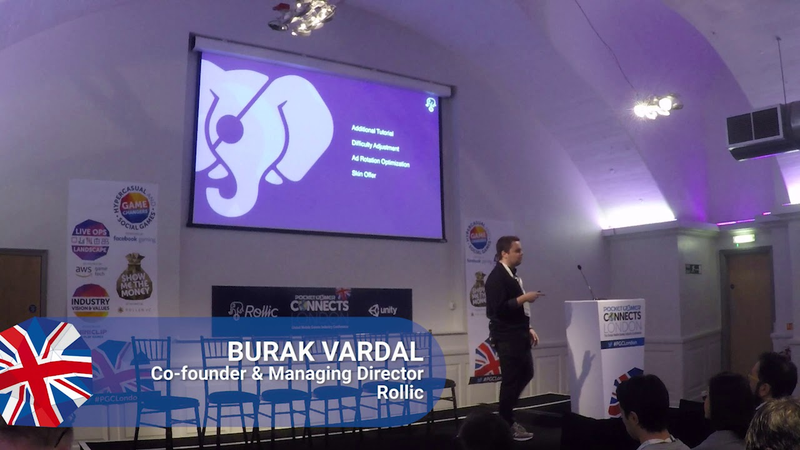
we were lacking time because of that and our feedback mechanism was very manual so next year what we're going to do is we're going to replace this manual process to our SDK with our SDK that we are launching which is named elephant so elephant will involve all analytics data where you can find the tools you are already using and it will remove the testing technology which will be like AV testing directly from our SDK it will remove insights of the game's AI feedback Inc and lastly automated optimization which I'm going to go into details right away so the first phase is think that you wake up in the morning you come to the office you open your computer and you log into our but elephant is just an exclusive tool for rollick partners so it's not usable for other developers or publishers so you're
a little partner and you log into the tool and you see a notification like this number of failure might saturate at level 8 adjust the difficulty so think that how much time you're going to spend just finding this at the failed events on level 8 and trying to figure out what to do right but you wake up and you see it in front of all tutorial they will recommend it that's probably having a lot of fail events in level number one the users are not understanding the original mechanic of the game or optimized ad rotation as minimum forty seconds per full screen because obviously 30 seconds as was giving you low retention right so this is a very basic feedbacks that b-minor manually gave in 2019 now there will be an SDK and artificial intelligence doing it for us next year so that was phase one thanks to is even if you have these feedbacks you
need to develop them so you need to adjust the difficulty you need to change the add row tation manually on the backhand side or you need to add a tutorial level to the game not imagine that you already did those when you're first developing the game at first place and those are in the game already and/or sdk elephant it is optimizing that for you without you doing any manual improvement on the back end so you put like four options of difficulty to the game if a user is churning out a lot with more fail events compared to others so it just the difficulty on a mass level and makes the game easier already and have giving you a higher retention and better understanding of your original mechanic so this is phase two but again we are talking about a big picture so when you when we are doing an optimization on this level we are optimizing the whole game not just the
per user what I mean is so actually the game changer part is phase three so on hyper casual you are dealing with a huge mass audience right so there every kind of person there so what we need to do is we need to understand each of these users and maximize the lifetime value for each of them maybe not on a mass picture so the third and most important phase of elephant is optimizing the game for each every user not only for every user generating for the game but for each every individual and understanding their tendency and behavior against your game and optimizing the next levels and everything throughout so let me tell you this through an example so this is Tom tom is playing your game
on his way to the office and he fails three times at level number one okay so he's frustrated a lot probably you will lose him so he's going to get out of the game and but we have two options right you don't deal with Tom and losing for like eternity and won't see him again or elephant may be watching him and directly putting an ad in additional tutorial level for him on next level to make him understand the mechanic better and easier and adjusting the difficulty of the next levels you're going to face during the game to make him stay more in the game and wrote analyzing the ad rotation and maybe showing him and ad not in 30 seconds in a minute because he's already frustrated and if you were going to show in an ad probably he will leave the game so we are doing everything to make him stay and lastly a bit makeover from
elephant that it shows and offers as skin offered directly in the end of the first level to Tom after all these optimizations if you lose Tom believe me he was never yours so he can leave but this is a way to be producing a better game for each every individual so we already better test it elephant in q4 2019 and there are some guys who already did that with us our studios and what wish what we see was the first time we were we are producing faster three times faster so what I mean by this is so we have like four different mechanic ideas we have but we put all of them in the first day and just do the a/b testing and we gain time like if you do
it in three weeks with the updates on App Store you will waste your time but you can see all of the results in just three days so we are producing three times faster right now and we will be doing it next year and we have 92 percent on target iteration what I mean 92 percent on target iteration is every iteration we do checking the data on elephant provides a positive feedback in terms of retention or in terms of time spent in the game or any other positive metric of the game so all of this big data provides you how to build a better game but don't just spent a lot of time on this if you have a 18% 20% retention on your game okay so if you have a 20 percent retention in again just this is just find a new mechanic or find a new game so elephant or any other tool won't
be giving you a 45 percent retention when you start with a twenty percent one because it feel it gives you the data that the original mechanic of the game is not already working so you need to find a new one all right and we didn't all with all this technology and automation we are planning to launch three times more global hits this year and we already launched two this month so we are in average two but I think we'll make the scale in average three global hits next year thank you - about huge fast seeing her get October actually one of the biggest strengths of our deadliest now obviously we've got a long way to go to local fruit but I think you're sure are you not actually delivering to find
things yeah so that the owner casual you don't have time right to develop anything and yes development costs a lot so what you need to do is from starting from the idea level you need to know what you're doing right so yes an elephant with with the coaching and with the tool we provide efficiency in terms of time and time is cost so that's that's the basic solution oh no because we believe that to become a perfect game company you should have a game not a video because we faced a lot there a lot of developers who are just producing videos for example they see like 6 cents on CPI test but they don't know what to do with the game because they don't have the game it is just a satisfying video so we always tell our developers and the way
we work is especially next year for each every brilliant idea we have we test it on the App Store and the reason we are very comfortable with it is we already know what will have a low of CPI so rolek has historical data for that so if if a game is going to have a high CPI most probably will stop the developers producing it so and just merging the creativity and data it can be solved but the game should always be on the store for us [Music] yeah that's the basic idea behind it [Music]
yeah [Music] [Music] versus being yeah actually this thing for hyper casual you need to stay simple so staying simple means that you need to have very shirts and and clean original mechanic the every other detail after that comes in soft launch face not on a prototype level face so our first option
and what we look at the first place is just a single mechanic maybe it's a tap an old one maybe it's a tap one maybe it's a swipe one but it should be single and easy to understand to be honest you know I think well I'm working on a template for hypercars games recently the idea being to filter out some of the sort of craziest ideas mm-hmm so you can just actually make sure you've got something simple one of these I like to do to make that easier for designers is to get to think about one mechanic in one game that they love is that kind of mindset that you see works yeah yeah starting from idea level is important because of that because sometimes when you leave developer Zen studios they go crazy and they develop or develop the game a lot so feedbacking should start from the from the and we start brainstorming ideas on paper not even on the store so yes we make them stop and just understand their mechanic and but
in the end of the day they would develop what they like because again this especially I pre casual doesn't have one big rule set right so every new mechanic think of the simulation games which are on the top charts right now in two years ago you wouldn't guess that design and that mechanics to be very successful on hyper casual but the world is evolving so we are always testing new things but yes we are always just leading them to month shirts and mechanic that they both even if it's going to succeed or not we need to be staying focused on that one so one last question you've got obviously a clear view of how you you systematize processes to initially learn but how do you respond to someone like Eric surfers challenged that hyper casual is dead is there still length in this market or is it cannibalizing yeah actually last week we tested like three games I guess with CPI is less than ten seconds ten
cents or E so if there's a CPI like that still then the market will grow continue growing so that's the way because we are still a bit far away from saturation so and the test results are giving the data so what I look at always is this month do we have some games which is which has lower CPI than 10 cents yes then it's it's it was still counting thank you very much question we bring you the mic because it's being recorded yeah is that elephant server-based or is it contained in there in the API I'm only asking because my kids what they do when they play a hyper casual you know they turn off the Wi-Fi and the data connections who don't get the ads so if your system isn't within the app to do the manipulation of the game mm-hmm and it's server base then it won't actually work for a lot of kids who play hyper casual yeah I'm still closing Wi-Fi and having
no access to the server is a very low percentage of our mass audience so it doesn't affect that much for us yeah yeah if they do it but mostly what we see is they start doing it after the second or third day of the game so not in the first or two days because they need more ads to improve more and stuff yes I don't know thank you very much tink [Applause] [Music]
Summary
The hypercasual gaming sector requires a rigorous balance between creative ideation and data-driven optimization to achieve commercial success. The primary challenge for developers is moving beyond manual, time-intensive processes to create scalable, future-proof ecosystems. By leveraging historical data and automated feedback loops, publishers can significantly increase production efficiency and the probability of launching global hits.
In 2019, Rollic tested 472 games to produce 13 global hits, highlighting the necessity of rapid prototyping. The development lifecycle is divided into three distinct phases: initial idea and execution, soft launch, and scaling. During the first phase, creativity is prioritized, but historical data is used to filter out concepts with prohibitively high costs per install (CPI). The soft launch phase serves as the critical period for A/B testing and refining mechanics, while the scaling phase focuses on maximizing lifetime value.
To automate these processes, the industry is shifting toward integrated SDK solutions, such as the proprietary tool Elephant. This technology replaces manual analysis by providing real-time AI-driven feedback on game difficulty, ad rotation, and tutorial placement. A key innovation involves individual-level optimization, where the game environment dynamically adjusts to a specific player’s behavior—such as modifying difficulty or ad frequency for frustrated users—to improve retention. Early testing of these automated systems resulted in a three-fold increase in production speed and a 92% success rate in positive-metric iterations. Despite concerns regarding market saturation, the continued viability of the hypercasual model is evidenced by the ability to consistently achieve CPIs below ten cents, proving that the sector remains a growth-oriented, mass-market opportunity.

















Comments