1 free read left. Create a free account for unlimited reading + AI research.
Create free account
State of the Mobile Gaming M&A Market
Key insights
6 takeaways- 01The mobile gaming market experienced a 34% compound annual growth rate between 2013 and 2019, reaching $68.5 billion in global revenue by 2019.
- 02M&A activity is characterized by frequent horizontal acquisitions in the $100 million to $500 million range, led by major players such as Playtika, Zynga, AppLovin, and Tencent.
- 03Rising user acquisition costs and discoverability challenges create significant barriers to entry, incentivizing smaller studios to pursue strategic acquisition as their primary exit path.
- 04The shift toward 'live service' gaming models has created more predictable revenue streams, increasing the attractiveness of these studios to private equity firms like Blackstone, KKR, and CVC.
- 05Valuation metrics for mobile gaming acquisitions are typically set at 2.5 times gross sales or 8.8 to 10.5 times EBITDA, depending on earn-out structures.
- 06Future market maturation is expected to be driven by potential IPOs for major industry players, providing increased capital liquidity for the sector.
Ask AI about this video
Transcript
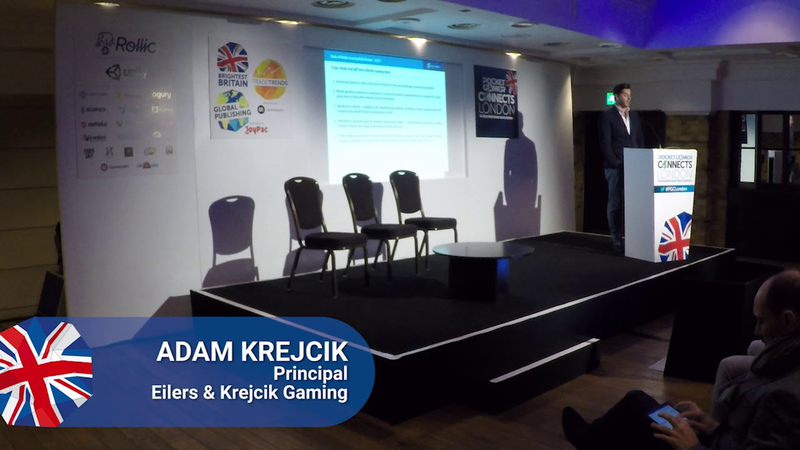
[Music] thank you very much it's crate check we picked we picked a really easy firm named Tod Eilers is the other partner my name is Adam krycek and so eilers and Krejci gaming it just rings off it rings off the tongue but anyway it's a pleasure to to be here at Pocket Gamer we're a US company I'm specifically from California and we also have an office in Las Vegas I'll just give a quick intro so you know just a little bit about us before we talk about the M&A market we're an independent research boutique research firm we produce market research intelligence competitive landscape
analysis we look at KPIs we incorporate data a lot of data but then importantly we provide a lot of qualitative analysis to that data so our reports they're subscription base their pay its paid research and we work with a lot of companies in the gaming industry both traditional casino real money gaming as well as as mobile free-to-play I head up the the mobile the free-to-play division at the firm and beyond the the market research reports that we produce we also do some some consulting and advisory if you're interested in a copy of this presentation we have a booth here please leave your business card and I can send you a digital copy of the report we also have samples of some of the other market research reports that we produce so moving on mobile gaming M&A first obligatory slide here on the on the
market size these estimates will vary a little bit but most people ourselves included I've got the market this is mobile gaming only at close to seventy billion we're at sixty eight point five billion for 2019 this is iOS and Google Play Store revenues worldwide and then we've also broken it out recently between IP and app purchases and revenues and in-app advertising revenue so you can see I ap still still drives the majority of the revenues but in-app advertising has been growing and not a faster rate overall the market we project is growing about 34 percent calendar eyes growth rate from 2013 to to 2019 and the reason this is important with respects to the the mobile gaming market is basically you've seen deal volume and the size of the
transactions quarterly pretty nicely with this chart so if we were to overlay the number of M&A transactions in mobile gaming and the average deal size it would look similar not exactly but generally speaking you know the the M&A market is supported by a growing mobile game market size which again shouldn't be a major surprise to to anyone so looking at the the M&A market the state of M&A so this is kind of the last two years there's a couple of important components here number one strategic M&A this is companies acquiring other companies really the theme over the past two years is there hasn't been any mega transactions by mega transactions we define that as over 1 billion dollars in deal size rather what you've had is a number of what we would say smaller cross horizontal type acquisitions
mostly in the 102 to 500 million dollar range and I would say the four most active companies and and relevant ones are listed here starting with platica well-known Israeli social casino company they've been on an acquisition spree mostly acquiring Studios with games outside of casino they've acquired super treat which Perdue solitaire Wooga and then most recently seriously games so they've been a very aggressive on the M&A side looking at expanding their business into casual outside of of core casino another big player recently has been Zynga if you were in this track earlier you you heard from some of the their recent acquirers small giant and grand games but Zynga's been very active again on the M&A front next up app loving this might come as a surprise to some people the app 11 is a major ad
tech company but increasingly they're also a major player in the mobile gaming space I think it's well known that they own Lion Studios the hyper casual division perhaps less known as they also on fire craft studios that's the studio behind machen tunes mansion and then they've also invested in in some well-known companies like Belka games and people fund people funds the the developers behind Ward escapes last but not least you have $0.10 largest gaming company in the world they're constantly in the market pursuing transactions to their most recent ones illion a developer of Bubble shooter out is and in short Bob so that's those are some of the notable deals on from a strategic side importantly you also have a pretty robust private equity and fundraising market and the reason we also include this on the lower level is you really need all of these players all
of these markets in the in the in the ecosystem to be working to have a really vibrant M&A market and that's exactly what you have right now you have healthy fundraising from some well-known game VC funds like makers and benchmark and then perhaps less known is is private equity is also increasingly taking stakes and in some in some game companies Blackstone acquired a social casino company called murca and the the ad tech rewarded video company vongole last year KKR has major investments in app love in an epic and then CVC a well-known your PMP firm made a large investment in iron source last year as well so again the theme here is the backdrop is a is a very robust vibrant M&A market supported by both strategic as well as as private equity and NVC fundraising so despite the lack of kind of headline transformative 1 billion dollar-plus
deals I would argue the the M&A market is very very healthy right now and so are the good times coming to an end we don't think so and so I've kind of laid out five themes on why we think you're going to continue to see a very healthy vibrant mobile gaming M&A market number one increasing barriers to entry in the form of rising UA costs and challenges around discoverability so basically it shouldn't be a surprise if you're a developer publisher it's increasingly expensive to get your game out in the market to get discovered and this this is you know arguably the biggest barrier to entry costs and it's it's very difficult for smaller studios to to scale and so again this is a favor and a tailwind for 4ma point number two the mobile gaming ecosystem
is structured in a way that provides outside returns for companies at scale you know look economies of scale exist in every in every business but we would argue that the way the app store system is set up the way the power of getting featured on Apple on Google your relationships with the various ad networks it's incredibly powerful to to have scale in mobile gaming and I would say it's it's even more so than just about any other internet service based business where again it really favors those those larger companies so again that's another theme to why we think you'll continue to see ma point number 3 games as a service live entertainment platforms this is a theme you've probably heard before but you know games today if you heard supercell earlier you know look their games have been in the market top grossing games for 10 plus
years and they think they'll still be people will be playing them for another 10 years so games are no longer hit driven there they there truly are a live entertainment service and what this means is a much more predictable revenue stream and a more predictable revenue stream is a lot more valuable to investors and companies and so this business as a whole we would argue is just becoming much more valuable as we move forward point number four and this might be a little controversial but we think innovation is largely found at smaller and independent studios the incentivization model the payout structures really favor smaller studios developers to take risks and larger companies to basically follow the status quo and you know there's obviously you
know it won't always be the case but companies like small giant with Empire and puzzles moon active with coin master these are smaller companies taking risks taking you know trying to disrupt the ecosystem and and and having very very positive outcomes and being rewarded for that and we think this this is largely going to to hold where the smaller companies is typically where the innovation is found and then you'll always have this demand from from larger companies finally point number five last but not least public equity markets really have not been that kind to to mobile gaming so in most instances if you're a mobile game company a mobile studio the most likely exit is going to be a strategic M&A very few companies have had success go in public you know that could change but again we think
strategic M&A certainly has been the most likely outcome and and will continue in the in the near term this is a slide we do a lot of work in in social casino market and so I just wanted to provide some context here this is a I'd like to joke a bankers wet dream but between 2011 and 2017 this is a good example of what can occur in a high-growth drawner where there's significant third-party interest and companies needing to scale you saw almost 10 billion dollars worth of transactions just in one very specific sector I'm not sure if this will be repeatable but again it's an interesting example of what can happen in one of these in these you know M&A type waves and surges lots of numbers here but to take away this is is the comps this is the the
average multipliers for transactions for a lot of notice of notable mobile gaming transactions after over the last 10 years the key numbers to note here and questions that come up a lot is what what's my company valued what's the business worth a very easy back-of-the-envelope way to do that is to look at what the average multipliers have been and basically on a on a sales basis on gross revenues two and a half times trailing has been the average multiplier and this is the upfront component only if you look at on an EBIT dot basis it's been eight point eight times trailing 12 months EBIT da if we add in the total deal value if we add in contingency payments and earn outs that goes higher to about ten and a half times again they will skew and will vary but a very easy kind of
back-of-the-envelope valuation methodology is to to look at at comps and interestingly public companies are trading at much higher multiples and the reason this is important is this makes makes the public companies acquiring privates pretty can be pretty accretive granted these there's not many pure-play mobile gaming companies on this list but nonetheless the the public markets public video game and digital game companies are still trading at a pretty nice multiple 17 times for diba da 23 times trailing a quick slide here on on Zynga again and we bring them up as I noted earlier my lecture they've been among the more active on the strategic M&A front and really have had some good success I
think you know historically Zynga has gone through some tumultuous times they've had some very bad acquisitions but credit where credit is due and the last two deals that they've done acquiring gramm games maker of merged dragons in May 2018 and then empires and puzzles later that year have really been homeruns there's lots of ways to to measure the success one easy way just looking at the share price it's increased almost twofold since they've announced those deals and I will tell you that empires and puzzles and merge dragons are now their two biggest games in their entire portfolio so two very important deals for Zynga's and two that have been very well received by the market okay final slide for me here you know I mentioned that you know we think strategic M&A it's gonna be kind
of a continue but this is this slide I'm sorry there's a lot of text on here it's from a larger report that we did 2020 and really 2022 over the next couple of years there could be a number of IPOs and I think that would be good for the markets as well because there really isn't that many pure-play mobile gaming companies and we've kind of put our likelihood again this isn't based on any you know insight this is our own kind of analysis but top of that list is app lovin we think they are absolutely going to go public sometime here in the next year or two again they it's a natural exit for KKR they've made some some management changes they've brought in they've been acquiring Studios revenue expected to exceed a billion dollar so they're certainly at some nice scale and they were last valued at two billion dollars they're likely looking at China IPO
simmer and not three to four billion dollar range and so that's our highest conference in terms of companies on here that could go public next year platica has been in the news again massive massive social casino company they're owned by a Chinese conglomerate right now last acquired in 2016 for 4.4 billion that company has they've grown significantly since then both organically and through strategic M&A if we were happy if we had to guess you would likely be looking at an IPO and eight to ten billion dollar range so they would be a massive one of the biggest game companies out there two more here again are our confidence in terms of when they could IPO is is a little bit lowered here but jam city and scope Lee both Los Angeles based companies have a very significant money from investors and so we believe at some point if it's not strategic M&A both of
those companies could could look to go public they certainly have the the infrastructure in place to do that and then last but not least we also put epic games in here but we don't think that's a near-term likelihood so again takeaways here very robust vibrant M&A market there's been a lot of deals over the last few years we think that is going to continue and who knows we might even get some some more mobile gaming IPOs in the future as well so thank you for listening happy to take questions [Applause] yes I'm bringing the microphone to you just a second Halston hi so you spoke about the likes of Zynga what is there or a company like them what do you feel
is their ultimate motivation for acquiring some of these studios do they feel that they can potentially make them earn that much more and therefore they're getting good value or is it portfolio diversification what is ultimately driving them to M&A yeah I mean they think the the combination of them is is you know one plus one equals is three and that's always a cliche way to say it but they think they can bring some value in terms of of scale and certainly they view these businesses as as complimentary to to kind of their core business as well and and you know Zynga is a a publicly traded company and so they you know they are working and get you know for their shareholders essentially and trying to grow their there their revenues earnings and and have a successful stock reaction as well
[Music]
Summary
The mobile gaming mergers and acquisitions (M&A) market remains robust and vibrant, characterized by a steady stream of strategic acquisitions rather than singular, transformative mega-deals. As of 2019, the global mobile gaming market reached approximately $68.5 billion in revenue, with a compound annual growth rate of 34% between 2013 and 2019. This consistent market expansion serves as the primary catalyst for deal volume, as larger entities seek to acquire smaller, innovative studios to maintain growth and scale.
Key industry players such as Playtika, Zynga, AppLovin, and Tencent have been particularly active in executing horizontal acquisitions, typically ranging from $100 million to $500 million. These transactions are supported by a healthy ecosystem of private equity and venture capital, with firms like Blackstone, KKR, and CVC increasingly investing in gaming and ad-tech companies. Valuation methodologies for these deals generally rely on trailing revenue multiples of approximately 2.5 times gross sales, or 8.8 to 10.5 times EBITDA, depending on the inclusion of earn-outs and contingency payments.
The outlook for continued M&A activity remains positive, driven by several structural factors. Rising user acquisition costs and discoverability challenges create high barriers to entry, favoring larger companies with the scale to navigate the ecosystem. Furthermore, the transition of games into long-term "live service" platforms provides more predictable revenue streams, making them attractive assets for investors. Because public equity markets have historically been challenging for pure-play mobile gaming studios, strategic acquisition remains the most viable exit strategy for most developers. Looking ahead, the industry may see a shift toward initial public offerings for major players like AppLovin and Playtika, which would further mature the sector and provide new avenues for capital liquidity.






















Comments