1 free read left. Create a free account for unlimited reading + AI research.
Create free accountWhitepaper DiGRA
1 free read left. Create a free account for unlimited reading + AI research.
Create free accountWhitepaperDiGRA
The study argues that playtime plays both roles, yet digital storefronts lack a consistent structure for presenting time-centric information.
This study examines how playtime is framed in video game marketing and how it shapes user reviews on Steam, Valve's digital distribution platform. Its central argument is that playtime functions both as a driver of audience behaviour and as a design and commercial category, yet digital storefronts have not established a consistent structure for presenting time-centric information. The research positions itself against prior work that largely treats playtime through the lens of pathological play, such as studies linking gaming hours to anxiety or addiction, and seeks instead to understand how time is discursively presented and received.
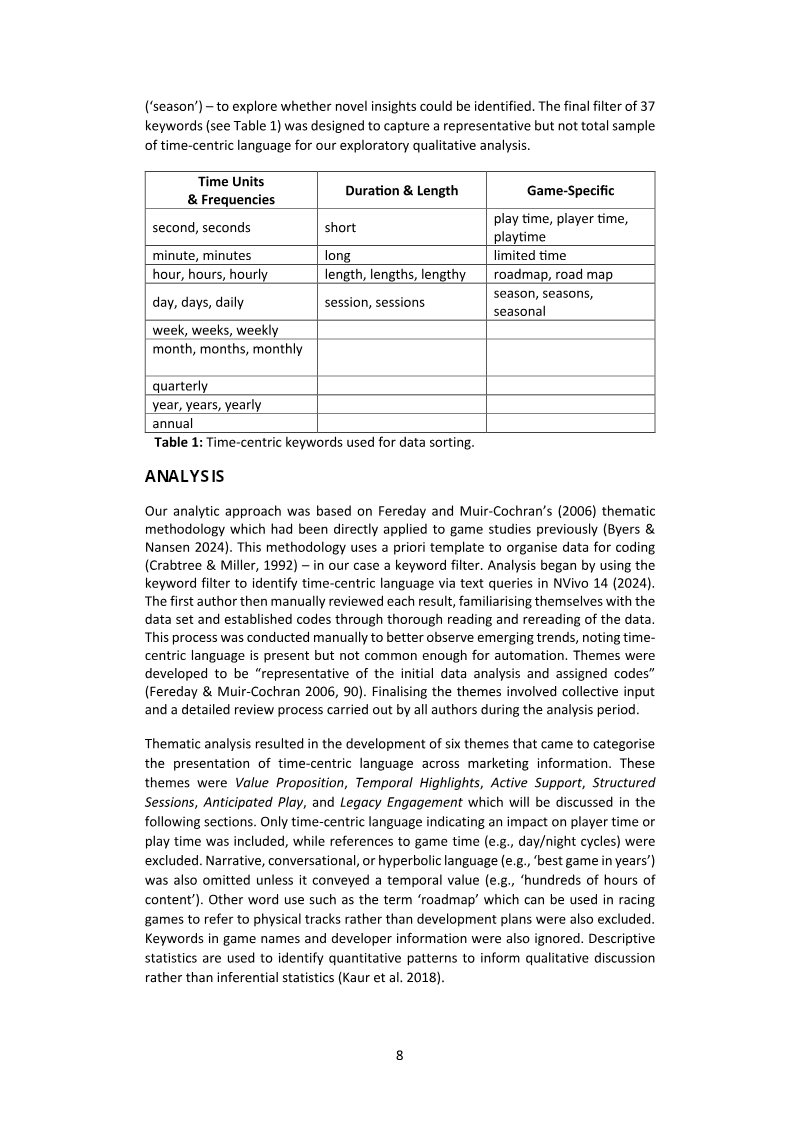
The exploratory analysis draws on scraped Steam game pages and user reviews, with an early dataset of 1,000 games. Keyword searches for terms such as "playtime," "hours," and "lifespan" reveal a contrast in marketing practice: base games tend to be described in spatial terms (levels, areas, sequences, endings), while downloadable content, remasters, and special editions are more often quantified temporally, emphasising expected longevity for returning players. User reviews, meanwhile, treat playtime as a recurring point of recommendation or warning, but not as a simple binary of good or bad. Longer playtimes are not inherently valued more highly, and shorter ones are not automatically criticised, with the judgement depending heavily on context and perceived quality of play.
The author notes that these findings are preliminary and situated within a broader project on the relationship between play and time. Steam is presented as a suitable site because of its large, active user base, extensive catalogue spanning genres and multiplatform titles, and accessible data through the Steamworks API and the third-party service Steam Spy. Future work is proposed to extend the analysis to other platforms, to examine motivational models of player engagement that omit playtime, and to explore how playtime metrics might be integrated into game design and development.
Each row is a game or company this document names, each column a document, oldest first. A mark means that document names it. Select a row to see those documents.

DiGRA · 2026

DiGRA · 2026



DiGRA · 2026



DiGRA · 2026



DiGRA · 2026



DiGRA · 2026



DiGRA · 2026



DiGRA · 2026

DiGRA · 2026



DiGRA · 2026



DiGRA · 2026

DiGRA · 2026