1 free read left. Create a free account for unlimited reading + AI research.
Create free accountWhitepaper European Conference on Games Based Learning (ECGBL)
1 free read left. Create a free account for unlimited reading + AI research.
Create free accountWhitepaperEuropean Conference on Games Based Learning (ECGBL)
138 UK universities offer games design degrees. Staffordshire's Games Institute enrols roughly 1,800 students across games disciplines.
This position paper by David James and Christopher J. Headleand of Staffordshire University's Games Institute argues that pre-built game "frameworks" offer an effective way to teach games design to a large, diverse cohort of first-year students. A framework is a playable game structure built in an engine such as Unreal Engine or Unity, with core systems (inputs, character, camera, animation) already implemented and deliberate gaps left for students to fill in. The authors contend that this lets learners engage quickly with iterative gameplay design, lets educators focus assessment on specific learning outcomes, and mirrors industry practice, where graduates typically join teams extending systems that already exist.
The paper's motivation rests on the growth of games education, with 138 UK universities offering games design degrees and Staffordshire's Games Institute enrolling roughly 1,800 students across games disciplines. The authors note that students arrive with widely varying technical and design backgrounds, which makes a one-size-fits-all curriculum difficult, particularly when many parallel classes must deliver consistent learning. The paper also describes the earlier practice of using commercial level editors such as the Unreal Tournament editor, which taught level design but not scripting or prototyping and produced project files of around 20 gigabytes, compared with a 16-megabyte Sentinel framework project.
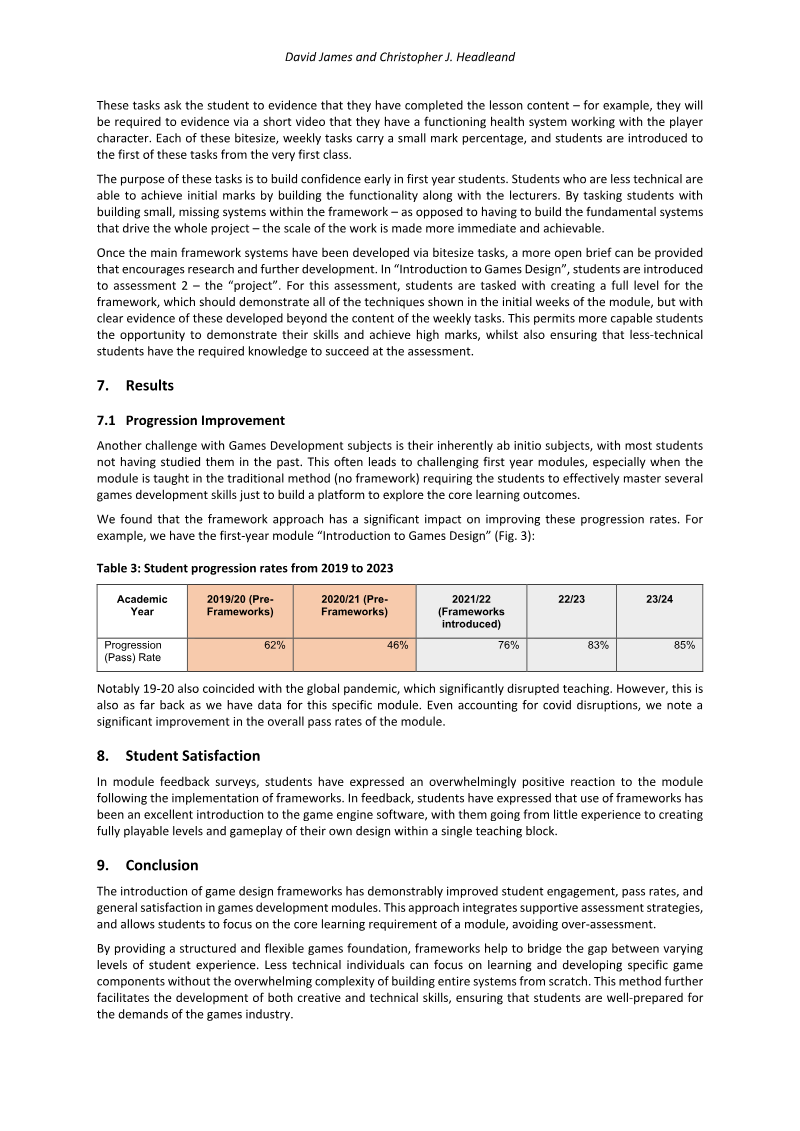
The framework approach is organised around the "Three Cs" of character, control and camera, with a narrative-driven module mascot and a top-down camera chosen to focus attention on encounters and puzzles. Assessment combines small weekly bite-sized tasks, which support less technical students, with an open final project that stretches more capable ones. The reported evidence is primarily internal: module pass rates rose from 46% in 2020/21 (before frameworks) to 85% in 2023/24, and student feedback was overwhelmingly positive. The authors acknowledge that the 2019/20 figure coincided with pandemic disruption, and the study is a single-institution, single-module observational account rather than a controlled comparison.
Each row is a game or company this document names, each column a document, oldest first. A mark means that document names it. Select a row to see those documents.



European Conference on Games Based Learning (ECGBL) · 2026



European Conference on Games Based Learning (ECGBL) · 2026



European Conference on Games Based Learning (ECGBL) · 2026



European Conference on Games Based Learning (ECGBL) · 2026



European Conference on Games Based Learning (ECGBL) · 2026



European Conference on Games Based Learning (ECGBL) · 2026



European Conference on Games Based Learning (ECGBL) · 2026



European Conference on Games Based Learning (ECGBL) · 2026



European Conference on Games Based Learning (ECGBL) · 2026



European Conference on Games Based Learning (ECGBL) · 2026



European Conference on Games Based Learning (ECGBL) · 2026



European Conference on Games Based Learning (ECGBL) · 2026

European Conference on Games Based Learning (ECGBL) · 2026
European Conference on Games Based Learning (ECGBL) · 2024
European Conference on Games Based Learning (ECGBL) · 2024