1 free read left. Create a free account for unlimited reading + AI research.
Create free accountWhitepaper DiGRA
1 free read left. Create a free account for unlimited reading + AI research.
Create free accountWhitepaperDiGRA
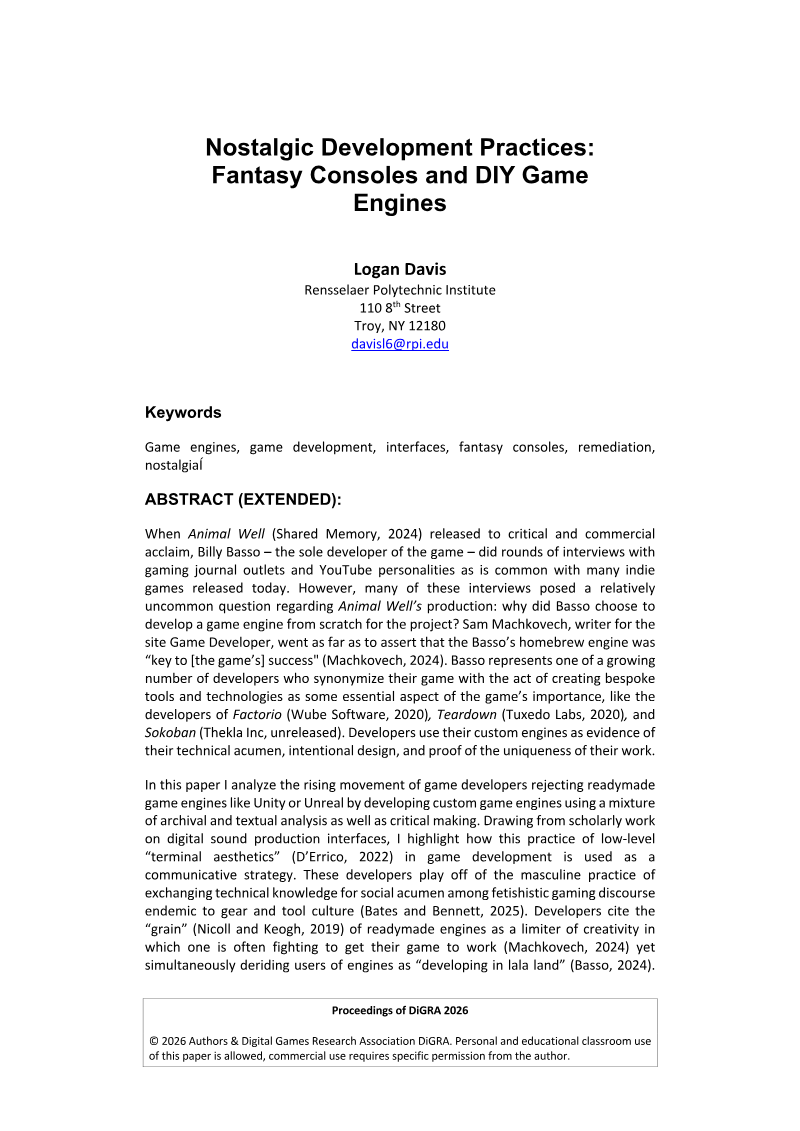
The paper examines how nostalgia works as a deliberate design strategy in this console.
This paper examines how nostalgia functions as a deliberate design strategy in the Playdate handheld console, produced by Panic Inc. and first conceived in 2019. The authors argue that nostalgic design is not merely an aesthetic choice but a value-laden practice that shapes player pleasure, community formation, and the political economy of game production. Drawing on Garda's distinction between "restorative" nostalgia, which seeks to revive the past, and "reflective" nostalgia, which imagines alternative times and places, the work positions Playdate as a case of reflective design that promotes a utopian vision of independent gaming.
The study uses a multimethod approach combining platform analysis, discourse analysis of posts in the Playdate developer forum's Games section, and planned interviews with twenty console and game developers scheduled for completion in 2026. The analysis is grounded in a collective memory framework, treating Playdate as a memory object whose hardware, including a monochrome display, a hand crank, and the Lua programming language, evokes earlier handheld and development norms. Preliminary findings indicate that the platform's technology, content, and tactile features are read as nostalgic by developers and players, particularly those who grew up with 1990s systems. Its content frequently imitates classic arcade titles, and its distribution through paid seasons and side-loading via creator-focused sites represents a deliberate step away from mainstream channels such as Steam and Xbox Game Pass.
Forum discussions reinforce these readings, with developers explicitly framing their work within histories of classic games and expressing a sense of niche enjoyment and independent creativity. The authors suggest that Playdate's appeal rests on a peripheral audience that values pleasurable, decentralized production. The work is presented as in progress, so its conclusions about the broader implications of nostalgic design remain provisional pending the full interview analysis.
Each row is a game or company this document names, each column a document, oldest first. A mark means that document names it. Select a row to see those documents.

DiGRA · 2026

DiGRA · 2026



DiGRA · 2026



DiGRA · 2026



DiGRA · 2026



DiGRA · 2026



DiGRA · 2026



DiGRA · 2026

DiGRA · 2026



DiGRA · 2026



DiGRA · 2026

DiGRA · 2026
East Side Games