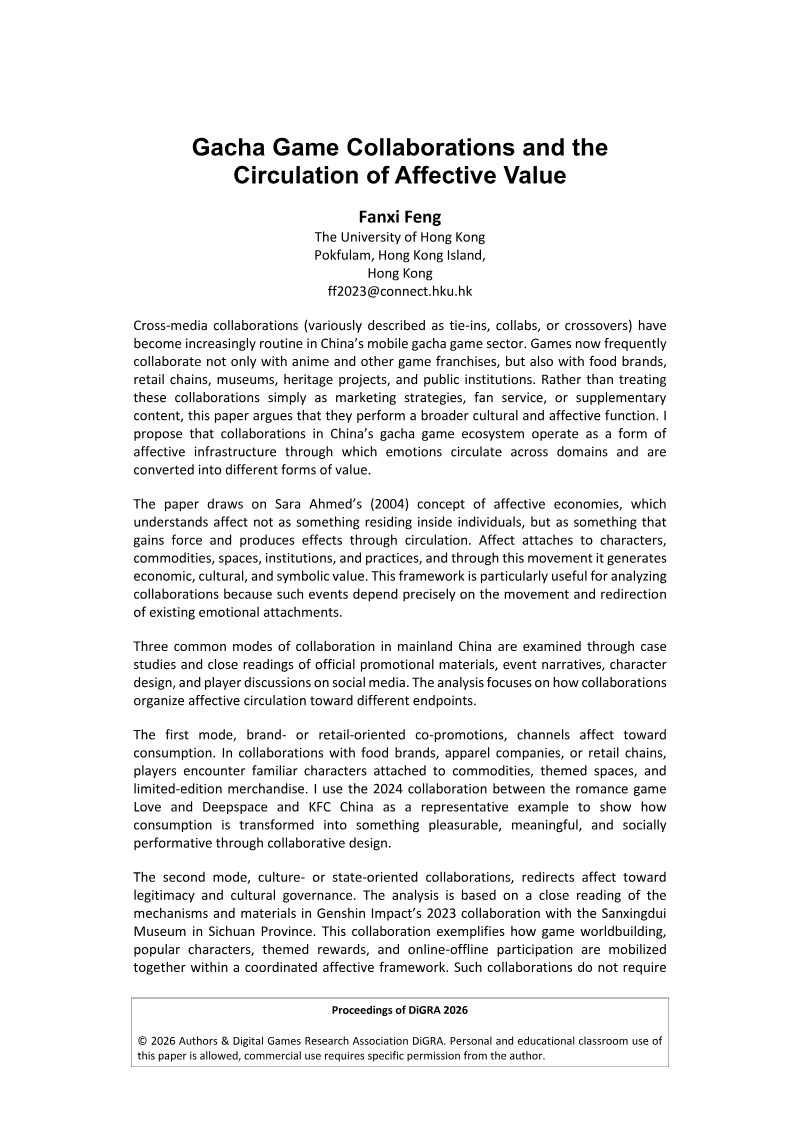
1 free read left. Create a free account for unlimited reading + AI research.
Create free accountWhitepaper DiGRA
1 free read left. Create a free account for unlimited reading + AI research.
Create free accountWhitepaperDiGRA
Estimates suggest the sector includes freelancers, students, retired esports players, and streamers. Freelance earnings are typically between 10,000 and 20,000 yuan per month.
This paper examines commercial boosting, the practice of lending a player's account to a skilled booster who completes time-consuming tasks or raises competitive rankings on the owner's behalf, as a growing underground market in China. Its central argument is that repetitive gameplay mechanics, particularly in player-versus-player modes and battle pass systems, combined with industry structures, drive the expansion of this trade and produce precarious labour conditions that blur the boundaries between play and work. The authors frame boosting as a "grey" area, both because most game companies prohibit it as cheating and because it sits uneasily within Chinese law.
The study draws on a qualitative methodology built around three popular mobile games: Honor of Kings, Onmyoji, and Game for Peace. It combines semi-structured interviews with five boosters and four paying customers, observations of boosters on Bilibili, comments collected from Bilibili and Xiaohongshu, and advertisements gathered from Taobao and Xianyu, supplemented by one author's direct experience as a booster and live stream moderator. Estimates suggest that China's boosting sector includes six to seven million participants, ranging from self-employed freelancers and students to retired esports players and streamers, with freelance earnings typically between 10,000 and 20,000 yuan per month.
The findings indicate that e-commerce, live streaming, and social media platforms have substantially enabled the growth of boosting services, with boosters competing fiercely, sometimes underselling their work, and often absorbing unpaid labour time. Conditions in informal "gaming workshops" appear considerably harsher, including low pay and reported sexual harassment. Nonetheless, some interviewees described boosting as a deliberate career choice offering income, flexibility, and a sense of accomplishment. The paper also notes legal complications, including weak contractual protections, conflicts with personal data regulations, and the potential circumvention of anti-addiction rules for minors.
Each row is a game or company this document names, each column a document, oldest first. A mark means that document names it. Select a row to see those documents.

DiGRA · 2026

DiGRA · 2026



DiGRA · 2026



DiGRA · 2026



DiGRA · 2026



DiGRA · 2026



DiGRA · 2026



DiGRA · 2026

DiGRA · 2026



DiGRA · 2026



DiGRA · 2026

DiGRA · 2026