1 free read left. Create a free account for unlimited reading + AI research.
Create free accountWhitepaper International Journal of Serious Games
1 free read left. Create a free account for unlimited reading + AI research.
Create free accountWhitepaperInternational Journal of Serious Games
This valuation reflects the established role of serious games in bridging the gap between theoretical knowledge and practical application.
Market Value. The serious games market is currently valued at €2.35 billion.
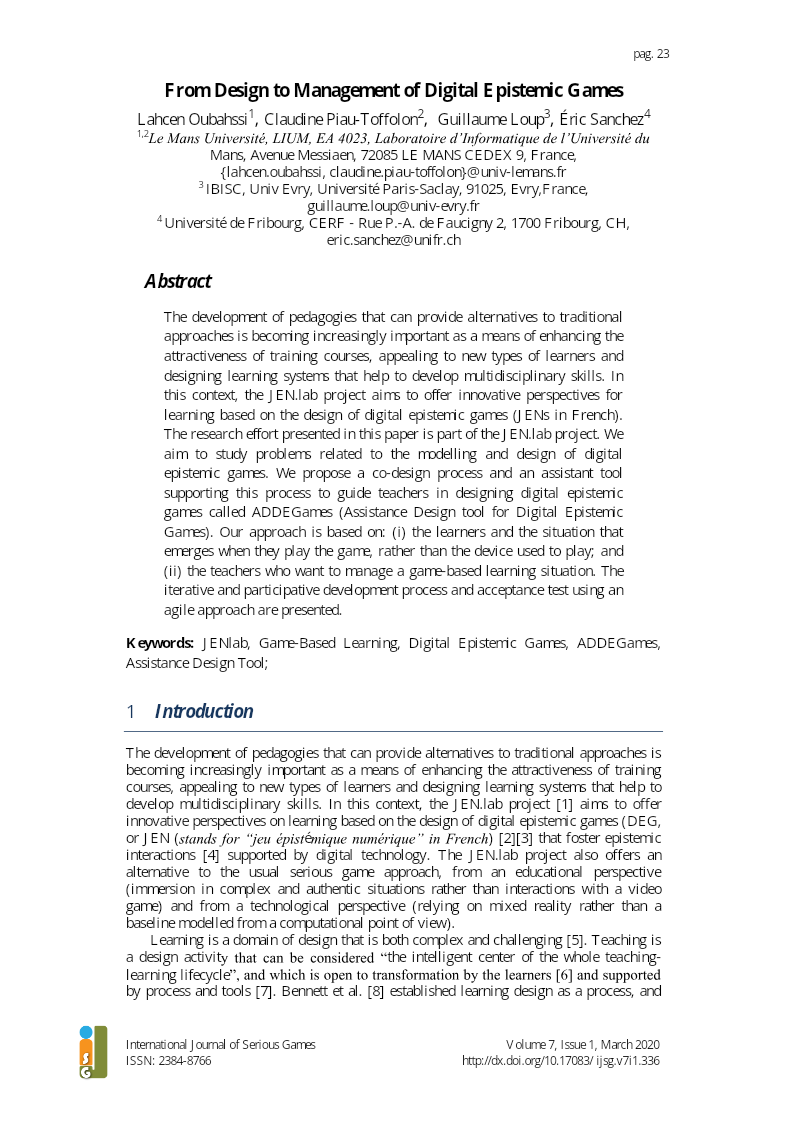
Serious games function as powerful educational instruments that utilize simulation and visualization to promote situated cognition across global education and professional training sectors. With a market valuation of €2.35 billion, these tools are increasingly recognized for their ability to bridge the gap between theoretical knowledge and practical application. The primary objective of the field is to harmonize pedagogical rigor with immersive gameplay, ensuring that learning outcomes are not compromised by entertainment mechanics. Success in this domain relies on a multidisciplinary approach that integrates established educational theories, such as constructivism, the Revised Bloom Taxonomy, and Kolb’s Experiential Learning model, into the core architecture of the software.
Maintaining user engagement requires a delicate balance between challenge and skill, a state commonly referred to as flow. To achieve this, developers are moving away from static experiences toward adaptive mechanics that respond to individual learner profiles in real time. Frameworks like the Learning Mechanics-Game Mechanics model serve as essential bridges, allowing designers to embed assessment and feedback directly into the interactive experience. Evidence from applications such as CancerSpace and Re-Mission confirms that when these elements are properly aligned, serious games can drive significant behavioral change and improve performance metrics.
Despite these advancements, the industry continues to grapple with the complexities of objective evaluation and the management of cognitive load. While the proliferation of accessible development platforms like the Unity engine has lowered the barrier to entry, creating high-quality simulations remains a technical and pedagogical challenge. Future progress depends on the continued refinement of learning analytics and the rigorous application of psychological research to ensure that digital environments remain both effective and scalable. By leveraging data-driven feedback and robust design frameworks, serious games are positioned to remain a critical component of modern instructional strategy.
Each row is a game or company this document names, each column a document, oldest first. A mark means that document names it. Select a row to see those documents.
International Journal of Serious Games · 2023
International Journal of Serious Games · 2022

International Journal of Serious Games · 2020

International Journal of Serious Games · 2020

International Journal of Serious Games · 2020



International Journal of Serious Games · 2020
International Journal of Serious Games · 2020
International Journal of Serious Games · 2020

International Journal of Serious Games · 2020

International Journal of Serious Games · 2020

International Journal of Serious Games · 2020
Air Force Institute of Technology · 2020
European Conference on Games Based Learning (ECGBL) · 2025