1 free read left. Create a free account for unlimited reading + AI research.
Create free account
Scale for Success: A Developer's Guide on UA Strategy & DSP Partnerships
Key insights
6 takeaways- 01DSPs are essential for capturing the 63% of ad impressions that exist outside of major 'walled garden' ecosystems.
- 02Effective partnerships rely on the developer’s deep understanding of long-term lifetime value (LTV) curves and proxy events to allow DSPs to optimize for specific, actionable milestones.
- 03DSP machine learning models require a four-to-six-week stabilization period to learn effectively, necessitating the separation of 'business as usual' budgets from experimental test budgets.
- 04Successful UA scaling requires a unified 'source of truth' for data, as discrepancies between internal business intelligence and mobile measurement partners (MMPs) prevent effective ML optimization.
- 05Vertical scaling involves incrementally increasing daily spend caps to test the limits of the ML bidder, which typically causes temporary performance fluctuations before stabilization.
- 06Horizontal scaling leverages data-informed insights, such as install-to-action ratios and market size, to efficiently expand campaigns across multiple geographic regions.
Ask AI about this video
Transcript
[Music] [Music] so the wonderful will from moloko is here to carry on them telling us all about um a developer's guide to ua strategy and dsp partnerships thanks for uh thanks for coming to the talk so uh i'm william i'm vp of sales at amir um that's me it's a bit bit backwards but uh yeah vp of sales amir we launched actually at this event two years ago uh it was just me and my uh my second in command alex bidaway uh there's now thirty of us in the london office um and maloko is a performance dsp so you may have heard of us
or you may not because we haven't really had a marketing department until about a few months ago michaela being one of them so thanks for helping with everything michaela so today i'm going to talk about how you can ultimately scale with a dsp um so there'll be a bit about a bit of an introduction and you'll find a lot about partnerships because actually scaling really requires a strong partnership so i was kind of trying to think about what it actually looks like and funnily enough for those who've met their life partner it looks a bit like a really really strong marriage i'd say it's about mutuality cooperation clearly defined roles and it works really well when you get that foundation correct so there's actually quite a bit about partnerships and then we move into scaling techniques which typically happens pretty pretty easily once you've got the foundations correctly so who is who is maloko we are a machine learning business there's a lot of us out there i know um but ultimately
our our sort of vision is to make machine learning accessible to businesses of all sizes across the across the ecosystem and there's two sides to our business the one most important to you guys will be the dsp and this is how we use ml to drive return on ad spend for your user acquisition campaigns in the non-owned and operated space the other side to the business is rmp and that's retail media platform and that donate basically uses rml to monetize users of retail apps so where do we exist we exist outside of google and facebook ultimately so a lot of you may have bought direct deals from the networks there's about 63 of user impressions come from that space sixty three sixty percent of spend goes into the thirty seven percent of impressions coming from google and facebook so i guess what you could see moloka as is the ability to use ml to
drive better performance for the remaining 63 of impressions so partnerships keys to success as i said it's a foundation and without that foundation there's no scale so what to consider first so joint expectations basically we need and we both need clear goals from the partnership um what does success look like to you um when are you seeing positive rest by what time do you need it and then from a dsp perspective what what do we need to know from a developer what are your budgets what are your spend caps uh by when do you need to see success also what do you like with vtct ratios how are you deduping installs if you are or not um these are really crucial pieces of information that we need to understand because unless the bidder understands this it's going to be it incorrectly for you so getting that set up right with your
sales rep from a local or any other dsp as well as your implementation manager is pretty crucial there finally we need agreed milestones so do you work on evaluation cycles how frequent are they can you let us know when you're having them so we can provide you with the data you might need to evaluate your success of a campaign partnership roles so from a from a developer perspective i would say our most successful partnerships and we can scale up to a quarter of a million a day with some of our largest clients these guys they know their ltv curve it's really crucial that you understand what ltv looks like in the long term and how you can proxy that back to your sort of earlier d7 sort of time timetable are there proxy events that are a great indicator of success that can give your account manager at the dspn some indication as to how we're doing if there's a longer longer term event that you're targeting
uh what's your time from install to in that purchase crucial it gives us an indication although we might be working to d7 ross if we know that 80 of your purchases come on d3 that's a great way for us to understand early indications of success and make action one way or shape or form and then post post in it purchase what is your frequency of in-app purchase how many further purchases can we expect and therefore how are we doing in terms of frequency and then from the dsp what can you expect from us well we've got to know our product um we're kind of a bunch of geeks i would say in my loco um hence we didn't have a marketing department until recently um and we've got a lot of experience of how to scale using the dsp and we've also got a lot of market intel so we offer good advice it's a shared role it's a partnership we want to scale as much as you do when we're hitting roes so that's really going to be the key to key to what we can offer here
in terms of mutual expectations i think it's about shared feedback and data this goes both ways and over time if we do set things up we might even change our product for you so some good examples here were a ctvt knob which enables our us to get our bidder to not bid where vt looks strong because it didn't recognize back in 2020 a vt from a ct that came up we changed the product so now we can bring that to there and we can make sure that works other things would be our multi geo campaigns which are great for targeting tier three geos across multiple across multiple geos in one campaign and then data sharing so why is it so important our bidder works to your data um ultimately transparency both ways really is is fundamental and the more data our ml gets and listens into the better it can bid for you so we look at your unattributed data
from moloka in particular we require unattributed data our minimum is installs and actions but also benchmarking it helps us understand where we're at in your marketing mix and then qualitative what's your feedback how are we doing what can we do better we're really really important that we hear this so we can ultimately work with you and perform better for you and then when it comes to the post backs that you select we need the right postbacks uh garbage in garbage out is the uh is the phrase um but we need to be targeting the postback that works for you and delivers ultimately row s and annual targets so that's a bit about uh partnerships in terms of kpis i thought about this too i think there's there's lines of responsibility here so i'd say i think the client's responsibility is to give us a kpi that is the right kpi for them and then it's a dsp's responsibility to hit that kpi and i think if we align ourselves
along that way we can get get into a good partnership format there the key key considerations with kpis it's uh what is it your ultimate kpi i think most in game space it's return on ad spend typically d7 uh that could change um but the more reporting we get post e7 uh the better we can optimize our campaigns uh do we need a proxy i think this is this is a key one so we're actually doing really well in the hybrid casual space we are entering into the hyper casual space um it was a little bit impractical to target ad revenue so what did we do we target we targeted in-app purchases we're picking up a very very large swathe of ad revenue at the same time so that acted as a proxy for total uh return on ad spend and it's working really well with our clients um then is that kpi realistic and achievable i guess we i guess we find out in practice um but also your account manager can give you a sense of whether or not we think we'll hit that and then have you factored in to a
factored in your time and the budget it takes to learn so it does take time and there's usually about a four to six week period um where the dsp improves and your campaigns improve but we should be getting early signals and your account manager can give you a sense in terms of the early signals as to where we're going but uh we like to see success within a within about a month so your testing strategy so is it we need a clearly defined testing strategy so what's your budget what are the geos you want to work in i think from geo's perspective if you work direct you by the way i've sold off a wall i've sold rewarded video direct and back in those days especially rewarded video you take a small country because you didn't want to leverage yourself too much than saw if it would work from us you kind of reverse the equation and you want to go where the dsp works well so the usa for us would be our normal testing budget because we've got so many campaigns we know that market so well and we can match the
audience back against your your targets um what is your minimum testing period how does that match with your your budget what time am i oh we're going through quite nicely um and what events are the important ones for you for and for us to target and are there any new dsp features that you could use for instance multigeo campaigns i think for a test i'd say keep it simple take some advice from your account manager and they'll sort of work out from your data where we think we can see success um and then you've got an assessment framework so i'd say what we want ideally is assessment to be at the campaign level so if it's at the bundle level what we can see is the tests bring down overall uh performance so you might be testing you might have a live campaign that's going well we'd like to see a set of essentially tests being assessed at the uh at the campaign level basically so partnerships i think this is a key
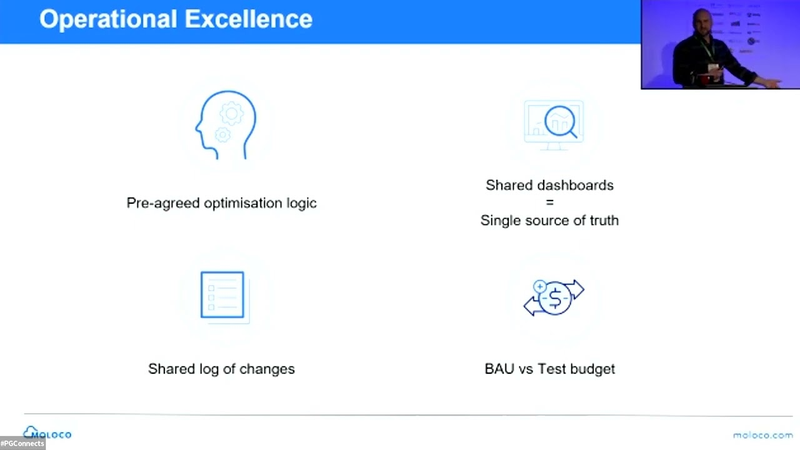
bit operation that's excellent so this is like what your partnership looks like with our account managers um day-to-day so the pre-agreed optimization logic so i'd say this is actually taken from some of our largest spenders um and it works very very well and i think just because they're the largest spenders it doesn't mean anyone can't just actually adopt these processes so pre-agreed optimization logic we can't just immediately optimize by switching off publishers in fact switching off publishers harms campaigns for us because it reduces the data support that our video can work on and therefore drives up cpm so we have to work slightly differently so an optimization logic might be something like if you've seen uh underperforming campaign for two weeks at that point then we discuss maybe dropping the budget a little bit to see if we can improve performance there or it might be if we see success during the week and we're seeing positive rice in a campaign we do a 10 or 20 burst at the
weekend where you know you're gonna pick up users and this way you can really either hedge your x and and play a bit of defense or you can potentially maximize scale so setting that right with your account manager with maloco is uh is an important working process and then shared dashboards so this is a single source of truth so we like we all have an mmp a lot of our partners also use an internal dashboard set up from their own bi in practice we see some discrepancies um this could be a bit of a nightmare because actually if we see success we might think we might think our campaign's doing great and if uh if our partner is working from a different inbound inbook i think it's a himba they might be seeing something completely different so what we'd ask really is that we work from the same source of truth whether that's the internal bi if you can give us a login or we both work from the mmp i think that's mission critical to keep us all on the same page on an ongoing basis
and then a shared log of changes so it's quite a complex process working with a dsp um logging the changes that are made and both partners having access to these changes um it's an important piece of that process things happen over time with a dsp performance can either decay or improve and this can happen over weeks or months um and it's really important that we have a time stamped log of changes so that we can look back and maybe unders and try and get an understanding of what may have been done that can have influenced this performance change so keeping that going and keeping that live is another key point and then finally i kind of referred to this earlier in in the test process so one of the things my account managers have done is really work hard with our largest clients to define business as usual and test budgets um ultimately we don't want one campaign with our partners we want multiple campaigns globally
the problem that happens is when you have a learning phase it takes time for a campaign to actually begin to perform so if you lump it all together in one budget a learning phase of a new test campaign can bring down the overall performance when you report back up to your superiors it can make it quite tough to uh to sort of promote us as a business so where we have seen a lot of success with some of the largest partners is to argue the case to separate tests from business as usual budgets when we do that we we get the test budgets going through and the test campaigns and when they hit performance we move them into bau so that can continue on its scale process so that would be the the operational process we'd like to work with with our partners that was a countdown i had loads of time yeah it's a good good point thanks okay oh we're pretty much there actually so that's partnerships that's the marriage or my vision of a marriage i hope it works with you guys
um so scaling techniques so there's ultimately two types of scaling there's vertical and it's horizontal my sales guys know i like horizontal thank you zan um and um we're gonna just cover two so vertical scaling so this is a bit of a pitch something that happened with moloko in last year in 2021 was we realized our ml could work rapidly um in 2020 i mean as i said we launched in 2020 we were cautious we didn't want to over stretch our ml and we had very very very gradual scaling models and actually the rapid scale technique is a great example of a partnership so we didn't come up with it actually it's one of our largest partners decided they wanted to stretch our our machine learning and our bidder they wanted to have a go so they basically set set our bidder a 20 increase in revenue in in our in our daily cap every every three days to four days for a few weeks to see how high it could go
um before we we saw a performance drop so we all thought we'd give it a go and it actually looks something like that so we actually scaled very very rapidly and this curve is a pretty normal thing now with our rapid scaling methodology and what you can see is rapid scale it kind of overshoots the mark of where we can hit performance there's a slight correction and then we ultimately we stabilize out and we see basically pretty stable performance ongoing um after that point it will be improvements in the product to market changes and things that will impact performance but it's a great way of maximizing the the revenue you can get from a new partner or with specifically a dsp in that way so then horizontal scaling interestingly enough you see all these colors that's different geos so that's quite interesting so that exponential growth curve is because this campaign was run across multiple geos so
multiple geos are a great a great piece to work with we've got successful campaigns you don't always want to scale vertically in one um ideally because that's actually potentially risky when it comes to performance so how can you then scale your spend with us go horizontal and launch multiple geos at any given point um your account managers will take a data informed approach and they'll look at your install to action ratios market size app representation in different markets and can actually recommend you different markets uh in which you can conduct new tests and actually because we're we're integrated with all the key exchanges where your app's performing we should also be able to find performance so our best skilled partner out of emir is live in 75 markets so i think that's about it really that's what we covered we want shared expectations we want to find roles
we want to share data and we want you to share your data operational excellence and that should really see scale [Music] [Music] you
Summary
Effective user acquisition (UA) at scale requires a strategic, collaborative partnership between mobile developers and demand-side platforms (DSPs). Success is predicated on a foundation of mutual transparency, clearly defined roles, and shared data. Developers must provide DSPs with precise goals, budget caps, and key performance indicators (KPIs), while DSPs must leverage machine learning (ML) to optimize performance across the 63% of ad impressions that exist outside of the major "walled garden" ecosystems.
A successful partnership functions like a long-term alliance, requiring a unified "source of truth" for data. Discrepancies between internal business intelligence tools and mobile measurement partners (MMPs) can hinder optimization. Consequently, both parties should align on a shared dashboard and maintain a timestamped log of all campaign changes. This operational rigor allows the DSP’s ML models to learn effectively, typically requiring a four-to-six-week stabilization period. Developers are encouraged to separate "business as usual" budgets from experimental test budgets to ensure that the learning phase of new campaigns does not negatively impact overall performance metrics.
Scaling techniques generally fall into two categories: vertical and horizontal. Vertical scaling involves aggressive, incremental increases in daily spend caps to test the limits of the ML bidder, often resulting in a brief period of performance fluctuation followed by stabilization. Horizontal scaling involves expanding campaigns across multiple geographic regions simultaneously. By utilizing data-informed insights—such as install-to-action ratios and market size—DSPs can help developers identify and enter new markets efficiently. Ultimately, the most effective partnerships are those where the developer understands their long-term lifetime value (LTV) curves and proxy events, allowing the DSP to optimize for specific, actionable milestones that drive sustainable return on ad spend.

















Comments